
How AI and Drones Are Accelerating Global Landmine Clearance
Humanitarian organizations and military engineers are deploying AI-equipped drones to map and clear minefields at unprecedented speeds. New evidence shows these systems are drastically reducing suspected hazardous areas and keeping human deminers out of harm's way.
By Factlen Editorial Team
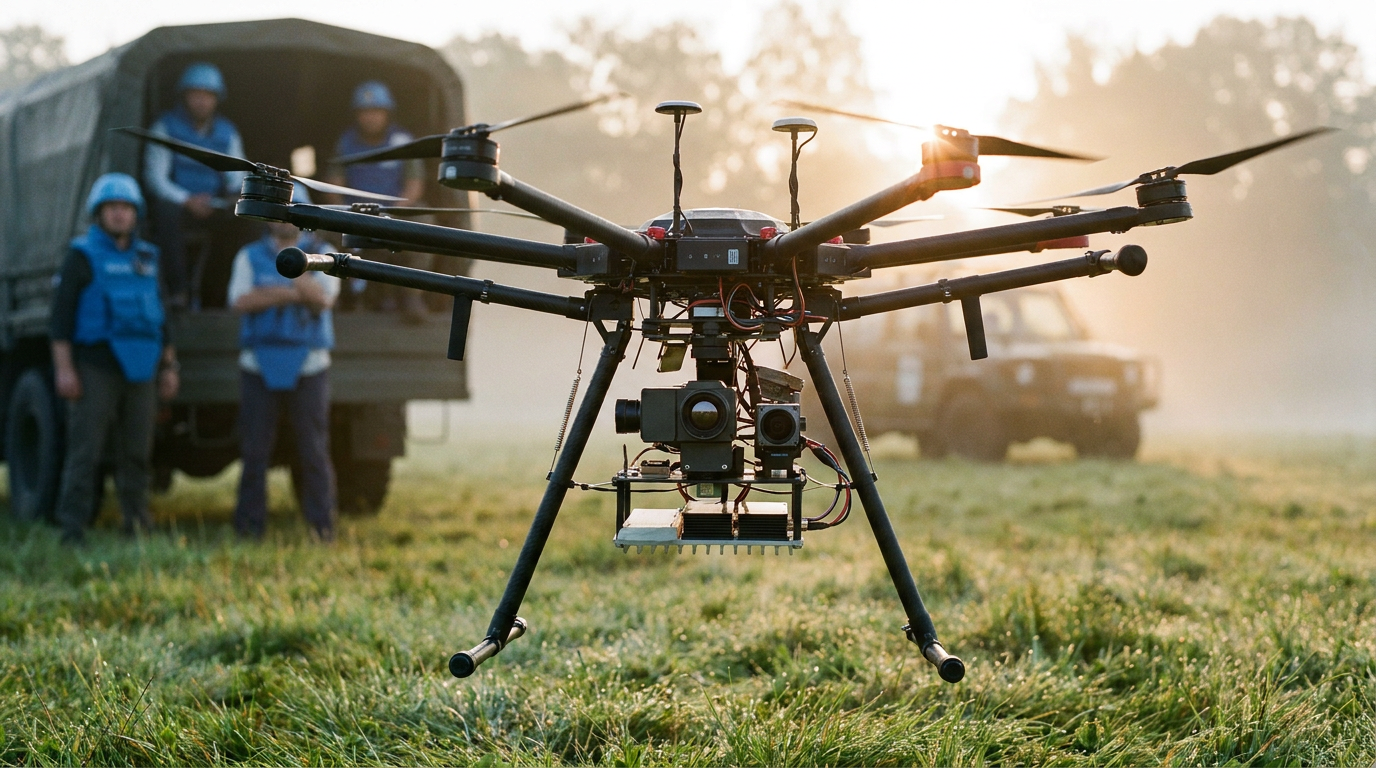
- Humanitarian Deminers
- Focused on civilian safety and returning agricultural land to communities.
- Combat Engineers
- Focused on rapid battlefield breaching and immediate force protection.
- Technology Developers
- Focused on sensor fusion, machine learning accuracy, and mitigating false positives.
What's not represented
- · Local farmers returning to land cleared by AI systems
- · Manufacturers of traditional manual demining equipment
Why this matters
Landmines contaminate dozens of countries, halting agriculture and killing thousands of civilians annually. By replacing slow, dangerous manual probing with rapid aerial AI scanning, organizations can return safe land to communities years faster than previously thought possible.
Key points
- AI and satellite imagery are drastically reducing the estimated size of contaminated areas by proving land is safe without manual inspection.
- Drone-mounted AI systems can identify over 150 types of explosive threats using visual, thermal, and magnetic sensor fusion.
- Edge computing allows drones to process threat data in real-time without relying on vulnerable cloud connections.
- Aerial scanning bypasses modern high-tech landmines equipped with seismic and magnetic sensors that target human deminers.
For decades, the process of clearing landmines has been agonizingly slow and inherently deadly. Human deminers inch forward with metal detectors and prodders, treating every square meter of suspected land as a lethal threat. But a new generation of artificial intelligence and drone technology is fundamentally altering the math of mine clearance. By shifting the initial detection phase to the sky, humanitarian organizations and military engineers are gathering hard evidence that AI can clear land faster, cheaper, and safer than traditional methods.[1][5]
The most significant claim emerging from recent field data is that AI dramatically accelerates "area reduction"—the process of proving land is safe rather than finding every individual mine. In Ukraine, initial estimates suggested that 174,000 square kilometers were contaminated with explosive remnants of war.[1]
However, the HALO Trust, a leading humanitarian demining organization, has utilized a combination of satellite imagery, drone data, and Amazon Web Services' AI analytical tools to forensically map these regions. The evidence shows that by identifying precise danger zones, the actual contaminated area is closer to the size of Massachusetts. So far, this data-driven approach has allowed HALO to cancel 13,000 suspected danger zones, confidently returning the land to civilians and farmers without requiring a single human to walk the ground.[1]

Beyond macro-level mapping, the evidence for micro-level AI detection is mounting. Systems are now capable of identifying individual buried munitions using multi-sensor fusion. Safe Pro Group recently surpassed 50,000 confirmed landmine and unexploded ordnance (UXO) detections in Ukraine using its Safe Pro Object Threat Detection (SPOTD) technology.[2]
Trained on a dataset of over 2.75 million drone images, the SPOTD system can identify more than 150 types of explosive threats. The primary evidence supporting this capability relies on high-resolution photogrammetry and GPS-tagged geospatial data, which the AI processes to spot visual anomalies that human eyes miss, such as tripwires or the subtle ground disturbances left by recently buried mines.[2]
However, visual data alone is insufficient for older, deeply buried, or camouflaged mines. To address this, researchers are compiling evidence on the efficacy of thermal sensing. At Waseda University, engineers have equipped drones with infrared (IR) cameras to detect the thermal energy radiated from the ground.[3]
Because metal and plastic explosives absorb and release heat differently than surrounding soil, buried mines appear as distinct thermal anomalies. In controlled trials in Denmark, the Waseda machine learning system achieved a 100% correct prediction rate on 81 test images.[3]

Because metal and plastic explosives absorb and release heat differently than surrounding soil, buried mines appear as distinct thermal anomalies.
Yet, transparent uncertainty remains regarding false positives. The Waseda researchers noted that in some environments, the AI mistakenly identified surrounding vegetation as landmines, resulting in low confidence scores. Similarly, the HALO Trust acknowledges that while AI is highly effective for mapping, current autonomous systems still struggle to determine the exact depth of buried mines, particularly in wet soil conditions or dense undergrowth.[1][3]
To counter environmental challenges, specialized platforms are expanding the sensor suite. The "Postup" Foundation's MinesEye drone, which recently received NATO R&D funding, integrates magnetic imaging and echosonars. During tests in the Kyiv region, the system successfully detected ferromagnetic anomalies buried under layers of lake silt. The developers claim a 90% detection rate for mines hidden in tall grass or buried up to 0.5 meters deep.[6]
A critical variable in the evidence pack is the computing architecture required to run these models in austere environments. Traditional AI relies on cloud connectivity, which introduces latency and vulnerability in conflict zones.[7]
The latest hardware iterations utilize edge computing—processing the threat recognition algorithms directly on the drone's onboard AI chips. This eliminates network dependency, allowing for real-time threat identification. For combat engineers, this real-time capability is the difference between safely bypassing a minefield and driving into an ambush.[4][7]

The British Army's 33 Engineer Regiment recently field-tested an edge-AI drone system developed by the UK Ministry of Defence. The trials demonstrated that the AI models could be rapidly retrained on the edge to identify new threat types. This adaptability is crucial, as the technology of the mines themselves is rapidly evolving.[4]
According to the UN Mine Action Service (UNMAS), modern conflicts are seeing the deployment of "high-tech" mines equipped with seismic sensors that detect approaching footsteps, or magnetic influence fuses that detonate when exposed to the electromagnetic field of a traditional handheld metal detector.[5]
The piece of technology used to find the mine can now actively trigger it. Drones bypass these ground-based sensors entirely, providing a critical asymmetric advantage in what UNMAS describes as an ongoing arms race between mine developers and deminers.[5]

While the evidence strongly supports AI and drones as revolutionary tools for detection and area reduction, the physical removal of mines remains a largely manual or heavily mechanized task. The consensus among demining experts is that fully autonomous robotic clearance is the next frontier, but until then, AI's greatest triumph is keeping humans out of the minefield until the exact location of the threat is known.[1][8]
How we got here
2022-2024
The conflict in Ukraine results in massive, rapid landmine contamination, prompting an urgent need for faster clearance methods.
May 2025
Waseda University publishes research demonstrating the efficacy of combining drone-mounted thermal sensing with machine learning.
July 2025
The Postup Foundation successfully tests the AI-enhanced MinesEye drone system in Ukraine, receiving NATO R&D funding.
February 2026
Advancements in edge AI chips enable drones to process threat recognition algorithms in real-time without cloud connectivity.
April 2026
The British Army successfully field-tests an AI-enabled drone system capable of rapid retraining for new explosive threats.
May 2026
Safe Pro Group surpasses 50,000 confirmed AI-powered landmine detections in Ukraine.
Viewpoints in depth
Humanitarian Deminers
Focused on civilian safety and returning agricultural land to communities.
For NGOs like the HALO Trust and UNMAS, the primary metric of success is not just finding mines, but proving that land is safe for civilians to return to. They argue that AI's greatest contribution is 'area reduction'—using satellite and drone data to cancel suspected hazardous areas without putting humans at risk. However, they remain cautious about fully autonomous clearance, insisting that the final verification must meet strict humanitarian standards where a single missed mine is a catastrophic failure.
Combat Engineers
Focused on rapid battlefield breaching and immediate force protection.
Military units view AI demining through the lens of operational momentum. For combat engineers, the priority is identifying safe corridors through minefields in real-time, often under hostile conditions. They emphasize the necessity of 'edge computing'—processing AI algorithms directly on the drone without relying on cloud connectivity. This allows for rapid retraining of models to identify newly deployed threat types, ensuring that advancing forces are not stalled by evolving mine technologies.
Technology Developers
Focused on sensor fusion, machine learning accuracy, and mitigating false positives.
Engineers and researchers are primarily concerned with the technical limitations of current detection models. While visual and thermal sensors boast high success rates in controlled trials, developers acknowledge that real-world variables—such as dense vegetation, varying soil moisture, and deeply buried ordnance—still cause false positives. Their current focus is on 'sensor fusion,' combining ground-penetrating radar, magnetic imaging, and thermal data to create a comprehensive threat picture that overcomes the limitations of any single sensor.
What we don't know
- When fully autonomous robotic systems will be reliable enough to physically remove and neutralize mines without human intervention.
- How effectively AI models will adapt to entirely non-metallic, 3D-printed mines deployed in dense, wet environments.
- The long-term funding sustainability for deploying these advanced, expensive drone systems across all global mine-affected regions.
Key terms
- Unexploded Ordnance (UXO)
- Explosive weapons, such as bombs, shells, and grenades, that did not explode when they were deployed and still pose a risk of detonation.
- Edge Computing
- Processing data directly on the device where it is generated (like a drone's onboard chip) rather than relying on a remote cloud server.
- Thermal Sensing
- Technology that detects and visualizes the heat radiated from objects, used to spot buried mines that absorb and release heat differently than soil.
- Sensor Fusion
- The combination of data from multiple different types of sensors (e.g., visual, thermal, magnetic) to create a more accurate and reliable detection model.
- Magnetic Influence Fuse
- A modern trigger mechanism in some landmines that detonates the explosive when it detects the electromagnetic field of a nearby metal detector or vehicle.
Frequently asked
How does AI detect landmines from the air?
AI processes data from drone-mounted sensors—including high-resolution cameras, thermal imaging, and magnetic scanners—to identify visual anomalies, heat signatures, and metallic disturbances associated with buried explosives.
Can drones physically remove the landmines?
Currently, drones are primarily used for detection and mapping. The physical removal or neutralization of the mines is still largely conducted by human deminers or specialized armored vehicles.
Why is edge computing important for demining drones?
Edge computing allows the drone to process AI algorithms onboard in real-time, eliminating the need for a stable internet connection to cloud servers, which is often unavailable or vulnerable in conflict zones.
What is 'area reduction' in humanitarian demining?
Area reduction is the process of using data, such as satellite imagery and AI analysis, to prove that a suspected hazardous area is actually safe, allowing it to be returned to civilians without requiring manual clearance.
Sources
Source coverage
8 outlets
3 viewpoints surfaced







[1]National Defense MagazineHumanitarian Deminers
Ukraine War Spurs Demining Tech Advancements
Read on National Defense Magazine →[2]GlobeNewswireTechnology Developers
Safe Pro Celebrates 50,000th AI-Powered Landmine Detection Milestone Pioneering Modernized Force Protection and Humanitarian Innovation
Read on GlobeNewswire →[3]Waseda UniversityTechnology Developers
Using Drones and AI for a Mine-free World
Read on Waseda University →[4]Defense NewsCombat Engineers
British Army Tests AI Drone for Landmine Detection as Ukraine War Shapes New Tactics
Read on Defense News →[5]UN NewsHumanitarian Deminers
Deminers race to keep up with military technology
Read on UN News →[6]Defender MediaTechnology Developers
AI-powered drone system for mine detection tested in Ukraine
Read on Defender Media →[7]VOLT AITechnology Developers
Edge AI Chips for Drone Landmine Detection: What Real-Time Threat Recognition Means for Security Operations
Read on VOLT AI →[8]Ministry of Defence of UkraineCombat Engineers
AI-powered drone and geosensor mine detector: Ministry of Defence participates in demonstration of state-of-the-art demining equipment
Read on Ministry of Defence of Ukraine →

Every angle. Every day.
Get defense security stories with full source coverage and perspective breakdowns delivered to your inbox.