
Evidence Pack: How Accurate Are Smart Rings and Watches at Tracking Sleep?
Consumer wearables boast advanced sleep-staging algorithms, but clinical validation studies reveal a significant gap between marketing claims and actual polysomnography data, especially for older adults.
By Factlen Editorial Team
- Clinical Sleep Researchers
- Medical professionals who rely on polysomnography and view wearables as flawed but useful.
- Wearable Manufacturers
- Companies defending their proprietary algorithms and continuous monitoring capabilities.
- Quantified Self Advocates
- Data-driven consumers who use wearable metrics to optimize daily performance.
- Factlen Editorial
- Independent synthesis of the current evidence landscape.
What's not represented
- · People with diagnosed sleep disorders
- · Algorithm developers
Why this matters
Millions of consumers use wearable sleep data to make daily decisions about their health, training, and productivity. Understanding the scientific limitations of these devices prevents unnecessary anxiety and helps users focus on the metrics that actually matter.
Key points
- Consumer wearables are highly accurate at detecting when you are asleep versus awake.
- Devices struggle significantly to accurately classify specific sleep stages like Deep and REM sleep.
- Smart rings generally capture cleaner optical heart rate data than smartwatches due to finger placement.
- Recent studies show wearable accuracy drops significantly when used by older adults.
Millions of people now begin their mornings by consulting a screen to find out how they slept. The proliferation of smart rings and smartwatches has turned sleep tracking from a clinical procedure into a daily consumer habit, fundamentally changing how we interact with our own rest.[7]
Manufacturers market these devices as comprehensive sleep laboratories on your wrist or finger, promising to break down your night into precise percentages of light, deep, and REM sleep. The data is often presented with absolute certainty, assigning users a definitive daily score.[5]
However, an evidence-based review of recent clinical validation studies reveals a more complex reality. While modern wearables are remarkably good at certain basic metrics, their ability to accurately map the intricate architecture of human sleep remains fundamentally limited by the sensors they rely on.[7]
To understand the accuracy gap, one must understand how these devices actually work. The clinical gold standard for measuring sleep is polysomnography, which uses electroencephalography to directly monitor electrical brain waves throughout the night.[4]
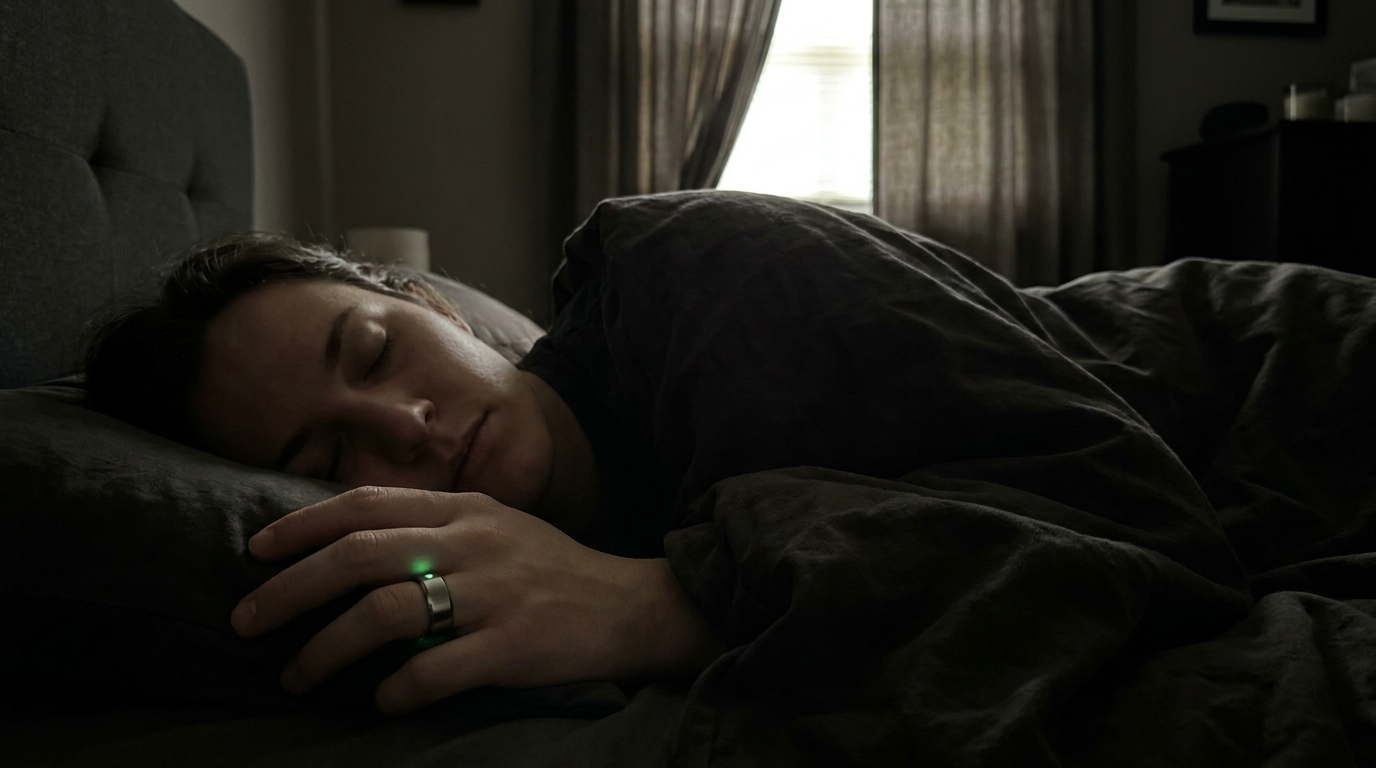
Consumer wearables do not measure brain waves. Instead, they rely on actigraphy to track physical motion and photoplethysmography—a green optical light shone into the skin—to measure blood flow and heart rate variability.[4]
By analyzing how still you are and how your cardiovascular system fluctuates, proprietary algorithms make an educated guess about what your brain is doing. They are measuring the physiological echoes of sleep, rather than the sleep itself.[4]

When it comes to tracking total sleep time, the evidence is generally strong, provided the user is a healthy young adult. Multiple studies confirm that top-tier devices from Apple, Oura, and Fitbit boast a sensitivity of 95 percent or higher for detecting sleep versus wakefulness.[1]
However, these devices suffer from a known limitation regarding specificity. Because they rely heavily on motion, wearables often misinterpret a user lying perfectly still while awake—such as reading or watching television—as light sleep.[4]
The claims surrounding precise sleep stage tracking are where the evidence becomes mixed to weak, and highly dependent on the specific device and the study's funding source.[7]
A prominent 2024 study published in the journal Sensors, conducted at Brigham and Women's Hospital, compared the Oura Ring Gen3, Apple Watch Series 8, and Fitbit Sense 2 directly against clinical polysomnography.[1]
The study found the Oura Ring achieved roughly 76 to 79.5 percent sensitivity for four-stage sleep classification. The Apple Watch performed exceptionally well at detecting wakefulness but struggled significantly with deep sleep, achieving only 50.5 percent sensitivity.[1]
The study found the Oura Ring achieved roughly 76 to 79.5 percent sensitivity for four-stage sleep classification.
It is crucial to note that this specific study was funded by Oura Health. Independent validation efforts often paint a more conservative picture of the entire consumer wearable landscape.[1][7]
A 2025 independent study by the University of Antwerp tested six devices against polysomnography without manufacturer funding. The highest-performing device in that cohort achieved a 69.6 percent accuracy rate for sleep staging, while others hovered near 50 percent.[3]

Furthermore, the assumption that wearables work equally well for everyone is demonstrably false. A January 2026 study published in Sleep Advances revealed a severe accuracy drop when these devices are used by older adults.[2]
In participants aged 56 to 80, devices consistently underestimated total sleep time—with Fitbit off by an average of 74.5 minutes—and drastically overestimated deep sleep by up to 97 minutes.[2]
Researchers concluded that the algorithms, which are primarily trained on data from younger demographics, fail to account for the natural changes in sleep architecture and cardiovascular baselines that occur with aging.[2]

When comparing form factors, smart rings currently hold a physiological advantage over watches. The arteries in the finger provide a cleaner, stronger optical signal than the wrist, which is more susceptible to motion artifacts and loose fits.[5]
Beyond the hardware limitations, sleep clinicians increasingly warn of orthosomnia—an unhealthy, anxiety-driven obsession with achieving perfect sleep scores.[5]
When a device with a 60 percent accuracy rate tells a user they received zero deep sleep, the resulting stress can ironically cause genuine insomnia the following night, creating a negative feedback loop.[4][5]
Ultimately, consumer sleep trackers are highly effective tools for monitoring longitudinal trends, such as changes in resting heart rate or the impact of late meals on recovery. However, their nightly sleep stage breakdowns should be viewed as algorithmic estimates rather than clinical facts.[7]
How we got here
Pre-2010s
Sleep tracking is confined to clinical laboratories using polysomnography (PSG) and medical-grade actigraphy.
Mid-2010s
Early consumer fitness trackers introduce basic movement-based sleep tracking, offering rough estimates of total sleep time.
Late 2010s
The integration of optical heart rate sensors (PPG) allows wearables to begin estimating specific sleep stages like REM and Deep sleep.
2024-2026
Independent clinical validation studies reveal significant accuracy discrepancies in modern algorithms, particularly concerning older adults.
Viewpoints in depth
Clinical Sleep Researchers
Medical professionals who rely on polysomnography and view wearables as flawed but useful.
Clinicians emphasize that consumer devices cannot diagnose sleep apnea or insomnia because they do not measure brain waves or respiration directly. However, they acknowledge that wearables provide unprecedented longitudinal data. A doctor cannot monitor a patient in a lab for 30 consecutive nights, making the trend data from a smartwatch highly valuable, even if the absolute nightly numbers are imprecise.
Wearable Manufacturers
Companies defending their proprietary algorithms and continuous monitoring capabilities.
Industry leaders argue that comparing a comfortable, non-invasive ring to a clinical sleep lab is a false equivalence. They point out that their algorithms are constantly improving via over-the-air updates and machine learning trained on massive datasets. For manufacturers, the goal is not perfect clinical replication, but providing actionable, accessible insights that drive behavioral change.
Quantified Self Advocates
Data-driven consumers who use wearable metrics to optimize daily performance.
This camp relies heavily on metrics like Heart Rate Variability (HRV) and recovery scores to dictate their training intensity and daily routines. They generally accept the margin of error in sleep staging, focusing instead on baseline deviations. If a smart ring shows a sudden drop in deep sleep and a spike in resting heart rate, they use that signal to prioritize rest, regardless of the exact minute count.
What we don't know
- How upcoming AI-driven algorithm updates will improve accuracy without hardware changes.
- The exact degree to which skin tone and tattoos degrade optical sensor accuracy across all modern devices.
- Whether consumer devices will ever achieve FDA clearance for diagnosing specific sleep disorders.
Key terms
- Polysomnography (PSG)
- The clinical gold standard for sleep studies, which uses sensors attached to the head and body to measure brain waves, oxygen levels, heart rate, and breathing.
- Photoplethysmography (PPG)
- An optical technology used in wearables that shines a green light into the skin to measure changes in blood flow and estimate heart rate.
- Actigraphy
- The continuous measurement of physical movement using an accelerometer, used by wearables to guess when you fall asleep and wake up.
- Orthosomnia
- A medical term for an unhealthy obsession with achieving perfect sleep tracking scores, which can paradoxically cause anxiety and insomnia.
Frequently asked
Are smart rings more accurate than smartwatches?
Current evidence suggests smart rings have a slight physiological advantage. The arteries in the finger provide a cleaner blood flow signal than the wrist, which is more prone to movement artifacts.
Can my Apple Watch or Oura Ring diagnose sleep apnea?
No. While some devices can detect breathing disturbances or blood oxygen drops, they are not FDA-cleared diagnostic tools for sleep apnea and cannot replace a clinical evaluation.
Why does my tracker say I was asleep when I was just reading in bed?
Wearables rely heavily on movement. If you lie perfectly still with a low resting heart rate, the device's algorithm will often misinterpret your stillness as light sleep.
Should I worry if my device says I get zero deep sleep?
Not necessarily. Consumer wearables frequently struggle to accurately distinguish between deep and light sleep. If you feel rested, you should trust your body over the device's algorithm.
Sources
Source coverage
7 outlets
4 viewpoints surfaced







[1]Sensors (Basel)Wearable Manufacturers
Accuracy of Three Commercial Wearable Devices for Sleep Tracking in Healthy Adults
Read on Sensors (Basel) →[2]Sleep AdvancesClinical Sleep Researchers
Validity of consumer sleep-tracking devices in older relative to young adults
Read on Sleep Advances →[3]University of AntwerpClinical Sleep Researchers
Performance of six consumer sleep trackers in comparison with polysomnography
Read on University of Antwerp →[4]The Better Sleep ClinicClinical Sleep Researchers
How Accurate Are Sleep Trackers On Smart Watches And Smart Rings?
Read on The Better Sleep Clinic →[5]LiveWorkSleepQuantified Self Advocates
Oura Ring vs Apple Watch for Sleep Tracking
Read on LiveWorkSleep →[6]WeLoveCyclingQuantified Self Advocates
How Do Garmin, Apple Watch, Oura Ring, and Whoop Compare in Sleep Tracking
Read on WeLoveCycling →[7]Factlen Editorial TeamFactlen Editorial
Synthesis by Factlen editorial team
Read on Factlen Editorial Team →

More in shopping
See all 7 stories →Audio Tech
The Science of Silence: How Active Noise Cancellation and Transparency Modes Work
0 sources
Digital Note-Taking
E-Ink vs. Traditional Tablets: The Trade-Offs for Office Productivity
0 sources
AI PCs
The 2026 Laptop Buyer’s Guide: Do You Actually Need an 'AI PC'?
0 sources
Sleep Tech
How Accurate Are Sleep Trackers? The 2026 Evidence Review
0 sources
Every angle. Every day.
Get shopping stories with full source coverage and perspective breakdowns delivered to your inbox.