
How SpaceX Justified a $2.1 Trillion Valuation—And What It Means for the Space Economy
SpaceX's record-shattering $85.7 billion IPO has propelled the company to a $2.1 trillion valuation, fundamentally reshaping the aerospace and venture capital landscape.
By Factlen Editorial Team
- Bullish Growth Investors
- This camp views SpaceX as an unprecedented monopoly that will serve as the foundational infrastructure for the global AI economy.
- Value Skeptics
- This camp warns that the company's valuation is dangerously detached from its current financial reality and heavily reliant on unproven AI promises.
- Aerospace Ecosystem Analysts
- This camp focuses on the structural market dynamics of the IPO and its ripple effects across the broader commercial space sector.
What's not represented
- · Traditional aerospace contractors
- · Antitrust regulators
Why this matters
The sheer scale of SpaceX's public debut has instantly drained capital from competing aerospace firms while setting a new benchmark for how markets value artificial intelligence infrastructure. For investors, it redefines the commercial space sector from a niche hardware industry into a foundational pillar of the global AI economy.
Key points
- SpaceX raised a record $85.7 billion in its IPO, achieving a $2.1 trillion valuation on its first day of trading.
- The company is pivoting its core narrative away from traditional launch services and toward a $26.5 trillion AI and orbital compute market.
- A microscopic 4.3% public float and forced index buying created a massive supply-demand imbalance, driving the stock up nearly 20%.
- The debut triggered a 'gravity well' effect, draining capital from other publicly traded space companies like Rocket Lab and Virgin Galactic.
- Value analysts warn the stock is priced for perfection, trading at an unprecedented 115 times its 2025 revenue.
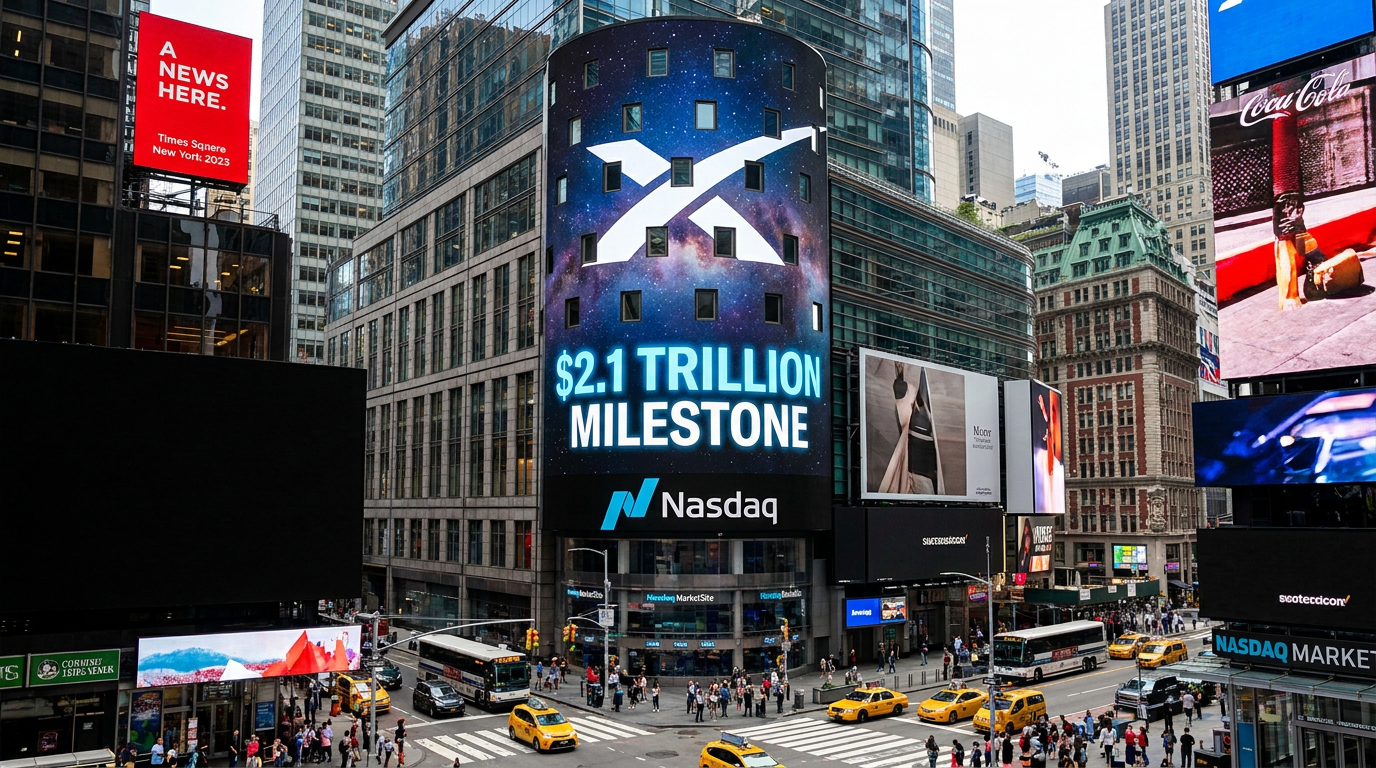
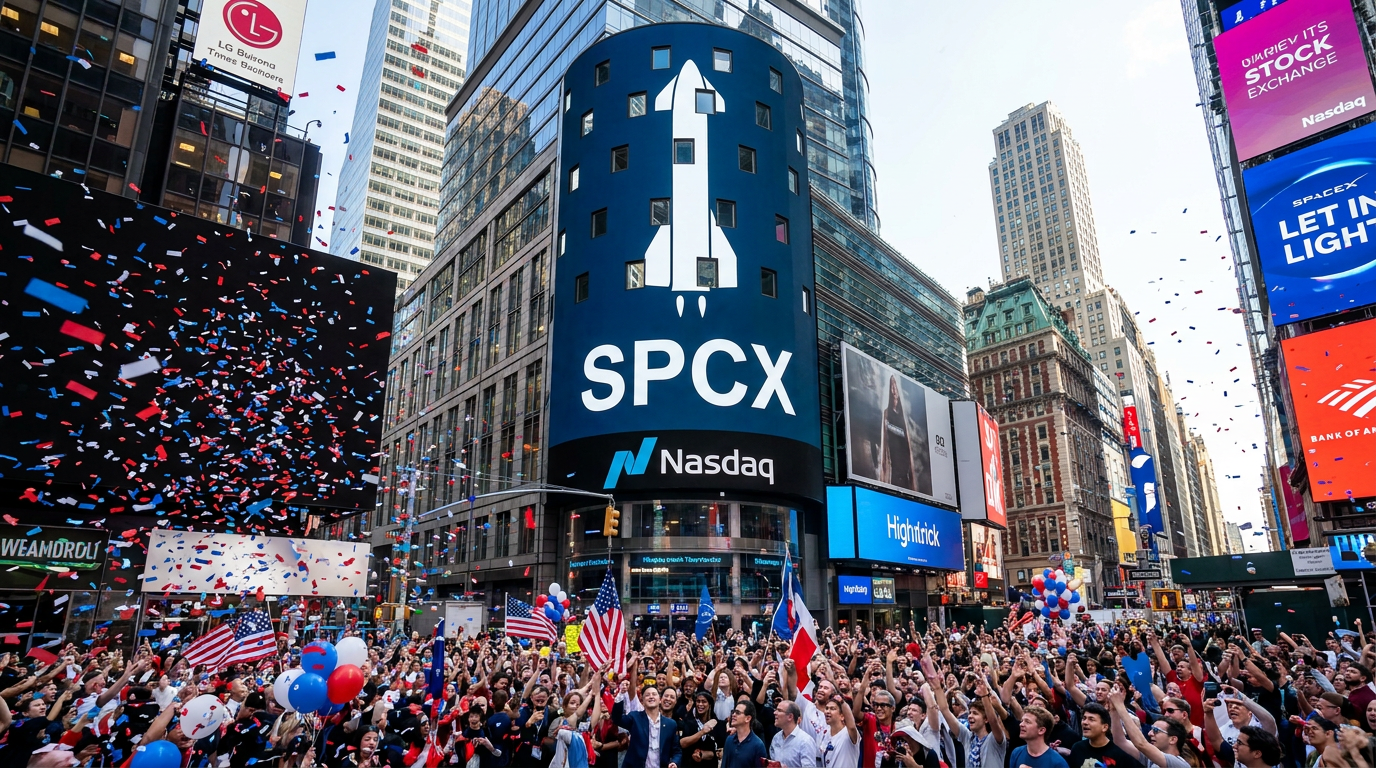
The opening bell at the Nasdaq on Friday didn't just signal the start of trading; it marked the largest wealth-creation event in the history of public markets. SpaceX’s initial public offering shattered every existing record, raising an unprecedented $75 billion and immediately propelling the aerospace giant to a $2.1 trillion valuation.[2][4]
By the time the closing bell rang, shares had surged nearly 20% from their $135 offering price to settle at $161.11. The debut officially minted CEO Elon Musk as the world’s first trillionaire and instantly created roughly 4,400 new millionaires among current and former SpaceX employees, a rarity even by Silicon Valley's aggressive wealth-creation standards.[2][4][5]
But the sheer scale of the offering—which underwriters expanded by another $10.7 billion on Monday through a 'greenshoe option' that allows them to sell additional shares to meet insatiable demand—has left Wall Street grappling with a profound structural question. How does a company that generated $18.7 billion in revenue last year justify a valuation larger than Amazon or Meta?[4][8]
The answer lies in a fundamental reframing of what SpaceX actually does. While the public knows the company for its reusable rockets and the Starlink satellite internet constellation, the IPO prospectus pitched a radically different narrative to institutional investors: artificial intelligence.[2][3]
SpaceX outlined a staggering $28.5 trillion Total Addressable Market (TAM), a figure it described as the largest in human history. However, the breakdown of that TAM reveals the company's true pivot. Only about $370 billion is tied to traditional launch services, and $1.6 trillion is allocated to global connectivity via Starlink.[3][4]

The remaining $26.5 trillion—the vast majority of the company's projected future value—is anchored entirely in AI and orbital data infrastructure. SpaceX is positioning itself not just as a transport company, but as the ultimate off-planet compute provider, a strategy underscored by a recent multi-billion-dollar deal with Anthropic for dedicated AI compute capacity.[3]
For many investors, SpaceX is viewed as the closest modern equivalent to investing in the railroads during the Industrial Revolution. This euphoric sentiment drove retail and institutional buyers alike to pay an extreme premium, betting that the company will serve as the foundational infrastructure for the next century of technological growth.[4]
The mechanics of the IPO itself were highly unusual, reflecting Musk's unprecedented leverage over Wall Street. SpaceX dictated terms to its 21 underwriting banks, setting a fixed $135 price early in the process and bypassing the traditional bookbuilding phase where banks typically gauge demand and adjust the price range.[3]
The mechanics of the IPO itself were highly unusual, reflecting Musk's unprecedented leverage over Wall Street.
Furthermore, the stock's immediate surge was heavily influenced by a microscopic public float. Only 4.3% of SpaceX shares were made publicly tradable at listing—representing about $85 billion of the $2.1 trillion company, while insiders and early investors remained locked up.[9]
With such a limited supply of shares available, forced buying from index funds created a massive supply-demand imbalance. Nasdaq altered its rules to allow SpaceX into the Nasdaq 100 after just 15 trading days, while MSCI added the stock to its global indices almost immediately, forcing passive funds to buy in at any price.[9]
Yet, the gravitational pull of the SpaceX IPO has created violent turbulence across the rest of the commercial space sector. For years, public market investors seeking exposure to the space economy had to rely on proxy stocks like Rocket Lab, Planet Labs, and Intuitive Machines.[6]
When the SpaceX constraint was finally removed, a brutal 'capital rotation' ensued. Rocket Lab, despite boasting a record $2.2 billion backlog and strong quarterly revenue growth, saw its stock plunge 10.8% on the day of the IPO as portfolio managers sold off their proxy investments to buy the real thing.[6]

Analysts quickly dubbed this the 'gravity well' effect. Investors liquidated their holdings in smaller aerospace firms to free up capital for the main event, sending Virgin Galactic down nearly 32% and AST SpaceMobile down 15.5%, entirely divorced from any changes in their underlying business fundamentals.[6]
Despite the broader market's enthusiasm, a vocal contingent of value analysts is urging extreme caution. At a $2.1 trillion market capitalization, SpaceX is trading at a staggering 115 times its 2025 revenue, a multiple that leaves zero room for execution errors.[1][9]
To put that multiple in perspective, Meta traded at 28 times revenue during its 2012 IPO, and Google traded at just 10 times revenue in 2004. Even Palantir, currently one of the most expensively valued software stocks in the S&P 500, carries a multiple of roughly 67.[9]

Independent research firms have pushed back hard against the AI-driven valuation. Morningstar analysts calculated a probability-weighted fair value of just $63 per share—roughly $780 billion in total—arguing that the company's AI segment is currently losing $6 billion a year and trails terrestrial competitors in actual deployment.[7][9]
CFRA Research went a step further, initiating coverage with an outright 'Sell' rating at $115. They explicitly warned that the company's massive valuation may soon become its own worst enemy if the orbital data center narrative fails to materialize as quickly as the market expects.[1][4]

Ultimately, the SpaceX IPO represents a defining test for public markets in the AI era. Investors are paying a historic premium for a vision that extends far beyond Earth's atmosphere, betting that the company can execute a flawless transition from a rocket manufacturer to the backbone of the next computing revolution.[1][3]
How we got here
June 3, 2026
SpaceX sets a firm $135 per share IPO price, bypassing the traditional Wall Street bookbuilding process.
June 12, 2026
SpaceX officially debuts on the Nasdaq, raising an initial $75 billion and closing its first day at a $2.1 trillion valuation.
June 15, 2026
Underwriters exercise their greenshoe option, purchasing an additional $10.7 billion in shares to meet overwhelming investor demand.
June 22, 2026
Rocket Lab is scheduled to join the Nasdaq-100 index, a move expected to drive passive institutional buying.
Viewpoints in depth
Bullish Growth Investors
This camp views SpaceX as an unprecedented monopoly that will serve as the foundational infrastructure for the global AI economy.
Growth investors argue that traditional valuation metrics are useless for a company with SpaceX's market dominance. They point to the company's $28.5 trillion Total Addressable Market and its recent multi-billion-dollar deal with Anthropic as evidence that SpaceX is no longer just an aerospace contractor, but an essential AI compute provider. From this perspective, paying a premium today is akin to buying into the foundational railroads of the Industrial Revolution before the tracks were fully laid.
Value Skeptics
This camp warns that the company's valuation is dangerously detached from its current financial reality and heavily reliant on unproven AI promises.
Value analysts emphasize that SpaceX is currently unprofitable and trading at an astronomical 115 times its 2025 revenue—a multiple far exceeding what Meta or Google commanded at their respective IPOs. Firms like Morningstar and CFRA Research argue that the core launch and connectivity businesses, while successful, only justify a valuation closer to $780 billion. They caution that the remaining $1.3 trillion in market cap is entirely speculative, resting on an AI division that is currently losing $6 billion annually.
Aerospace Ecosystem Analysts
This camp focuses on the structural market dynamics of the IPO and its ripple effects across the broader commercial space sector.
Ecosystem analysts are less concerned with SpaceX's ultimate valuation and more focused on the immediate 'gravity well' effect it has created. They note that for years, investors used companies like Rocket Lab as proxies for the private space economy. Now that SpaceX is public, capital is violently rotating out of those smaller firms. However, these analysts argue this creates a buying opportunity for fundamentally strong competitors, as the sell-off is driven by portfolio rebalancing rather than any underlying business weakness.
What we don't know
- Whether SpaceX can successfully deploy and monetize its planned orbital data centers to justify its massive AI-based valuation.
- How long the 'gravity well' effect will suppress the stock prices of fundamentally strong competitors like Rocket Lab.
- When early insiders and employees will be permitted to sell their locked-up shares, potentially flooding the market and impacting the stock price.
Key terms
- Greenshoe Option
- A provision in an underwriting agreement that allows the underwriters to sell more shares than originally planned if demand is exceptionally high.
- Total Addressable Market (TAM)
- The overall revenue opportunity available for a product or service if a company achieves 100% market share.
- Capital Rotation
- The movement of investment funds from one asset class, sector, or specific stock into another, often triggered by a major market event.
- Public Float
- The portion of a company's outstanding shares that are in the hands of public investors and available for daily trading.
- Price-to-Sales Multiple
- A valuation metric that compares a company's stock price to its revenues, used to gauge whether a stock is overvalued or undervalued.
Frequently asked
What was the SpaceX IPO price?
SpaceX set a fixed IPO price of $135 per share, and the stock closed at $161.11 on its first day of trading.
How much money did SpaceX raise?
The company raised an initial $75 billion, which increased to $85.7 billion after underwriters exercised their option to buy additional shares.
Why did other space stocks drop during the IPO?
Investors engaged in capital rotation, selling their shares in proxy space companies like Rocket Lab to free up cash to buy SpaceX directly.
How does AI factor into SpaceX's valuation?
SpaceX claims a $26.5 trillion addressable market for artificial intelligence, planning to build orbital data centers and provide off-planet compute capacity.
Sources
Source coverage
9 outlets
3 viewpoints surfaced








[1]MarketWatchValue Skeptics
SpaceX’s massive $2.1 trillion valuation may soon become its own worst enemy
Read on MarketWatch →[2]TradingKeyBullish Growth Investors
Musk's SpaceX Creates World's Largest IPO: Historic Leap From 10% Success Rate to 2.1 Trillion Giant
Read on TradingKey →[3]Seeking AlphaValue Skeptics
SpaceX: The $2 Trillion Stock That Already Left Earth
Read on Seeking Alpha →[4]ReutersBullish Growth Investors
UPDATE 14-SpaceX surges past $2 trillion in Nasdaq debut, closes in on Amazon
Read on Reuters →[5]ForbesBullish Growth Investors
SpaceX IPO Merch? $125 Bell, 'SPCX' T-Shirts And More After Historic Trading Debut
Read on Forbes →[6]TrefisAerospace Ecosystem Analysts
Can RKLB Stock Survive The SpaceX IPO Gravity Well?
Read on Trefis →[7]MorningstarValue Skeptics
SpaceX Valuation Analysis: Why Fair Value Sits at $780 Billion
Read on Morningstar →SpaceX’s stock jumps as the company reveals its IPO has raised another $10.7 billion
Read on MarketWatch →[9]INDmoneyAerospace Ecosystem Analysts
Why Is SpaceX Stock Rising? SPCX Rally, Price Targets and Low Float
Read on INDmoney →
Every angle. Every day.
Get finance stories with full source coverage and perspective breakdowns delivered to your inbox.