
Heat Pump vs. Vented Dryers: The Complete 2026 Upgrade Guide
Heat pump dryers use half the energy and are gentler on clothes, but traditional vented models still win on upfront cost and sheer speed.
By Factlen Editorial Team
- Energy Efficiency Advocates
- Prioritize long-term utility savings, environmental impact, and the architectural benefits of ventless design.
- Traditional Appliance Users
- Value the low upfront purchase price, proven reliability, and sheer speed of traditional vented machines.
- Appliance Retailers
- Focus on matching the right technology to the customer's specific home layout, electrical capacity, and budget.
What's not represented
- · Commercial laundromat operators
- · Appliance repair technicians
Why this matters
The clothes dryer is typically the second most energy-hungry appliance in a home. Choosing the right technology can save hundreds of dollars a year in electricity, extend the life of your wardrobe, and eliminate the need to drill ventilation holes in your walls.
Key points
- Heat pump dryers use 50% to 60% less electricity than traditional vented models, saving hundreds of dollars annually.
- Because they are ventless, heat pump dryers can be installed in closets, apartments, and interior rooms without drilling holes in walls.
- Heat pump models operate at lower temperatures, which prevents fabric shrinkage and extends the life of clothing.
- The primary trade-offs for heat pump technology are a higher upfront purchase price and longer drying cycles.
- Vented dryers remain the best option for households on a strict upfront budget or those who prioritize the fastest possible drying times.
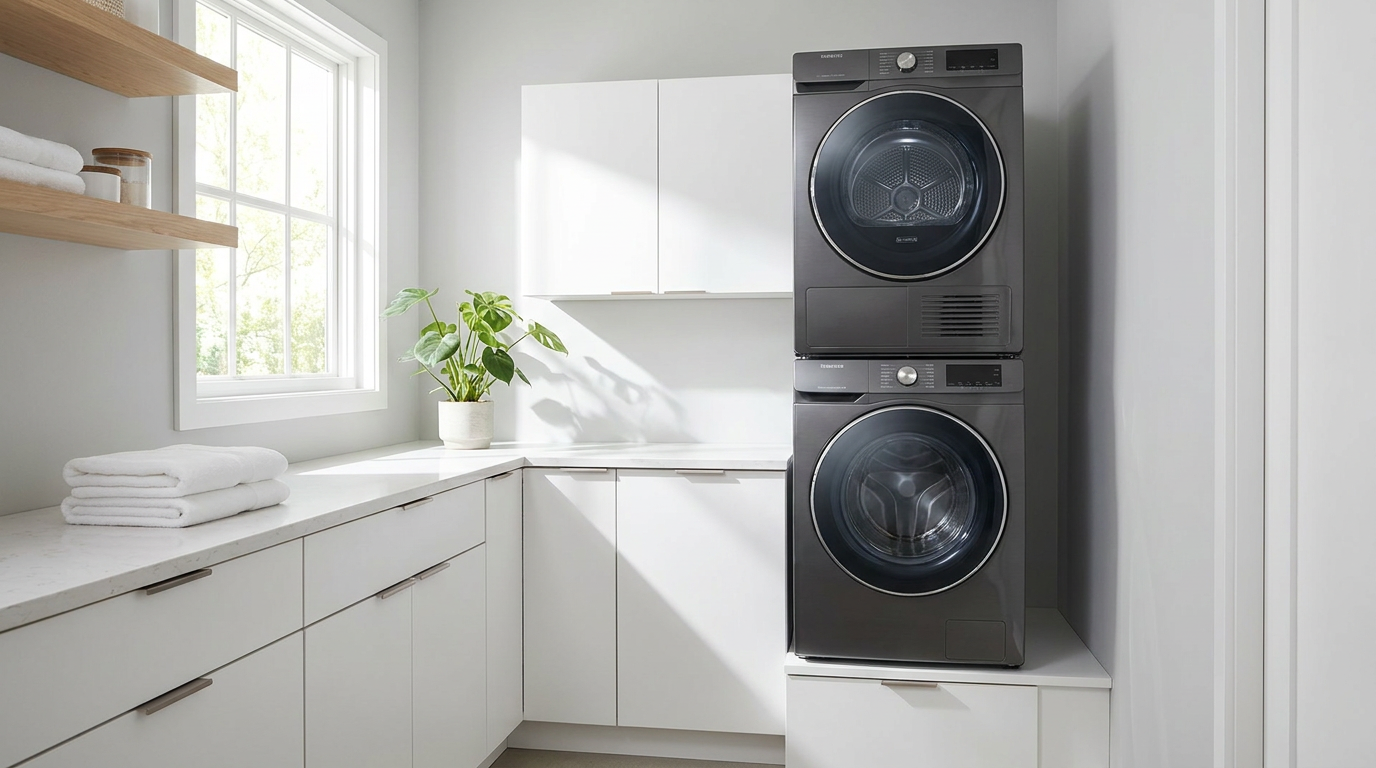
For decades, doing laundry meant relying on a simple, brute-force machine: the traditional vented dryer. It pulls in ambient room air, blasts it over a glowing electric heating element or gas burner, tumbles it through wet clothes, and pumps the resulting hot, humid air straight out of the house through a duct. It is fast, inexpensive to manufacture, and highly effective. But as energy costs rise and homes become more tightly insulated, a fundamentally different technology has moved from a niche European luxury to a mainstream necessity: the heat pump dryer.[1][6]
Instead of creating heat from scratch and throwing it away, a heat pump dryer operates on a closed-loop refrigeration cycle. It pulls air in, heats it, passes it through the tumbling clothes to absorb moisture, and then runs that damp air through a cooling coil. The sudden drop in temperature forces the water to condense and drain away. The machine then reheats that exact same dry air and sends it back into the drum. Because it recycles its own thermal energy rather than constantly generating new heat, the efficiency gains are massive.[3][4]
The most immediate argument for the heat pump dryer is its dramatic reduction in utility bills. According to Energy Star and appliance industry data, heat pump models use 50 to 60 percent less electricity than standard vented electric dryers. For a family doing four or five loads of laundry a week in a region with average electricity rates, that translates to roughly $150 to $250 in annual savings. Over the typical ten-year lifespan of a major appliance, the heat pump effectively pays for its own premium price tag in energy savings alone.[4][5]

Conversely, the traditional vented dryer remains the undisputed champion of upfront affordability. A reliable, high-capacity vented dryer can often be purchased for $500 to $700, whereas a quality heat pump model typically starts around $1,000 and can easily exceed $1,500. For households on a strict budget, or landlords outfitting a rental property where the tenant pays the utility bills, the lower initial purchase price of a vented unit is often the deciding factor.[1][2]
Beyond the financial math, heat pump dryers offer a massive architectural advantage: they are completely ventless. Because they extract moisture internally and collect it in a reservoir or pump it down a standard washing machine drain, they do not require a four-inch hole drilled through the exterior wall of the house. This makes them the definitive choice for high-rise apartments, interior closets, heritage homes, and ultra-efficient passive houses where maintaining an airtight building envelope is critical.[3][6]
Beyond the financial math, heat pump dryers offer a massive architectural advantage: they are completely ventless.
Furthermore, traditional vented dryers actively work against a home's climate control system. Every cubic foot of air a vented dryer blasts outside must be replaced by outside air seeping into the house through cracks and gaps. In the dead of winter, a vented dryer is effectively sucking expensive, furnace-heated air out of the living room and replacing it with freezing drafts. Heat pump dryers, being entirely self-contained, leave the home's carefully conditioned indoor air exactly where it belongs.[1][6]
Another major logistical benefit for renters and older homes is electrical compatibility. Traditional electric vented dryers require a dedicated 240-volt, 30-amp heavy-duty circuit to power their massive heating coils. Many modern heat pump dryers, because they draw so little power, can plug directly into a standard 120-volt household outlet. This allows homeowners to convert from gas to electric drying, or move their laundry setup to a different room, without hiring an electrician to run new heavy-gauge wiring through the walls.[3][6]
However, the heat pump's efficiency comes with a noticeable trade-off in speed. Vented dryers operate at high temperatures—often pushing 170 degrees Fahrenheit—which aggressively boils water out of fabrics, allowing them to finish a large load in 40 to 60 minutes. Heat pump dryers operate at a much gentler 120 to 140 degrees. Because they rely on dehumidification rather than raw heat, a standard cycle in a heat pump dryer typically takes 90 to 120 minutes. For busy households trying to churn through five loads of laundry on a Sunday afternoon, that extra time can create a frustrating bottleneck.[2][3]

That slower, cooler drying process is actually a hidden superpower when it comes to fabric care. The high, aggressive heat of a vented dryer is the primary culprit behind shrinking sweaters, fading colors, and the gradual degradation of elastic waistbands. By tumbling clothes at lower temperatures, heat pump dryers subject garments to significantly less thermal stress. Delicate fabrics like silk, wool, and activewear synthetics last noticeably longer, saving consumers money on wardrobe replacements over time.[3][4]
Maintenance requirements also differ between the two technologies. A vented dryer requires its exterior exhaust duct to be cleaned annually to prevent lint buildup, which is a major fire hazard and a leading cause of appliance inefficiency. Heat pump dryers eliminate the duct fire risk entirely, but they introduce a different chore: a secondary condenser filter located at the bottom of the machine. This filter must be vacuumed or rinsed every few weeks to keep the heat exchange coils clear; if it clogs, the machine's efficiency plummets and drying times stretch even longer.[1][6]

When evaluating the two options, the heat pump dryer fits well when a home lacks exterior venting, when local electricity rates are high, or when preserving expensive garments is a priority. It is the ideal upgrade for apartments, passive homes, and households willing to trade a bit of cycle speed for a massive reduction in their carbon footprint and utility bills. As government regulations increasingly target inefficient appliances, heat pumps are rapidly becoming the default standard in the industry.[1][4][6]
Conversely, the traditional vented dryer remains a strong fit when the upfront appliance budget is strictly limited, when laundry must be finished as quickly as possible, or when the household only runs a few loads per month. If a home already has a clean, dedicated exterior vent and access to relatively cheap electricity or natural gas, the older technology still holds its ground as a fast, simple, and reliable workhorse.[1][2][6]
Viewpoints in depth
Energy Efficiency Advocates
Focus on the long-term financial and environmental benefits of adopting closed-loop technology.
Advocates for energy efficiency point out that traditional vented dryers are an architectural and environmental anomaly. They are the only standard household appliance designed to actively pump a home's expensive, climate-controlled indoor air outside. By switching to a heat pump model, homeowners not only cut the appliance's direct electricity consumption by more than half, but they also reduce the load on their home's heating and cooling systems. For these advocates, the higher upfront cost is a temporary hurdle that is quickly erased by years of lower utility bills.
Traditional Appliance Users
Emphasize the practical benefits of speed, simplicity, and low initial costs.
For many consumers, laundry is a chore to be finished as quickly as possible, not an exercise in energy optimization. Traditional vented dryers excel at raw speed, often capable of drying a heavy load of towels in under an hour. Furthermore, the technology is simple, proven, and cheap to repair. If a heating element breaks on a vented dryer, a technician can often fix it for a fraction of the cost of servicing a complex refrigeration compressor. For households that only run a few loads a month, the math on a $1,200 heat pump dryer simply takes too long to pay off.
Appliance Retailers
Focus on matching the right machine to the specific constraints of the customer's home.
Retailers and installation experts view the debate through the lens of logistics. They note that heat pump dryers are problem-solvers. If a customer lives in a condo where the condo board forbids drilling new exterior vents, or if an older home lacks a 240-volt outlet in the desired laundry room, a 120-volt heat pump dryer is the only viable solution. However, retailers also caution buyers about the maintenance shift: customers must be willing to regularly clean the secondary condenser filter, or the heat pump will lose its efficiency and take hours to dry a single load.
What we don't know
- Whether the upfront cost of heat pump dryers will drop to match vented models as manufacturing scales up globally.
- How quickly local governments might move to ban the sale of inefficient vented electric dryers, as is currently being proposed in parts of Europe.
Key terms
- Heat Pump Technology
- A closed-loop system that extracts moisture from air, cools it to condense the water, and reheats the same air to dry clothes, using vastly less energy than generating new heat.
- Vented Dryer
- A traditional machine that draws in room air, heats it, passes it through tumbling clothes, and exhausts the hot, moist air outside through a duct.
- Condenser Dryer
- An older style of ventless dryer that uses a traditional heating element and a heat exchanger to extract moisture; it is less energy-efficient than a heat pump model.
- 120-Volt Outlet
- A standard household electrical plug, which can power many modern heat pump dryers without requiring a specialized heavy-duty circuit.
Frequently asked
Do heat pump dryers need an exhaust vent?
No. Heat pump dryers are completely ventless. They extract moisture from the air and collect it in a pull-out water tank or pump it directly into the same drain pipe used by your washing machine.
Can I plug a heat pump dryer into a normal outlet?
Many compact and some full-size heat pump dryers are designed to run on a standard 120-volt household outlet, eliminating the need for the heavy-duty 240-volt circuit required by traditional electric dryers.
Do heat pump dryers shrink clothes?
They are actually much safer for clothes than traditional dryers. Because they operate at lower temperatures (around 120 to 140 degrees Fahrenheit), they cause significantly less shrinkage and fabric wear.
Why do heat pump dryers take longer to dry?
Instead of blasting clothes with extreme heat, they gently dehumidify the air inside the drum. This saves massive amounts of energy and protects fabrics, but it typically adds 30 to 60 minutes to a standard drying cycle.
Sources
Source coverage
6 outlets
3 viewpoints surfaced






[1]Yale ApplianceAppliance Retailers
Heat Pump vs. Vented Dryers: Which is Better?
Read on Yale Appliance →[2]Consumer NZTraditional Appliance Users
Clothes dryer buying guide
Read on Consumer NZ →[3]East Coast ApplianceAppliance Retailers
Heat Pump Dryers: Smart Upgrade or Slow Spin Cycle?
Read on East Coast Appliance →[4]BekoEnergy Efficiency Advocates
The Ultimate Guide to Heat Pump Tumble Dryers
Read on Beko →[5]Energy StarEnergy Efficiency Advocates
Energy Efficient Clothes Dryers
Read on Energy Star →[6]Factlen Editorial TeamAppliance Retailers
Synthesis by Factlen editorial team
Read on Factlen Editorial Team →

More in shopping
See all 6 stories →AI Laptops
The 2026 Guide to AI PCs: Why the NPU is the New Standard for Laptops
0 sources

E-Bike Tech
The 2026 Guide to Buying an E-Bike: Motors, Batteries, and Classes Explained
0 sources
Air Purifiers
HEPA vs. PECO vs. Ionizers: An Evidence-Based Guide to Air Purifiers
0 sources
Home Energy
The 2026 Guide to Buying a Home Solar Battery
0 sources
Every angle. Every day.
Get shopping stories with full source coverage and perspective breakdowns delivered to your inbox.