
SpaceX Completes Historic $85 Billion IPO, Minting Elon Musk as World's First Trillionaire
The aerospace giant shattered records with the largest stock market debut in history, achieving a $2.1 trillion valuation and marking a new era for the commercial space industry.
By Factlen Editorial Team
- Market Bulls & Industry Advocates
- View the IPO as a massive validation of the commercial space sector that will inject capital into the broader aerospace ecosystem.
- Financial Analysts
- Focus on the mechanics of the record-breaking raise, index inclusion, and the stock's immediate impact on major markets.
- Governance Skeptics
- Raise concerns over the company's valuation, Musk's super-voting control, and the systemic risk to retail portfolios.
What's not represented
- · Environmental Watchdogs
- · Rival Aerospace Companies
- · Telecommunications Competitors
Why this matters
The unprecedented $85.7 billion raise not only transforms the financial landscape of the space economy but also provides SpaceX with the massive capital required to accelerate its Starship program, expand Starlink, and fund its ambitious Mars colonization goals. Furthermore, the company's impending inclusion in major stock indices means millions of everyday retail investors will soon have their retirement portfolios tied to the success of the commercial space sector.
Key points
- SpaceX debuted on the Nasdaq under the ticker SPCX, executing the largest initial public offering in history.
- The company raised $85.7 billion, more than doubling the previous IPO record set by Saudi Aramco.
- Shares closed at $160.95 on the first day of trading, giving SpaceX a market capitalization of $2.1 trillion.
- The massive surge in valuation officially made CEO Elon Musk the world's first trillionaire.
- SpaceX plans to use the capital to fund Starship development, expand Starlink, and build space-based AI infrastructure.
- The stock's debut drained liquidity from smaller space companies as investors reallocated funds to the industry leader.
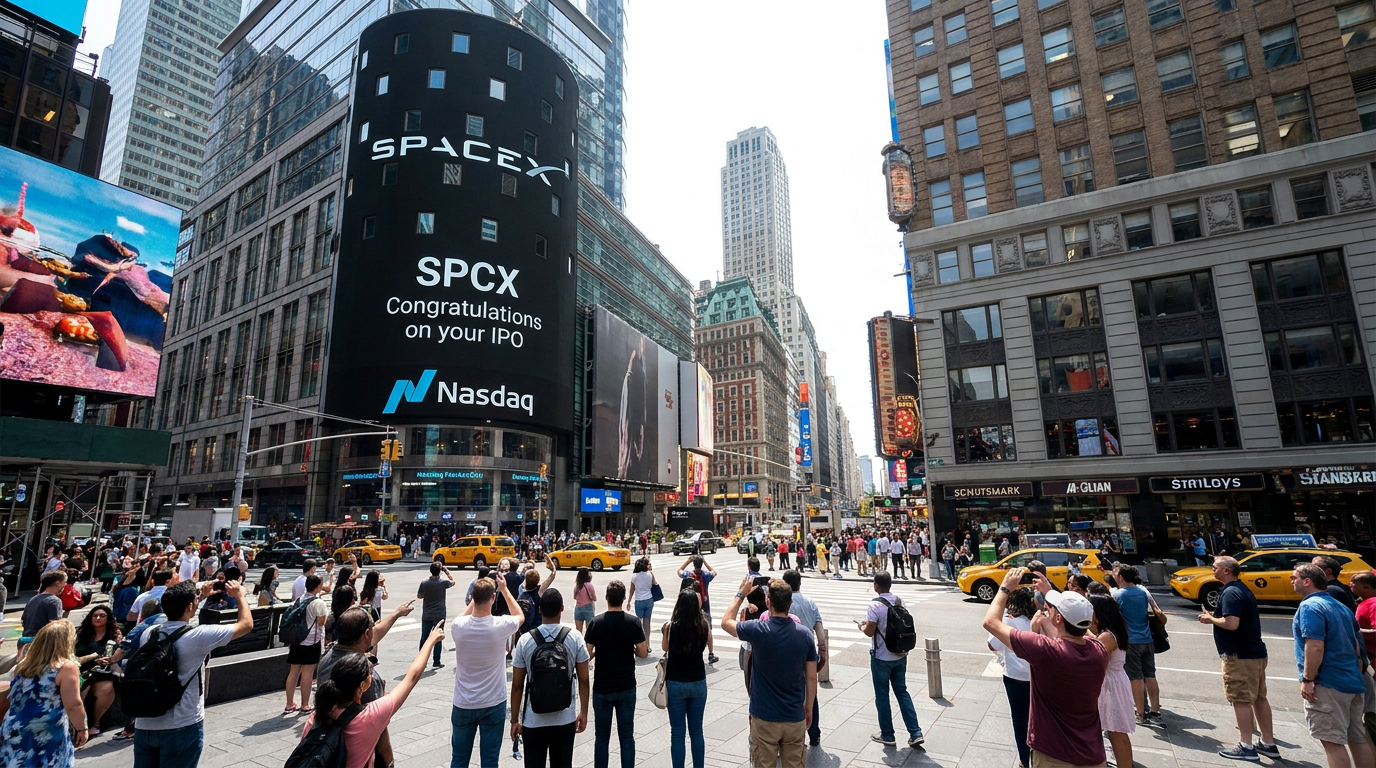
Twenty-four years after its founding in a California warehouse, SpaceX has executed the largest initial public offering in financial history. On Friday, June 12, 2026, the aerospace giant debuted on the Nasdaq under the ticker symbol SPCX, shattering previous records and fundamentally reshaping the commercial space industry. The highly anticipated listing marks a dramatic transition for a company that spent two decades operating privately, relying on venture capital and internal revenue to fund its ambitions. Now, backed by the public markets, SpaceX has secured an unprecedented war chest to accelerate its mission of making humanity multiplanetary.[1][2]
The sheer scale of the offering eclipsed anything Wall Street had ever seen. SpaceX initially priced its shares at $135 on Thursday evening, aiming to raise $75 billion. However, overwhelming investor demand prompted underwriters to exercise a "greenshoe" overallotment option. By the time the transaction officially closed on Monday, the company had issued 638.9 million shares, bringing the total capital raised to a staggering $85.7 billion. This figure more than doubles the previous IPO record of $29 billion set by Saudi Aramco in 2019.[3][6]
When trading commenced on Friday morning, the pent-up demand was palpable. The volume of order-matching activity was so intense that the first public trades were delayed for hours after the opening bell. When SPCX finally opened, it debuted at $150—an instant 11 percent premium over its offer price. The stock surged to an intraday high of $176.52 before settling to close its first session at $160.95. The 19 percent first-day pop cemented SpaceX's market capitalization at approximately $2.1 trillion, making it the sixth-largest publicly traded company in the United States.[4][7]

The historic debut was celebrated with a bicoastal display of the company's operational tempo. In New York City, SpaceX President and Chief Operating Officer Gwynne Shotwell rang the Nasdaq opening bell as Elton John's "Rocket Man" played across the trading floor. Meanwhile, CEO Elon Musk joined the broadcast via livestream from the company's Starbase facility in Texas. Fittingly, the market debut occurred just an hour after SpaceX successfully launched a Falcon 9 rocket carrying 29 Starlink satellites from Florida, underscoring the routine cadence of its core business.[1][4]
The financial windfall from the IPO triggered one of the largest wealth-creation events in Silicon Valley history. The soaring valuation pushed Elon Musk's estimated net worth past $1.1 trillion, officially making him the world's first trillionaire. The offering also minted a new class of billionaires among the company's early backers and executive team. Shotwell, who has served as Musk's second-in-command for over a decade and was instrumental in building the company's commercial launch business, saw her personal stake valued at $1.9 billion by the end of trading.[1][8]
The financial windfall from the IPO triggered one of the largest wealth-creation events in Silicon Valley history.
For years, SpaceX leadership had publicly resisted the idea of an IPO. Musk frequently argued that the short-term pressures of quarterly earnings reports would distract from the company's long-term, capital-intensive goal of colonizing Mars. Shotwell echoed these sentiments, expressing skepticism about subjecting the firm's volatile development cycles to public market scrutiny. However, the immense capital requirements of the company's next-generation projects ultimately shifted the equation, prompting a strategic pivot that culminated in Friday's blockbuster listing.[2][5]
In its prospectus, SpaceX outlined a staggering $28.5 trillion total addressable market to justify its eye-popping valuation. While the company is best known for its reusable Falcon rockets, the bulk of its future revenue projections are tied to its Starlink satellite internet constellation and emerging artificial intelligence infrastructure. Following its acquisition of Musk's AI startup xAI earlier in 2026, SpaceX plans to build massive data centers in space. Management argues that as autonomous vehicles, humanoid robots, and digital infrastructure proliferate, they will all require the ubiquitous, low-latency connectivity that only Starlink can provide.[2]
Retail investors clamored for a piece of the aerospace giant, placing orders for more than $100 billion in shares ahead of the debut. Brokerages reported unprecedented activity, with individual investors eager to gain direct exposure to the commercial space economy. Over 360 million shares traded across all venues on day one, breaking records for the most actively traded stock on the Nasdaq. The enthusiasm validated the company's decision to allocate up to 30 percent of the offering to retail buyers, a higher proportion than is typical for mega-cap tech listings.[3][4]

The gravitational pull of the SpaceX IPO had immediate ripple effects across the broader space sector. As institutional and retail capital flooded into SPCX, other publicly traded space companies experienced a sharp pullback. Firms like Rocket Lab, Planet Labs, and AST SpaceMobile saw their stock prices dip between 8 and 15 percent on Friday. Market analysts attribute this to portfolio rebalancing, as investors liquidated positions in smaller aerospace startups to free up liquidity for the industry's undisputed apex predator.[5]
Despite the triumphant debut, the sheer size of the offering has drawn scrutiny from regulators and governance advocates. Lawmakers, including Senator Elizabeth Warren, petitioned the Securities and Exchange Commission to carefully review the listing, questioning whether index funds and retail investors are adequately protected from the stock's potential volatility. Critics have also highlighted SpaceX's governance structure; through a super-voting share class, Musk retains approximately 85 percent of the company's voting control, leaving public shareholders with little influence over corporate direction.[3][4]
Looking ahead, financial analysts expect SPCX to be fast-tracked into major indices. Nasdaq recently amended its rules to allow the stock eligibility for the Nasdaq 100 after just 15 trading days, and inclusion in the S&P 500 is anticipated by next year if the company meets GAAP profitability criteria. This index inclusion will force passive funds to purchase billions of dollars in SpaceX stock, further embedding the company's fortunes into the retirement accounts of millions of everyday investors.[4][7]

With $85.7 billion in fresh capital, SpaceX is now uniquely positioned to execute its most ambitious projects without the constraints of private fundraising rounds. The funds are expected to accelerate the testing and mass production of the Starship launch vehicle, expand the Starlink constellation to over 100,000 satellites, and pioneer space-based AI infrastructure. As the company transitions from a scrappy disruptor to a cornerstone of the public markets, it carries the financial weight—and the expectations—of an entirely new era in human spaceflight.[1][2]
How we got here
April 2026
SpaceX confidentially submits a draft registration statement to the SEC to begin the IPO process.
May 20, 2026
The SEC publicly discloses SpaceX's S-1 filing, detailing the company's financials and plans to go public.
June 11, 2026
SpaceX finalizes its IPO price at $135 per share, cementing it as the largest offering in history.
June 12, 2026
SPCX begins trading on the Nasdaq, opening at $150 and closing its first day at $160.95.
June 15, 2026
The transaction officially closes, with underwriters exercising options to bring the total raise to $85.7 billion.
Viewpoints in depth
Market Bulls & Industry Advocates
View the IPO as a massive validation of the commercial space sector that will inject capital into the broader aerospace ecosystem.
Proponents argue that SpaceX's $2.1 trillion valuation is justified by its near-monopoly on commercial launch services and the explosive growth of its Starlink network. They view the $85.7 billion capital injection as essential fuel for humanity's multiplanetary future, providing the runway needed to perfect the Starship vehicle and build space-based AI infrastructure. For these advocates, the public listing democratizes access to the space economy, allowing retail investors to finally participate in the financial upside of the industry's most successful firm.
Financial Analysts
Focus on the mechanics of the record-breaking raise, index inclusion, and the stock's immediate impact on major markets.
Market analysts are closely tracking the sheer gravitational pull of SPCX on the broader equities landscape. They note that the unprecedented $100 billion in retail demand and the stock's impending fast-track inclusion into the Nasdaq 100 will force massive portfolio rebalancing. Analysts point out that the IPO has already drained liquidity from smaller, publicly traded space companies as investors consolidate their aerospace holdings into SpaceX, establishing the firm as the undisputed bellwether for the entire sector.
Governance Skeptics
Raise concerns over the company's valuation, Musk's super-voting control, and the systemic risk to retail portfolios.
Critics and regulatory watchdogs warn that the enthusiasm surrounding the IPO masks significant governance risks. They point to Elon Musk's retention of 85 percent voting control, which effectively renders public shareholders powerless over corporate strategy. Furthermore, skeptics argue that fast-tracking a highly volatile, capital-intensive aerospace company into major index funds forces everyday pensioners to underwrite the immense financial risks of Mars colonization and AI development, regardless of their individual risk tolerance.
What we don't know
- It remains unclear exactly how quickly SpaceX will be added to the S&P 500, which depends on meeting strict GAAP profitability criteria.
- The long-term impact of the IPO on SpaceX's internal culture and its ability to maintain rapid, high-risk development cycles under public market scrutiny is unknown.
- Regulators have not yet indicated whether they will act on requests from lawmakers to investigate the company's governance structure and valuation.
Key terms
- Initial Public Offering (IPO)
- The process of offering shares of a private corporation to the public in a new stock issuance.
- Greenshoe Option
- A provision that allows underwriters to sell more shares than originally planned if investor demand exceeds expectations.
- Market Capitalization
- The total value of a publicly traded company's outstanding shares, calculated by multiplying the share price by the total number of shares.
- Total Addressable Market (TAM)
- The overall revenue opportunity available for a product or service if 100 percent market share is achieved.
Frequently asked
What is SpaceX's ticker symbol and where does it trade?
SpaceX trades on the Nasdaq exchange under the ticker symbol SPCX.
How much money did SpaceX raise in its IPO?
The company raised a record $85.7 billion, including the exercise of a greenshoe overallotment option, surpassing Saudi Aramco's previous record.
Did Elon Musk become a trillionaire?
Yes. Following the IPO, Musk's combined stakes in SpaceX and Tesla pushed his estimated net worth past $1.1 trillion, making him the world's first trillionaire.
Why did SpaceX decide to go public now?
Leadership cited the need to raise massive capital for a 'significant growth phase,' which includes developing the Starship rocket, expanding Starlink, and building space-based AI data centers.
Sources
Source coverage
8 outlets
3 viewpoints surfaced








[1]The GuardianGovernance Skeptics
Elon Musk becomes world's first trillionaire as SpaceX ends trading day with valuation of $2.1tn
Read on The Guardian →[2]CNBCMarket Bulls & Industry Advocates
SpaceX begins trading Friday under the ticker SPCX after the biggest initial public offering ever
Read on CNBC →[3]ForbesMarket Bulls & Industry Advocates
SpaceX Opens At $150—Surging 20% After Largest IPO Ever
Read on Forbes →[4]ThinkMarketsFinancial Analysts
First-Day Trading Recap: SpaceX Goes Public
Read on ThinkMarkets →[5]Payload SpaceMarket Bulls & Industry Advocates
Space Stocks Dip After SpaceX IPO
Read on Payload Space →[6]QazinformFinancial Analysts
SpaceX IPO tops expectations with $85.7bn raise
Read on Qazinform →[7]Zacks Investment ResearchFinancial Analysts
SpaceX IPO: The Timeline
Read on Zacks Investment Research →[8]Business InsiderGovernance Skeptics
The SpaceX IPO just created one of the biggest wealth events in Silicon Valley history
Read on Business Insider →


Every angle. Every day.
Get business stories with full source coverage and perspective breakdowns delivered to your inbox.