
At-Home Brain Implant Restores Speech and Autonomy for Man with ALS
A 47-year-old man with severe paralysis has successfully used a brain-computer interface in his home for nearly two years to communicate and work independently. The milestone proves that neuroprosthetics are ready to transition from laboratory experiments to practical medical devices.
By Factlen Editorial Team
- Clinical Researchers
- Focus on the scientific milestone of achieving sustained, highly accurate BCI performance outside of a controlled laboratory environment.
- ALS Patients & Advocates
- Emphasize the profound psychological impact of restoring autonomy, dignity, and the ability to connect with loved ones.
- Commercial BCI Developers
- View the academic success as a vital proof-of-concept that accelerates the race to bring scalable, wireless neural interfaces to the broader market.
What's not represented
- · Caregivers who manage the daily physical connection of the BCI hardware
- · Health insurance providers evaluating the future cost coverage of neuroprosthetics
Why this matters
For the millions of people living with severe paralysis from ALS, strokes, or spinal cord injuries, the loss of speech is one of the most devastating outcomes. This breakthrough proves that brain-computer interfaces can reliably restore communication and autonomy in a home environment, moving the technology out of the realm of science fiction and into practical daily care.
Key points
- A 47-year-old man with ALS has used a brain-computer interface at home for nearly two years.
- The system decodes attempted speech at 56 words per minute with a 125,000-word vocabulary.
- The patient used the device independently for over 3,800 hours without researchers present.
- The implant also allows for full computer cursor control, enabling internet browsing and work.
- The milestone proves that neural interfaces can function reliably outside of laboratory settings.
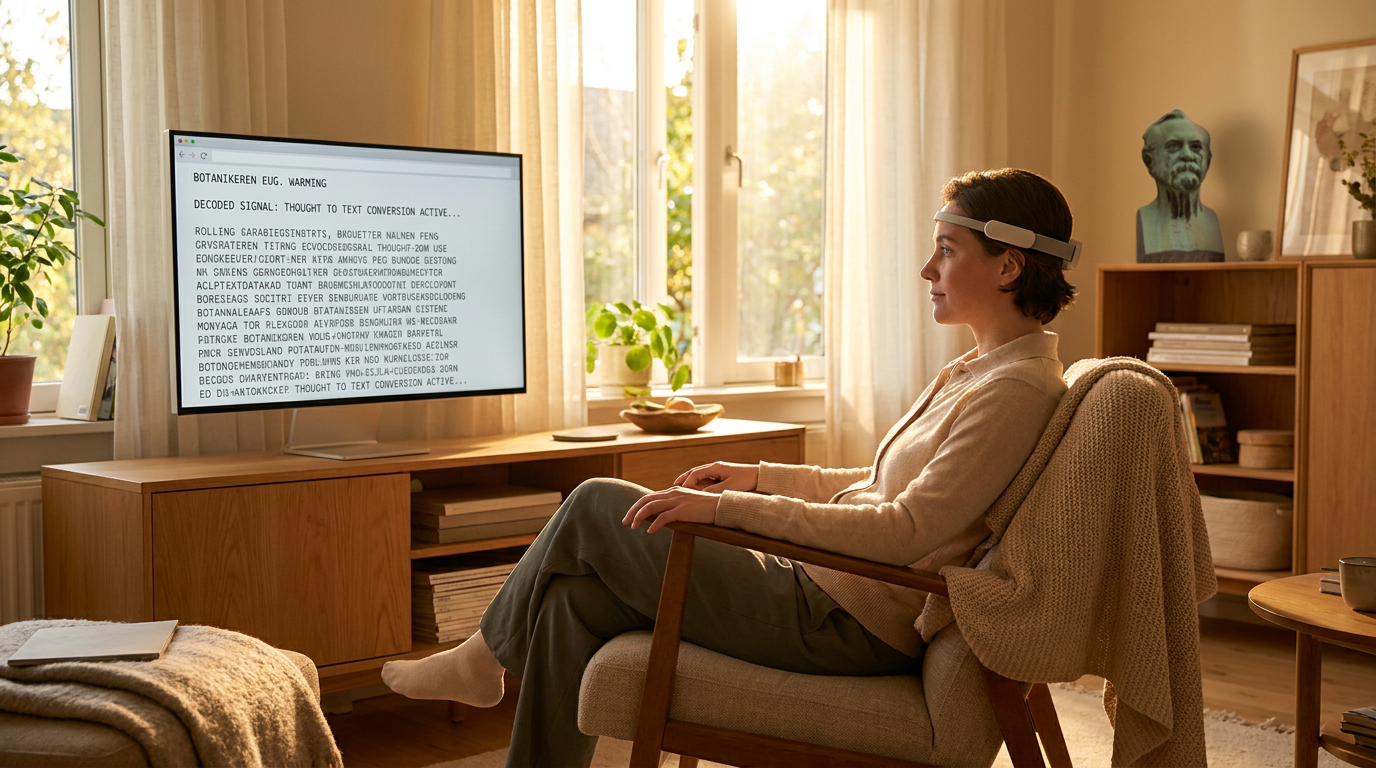
For nearly two years, Casey Harrell has been living with a device embedded in his brain that has fundamentally altered the trajectory of his life. Diagnosed with amyotrophic lateral sclerosis (ALS) six years ago, the 47-year-old gradually lost control over his muscles, including the ability to speak. But today, Harrell is communicating, working, and interacting with his family using a brain-computer interface (BCI) directly from his home. The system translates his neural activity into text and synthesized speech, allowing him to bypass his paralyzed vocal cords and reconnect with the digital and physical world. This sustained, independent use marks a watershed moment in neuroprosthetics, proving that severe paralysis no longer has to mean total isolation.[1][2]
The significance of this breakthrough lies in its setting. For decades, brain-computer interfaces have been confined to highly controlled laboratory environments. Patients could only use the technology when surrounded by a team of neuroscientists and engineers who managed the complex hardware and software. Harrell’s experience shatters that paradigm. He has become what researchers describe as the first true "power user" of a speech BCI, operating the system in his own living room. By moving the technology out of the lab and into the messy reality of daily life, scientists have demonstrated that neural interfaces are finally crossing the threshold from experimental research tools to practical medical devices.[3][8]
The clinical data, published in the journal Nature Medicine by a collaborative team from UC Davis, Brown University, and the Mass General Brigham Neuroscience Institute, details an unprecedented level of real-world engagement. During the first 22.6 months after the surgical implantation, Harrell used the BCI on 364 out of 397 days. He logged more than 3,800 hours of use without a single researcher physically present in his home. This extensive, unassisted operation represents the longest period of independent daily use ever reported for a speech-focused brain implant, establishing a new benchmark for the reliability and durability of intracortical microelectrode arrays.[1][2][6]

The mechanics of the system rely on capturing high-resolution electrical signals directly from the brain's surface. In July 2023, neurosurgeons implanted four tiny microelectrode arrays—comprising a total of 256 individual electrodes—into Harrell’s left precentral gyrus. This specific region of the motor cortex is responsible for coordinating the complex sequence of voluntary muscle movements required for speech. The arrays act as a highly sensitive listening device, intercepting the electrical impulses that Harrell’s brain generates when he attempts to form words, even though those signals can no longer reach his facial muscles or vocal cords.[1][7]
Crucially, the implant does not read Harrell’s internal thoughts or inner monologue. Instead, it decodes the specific neural commands associated with the physical attempt to articulate sounds. Advanced machine-learning algorithms process these signals in real time, identifying the distinct patterns of brain activity that correspond to different phonemes and words. The system then translates those patterns into text on a screen and generates synthesized audio. This distinction between reading thoughts and decoding attempted movement is a vital ethical and functional boundary in the development of neuroprosthetics, ensuring that the user retains complete control over what is actually broadcast to the outside world.[2][8]
Crucially, the implant does not read Harrell’s internal thoughts or inner monologue.
The performance metrics of the home-based system rival those achieved in tightly controlled clinical trials. The decoding software supports a massive 125,000-word vocabulary and operates at an average speed of 56 words per minute—fast enough to sustain a natural, flowing conversation. During his thousands of hours of at-home use, Harrell communicated more than 183,000 sentences. When asked to evaluate the system's accuracy in real-world conditions, he reported that 92 percent of his sentences were decoded correctly or mostly correctly. In formal, controlled testing, the system achieved a word accuracy rate exceeding 97 percent.[1][4]
The UC Davis system is not limited to speech. The implant also captures the neural signals generated when Harrell attempts to move his hands, providing a secondary "movement BCI" that allows him to control a computer cursor. This dual-functionality framework empowers him with full personal computer interaction without the need for eye-tracking cameras or other cumbersome assistive devices. By simply thinking about moving his hand, Harrell can navigate the internet, send emails, read stories to his young daughter, and continue his professional work. The seamless integration of speech and cursor control dramatically enhances his autonomy.[2][7]

The emotional and psychological impact of this restored autonomy cannot be overstated. ALS is a uniquely cruel disease; it leaves a person's cognitive faculties entirely intact while progressively locking them inside an unresponsive body. The loss of speech often brings a profound sense of isolation and a shrinking of one's world. Harrell noted that living with a terminal neurodegenerative disease usually means accepting diminished dreams and a narrowing horizon. But the implant has inverted that reality. The ability to communicate freely and independently has, in his words, given him his daily life back, allowing him to remain an active participant in his family rather than just an observer.[3][6]
The success of Harrell’s implant is accelerating a broader race within the neurotechnology sector to commercialize brain-computer interfaces. While academic institutions like UC Davis and Stanford have pioneered the fundamental science, companies like Neuralink, Synchron, and Ability Neurotech are now aggressively developing systems designed for mass manufacturing and surgical scalability. Ability Neurotech, for example, recently received regulatory approval in the Netherlands to begin a long-term implantation study of its own wireless BCI in ALS patients. The transition from bespoke, university-built prototypes to commercial medical devices is widely seen as the necessary next step to make this technology accessible to the millions of people living with severe paralysis.[5][8]
Despite the monumental progress, significant engineering hurdles remain before BCIs can become a standard of care. Harrell’s current system still requires a physical, wired connection. The electrodes in his brain are wired to pedestals that protrude through his skull, which must be manually connected via cables to an external computer processor by a caregiver each day. The ultimate goal for the industry is to develop fully implantable, wireless systems—similar to cardiac pacemakers—that transmit data via Bluetooth or proprietary wireless protocols, eliminating the infection risks associated with open skin ports and the need for daily physical tethering.[8]

Researchers are also pushing the boundaries of how synthesized speech sounds and feels. Current text-to-speech engines, while highly accurate, often sound robotic and flat. The next frontier is "brain-to-voice" technology, which aims to decode not just the intended words, but the intended emotional tone, pitch, and inflection directly from the motor cortex. By capturing the neural signals that control the subtle vocal cord adjustments used to express excitement, sarcasm, or sadness, scientists hope to create synthesized voices that are indistinguishable from natural human speech, further restoring the user's unique identity and personality.[6][8]
For now, the UC Davis study stands as a definitive proof-of-concept that will shape the future of clinical neuroscience. It proves that the human brain can adapt to and sustain a high-bandwidth connection with a computer over a period of years, without the signal degrading or the hardware failing. By empowering a paralyzed man to speak on his own terms, in his own home, the research has fundamentally altered the expectations for what assistive technology can achieve. It offers a tangible, evidence-backed blueprint for a future where neurological diseases may rob people of their movement, but never again of their voice.[2][8]
How we got here
2020
Casey Harrell first notices symptoms of muscle weakness and is subsequently diagnosed with amyotrophic lateral sclerosis (ALS).
July 2023
Surgeons implant four microelectrode arrays into Harrell's brain as part of a clinical trial led by UC Davis.
2024
Harrell begins using the brain-computer interface independently at home, transitioning the technology out of the laboratory.
June 2026
Researchers publish data in Nature Medicine detailing Harrell's nearly two years of successful, independent daily use of the system.
Viewpoints in depth
The Clinical Milestone
Researchers emphasize the leap from lab-bound experiments to reliable, daily home use.
For neuroscientists and engineers, the true breakthrough of the UC Davis study is not just the decoding accuracy, but the durability and independence of the system. Historically, brain-computer interfaces required constant recalibration by experts to account for tiny shifts in the brain or signal degradation. The fact that Casey Harrell could use the device for nearly two years, logging thousands of hours without a researcher present, proves that the underlying machine-learning algorithms can adapt to real-world noise. This stability is the prerequisite for turning experimental neuroprosthetics into standard medical devices.
The Patient Experience
Advocates highlight the restoration of agency for those 'locked in' by neurodegenerative disease.
From the perspective of ALS patients and advocacy groups, the technology represents a lifeline out of isolation. The progressive loss of motor function in ALS leaves patients entirely reliant on caregivers, often stripping away their ability to work, parent, or express complex thoughts. Eye-tracking communication devices exist, but they are slow and fatiguing. By enabling a typing speed of 56 words per minute and full cursor control, the intracortical implant restores a level of agency that fundamentally changes the patient's quality of life, allowing them to participate actively in their own lives rather than merely observing.
The Commercial Race
Industry watchers see this academic success as a catalyst for the commercial neurotech sector.
For the burgeoning commercial BCI industry, academic milestones serve as vital de-risking events. Companies like Neuralink, Synchron, and Ability Neurotech are watching these long-term efficacy studies closely as they design their own proprietary systems. The commercial focus is now shifting toward hardware refinement—specifically, developing fully implantable, wireless transmitters that eliminate the need for cables protruding through the skull. Industry analysts argue that while academic labs have proven the software decoding works, it will take the manufacturing scale and venture capital of the private sector to make these devices accessible and affordable for the general public.
What we don't know
- How long the implanted microelectrodes will continue to function before scar tissue degrades the neural signal.
- When a fully wireless, commercially available version of the speech BCI will be approved by the FDA for general use.
- The exact cost of the surgery and hardware once the technology transitions from funded clinical trials to the commercial market.
Key terms
- Brain-Computer Interface (BCI)
- A technological system that translates electrical brain activity into commands that can control external devices, such as computers or speech synthesizers.
- Amyotrophic Lateral Sclerosis (ALS)
- A progressive neurodegenerative disease that destroys the motor neurons responsible for voluntary movement, eventually leading to paralysis and loss of speech.
- Intracortical Microelectrode Array
- A tiny, surgically implanted sensor that sits directly on the brain's cortex to record high-resolution electrical signals from individual neurons.
- Precentral Gyrus
- A specific ridge in the brain's motor cortex that is responsible for coordinating voluntary muscle movements, including the complex sequences required for speech.
- Neuroprosthesis
- A device that connects to the nervous system to replace or enhance sensory, motor, or cognitive functions that have been lost to disease or injury.
Frequently asked
Does the brain implant read the patient's thoughts?
No. The implant decodes the neural signals associated with the physical attempt to move facial muscles and vocal cords, not the user's internal thoughts or inner monologue.
Can the patient use the device completely alone?
Not entirely. Because the current system relies on physical cables, a caregiver must manually connect the implant's skull pedestals to the external computer each day. Once connected, the patient can use it independently.
Is this technology available to the general public?
Not yet. The technology is still in the clinical trial phase. Researchers and commercial companies are working to develop fully wireless, scalable versions that could eventually become standard medical devices.
How fast can the patient type with the implant?
The system operates at an average speed of 56 words per minute, which is fast enough to sustain a natural, flowing conversation and is significantly faster than traditional eye-tracking communication devices.
Sources
Source coverage
8 outlets
3 viewpoints surfaced








[1]Nature MedicineClinical Researchers
Long-term independent use of an intracortical brain–computer interface for speech and cursor control
Read on Nature Medicine →[2]UC Davis HealthClinical Researchers
Brain-computer interface enables independent, accurate communication for man living with ALS
Read on UC Davis Health →[3]MIT Technology ReviewCommercial BCI Developers
This man with ALS is 'the first power user' of a brain implant that lets him speak
Read on MIT Technology Review →[4]Medical XpressALS Patients & Advocates
Brain-computer interface enables independent, accurate communication for man living with ALS
Read on Medical Xpress →[5]ALS News TodayALS Patients & Advocates
Netherlands approves trial of brain implant for ALS communication
Read on ALS News Today →[6]The Washington PostALS Patients & Advocates
Two years, 2 million words: How a brain implant transformed an ALS patient's life
Read on The Washington Post →[7]Science MagazineClinical Researchers
Brain-computer interface enables independent, accurate communication for man living with ALS
Read on Science Magazine →[8]Factlen Editorial TeamCommercial BCI Developers
Synthesis by Factlen editorial team
Read on Factlen Editorial Team →

More in science
See all 6 stories →Neural Interfaces
The Era of the At-Home Brain-Computer Interface Has Arrived
0 sources
Neuroprosthetics
At-Home Brain Implant Restores Speech for Paralyzed ALS Patient in Historic Milestone
0 sources
Archaeological Tech
AI Is Unlocking the Lost Library of Herculaneum Without Unrolling a Single Scroll
0 sources

Exoplanet Biosignatures
The End of the 'Silver Bullet' Biosignature: How JWST is Rewriting the Search for Extraterrestrial Life
0 sources

Every angle. Every day.
Get science stories with full source coverage and perspective breakdowns delivered to your inbox.