
AI Is Unlocking the Lost Library of Herculaneum Without Unrolling a Single Scroll
Using ultra-high-resolution CT scans and machine learning, researchers are successfully reading the carbonized Herculaneum scrolls destroyed by Mount Vesuvius. The breakthrough promises to recover hundreds of lost texts from classical antiquity.
By Factlen Editorial Team
- Computer Scientists & AI Researchers
- Focused on the technical hurdles of 3D geometry and machine learning.
- Classicists & Papyrologists
- Focused on the historical and literary value of the recovered texts.
- Open-Source Advocates
- Focused on the collaborative, decentralized model of the discovery.
What's not represented
- · Traditional archaeologists concerned about the physical preservation of the artifacts
- · Italian cultural heritage authorities managing the physical site
Why this matters
The ability to read carbonized scrolls without opening them unlocks the only surviving library from classical antiquity. This breakthrough promises to recover thousands of lost philosophical, historical, and literary works, fundamentally rewriting our understanding of the ancient world.
Key points
- The Vesuvius Challenge uses AI to read ancient scrolls carbonized by the AD 79 eruption.
- Ultra-high-resolution CT scans reveal microscopic 'crackle patterns' left by ancient ink.
- Generalist AI models can now detect Greek letters across multiple scrolls automatically.
- A recently decoded scroll pinpointed the exact burial location of the philosopher Plato.
- The project is now focused on automating the 3D segmentation of the scrolls to read them at scale.
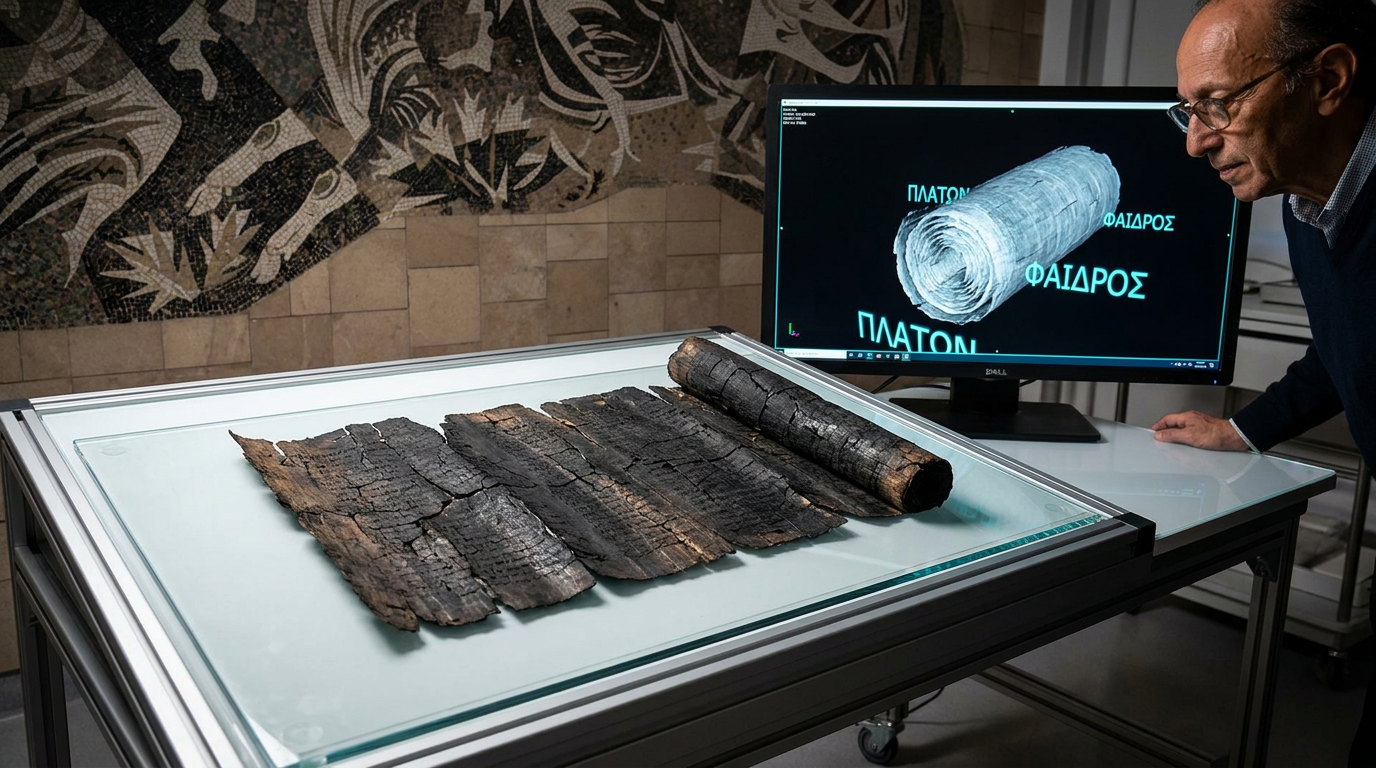
The eruption of Mount Vesuvius in AD 79 is most famous for instantly burying the Roman cities of Pompeii and Herculaneum under millions of tons of volcanic ash and pumice. While the disaster extinguished thousands of lives, it also inadvertently preserved the only intact library surviving from classical antiquity. Deep inside the luxurious Villa of the Papyri—a massive estate believed to have been owned by the father-in-law of Julius Caesar—hundreds of papyrus scrolls were flash-heated by the pyroclastic surge. Buried under twenty meters of superheated volcanic mud and debris, the scrolls were baked into solid, carbonized lumps. For centuries, these blackened artifacts sat in the dark, perfectly preserved from the oxygen and moisture that typically rot ancient organic materials, waiting for a technology capable of peering inside their fused layers.[3][8]
For over 250 years following their initial rediscovery by farmworkers digging a well in the 1750s, these carbonized scrolls were widely considered to be unreadable. Early physical attempts to unroll them proved catastrophic; the fragile, charred papyrus simply crumbled into unrecognizable dust and flakes when handled, destroying the very texts researchers were desperate to read. However, in 2026, the archaeological landscape has been fundamentally transformed by the Vesuvius Challenge. This global, crowdsourced competition is successfully utilizing advanced artificial intelligence and computer vision to read the scrolls without ever physically opening them. By treating the artifacts as complex 3D data puzzles rather than physical books, scientists have bypassed the fragility of the papyrus entirely, unlocking a wealth of ancient knowledge that was previously thought to be lost forever.[2][7]
What began as a highly experimental proof-of-concept has rapidly evolved into an industrial-scale recovery effort. As of early 2026, the Vesuvius Challenge initiative has awarded over $1.5 million in prize money to a decentralized network of students, software engineers, and data scientists. The project has officially moved into its highly anticipated "Unwrapping at Scale" phase. Rather than painstakingly deciphering a few isolated words or paragraphs, the current objective is to fully automate the digital extraction of entire 3D volumes. This shift from manual digital tracing to automated, algorithmic processing represents a massive leap forward, transitioning the project from a computer science experiment into a reliable, high-throughput archaeological tool capable of processing the hundreds of scrolls that remain in storage.[1][5]
The core scientific claim driving the Vesuvius Challenge is that machine learning models can accurately detect carbon-based ink on carbonized papyrus. For decades, this was considered a physical impossibility. Because the ancient Roman ink was made from soot and water, and the papyrus itself was turned into carbon by the volcano, both materials share the exact same elemental density. When viewed through traditional X-rays, the ink is completely invisible, blending seamlessly into the charred paper. The breakthrough required a paradigm shift in how researchers analyzed the data, moving away from looking for chemical differences and instead focusing on microscopic structural anomalies left behind by the ink as it dried on the plant fibers two millennia ago.[2][3]

The foundational evidence supporting this claim relies on ultra-high-resolution X-ray computed tomography (CT) scans, primarily conducted at particle accelerators. Recent scans utilized by the 2026 competition have achieved an astonishing resolution of 2 micrometers—roughly one-fiftieth the width of a human hair. At this extreme microscopic scale, researchers discovered that the ancient ink did not just sit flat on the page; it physically altered the surface of the papyrus. The dried ink left a faint but distinct "crackle pattern," a microscopic texture of ridges and micro-fissures that stands out against the smoother background of the uninked plant fibers. This textural signature is the key to differentiating the text from the void.[5][8]
By training sophisticated machine learning models on these microscopic textural anomalies, the artificial intelligence can highlight the invisible ink, revealing highly legible Greek characters that have not been seen by human eyes since the days of the Roman Empire. The evidence for the efficacy of this method is incredibly robust. Over the past year, the AI models have successfully recovered multiple, continuous passages of text. Independent classicists and papyrologists have verified these findings, confirming that the Greek syntax is accurate, contextually appropriate, and translates into coherent philosophical arguments. The models are not just finding random shapes; they are recovering actual, verifiable human language.[2][7]
A major technological breakthrough defining the 2026 landscape is the successful development of "generalist" AI models. In the early days of the challenge, the ink-detection software was highly brittle; models had to be painstakingly retrained to accommodate the specific physical quirks, compression levels, and damage patterns of each individual scroll. If a model trained on Scroll A was applied to Scroll B, it would often fail to detect anything. The new generation of generalist models has overcome this limitation, learning the fundamental physical properties of the ink's crackle pattern rather than memorizing the specific noise of a single dataset.[5]
A major technological breakthrough defining the 2026 landscape is the successful development of "generalist" AI models.
Because these models have generalized their understanding of the ink, they can now seamlessly "see" Greek letters across multiple different scrolls without requiring manual recalibration. Furthermore, they are proving capable of detecting text in hidden, fused layers of papyrus that are tightly compressed together—areas where the 3D geometry is incredibly messy. This capability dramatically accelerates the overall pace of discovery. Instead of treating each scroll as a bespoke, multi-month research project, researchers can now run the generalist models across terabytes of CT data, rapidly surfacing legible text from the darkest, most tangled interiors of the carbonized artifacts.[1][5]

The historical and literary stakes of this technology are difficult to overstate. The Villa of the Papyri is widely believed to have belonged to Lucius Calpurnius Piso Caesoninus, the father-in-law of Julius Caesar and a known patron of Epicurean philosophy. The scrolls decoded so far have already yielded previously unknown philosophical texts, offering fresh insights into Hellenistic thought. Scholars estimate that the surviving library could contain missing masterpieces of antiquity, ranging from lost plays by Sophocles and Aeschylus to the missing volumes of Livy's monumental history of Rome. Every new layer unrolled digitally holds the potential to rewrite the textbooks of Western history.[3][8]
The profound impact of this technology was recently demonstrated by a stunning historical revelation. Researchers utilizing the latest digital unwrapping pipeline decoded a scroll that explicitly pinpointed the exact burial spot of the legendary philosopher Plato in Athens. This highly specific biographical detail had been lost to history for over two millennia, buried beneath the ash of Vesuvius. The recovery of this single fact underscores the immense value of the Herculaneum library; it is a time capsule of the ancient world's knowledge, preserving details, debates, and narratives that failed to survive the arduous process of medieval manuscript copying.[5]
Despite these monumental successes, the "virtual unwrapping" pipeline is not without significant technical challenges and transparent uncertainties. The entire process relies heavily on a step known as "segmentation"—the digital tracing of the scroll's surface as it winds through complex folds, gaps, and severe distortions in the 3D CT data. Before the AI can look for ink, it must first have a perfectly flattened digital sheet of papyrus to analyze. In a carbonized scroll that has been crushed by twenty meters of volcanic rock, the internal layers are often fused together, torn, or warped into chaotic, unpredictable shapes.[4]
While clean, well-spaced layers of papyrus near the outer edges of the scrolls are relatively easy to segment using automated tools, the tightest, most tangled areas near the core remain highly resistant to current digital methods. If the segmentation software makes a topological mistake—such as artificially merging two different sheets of papyrus together, or creating a digital hole that splits a single continuous sentence—the resulting 3D surface will be distorted. When the ink-detection AI is applied to a distorted surface, the text becomes garbled and unreadable, limiting the amount of continuous literature that can be recovered.[4]

To directly address this persistent bottleneck, the 2026 phase of the Vesuvius Challenge launched specific, targeted competitions, such as the Surface Detection prize. This initiative aims to crowd-source better, more resilient algorithms capable of handling severe noise and compression without distorting the scroll's fundamental shape. By offering substantial financial incentives, the project is attracting top-tier talent from the fields of medical imaging, aerospace engineering, and autonomous driving—disciplines that specialize in processing complex, noisy 3D spatial data. Solving the segmentation problem is the final major hurdle to fully automating the unwrapping process.[1][4]
Another critical area of uncertainty involves the inherent risk of AI "hallucinations." Because machine learning models function as highly advanced pattern-matching engines, there is always a theoretical risk that the software might "invent" Greek letters out of random noise in the papyrus texture. If a model is trained too aggressively to find letters, it might interpret a random cluster of volcanic ash or a natural flaw in the plant fibers as a piece of ancient text. In the context of historical preservation, publishing a hallucinated text as a genuine ancient artifact would be a catastrophic academic failure.[6]
The Vesuvius Challenge explicitly mitigates this weak point by enforcing strict requirements for independent verification. To claim a prize, winning submissions must demonstrate that multiple, differently architected AI models can detect the exact same text in the exact same location on the papyrus. If a ResNet model and a Vision Transformer model both independently highlight the same Greek word based on the same CT data, researchers can be highly confident that the letters are physically present in the artifact and not a digital mirage. This rigorous cross-validation ensures the integrity of the archaeological evidence.[1][6]
As this computer vision technology continues to mature, its implications extend far beyond the ashes of Herculaneum. If artificial intelligence can reliably and accurately extract text from severely degraded, carbonized papyrus, the underlying algorithms could theoretically be applied to a vast array of other fragile, unreadable artifacts. Museums and archives around the world hold waterlogged medieval manuscripts, fused ancient Egyptian papyri, and severely oxidized parchment that cannot be physically opened. The tools forged in the Vesuvius Challenge could eventually illuminate these dark corners of history, creating a new standard for non-destructive archaeological analysis.[3][7]

For now, however, the immediate focus remains squarely on the hundreds of unread scrolls currently sitting in storage facilities in Naples and Paris. With the rapid automation of 3D segmentation and the continuous refinement of generalist ink-detection models, the pace of translation is accelerating exponentially. Classicists and historians are actively preparing for what could be the largest sudden influx of new ancient literature since the Renaissance. As the AI peels back the final layers of ash, the lost voices of antiquity are finally preparing to speak again.[1][5]
How we got here
79 AD
Mount Vesuvius erupts, burying the Villa of the Papyri and carbonizing its library of scrolls.
1750
Farmworkers digging a well discover the buried villa and the intact, but unreadable, carbonized library.
2015
Dr. Brent Seales pioneers the early techniques of 'virtual unwrapping' using X-ray CT scans.
March 2023
The Vesuvius Challenge is launched, offering cash prizes to anyone who can use AI to read the scrolls.
Late 2023
The first word, 'porphyras' (purple), is successfully decoded by a student detecting the ink's 'crackle pattern.'
Early 2026
The project enters the 'Unwrapping at Scale' phase, utilizing generalist AI models to automate the reading of entire 3D volumes.
Viewpoints in depth
Computer Scientists & AI Researchers
Focused on the technical hurdles of 3D geometry and machine learning.
For the tech community, the scrolls represent a monumental data challenge. The primary bottleneck is no longer reading the ink, but "segmentation"—the geometric nightmare of tracing a crushed, warped, and fused 3D surface. Researchers in this camp prioritize building robust, automated pipelines that can handle terabytes of noisy CT data without requiring thousands of hours of manual human tracing.
Classicists & Papyrologists
Focused on the historical and literary value of the recovered texts.
Scholars of antiquity view this technology as the key to a new Renaissance. They are less concerned with the algorithms and more focused on the output: the potential recovery of lost works by Epicurus, missing books of Livy's history of Rome, or early Christian texts. This camp emphasizes the need for rigorous peer review and translation, ensuring that the AI's output is historically accurate and contextually understood.
Open-Source Advocates
Focused on the collaborative, decentralized model of the discovery.
This camp highlights the Vesuvius Challenge as a triumph of open science. Rather than a single university hoarding the data, the high-resolution CT scans were released publicly, allowing students, independent coders, and aerospace engineers to contribute. They argue this crowdsourced, prize-driven model should be replicated across other stalled scientific and archaeological disciplines.
What we don't know
- It remains unclear how many of the 800 surviving scrolls contain entirely new, undiscovered literature versus known texts.
- The tightest, most tangled inner cores of the scrolls still resist current 3D segmentation algorithms.
- We do not yet know if this technology can be successfully adapted for other types of degraded artifacts, such as waterlogged manuscripts.
Key terms
- Carbonization
- The process by which organic material, like papyrus, is converted into carbon through extreme heat without catching fire, preserving its structure but making it extremely brittle.
- Virtual Unwrapping
- A digital technique that uses 3D CT scans and software to flatten and read the internal layers of a rolled or folded object without physically opening it.
- Segmentation
- In computer vision, the process of isolating specific structures within a 3D dataset—in this case, digitally tracing the continuous surface of a single sheet of papyrus as it winds through a rolled scroll.
- Machine Learning Model
- An artificial intelligence system trained on vast amounts of data to recognize patterns, used here to identify the microscopic texture of ancient ink.
- Papyrus
- A thick, paper-like material used in antiquity for writing, made from the pith of the papyrus plant.
Frequently asked
Why can't archaeologists just unroll the scrolls?
The scrolls were carbonized by the extreme heat of Mount Vesuvius. They are essentially fragile lumps of charcoal, and any physical attempts to open them cause the papyrus to crumble into dust.
How does the AI see the invisible ink?
The AI is trained to detect microscopic textural changes—a "crackle pattern"—left by the carbon-based ink on the surface of the papyrus, which is visible in ultra-high-resolution CT scans.
What kind of texts are inside the scrolls?
The library is believed to contain Epicurean philosophy, Stoic texts, and potentially lost Roman histories. Recently, a decoded scroll revealed the exact burial location of the philosopher Plato.
Is the AI just guessing the letters?
No. To prevent AI "hallucinations," researchers require multiple independent machine learning models to detect the exact same shapes in the exact same locations before confirming the text is real.
Sources
Source coverage
8 outlets
3 viewpoints surfaced








[1]Vesuvius Challenge OfficialOpen-Source Advocates
2026 AD: The Challenge Continues - Unwrapping at Scale
Read on Vesuvius Challenge Official →[2]Understanding AIComputer Scientists & AI Researchers
A volcano scorched hundreds of Roman scrolls — can AI recover their text?
Read on Understanding AI →[3]Big ThinkClassicists & Papyrologists
Vesuvius Challenge: Can AI decipher these mysterious ancient scrolls?
Read on Big Think →[4]KaggleComputer Scientists & AI Researchers
Vesuvius Challenge - Surface Detection
Read on Kaggle →[5]Reddit Archaeology CommunityOpen-Source Advocates
Officially 'UNBURNING' History: The 2000-year-old Library of Herculaneum is Being Read by AI
Read on Reddit Archaeology Community →[6]Factlen Editorial Team
Synthesis by Factlen editorial team
Read on Factlen Editorial Team →[7]NatureClassicists & Papyrologists
AI reads text from ancient Herculaneum scroll for the first time
Read on Nature →[8]University of KentuckyClassicists & Papyrologists
Digital Restoration Initiative: The Herculaneum Scrolls
Read on University of Kentucky →

Every angle. Every day.
Get science stories with full source coverage and perspective breakdowns delivered to your inbox.