
The Rise of the Cozy Web: How Digital Gardens and Slow Internet are Reclaiming Online Life
Exhausted by algorithmic feeds and public outrage, a growing movement of internet users is retreating into private spaces and cultivating interconnected "digital gardens." This shift prioritizes slow, intentional thinking over viral engagement.
By Factlen Editorial Team
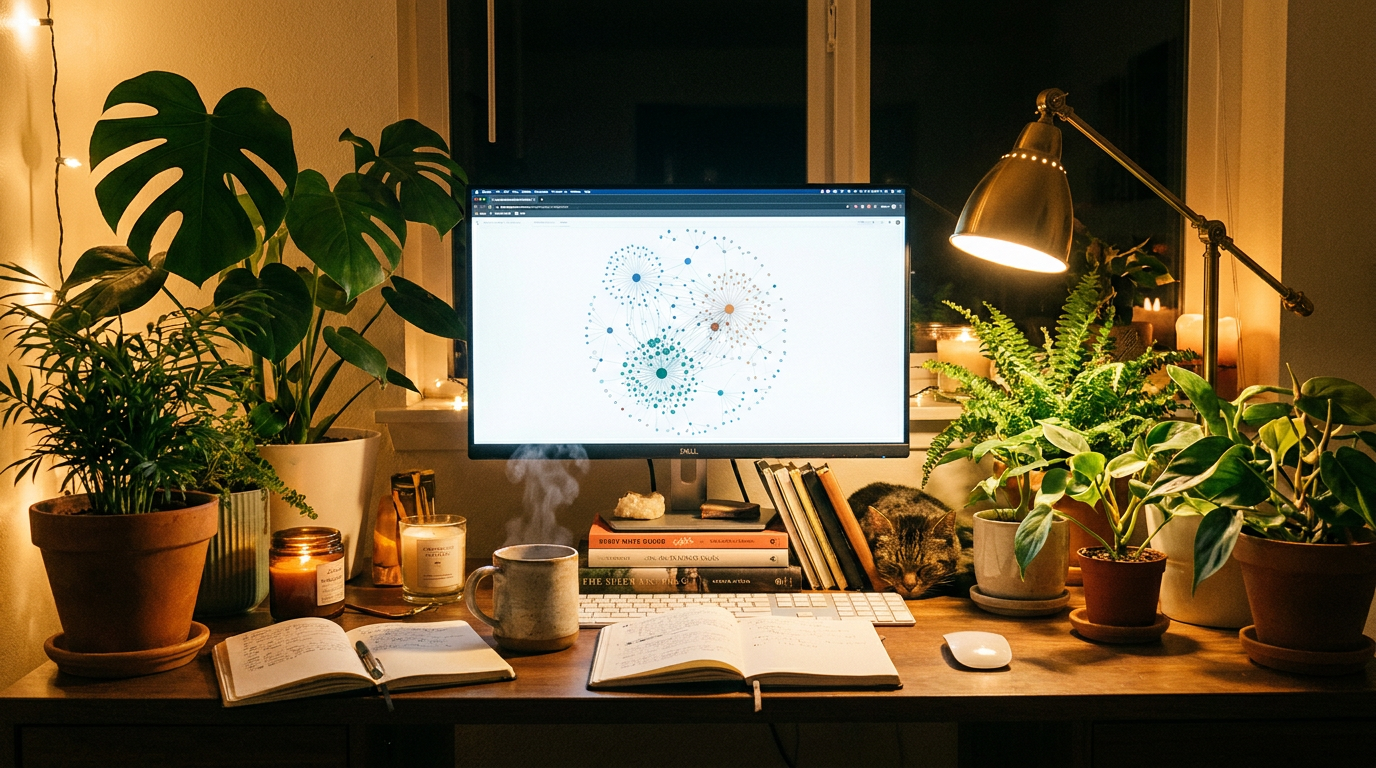
- Digital Gardeners
- Argue that knowledge should be cultivated slowly and interconnectedly, prioritizing process and personal ownership over polished, viral content.
- Slow Web Advocates
- Focus on the mental health and ethical design aspects, pushing for technology that respects human attention spans and reduces algorithmic overload.
- Mainstream Platform Critics
- View the public internet as a 'dark forest' compromised by surveillance, bots, and outrage, necessitating a retreat to private, gatekept communities.
What's not represented
- · Social media executives defending the value of algorithmic discovery
- · Advertisers navigating the loss of access to 'Cozy Web' demographics
Why this matters
As mainstream social media becomes increasingly dominated by bots, ads, and algorithmic outrage, understanding the "Cozy Web" offers a practical blueprint for taking back control of your digital environment, protecting your attention, and finding genuine community online.
Key points
- Users are retreating from public social media into private, gatekept 'Cozy Web' spaces.
- Digital gardens replace chronological blogs with interconnected, evolving knowledge networks.
- The Slow Web movement advocates for technology that respects human attention and pacing.
- Open-source tools and note-taking apps are fueling a renaissance in personal websites.
- Creators are trading viral algorithmic reach for digital sovereignty and deep, contextual value.
For the better part of a decade, the default experience of the internet has been the "stream." Users log onto massive, centralized platforms and are immediately hit with a reverse-chronological firehose of content, sorted by algorithms designed to maximize engagement. It is an environment of constant motion, where ideas are ephemeral, outrage is heavily incentivized, and the sheer volume of information can feel paralyzing to the human brain.[1][5]
But a quiet, deliberate rebellion is taking root. Across the internet, users are actively rejecting the performative, high-stress arenas of mainstream social media. They are packing up their digital belongings and migrating toward spaces that prioritize intimacy, intentionality, and slow thinking, fundamentally reshaping what it means to be "online" in the modern era.[1][4]
This migration is often framed through the "Dark Forest Theory of the Internet," a concept popularized by entrepreneur Yancey Strickler. Drawing from science fiction, the theory posits that the public web has become a dark forest full of predators—trolls, tracking bots, advertisers, and reply guys. To survive in such a hostile environment, the animals stay silent. Revealing yourself authentically in the public square has simply become too risky.[2]
The natural response to the dark forest is what writer Venkatesh Rao coined the "Cozy Web." If the public internet is a treacherous wilderness, the Cozy Web consists of the underground burrows where people actually live. It is the high-gatekeeping, low-stakes realm of private Discord servers, Slack channels, Telegram groups, and intimate group chats.[2][7]

In the Cozy Web, the pressure to build a "personal brand" evaporates. Conversations are depressurized, non-indexed by search engines, and completely shielded from algorithmic manipulation. It is a return to the messily human internet of the early 2000s, where people gather around niche interests rather than viral trends, allowing for genuine vulnerability and connection.[2][7]
Adjacent to these private chat spaces is another flourishing ecosystem: the "digital garden." As designer and anthropologist Maggie Appleton illustrates, digital gardens are the antithesis of the time-bound stream. They are personal wikis, interconnected note-taking spaces, and evolving websites designed for contemplation rather than immediate consumption.[2][4]
Unlike a traditional blog, which demands polished, finalized posts published in reverse-chronological order, a digital garden is topological. Ideas are planted as "seedlings"—rough, unfinished thoughts—and cultivated over time. They are connected through bidirectional links, allowing readers to wander through a creator's mind by following contextual associations rather than a rigid timeline.[2][6]

Unlike a traditional blog, which demands polished, finalized posts published in reverse-chronological order, a digital garden is topological.
This approach acknowledges that human knowledge doesn't develop in neat, daily updates. By publishing half-finished thoughts and updating them as their understanding grows, digital gardeners embrace process over polish. It is a prime example of "learning in public," stripping away the anxiety of perfectionism that plagues modern content creation.[4][6]
The architecture of these spaces fundamentally changes how we consume information. Think of the way a reader navigates Wikipedia, hopping seamlessly from a historical event to a scientific concept. Digital gardens replicate this hyperlinked serendipity, giving the user active agency over which curiosity trail to follow, rather than passively accepting an algorithm's suggestions.[2][4]
This shift is part of a broader philosophy known as the "Slow Web" or "Slow Internet" movement. Much like the Slow Food movement emerged as a reaction to the industrialization of fast food, the Slow Web advocates for an ethical renaissance in how we build and consume technology, pushing back against the "sort by recency" default of modern platforms.[3][5]
Tariq Krim, founder of the Slow Web Initiative, describes this philosophy as "organic food for technology." The movement argues that the current pace of the social internet is neurologically unsustainable. The Slow Web demands products that act as silent coaches rather than conductors of our lives, respecting the user's inner pace and refusing to alter the genuineness of their emotions for the sake of engagement.[5]
In practice, Slow Internet design principles look radically different from mainstream platforms. They might include sorting feeds by relevance rather than recency, implementing intentional friction to prevent doomscrolling, or designing interfaces that don't rely on red notification badges to constantly hijack the user's attention.[3][5]
The resurgence of personal websites and digital gardens is heavily supported by a new wave of open-source tools. Applications like Obsidian, Roam Research, and Notion have made personal knowledge management accessible to the masses, while static site generators allow users to publish their gardens online with a single command.[4][6]

This technological empowerment aligns perfectly with the IndieWeb movement, which champions digital sovereignty. By hosting their own digital gardens, creators own their data, their links, and their identities. They are no longer digital sharecroppers on platforms that could change their algorithms or shut down overnight.[6]
Maintaining a digital garden or participating exclusively in the Cozy Web does come with trade-offs. The decentralized nature of these spaces makes discovery significantly more difficult. Without an algorithm pushing content to millions of feeds, gardeners rely on word-of-mouth, webrings, and pure serendipity to find their audience.[4]

Yet, for those who have made the switch, the loss of massive reach is a feature, not a bug. They are trading the shallow metrics of likes and retweets for deep, compounding value. A well-tended digital garden becomes a lifelong repository of critical thinking, while the Cozy Web provides the genuine human connection that social media originally promised but failed to deliver.[6][7]
As the broader internet becomes increasingly flooded with AI-generated content and automated noise, these human-curated spaces will only become more valuable. The future of the web may not be a single, massive public square, but a sprawling, interconnected landscape of quiet gardens and cozy rooms.[1][2]
How we got here
1994
Early personal websites flourish with platforms like GeoCities and links.net.
1998
Mark Bernstein publishes 'Hypertext Gardens,' laying early conceptual groundwork for non-linear web spaces.
2006-2009
Mainstream social media rises, eventually shifting to algorithmic, engagement-based feeds.
2011
The term 'Slow Web' is coined by Tariq Krim to advocate for technology that respects human pacing.
2019
The 'Dark Forest' and 'Cozy Web' concepts are popularized as users begin retreating from public platforms.
2020-Present
A resurgence of digital gardening and personal wikis takes hold as users reclaim digital sovereignty.
Viewpoints in depth
Digital Gardeners
Advocates for personal knowledge management and digital sovereignty.
This camp believes that the internet was always meant to be a decentralized network of personal spaces, not a series of corporate-owned walled gardens. By utilizing tools with bidirectional linking and static site generators, they argue that individuals can reclaim ownership of their data and their digital identities. For them, the value of a digital garden lies in its compounding nature—ideas grow and connect over years, creating a rich, topological map of a person's intellect that an ephemeral social media feed could never replicate.
Slow Web Advocates
Designers and philosophers pushing for ethical, human-centric technology.
Slow Web proponents focus heavily on the neurological and psychological impacts of modern internet architecture. They argue that features like infinite scroll, algorithmic sorting by recency, and aggressive push notifications are fundamentally hostile to human well-being. Their goal is to establish new design paradigms—much like the Slow Food movement did for culinary arts—that prioritize intentional friction, user consent, and interfaces that act as quiet tools rather than demanding constant attention.
Mainstream Platform Critics
Analysts who view the public internet as a compromised environment.
Drawing heavily on the 'Dark Forest Theory,' this perspective argues that the public squares of the internet (like Twitter or Facebook) are no longer safe for genuine human interaction. They point to the proliferation of AI-generated content, surveillance capitalism, and engagement-baiting algorithms as proof that the public web is fundamentally broken. From this viewpoint, retreating to the Cozy Web is not an act of isolation, but a necessary survival tactic to preserve authentic community and civil discourse.
What we don't know
- Whether the Cozy Web can scale without eventually replicating the toxicity of larger platforms.
- How the rise of AI-generated content will impact the discoverability of human-curated digital gardens.
Key terms
- Dark Forest Theory
- The concept that the public internet is full of predatory actors (bots, trolls, advertisers), causing real users to hide and stay silent.
- The Cozy Web
- Private, gatekeeper-bounded spaces of the internet, such as group chats and private servers, where depressurized conversation occurs.
- Digital Garden
- A non-linear, evolving personal website where ideas are cultivated over time through interconnected links rather than published chronologically.
- Bidirectional Linking
- A feature in note-taking tools where linking from Page A to Page B automatically creates a visible link back from Page B to Page A, forming a web of context.
- Slow Web
- A design philosophy advocating for technology that respects users' time and attention, acting as a silent tool rather than an addictive feed.
Frequently asked
What is the difference between a blog and a digital garden?
A blog publishes finished posts in reverse-chronological order. A digital garden organizes evolving, often unfinished ideas topically, connecting them through links so readers can explore by context rather than date.
How do people find content in the Cozy Web?
The Cozy Web is intentionally difficult to search. People discover these private spaces through direct invites, word-of-mouth, or links shared by trusted friends, keeping the communities small and safe.
What tools are used to build digital gardens?
Creators often use personal knowledge management apps with bidirectional linking, such as Obsidian, Roam Research, or Notion, combined with static site generators to publish their notes online.
Sources
Source coverage
7 outlets
3 viewpoints surfaced







[1]Factlen Editorial TeamMainstream Platform Critics
Synthesis by Factlen editorial team
Read on Factlen Editorial Team →[2]Maggie AppletonDigital Gardeners
The Dark Forest and the Cozy Web
Read on Maggie Appleton →[3]Slow Internet PortalSlow Web Advocates
Welcome to the Slow Internet portal
Read on Slow Internet Portal →[4]The Online ClarionDigital Gardeners
The Resurgence of Personal Websites and Digital Gardens
Read on The Online Clarion →[5]Slow Web InitiativeSlow Web Advocates
The Slow Web Initiative
Read on Slow Web Initiative →[6]GuideLight InnovationsDigital Gardeners
The Personal Website Renaissance
Read on GuideLight Innovations →[7]AW NetworkMainstream Platform Critics
Carving out cozy spaces of refuge
Read on AW Network →
Every angle. Every day.
Get culture stories with full source coverage and perspective breakdowns delivered to your inbox.