
SpaceX Overtakes Amazon as Fifth-Largest U.S. Company Following Record IPO
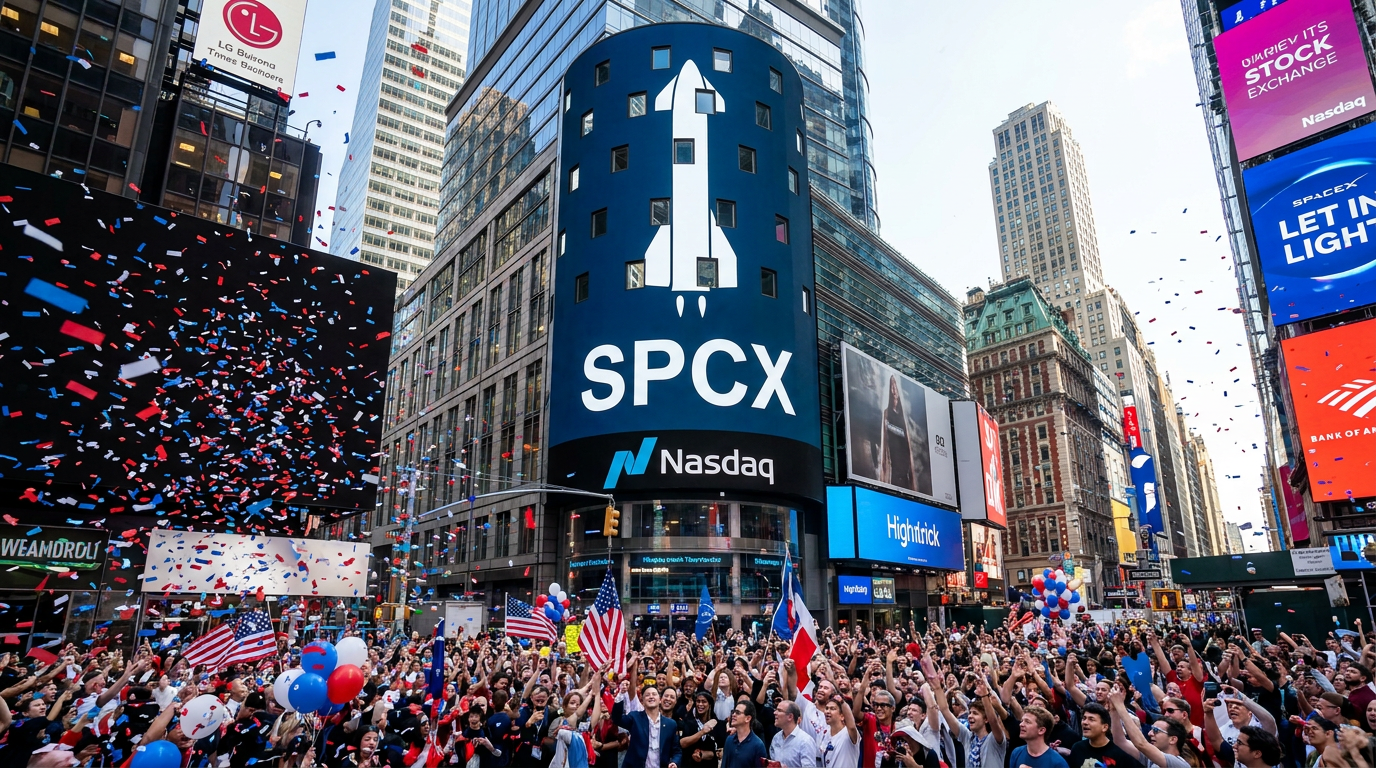
Following a historic initial public offering, SpaceX shares have surged to propel the aerospace and AI conglomerate's valuation past $2.8 trillion, overtaking Amazon as the fifth-largest public company in the United States.
By Factlen Editorial Team
- Retail Investors
- Viewing SpaceX as a generational wealth opportunity and clamoring for direct exposure to the space economy.
- Institutional Analysts
- Focusing on the mechanics of the tiny public float and the company's long-term path to profitability.
- Aerospace & Tech Sector
- Seeing a paradigm shift in market leadership from software to hard tech and physical infrastructure.
What's not represented
- · Amazon Shareholders
- · Traditional Aerospace Competitors
Why this matters
This milestone signals a massive shift in market leadership from traditional e-commerce to hard tech and space infrastructure, opening new avenues for retail and institutional investors to participate in the commercial space economy.
Key points
- SpaceX's valuation surpassed $2.8 trillion, overtaking Amazon as the fifth-largest U.S. company.
- The stock surged past $211 in pre-market trading, driven by high demand and a limited 4.9% share float.
- The historic IPO raised a total of $85.7 billion after underwriters fully exercised the greenshoe option.
- Trading volume for SpaceX shares eclipsed the combined pre-market volumes of Nvidia, Microsoft, Tesla, and Apple.
- The soaring valuation officially made CEO Elon Musk the world's first trillionaire.
SpaceX has officially eclipsed Amazon to become the fifth-largest publicly traded company in the United States, capping off a historic initial public offering that has rapidly reshaped the upper echelons of the stock market. In early Tuesday trading, shares of the aerospace and artificial intelligence conglomerate surged past $211, pushing its implied market capitalization to roughly $2.84 trillion and edging out the e-commerce giant's $2.66 trillion valuation.[1][2]
The milestone comes just four days after SpaceX executed the largest public market debut in history. Initially pricing its shares at $135 to raise $75 billion, the company saw overwhelming global demand that prompted underwriters to exercise their greenshoe option in full, bringing the total capital raised to a staggering $85.7 billion.[4][6]
The stock's ascent has been nothing short of meteoric. After jumping 19% on its first day of trading to close near $161, the rally continued unabated through Monday and into Tuesday's pre-market session. The surge has been fueled by a potent combination of intense retail investor enthusiasm, forced passive buying from index-tracking funds, and an extremely limited supply of available shares.[1][3]

Scarcity is playing a central role in the stock's rapid appreciation. SpaceX floated less than 5% of its total outstanding shares during the IPO, creating a massive supply-demand mismatch. With such a thin free float, the heavy influx of retail buy orders—which accounted for more than half of all U.S. retail trading on the day of the debut—has driven the price up at an unprecedented clip.[1][5]
Scarcity is playing a central role in the stock's rapid appreciation.
The trading volume itself has been historic. On Tuesday morning, more than $1.16 billion worth of SpaceX shares exchanged hands before the opening bell, a figure that eclipsed the combined pre-market trading volumes of tech heavyweights Nvidia, Microsoft, Tesla, and Apple. This level of liquidity for a newly listed company underscores the market's voracious appetite for exposure to the commercial space economy.[2][5]
Beyond rockets and satellite internet, investors are heavily pricing in SpaceX's expanding footprint in artificial intelligence. Following its February 2026 acquisition of Elon Musk's AI startup xAI, the company absorbed the Grok large language model and a massive wholesale AI compute business. This pivot has positioned SpaceX not just as an aerospace contractor, but as a foundational infrastructure provider for the next generation of orbital data centers and AI development.[4][6]

The IPO's success has also triggered a massive wealth generation event. The soaring valuation officially minted CEO Elon Musk as the world's first trillionaire, given his roughly 50% stake in the company. Furthermore, the public listing has turned thousands of current and former SpaceX employees into millionaires, unlocking vast amounts of equity that had been tied up during the company's two decades as a private entity.[3][6]
Despite the market euphoria, some analysts point to the company's ambitious cash burn. SpaceX remains unprofitable, having lost $4.9 billion in 2025 as it heavily reinvests in Starship development, Starlink expansion, and its new AI data centers. At its current spending pace, the record-breaking $85.7 billion raised could be deployed within a few years, though supporters argue the capital is necessary to capture an estimated $28.5 trillion total addressable market across the space and AI sectors.[6]

Looking ahead, the stock's trajectory will likely face its next major test as lock-up periods expire. The first wave of insider shares—representing about 20% of the company's equity—will become eligible for sale in mid-August, followed by rolling releases through the fall. Until then, with its fast-tracked inclusion into major indices like the Nasdaq 100 on the horizon, SpaceX's tight float and high demand are expected to keep the stock highly dynamic as it cements its new position among the world's most valuable corporations.[1][5]
How we got here
February 2026
SpaceX acquires Elon Musk's artificial intelligence startup, xAI.
June 12, 2026
SpaceX executes the largest IPO in history, pricing shares at $135 and raising an initial $75 billion.
June 15, 2026
Underwriters exercise the greenshoe option, bringing total capital raised to $85.7 billion as the stock surges 19%.
June 16, 2026
Pre-market trading pushes the stock past $211, propelling SpaceX's valuation over $2.8 trillion to overtake Amazon.
Viewpoints in depth
Retail Investors
Viewing SpaceX as a generational wealth opportunity.
Retail buyers have flooded the market, accounting for over half of all U.S. retail buy orders on the IPO's first day. For this camp, the stock represents a rare chance to gain direct exposure to the commercial space economy, satellite internet, and Elon Musk's broader AI ambitions, driving intense demand despite the premium valuation.
Institutional Analysts
Focusing on the mechanics of the float and long-term profitability.
Wall Street professionals emphasize that the stock's meteoric rise is heavily influenced by its tiny 4.9% public float, which exaggerates price movements. While acknowledging the company's massive total addressable market, they caution that SpaceX's $4.9 billion annual cash burn and upcoming insider lock-up expirations in August could introduce significant volatility.
Aerospace & Tech Sector
Seeing a paradigm shift in market leadership.
Industry observers view SpaceX surpassing Amazon as a symbolic passing of the torch from e-commerce and software to hard tech and physical infrastructure. They argue that the successful integration of xAI and the push for orbital data centers justifies the valuation, positioning the company as the foundational layer for the next era of technological expansion.
What we don't know
- How the stock price will react when the first wave of insider lock-up periods expires in August.
- Whether SpaceX can achieve profitability in the near term given its massive capital expenditures on Starship and AI infrastructure.
Key terms
- Initial Public Offering (IPO)
- The process of offering shares of a private corporation to the public in a new stock issuance.
- Market Capitalization
- The total value of a publicly traded company's outstanding shares, calculated by multiplying the share price by the number of shares.
- Free Float
- The portion of a company's shares that are in the hands of public investors and available to be traded on the open market.
- Greenshoe Option
- A provision that allows underwriters to sell more shares than originally planned if demand for a new stock issue is higher than expected.
Frequently asked
How much did SpaceX raise in its IPO?
SpaceX raised a record-breaking $85.7 billion after underwriters exercised their option to sell additional shares.
Why did the stock price jump so quickly?
The surge is driven by massive retail demand chasing a very small supply of available shares, as only about 4.9% of the company's stock was made public.
Is SpaceX currently profitable?
No, the company is operating at a loss, having spent heavily on Starship development, Starlink expansion, and artificial intelligence infrastructure.
Sources
Source coverage
6 outlets
3 viewpoints surfaced






[1]MarketWatchRetail Investors
Overnight price spike sees SpaceX overtake Amazon as America’s fifth-largest company
Read on MarketWatch →[2]ReutersInstitutional Analysts
SpaceX set to surpass Amazon's market cap as post-IPO rally continues
Read on Reuters →[3]The GuardianAerospace & Tech Sector
SpaceX makes largest ever stock market debut, making Elon Musk world's first trillionaire
Read on The Guardian →[4]Tech Funding NewsAerospace & Tech Sector
SpaceX raises record $85.7B in historic IPO as Musk bets on reusable rockets, Starlink, and orbital AI data centres
Read on Tech Funding News →[5]TNWRetail Investors
SpaceX overtakes Amazon as its post-IPO rally rolls on
Read on TNW →[6]TechweezInstitutional Analysts
SpaceX Debuts at $2.1 Trillion Valuation in Largest IPO Ever
Read on Techweez →

Every angle. Every day.
Get finance stories with full source coverage and perspective breakdowns delivered to your inbox.