
The "Sim-to-Wrench" Pipeline: How Virtual Reality is Transforming Vocational Training
As the skilled trades face a massive labor shortage, vocational schools and employers are turning to immersive VR simulations to train the next generation of technicians faster and safer.
By Factlen Editorial Team
- Vocational Educators
- Argue that VR democratizes access to high-quality training by removing the bottleneck of expensive physical equipment.
- EdTech Developers
- Focus on the scalability and data-driven nature of immersive learning, emphasizing AI-tracked metrics and gamified engagement.
- Industry Analysts & Tradespeople
- Maintain that while VR is an excellent tool for teaching theory, true mastery requires physical muscle memory and tactile feedback.
What's not represented
- · Students currently enrolled in VR programs
- · Small business contractors hiring VR-trained apprentices
Why this matters
The global economy is facing a critical deficit of skilled tradespeople required to build and maintain modern infrastructure. VR training accelerates the time it takes to get a novice job-ready, drastically reducing material costs and safety risks while appealing to a tech-native generation.
Key points
- The U.S. faces a shortage of over 500,000 skilled trades professionals annually.
- Virtual reality is being used to accelerate training for HVAC, electrical, welding, and advanced manufacturing roles.
- VR simulations allow students to practice dangerous or expensive tasks with zero physical risk and zero material cost.
- Platforms like Interplay Learning and Transfr report significantly higher learning retention compared to traditional web-based resources.
- While VR teaches cognitive steps and safety protocols, educators emphasize it supplements rather than replaces physical hands-on experience.
The global economy is facing a demographic cliff in the skilled trades. As a generation of master electricians, plumbers, and HVAC technicians retires, industries are scrambling to fill the void. In the United States alone, estimates suggest that 546,000 new trades professionals are needed annually just to keep pace with demand and infrastructure growth. Traditional vocational training—reliant on physical apprenticeships, expensive raw materials, and limited instructor bandwidth—is struggling to scale fast enough to meet this crisis. The bottleneck is not a lack of interest, but the sheer logistical friction of teaching complex, dangerous skills in a physical classroom.[5]
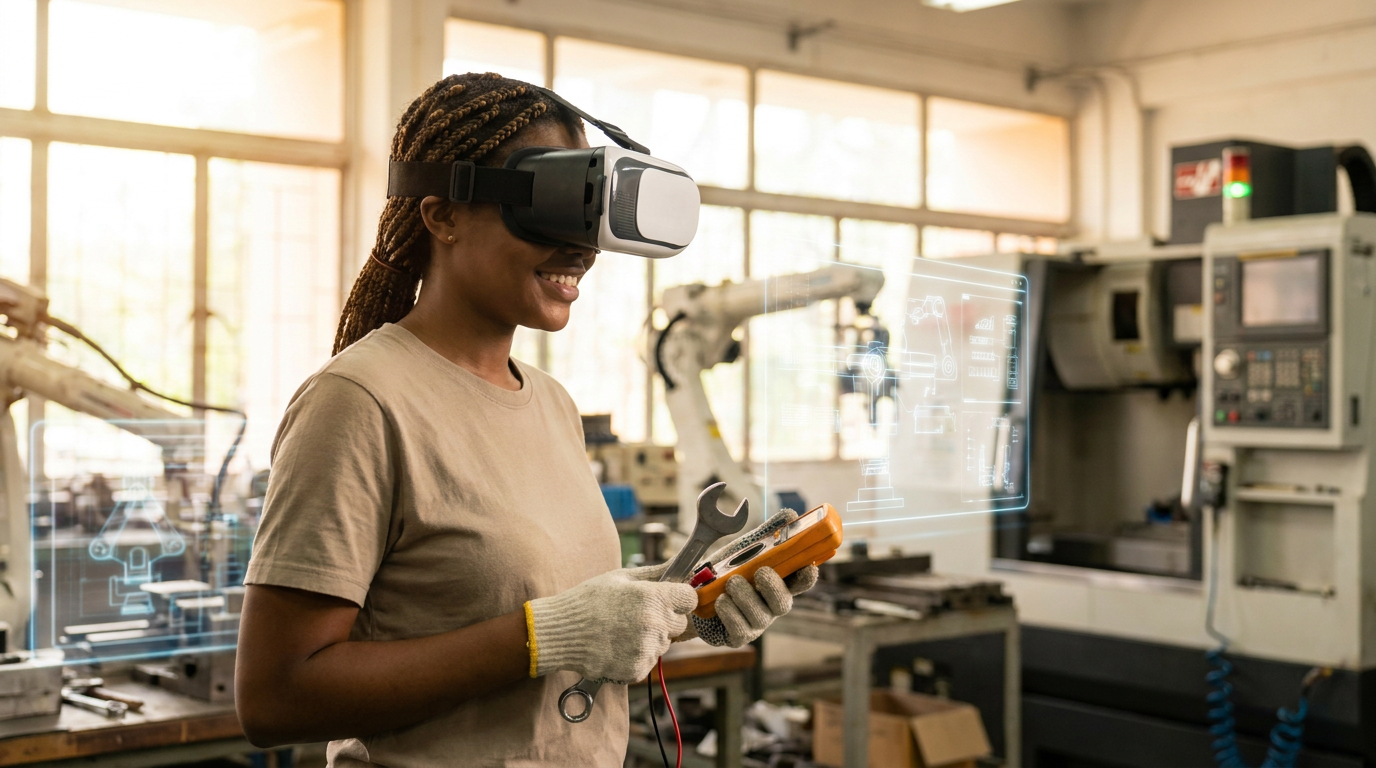
Enter the "sim-to-wrench" pipeline. Across community colleges, trade schools, and corporate training centers, virtual reality (VR) is fundamentally transforming how vocational skills are taught. By donning standalone headsets, students are stepping into immersive, 3D simulations where they can wire electrical panels, diagnose industrial air conditioning units, and operate heavy machinery without ever leaving the classroom. This digital-first approach allows institutions to onboard hundreds of students simultaneously, bypassing the traditional constraints of limited physical lab space and scarce training equipment.[3][8]
The primary appeal of VR in the trades is rooted in safety and repetition. In a traditional welding class, a novice might burn through hundreds of dollars of scrap metal and shielding gas just to learn basic bead control, all while exposed to intense heat and UV radiation. In a VR environment, that same student can practice a weld fifty times in a row, receiving instant, AI-driven feedback on their torch angle, travel speed, and distance. This zero-risk repetition builds cognitive muscle memory at zero marginal cost.[6]

Companies like Interplay Learning and Transfr are leading this educational shift. Interplay Learning, based in Austin, Texas, has built a massive library of skilled trades simulations, training nearly 600,000 individuals to date. Their platform allows a learner to walk up to a virtual rooftop HVAC unit, use digital multimeters to test voltage, and swap out faulty capacitors. If the student makes a catastrophic error—like failing to lock out the power supply—the simulation simply resets, rather than resulting in a lethal shock or a destroyed piece of equipment.[4][5]
Transfr, another major player in the space, recently launched an expanded suite of XR-based career training programs. Their "Transfr Train" system features over 330 VR simulations covering everything from workplace safety and material handling to advanced manufacturing and automotive repair. Early data indicates that this immersive approach is highly effective; students using Transfr simulations demonstrated 68% higher learning retention compared to those using traditional web-based resources, and reported being significantly less distracted during lessons.[1][2]

Transfr, another major player in the space, recently launched an expanded suite of XR-based career training programs.
Beyond basic trades, VR is becoming crucial for advanced manufacturing and the emerging "green collar" economy. As the world transitions to renewable energy, there is a desperate need for wind turbine technicians, solar installers, and electric vehicle battery specialists. Training for these roles often involves working at extreme heights or with high-voltage direct current. VR allows trainees to build cognitive muscle memory for these high-stakes environments before they ever set foot on a 300-foot wind tower or open a live battery array.[2][4]
In Michigan, educational initiatives are pushing this technology even further down the pipeline. The Michigan Virtual pilot program is deploying VR headsets to high schools, allowing teenagers to experience a "day in the life" of a surgeon, an electrician, or a fiber-optic cable installer. This early exposure is critical for destigmatizing vocational careers and showing Gen Z that the modern trades are highly technical, lucrative, and essential, sparking curiosity long before graduation.[7]
The gamification of learning is a subtle but powerful factor in VR's success. For a generation raised on interactive digital environments, the transition to VR vocational training feels intuitive. Earning digital badges for completing a complex diagnostic scenario taps into the same psychological reward systems as video games, keeping learners engaged and motivated through difficult technical material. It transforms studying from a passive reading exercise into an active, problem-solving challenge.[1][2]

However, educators and industry veterans are quick to point out that VR is a supplement, not a total replacement, for physical training. The metaverse cannot replicate the exact tactile resistance of a cross-threaded bolt, the physical exhaustion of working in a 120-degree attic, or the nuanced smell of an electrical short. The goal of VR is to accelerate the cognitive phase of learning—teaching the "what" and the "why"—so that when a student finally picks up a physical wrench, they are already familiar with the process and safety protocols.[8]
As hardware becomes lighter, cheaper, and more powerful, the integration of immersive technology into vocational education will only deepen. Augmented reality (AR)—where digital instructions, thermal imaging, and schematics are overlaid onto physical equipment via smart glasses—is the next frontier. This promises to guide apprentices in real-time on actual job sites, bridging the gap between the classroom and independent fieldwork.[6]
Ultimately, the integration of immersive technology into the trades represents a rare win-win for the labor market. It lowers the barrier to entry for students, reduces training costs and liability for employers, and accelerates the deployment of the skilled workforce required to build and maintain the infrastructure of the 21st century. The sim-to-wrench pipeline is proving that the fastest way to master the physical world might just be to start in the virtual one.[9]
How we got here
2016
Interplay Learning is founded, pioneering early 3D and VR simulations for the skilled trades.
2017
Transfr is established, focusing on workforce development and career exploration via immersive technology.
2024
Major trade organizations begin partnering with VR platforms to offer official certification exams within virtual environments.
2025
Transfr launches "Transfr Train," expanding its library to over 330 VR simulations across multiple high-growth sectors.
2026
VR adoption reaches critical mass in community colleges and enterprise training programs to combat the escalating skilled labor shortage.
Viewpoints in depth
Vocational Educators
Educators view VR as a democratizing tool that removes the bottleneck of expensive physical lab space.
For trade schools and community colleges, the primary constraint on enrollment is physical space and equipment. A school can only safely fit so many students around a live electrical panel or a running HVAC unit. Educators argue that VR shatters this bottleneck, allowing an entire classroom to practice complex diagnostics simultaneously. Furthermore, it provides a safe sandbox where students can make catastrophic mistakes—like failing to lock out a power supply—without risking injury or destroying expensive machinery.
EdTech Developers
Technology companies emphasize the scalability, gamification, and data-driven feedback of immersive learning.
Developers behind platforms like Transfr and Interplay Learning point to the objective data VR provides. In a traditional classroom, an instructor cannot watch every student's hands simultaneously. In a VR simulation, the software tracks exact tool placement, sequence of operations, and reaction times, providing personalized, AI-driven feedback. Developers also highlight the gamification aspect: by awarding digital badges and framing diagnostics as interactive puzzles, VR appeals directly to the learning styles of a tech-native generation.
Traditional Tradespeople
Industry veterans caution that virtual simulations cannot fully replicate the physical realities of a job site.
While acknowledging the benefits of learning theory and safety in a headset, veteran tradespeople maintain that true mastery requires physical muscle memory. The metaverse cannot simulate the tactile resistance of a rusted bolt, the physical exhaustion of working in a cramped, 120-degree attic, or the nuanced smell of an electrical short. They view VR as an excellent "pre-apprenticeship" tool that accelerates the cognitive phase of learning, but insist that the final, most crucial phase of training must always happen with a physical wrench in hand.
What we don't know
- How quickly augmented reality (AR) smart glasses will replace fully enclosed VR headsets on actual physical job sites.
- Whether the long-term retention of physical muscle memory matches the cognitive retention gained from virtual simulations.
- How smaller, independent trade schools will afford the ongoing software subscription costs as the technology becomes the industry standard.
Key terms
- Immersive Learning
- Educational techniques that use technologies like virtual reality to simulate real-world environments and scenarios.
- Haptic Feedback
- Technology that simulates the sense of touch by applying forces, vibrations, or motions to the user, mimicking the feel of physical tools.
- Digital Badging
- A validated indicator of accomplishment, skill, or quality that can be earned in virtual environments and shared with employers.
- Lockout/Tagout (LOTO)
- A critical safety procedure used in industry to ensure that dangerous machines are properly shut off and not able to be started up again prior to the completion of maintenance.
Frequently asked
Does virtual reality replace hands-on physical training?
No. VR is designed to supplement physical training by teaching cognitive steps, safety protocols, and diagnostic theory before a student touches real equipment.
Which trades are currently using VR training the most?
HVAC, electrical, plumbing, welding, and advanced manufacturing are the earliest and most aggressive adopters of VR technology.
How does VR save money for trade schools?
It drastically reduces the consumption of expensive raw materials (like scrap metal and welding gas) and prevents costly damage to physical training equipment caused by novice mistakes.
Can VR training lead to official certifications?
Yes. Many VR platforms map their curriculum to recognized industry standards, such as OSHA safety protocols and EPA certifications, allowing students to earn credentials.
Sources
Source coverage
9 outlets
3 viewpoints surfaced









[1]PR NewswireEdTech Developers
Transfr Launches XR-Based, Multimodal Programs and New Platform Capabilities
Read on PR Newswire →[2]EdTech Innovation HubEdTech Developers
Transfr launches XR-based career exploration platform
Read on EdTech Innovation Hub →[3]HumuloIndustry Analysts & Tradespeople
Quick Comparison: 8 Enterprise VR Training Providers
Read on Humulo →[4]Startup IntrosEdTech Developers
Interplay Learning: Immersive VR training simulations for skilled trades
Read on Startup Intros →[5]SkillCatIndustry Analysts & Tradespeople
Interplay Learning Review: VR HVAC Training
Read on SkillCat →[6]SimbottEdTech Developers
11 Benefits of Virtual Reality In Vocational Training
Read on Simbott →[7]Michigan VirtualVocational Educators
Revolutionize Career Exploration with VR: Transfr Pilot
Read on Michigan Virtual →[8]Vocational Training InstituteVocational Educators
Technology's Role in Modern HVAC Training
Read on Vocational Training Institute →[9]Factlen Editorial TeamIndustry Analysts & Tradespeople
Synthesis by Factlen editorial team
Read on Factlen Editorial Team →



Every angle. Every day.
Get education stories with full source coverage and perspective breakdowns delivered to your inbox.