
Bilingual Brains Rely on a Single 'Grammatical Engine' for All Languages, Study Finds
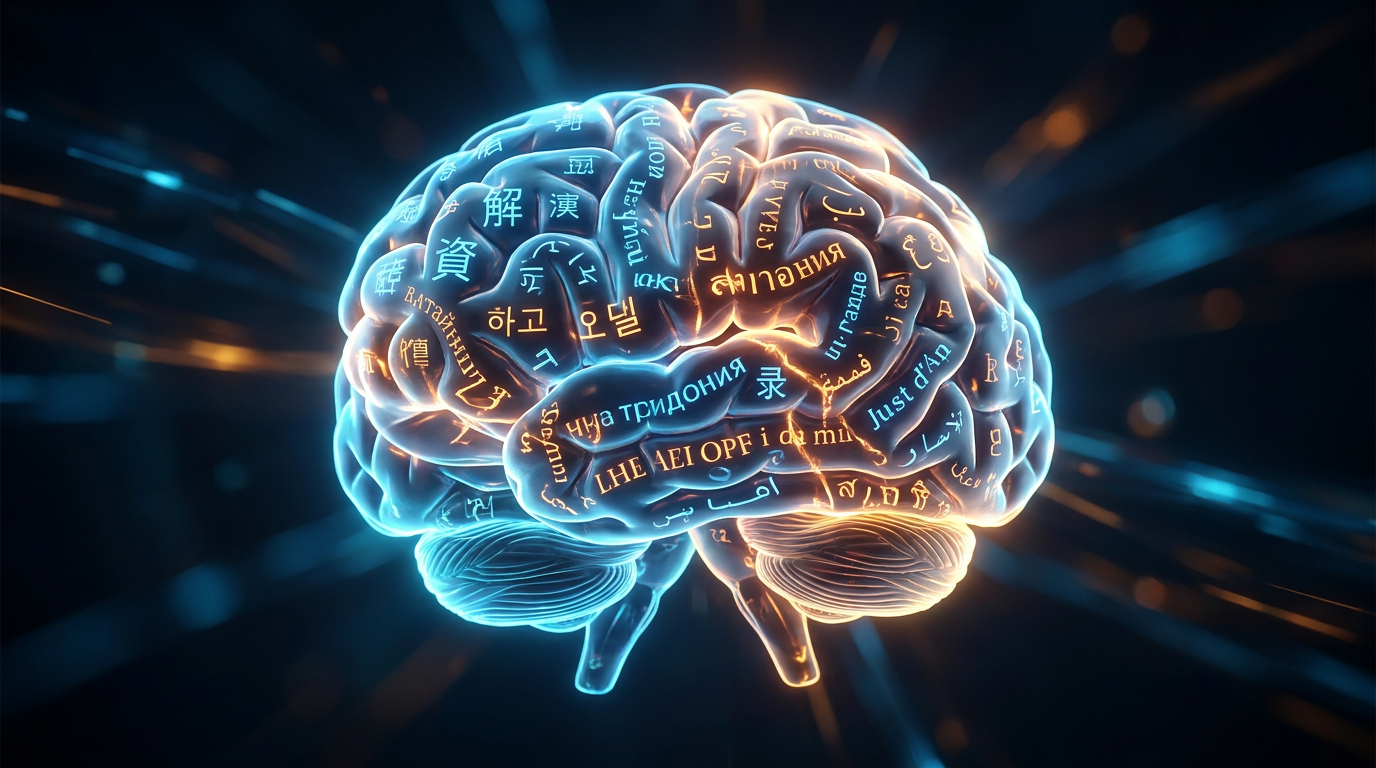
A new neuroimaging study reveals that bilingual individuals do not possess separate grammatical rulebooks for each language, but instead use a single, shared neural mechanism. The discovery fundamentally reshapes our understanding of language acquisition and cognitive efficiency.
By Factlen Editorial Team
- Cognitive Neuroscientists
- Focus on the architectural efficiency and adaptability of the human brain.
- Language Educators
- Focus on the practical implications for teaching and acquiring new languages.
- Clinical Neurologists
- Focus on therapeutic applications for brain injuries and developmental disorders.
What's not represented
- · Bilingual individuals with aphasia
- · Linguists studying non-Indo-European language pairs
Why this matters
Understanding that the brain uses a universal template for grammar explains why learning third or fourth languages is easier, and opens new pathways for treating speech loss (aphasia) in stroke patients by rehabilitating a single, shared neural network.
Key points
- Bilingual individuals use a single, shared neural mechanism to process grammar across all the languages they speak.
- NYU researchers used millisecond-by-millisecond MEG scans to track brain activity during grammatical transformations.
- The brain successfully applied grammar rules to completely fabricated 'pseudowords,' proving the mechanism is an abstract, reusable computation.
- The findings suggest that learning subsequent languages is easier because the brain reuses its existing grammatical template.
It is a nearly universal experience among bilingual individuals: the occasional, momentary slip where the grammatical rules of one language bleed into another. A native Spanish speaker conversing in English might accidentally say "I have 20 years" instead of "I am 20," applying a Spanish structural rule to English vocabulary. For decades, cognitive scientists have debated whether these linguistic mashups are evidence of two separate, competing language systems in the brain, or symptoms of a single system juggling multiple inputs.[1][6]
A landmark study published this week in the Journal of Neuroscience has definitively answered that question, fundamentally redrawing our understanding of human cognition. Researchers from New York University have demonstrated that bilingualism is not powered by separate, language-specific grammar engines. Instead, the brain relies on a single, shared neural mechanism—a universal grammatical engine—that works seamlessly across multiple languages.[2][3][4]
"Our research suggests that brains have a single grammatical engine that fuels all of the languages we speak—rather than separate engines for each one," explained Esti Blanco-Elorrieta, the senior author of the study and an assistant professor of psychology and neural science at NYU. The findings indicate that human language is built from abstract neural computations that transcend any single tongue, shifting the scientific consensus away from models that assumed the brain constructs independent frameworks for every language learned.[3][7]
Proving the existence of this shared engine required capturing the lightning-fast speed of human speech processing. Because grammatical calculations happen in a fraction of a second, standard functional MRI scans are simply too slow to catch the cognitive assembly line in action. To bypass this limitation, the research team utilized magnetoencephalography (MEG), an advanced neuroimaging tool that maps the exact, microscopic magnetic fields produced by the brain's electrical activity.[3][4]

This high-resolution imaging allowed the scientists to track brain activity millisecond-by-millisecond. The researchers recruited fluent Spanish-English bilinguals and subjected them to a morphological stress test. Participants were asked to instantly transform singular nouns into their correct grammatical plural forms across both languages—shifting the English word "boat" to "boats," and the Spanish word "barco" to "barcos".[2][4][8]
The empirical tracking data unmasked an identical, language-transcendent neural template firing across both tongues. The exact same network of brain areas activated to adjust the words to their grammatical context, regardless of whether the participant was speaking English or Spanish. The brain, it appears, executes grammar as a highly reusable, universal computational loop rather than deploying multiple language-specific rulebooks.[3][4][8]
However, the researchers faced a critical methodological hurdle: how could they be certain the brain was actively calculating a grammatical rule, rather than simply pulling a pre-memorized plural word from a mental dictionary? If the brain was just retrieving the whole word "boats" from memory, the MEG scan would be measuring vocabulary recall, not grammatical computation.[4][6]
To isolate the grammatical engine, the investigators introduced a clever control: completely fabricated "pseudowords". Participants were asked to apply pluralization rules to made-up terms they had never encountered before, such as the nonsense word "paple". Because these words did not exist in any language, the participants could not possibly have them stored in their memory banks.[3][4][8]

To isolate the grammatical engine, the investigators introduced a clever control: completely fabricated "pseudowords".
The results of the pseudoword test were definitive. Even when manipulating these fabricated lexical items, the bilingual speakers' brains engaged the exact same neural circuitry previously detected during real language use. The brain instantly stamped its abstract grammatical formula onto the novel words, proving that the neural mechanism is an active, reusable computation that can be applied to any new vocabulary.[4][7]
This discovery effectively dismantles the "dual-engine myth" that has long permeated popular understandings of bilingualism. The occasional grammatical slip-ups experienced by multilingual speakers are not caused by two separate grammar engines colliding in the brain. Rather, they occur precisely because the brain uses a single, unified system to handle every language, causing rules to occasionally overlap within the same computational loop.[4][6]
The NYU findings align perfectly with a broader shift in how neuroscientists view bilingual cognition. Earlier in 2026, a separate study from UC Berkeley utilized functional MRI to prove that bilinguals also use a shared semantic system to understand the meaning of words, resolving a decades-old debate about cross-language interference. Together, these studies paint a picture of a highly efficient brain that consolidates both meaning and structure into unified networks.[6][7]
Beyond theoretical neuroscience, the confirmation of a single grammatical engine carries profound implications for language education. The findings provide a biological explanation for why learning a third or fourth language is often significantly easier than learning a second. Because the core grammatical engine is already established and shared, acquiring subsequent languages does not require the brain to build a new cognitive system from scratch.[4][7][8]

"From the perspective of language learning, if it is true that there is one universal mechanism for language then it follows that it may be easier for you to learn new languages," Blanco-Elorrieta noted. Educators and language developers can leverage this insight, understanding that new language acquisition is primarily a process of feeding new vocabulary into an existing, highly adaptable template.[4][8]
The clinical implications of the research are equally significant, particularly for the treatment of neurotrauma and developmental language disorders. Understanding that bilingual brains employ consolidating neural circuits for grammar could revolutionize therapeutic strategies for patients suffering from aphasia following a stroke or traumatic brain injury.[6][7]
Speech-language pathologists may be able to optimize therapeutic approaches by harnessing the brain's inherent capacity to generalize grammatical processing across languages. If the engine is shared, rehabilitating the grammatical pathways in one language could theoretically accelerate the recovery of a patient's other languages, economizing the cognitive resources required for healing.[6][7]
Highlighting the immediate value of these insights to both cognitive healthspan and educational policy, the research was backed by major federal funding. The project was supported by grants from the National Science Foundation and the National Institutes of Health, underscoring the national interest in deciphering the architecture of human communication.[3][4]
While the study provides the clearest neural evidence to date of shared grammatical computations, mysteries remain. The current research focused exclusively on Spanish and English—two Indo-European languages that share certain structural similarities. Future research will need to determine if this single-engine mechanism operates with the exact same efficiency when a bilingual person speaks languages with vastly different syntactic rules, such as English and Mandarin.[3][6][7]
How we got here
1990s-2010s
Early linguistic models debate whether bilingual brains use separate language-specific networks or a shared system.
2022
Theoretical models propose that bilingual cognition might rely on a single syntactic computational system, challenging the 'monolingual ideal'.
February 2026
A UC Berkeley study finds bilinguals use shared semantic representations to understand the meaning of words across languages.
June 15, 2026
NYU researchers publish definitive MEG tracking data in JNeurosci proving the existence of a single grammatical engine.
Viewpoints in depth
Cognitive Neuroscientists
Focus on the architectural efficiency and adaptability of the human brain.
Neuroscientists emphasize that the brain is fundamentally an energy-saving organ. By proving that human grammar is executed as a highly reusable, universal computational loop, this research highlights the brain's remarkable adaptability. Rather than duplicating complex grammatical systems for each new language, it economizes cognitive resources by repurposing a core set of mechanisms. This challenges decades of models that assumed discrete, language-specific networks.
Language Educators
Focus on the practical implications for teaching and acquiring new languages.
For educators, the single-engine discovery offers an optimistic framework for language acquisition. If the underlying mechanism is universal, learning a third or fourth language becomes significantly less daunting. Instructors can potentially design curricula that explicitly map new vocabulary onto the student's existing grammatical template, accelerating fluency and reducing the cognitive load of learning entirely new syntactic rules.
Clinical Neurologists
Focus on therapeutic applications for brain injuries and developmental disorders.
Clinicians view the shared neural network as a critical pathway for rehabilitation. Understanding that bilingual brains employ consolidating neural circuits for grammar could revolutionize therapeutic strategies for aphasia or stroke recovery. Therapies might be optimized by harnessing the brain's inherent capacity to generalize grammatical processing across a patient's known languages, potentially allowing rehabilitation in one language to cascade benefits to others.
What we don't know
- Whether the single grammatical engine operates with the exact same efficiency when processing two languages with vastly different syntactic structures, such as English and Mandarin.
- How the shared neural network develops over time in individuals who learn a second language late in life compared to those raised bilingual from birth.
Key terms
- Magnetoencephalography (MEG)
- An advanced brain-imaging technique that measures the microscopic magnetic fields produced by electrical activity, allowing scientists to track thought processes millisecond-by-millisecond.
- Pseudoword
- A completely fabricated, meaningless word used in linguistic testing to ensure the brain is applying grammar rules rather than just retrieving memorized terms.
- Morphological adjustment
- The process of changing a word's form to fit a grammatical rule, such as turning a singular noun into a plural.
- Cognate
- Words in different languages that share a similar meaning, spelling, and pronunciation due to common linguistic roots.
Frequently asked
Why do bilingual people sometimes mix up grammar rules?
Because the brain processes all languages through a single grammatical engine, rules from one language can occasionally overlap or interfere with another during real-time speech.
Does this mean learning a third language is easier?
Yes. Researchers believe that because the brain reuses its existing grammatical framework, learning subsequent languages involves feeding new vocabulary into an established template rather than building a new system from scratch.
How did scientists prove the brain wasn't just remembering words?
They asked participants to apply grammar rules to completely made-up 'pseudowords.' Because the words didn't exist, the brain couldn't rely on memory, proving it was actively calculating the grammar.
Sources
Source coverage
8 outlets
3 viewpoints surfaced








[1]The New York TimesLanguage Educators
How Does One Brain Speak Two Languages?
Read on The New York Times →[2]JNeurosciCognitive Neuroscientists
A Shared Neural Mechanism for Abstract Grammatical Computations Across Languages in Bilinguals
Read on JNeurosci →[3]New York UniversityCognitive Neuroscientists
Bilingual Brains Rely on a Single 'Grammatical Engine,' Study Finds
Read on New York University →[4]Neuroscience NewsClinical Neurologists
A Single Grammatical Engine Powers the Bilingual Brain
Read on Neuroscience News →[5]National Science FoundationCognitive Neuroscientists
BCS-Grant 2446452: Neural Mechanisms of Bilingual Grammar
Read on National Science Foundation →[6]Factlen Editorial TeamCognitive Neuroscientists
Synthesis by Factlen editorial team
Read on Factlen Editorial Team →[7]ScienmagLanguage Educators
A Universal Brain Mechanism Underlying Multiple Languages
Read on Scienmag →[8]Society for NeuroscienceCognitive Neuroscientists
A universal brain mechanism for different languages
Read on Society for Neuroscience →
More in health
See all 6 stories →Metabolic Health
The Rise of Over-the-Counter CGMs: How Non-Diabetics Are Tracking Blood Sugar to Optimize Health
0 sources

Vaccine Efficacy
Updated COVID-19 Vaccines Cut Risk of All-Cause Cardiac Events by 24%, Large Study Finds
0 sources
Biomimetic Dentistry
How Biomimetic Dentistry is Regrowing Tooth Enamel Without the Drill
0 sources

Endometriosis Tech
New Saliva and Blood Tests Are Ending the Decade-Long Delay in Endometriosis Diagnosis
0 sources

Every angle. Every day.
Get health stories with full source coverage and perspective breakdowns delivered to your inbox.