
Solid-State EV Batteries Move From Lab to Production Line in 2026
After decades of research, solid-state battery technology is finally reaching commercial viability, promising electric vehicles with 600-mile ranges and five-minute charging times.
By Factlen Editorial Team
- Aggressive Innovators
- Startups and Chinese manufacturers pushing for immediate commercialization in 2026.
- Measured Incumbents
- Legacy automakers prioritizing long-term validation and targeting 2027-2028.
- Industry Pragmatists
- Analysts focusing on the massive hurdles of cost parity and gigawatt-scale manufacturing.
What's not represented
- · Lithium mining communities
- · Independent repair shops
Why this matters
Solid-state batteries eliminate the fire risks of current lithium-ion cells while doubling their energy capacity. For consumers, this means the impending end of EV range anxiety and charging times that rival filling up a gas tank.
Key points
- Solid-state batteries are moving from lab prototypes to commercial production lines in 2026.
- The technology replaces flammable liquid electrolytes with solid materials, eliminating thermal runaway risks.
- Energy density is expected to nearly double, enabling EV ranges of over 600 miles.
- Early adoption is beginning with electric motorcycles and premium vehicles before scaling to mass-market cars by 2028.
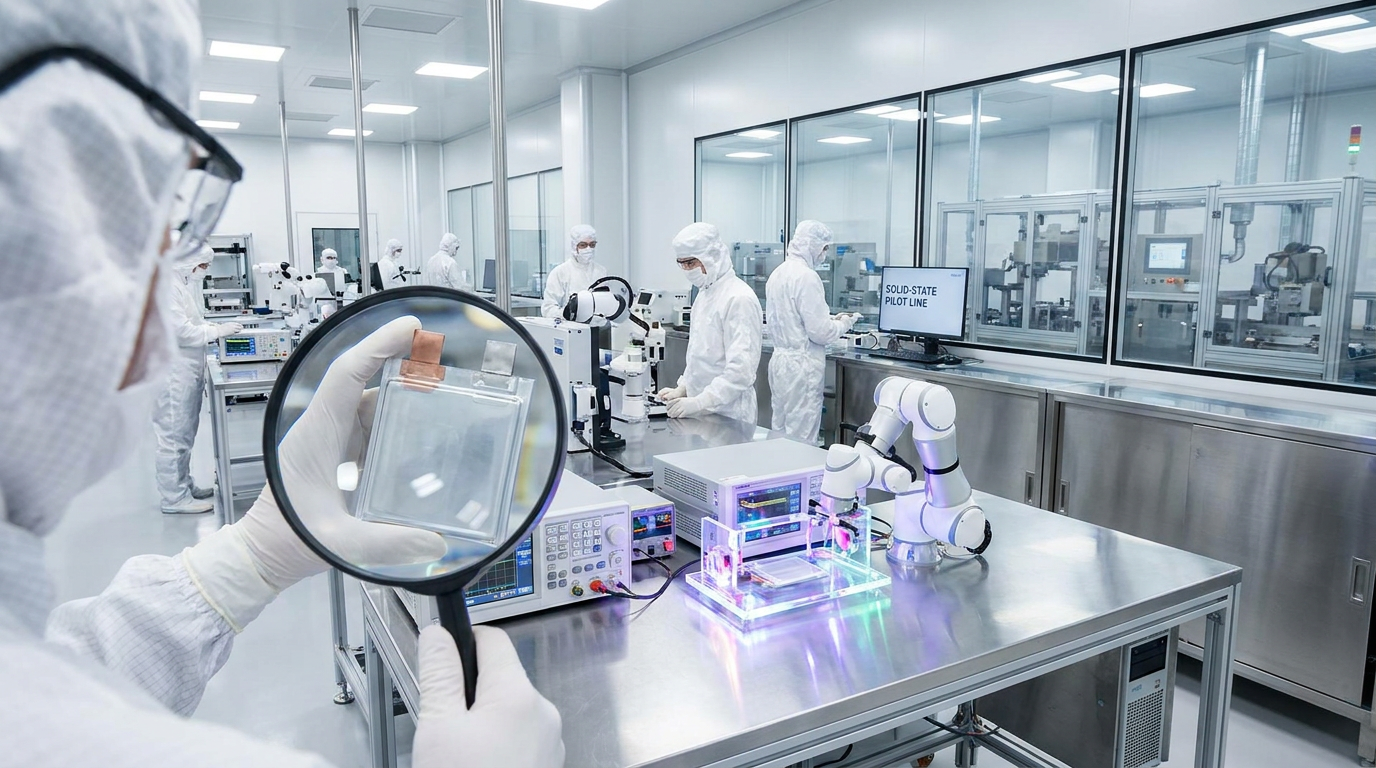
For the better part of a decade, the solid-state battery has been the electric vehicle industry’s white whale—a theoretical marvel perpetually "five years away." But in 2026, the timeline has abruptly collapsed. Across the globe, from Chinese manufacturing hubs to the floor of CES in Las Vegas, solid-state technology is finally crossing the chasm from laboratory experiment to commercial production line.[1][5]
The shift represents arguably the most significant leap in energy storage since the commercialization of the rechargeable lithium-ion cell in the early 1990s. Early versions of these batteries are already appearing in electric motorcycles and specialized industrial equipment, with passenger vehicles slated to follow closely behind. For consumers, the promises are staggering: electric vehicles that can travel over 600 miles on a single charge, recharge in the time it takes to pump a tank of gas, and operate safely without the risk of catastrophic fires.[5][6][8]
The momentum in early 2026 has been undeniable. In April, Greater Bay Technology (GBT), a battery manufacturer backed by China's GAC Group, announced that its first "A-sample" all-solid-state battery cells had successfully rolled off the production line. The company has set an aggressive target to achieve gigawatt-hour-level mass production for in-vehicle use by the end of the year.[2]
Meanwhile, at CES 2026, a company called Donut Lab debuted a solid-state battery that is already being integrated into OEM production vehicles. Their cells will power the 2026 model lineup of Verge Motorcycles, which are scheduled to hit public roads in the first quarter of the year. These milestones indicate that the industry has moved past proving the fundamental chemistry and is now grappling with the realities of manufacturing scale.[1][3][6][7]

To understand why this transition is so consequential, one must look at the fundamental architecture of modern batteries. Traditional lithium-ion batteries rely on a liquid electrolyte—typically a lithium salt dissolved in an organic solvent—to shuttle ions back and forth between the cathode and the anode during charging and discharging.[5][7]
While effective, this liquid electrolyte is inherently flawed. It is highly flammable and sensitive to temperature extremes. Under severe stress, such as overcharging, a high-speed collision, or extreme heat, the liquid can ignite, triggering a dangerous chain reaction known as thermal runaway. This vulnerability has forced automakers to encase EV batteries in heavy, expensive cooling systems and protective armor, adding dead weight to the vehicle.[5][7][8]
Solid-state batteries solve this by replacing the volatile liquid with a stable, non-flammable solid material—usually advanced polymers, oxides, or sulfides. In comparative testing, thermal events in solid-state systems do not begin until temperatures reach approximately 247 degrees Celsius, compared to just 90 degrees for conventional lithium-ion cells. When GBT subjected its new solid-state cells to brutal needle penetration and extrusion tests, the batteries neither caught fire nor exploded.[2][5][7]
But safety is only half the equation; the true prize is energy density. Energy density measures how much power a battery can store relative to its weight, typically expressed in watt-hours per kilogram (Wh/kg). Today’s best liquid lithium-ion batteries top out around 250 to 300 Wh/kg.[5][7]
But safety is only half the equation; the true prize is energy density.
By utilizing a solid electrolyte, engineers can safely swap out the traditional graphite anode for one made of pure lithium metal. In a liquid battery, a lithium metal anode tends to grow microscopic, needle-like structures called dendrites, which can pierce the battery's separator and cause a short circuit. A robust solid electrolyte physically blocks these dendrites from forming.[5][7]

The result is a massive leap in storage capacity. The solid-state cells entering production in 2026 are targeting energy densities between 400 and 500 Wh/kg. Donut Lab claims its production-ready battery delivers exactly 400 Wh/kg, enabling its partner motorcycles to achieve up to 600 kilometers of range on a single charge.[3][5][6][8]
Charging speeds are seeing a similar revolution. Because solid electrolytes are less prone to degradation under high-voltage stress, they can absorb power at astonishing rates. GBT reports that its new organic-inorganic composite electrolyte system enables stable ultra-fast charging, allowing a battery to go from 10 percent to 80 percent capacity in under ten minutes. Donut Lab boasts an even more aggressive metric, claiming a full charge in just five minutes without the need to throttle the charging rate to protect the cell's longevity.[2][3][7]
The race to dominate this new era of electrification has triggered a massive realignment among global automakers. Chinese manufacturers, heavily supported by state investment, are currently setting the pace for near-term commercialization. Alongside GBT, automotive giant Geely is reportedly finalizing a solid-state battery pack that will be installed into a validation vehicle by late 2026.[2][8]
Japan's Toyota, which holds over 1,000 patents related to solid-state technology—the most of any company in the world—is taking a slightly longer view. While Toyota plans to begin small-scale production and vehicle integration in the 2027 to 2028 timeframe, it is utilizing 2026 to finalize its manufacturing processes and validate prototypes that have recently demonstrated a 50 percent increase in driving range.[4][8]

Despite the palpable optimism, significant uncertainties remain as the technology transitions from boutique assembly to global mass production. Building a handful of perfect cells in a pristine laboratory environment is vastly different from churning out millions of units on an automated gigafactory line.[1][5]
Skeptics within the industry caution that terms like "off the production line" can sometimes blur the line between a low-volume pilot run and true commercial scale. Furthermore, the specialized materials required for solid electrolytes—particularly sulfide-based compounds—are currently expensive and difficult to manufacture in bulk, raising questions about when solid-state EVs will reach price parity with their liquid-based predecessors.[5][7][8]
There are also lingering questions about long-term durability in varied climates. While Donut Lab claims a design life of up to 100,000 cycles with minimal capacity fade, real-world automotive environments—with their constant vibrations, extreme winter freezes, and blistering summer heat—will provide the ultimate stress test for these new chemical architectures.[3][7]

Nevertheless, the milestones achieved in 2026 suggest that the solid-state era is no longer a distant mirage. The initial rollout strategy—targeting premium motorcycles, high-end performance vehicles, and commercial fleets—allows manufacturers to absorb the early premium costs while scaling up their supply chains.[5][6]
As production volumes increase and costs inevitably fall, the technology is expected to cascade down to mass-market passenger cars by the end of the decade. For the everyday driver, the implications are profound: the eventual eradication of range anxiety, the normalization of five-minute charging stops, and a fundamental shift in how the world powers its transportation.[1][5][8]
How we got here
1991
Sony commercializes the first rechargeable lithium-ion battery, revolutionizing portable electronics.
2010s
Solid-state batteries remain confined to laboratories due to high costs and manufacturing complexities.
2024
Major breakthroughs in suppressing dendrite growth using advanced polymer and sulfide solid electrolytes.
Early 2026
First A-sample solid-state cells roll off production lines; Verge Motorcycles announces Q1 integration.
Viewpoints in depth
Aggressive Innovators
Startups and Chinese manufacturers pushing for immediate commercialization.
Companies like GBT and Donut Lab argue that the fundamental chemistry is solved and the focus must now shift entirely to gigawatt-hour scaling. They point to successful A-sample cells and early OEM partnerships as proof that solid-state is ready for the mass market today, dismissing concerns about prolonged validation periods.
Measured Incumbents
Legacy automakers prioritizing long-term validation and targeting 2027-2028.
Giants like Toyota acknowledge the massive potential but prioritize rigorous safety and longevity testing over being first to market. They argue that automotive-grade durability requires years of real-world validation across extreme temperatures and vibration profiles, targeting 2027-2028 for mass integration to avoid costly recalls.
Industry Pragmatists
Analysts focusing on the massive hurdles of cost parity and gigawatt-scale manufacturing.
Supply chain analysts and material scientists caution that manufacturing a solid electrolyte at scale remains prohibitively expensive. They argue that while pilot lines are succeeding, achieving the economies of scale necessary to replace cheap liquid lithium-ion batteries in everyday passenger cars is still a decade away.
What we don't know
- When solid-state batteries will reach price parity with traditional lithium-ion cells.
- How the new solid electrolytes will perform over a decade of real-world automotive wear and tear.
- Whether the global supply chain can produce enough specialized sulfide materials to meet mass-market demand.
Key terms
- Solid-State Battery
- A battery that uses a solid material, rather than a liquid, to conduct ions between its electrodes, vastly improving safety and capacity.
- Electrolyte
- The medium inside a battery that allows electrical charge (ions) to flow between the cathode and the anode.
- Energy Density
- The amount of energy a battery can store relative to its weight, typically measured in watt-hours per kilogram (Wh/kg).
- Dendrites
- Microscopic, needle-like metallic structures that can grow inside liquid batteries, potentially causing short circuits and fires.
Frequently asked
When can I buy a car with a solid-state battery?
Early integrations are happening in 2026 for motorcycles and premium vehicles, but mass-market passenger cars from major automakers like Toyota are targeted for 2027-2028.
Are solid-state batteries really fireproof?
They are vastly safer than current batteries. They eliminate the flammable liquid electrolyte, meaning they can withstand much higher temperatures and physical damage without triggering thermal runaway.
How fast do they charge?
Current production-ready models claim they can charge from 10% to 80% in 5 to 10 minutes, rivaling the time it takes to fill a gas tank.
Will they make EVs cheaper?
Not immediately. The initial manufacturing costs for solid electrolytes are high. However, as production scales up over the next decade, they are expected to drive down the overall cost of EVs.
Sources
Source coverage
8 outlets
3 viewpoints surfaced








[1]Factlen Editorial TeamIndustry Pragmatists
Synthesis by Factlen editorial team
Read on Factlen Editorial Team →[2]NE-TimeAggressive Innovators
Greater Bay Technology aims for 2026 mass production of all-solid-state battery
Read on NE-Time →[3]Donut LabAggressive Innovators
Donut Lab Introduces World's First All-Solid-State Battery Ready for OEM Production
Read on Donut Lab →[4]Toyota Global NewsroomMeasured Incumbents
Toyota accelerates solid-state battery development for 2027-2028 rollout
Read on Toyota Global Newsroom →[5]BloombergIndustry Pragmatists
Solid-State Batteries 2026: How the Technology Is Finally Reaching Commercial Use
Read on Bloomberg →[6]The VergeAggressive Innovators
Verge Motorcycles will put solid-state batteries on the road in Q1 2026
Read on The Verge →[7]IEEE SpectrumIndustry Pragmatists
The Chemistry Behind 2026's Solid-State Battery Breakthroughs
Read on IEEE Spectrum →[8]ElectrekMeasured Incumbents
Solid-state battery technology: Toyota, Geely, and GAC leading the EV charge
Read on Electrek →
More in technology
See all 5 stories →
Every angle. Every day.
Get technology stories with full source coverage and perspective breakdowns delivered to your inbox.