
How AI Tutors Are Closing the Learning Gap in Public Schools
Purpose-built AI tutors are moving from experimental pilots to proven educational infrastructure, delivering massive learning gains and democratizing one-on-one support for K-12 students.
By Factlen Editorial Team
- EdTech Researchers
- Focuses on rigorous efficacy data, randomized controlled trials, and measurable learning gains.
- Public School Educators
- Values the reduction in administrative burden and the preservation of human mentorship.
- Education Equity Advocates
- Emphasizes the democratization of one-on-one tutoring for under-resourced districts.
What's not represented
- · Students without home internet access
- · Data privacy advocates
Why this matters
For decades, personalized one-on-one tutoring was a luxury reserved for wealthy families, leaving public schools struggling to close the achievement gap. The proven efficacy of AI tutors is democratizing this level of support, offering a scalable, low-cost way to dramatically improve student outcomes while reducing teacher burnout.
Key points
- Recent randomized controlled trials show AI tutors deliver twice the learning gains of traditional active-learning classrooms.
- Purpose-built educational AI uses Socratic dialogue to guide students, refusing to simply hand over answers.
- Teachers using AI tools report saving an average of 5.9 hours per week on administrative tasks and lesson planning.
- At roughly $20 to $44 per student annually, AI platforms are democratizing access to personalized tutoring for under-resourced districts.
For decades, the "two-sigma problem" has haunted public education: students who receive one-on-one tutoring perform two standard deviations better than those in traditional classrooms, but scaling human tutoring to every child was financially impossible. In 2026, that mathematical ceiling is finally breaking. Across K-12 public schools, the deployment of purpose-built artificial intelligence tutors is transforming the classroom experience, moving the technology from a speculative novelty to a proven engine for academic recovery.[6]
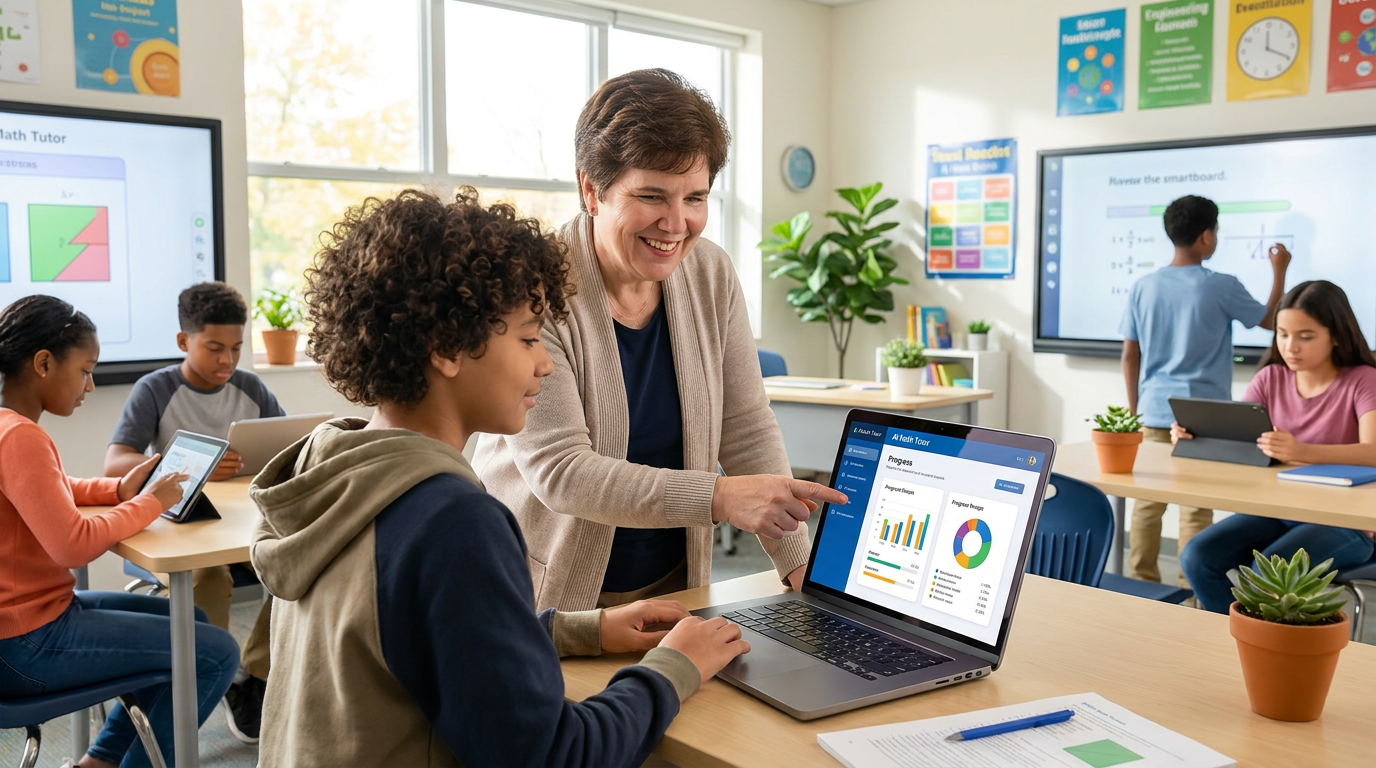
The narrative surrounding AI in education has shifted dramatically over the past two years. While early headlines focused on students using generic chatbots to write essays, the current wave of adoption centers on specialized platforms designed with strict pedagogical guardrails. These systems are not answer keys; they are digital teaching assistants programmed to guide, prompt, and support students through complex problem-solving.[1]
The efficacy data emerging in 2026 provides some of the strongest experimental results in modern education research. A landmark randomized controlled trial published in Scientific Reports found that students using a well-designed AI tutor learned more than twice as much in less time compared to peers in traditional active-learning classrooms. The study recorded an effect size between 0.73 and 1.3 standard deviations, a massive leap in a field where even a 0.2 improvement is considered a success.[5]
The benefits extend beyond independent student work. The Brookings Institution recently analyzed the first randomized controlled trial of a human-AI hybrid system, involving 1,800 K-12 students from historically underserved communities. In this model, human tutors were equipped with an AI "co-pilot" that suggested pedagogical strategies in real time. The AI assistance boosted the effectiveness of lower-rated human tutors by nine percentage points, effectively raising the baseline quality of instruction across the board.[2]

The mechanism driving these gains is rooted in Socratic dialogue. When a student using a platform like Khan Academy's Khanmigo asks for the solution to an algebra equation, the AI refuses to provide it. Instead, it asks the student to identify the first step, gently correcting misconceptions and offering hints only when the student is genuinely stuck. This active friction forces the student to engage with the material rather than passively copying a result.[3][4][6]
Beyond cognitive support, AI tutors offer a profound psychological advantage: infinite patience. In a crowded classroom, students are often embarrassed to raise their hands, fearing they will look foolish in front of their peers if they ask a teacher to explain a concept for the third time. The AI tutor provides a completely non-judgmental environment where a student can make mistakes without social anxiety.[2]
This infinite patience is particularly transformative for students who need foundational review. An AI system can explain a fraction concept ten different ways, adjust its vocabulary to match the student's reading level, and wait as long as necessary for the student to process the information. It never sighs, it never looks at the clock, and it never moves on to the next lesson before the student is ready.[1][6]
This infinite patience is particularly transformative for students who need foundational review.
Another surprise breakthrough has been the technology's impact on English-language learners. During the massive expansion of these tools over the last two school years, educators reported that AI tutors became invaluable translation engines. Because the underlying models are fluent in dozens of languages, a student who recently immigrated can ask a complex physics question in their native language, receive an explanation they understand, and then seamlessly transition back to English terminology.[4]
The scale of this rollout is unprecedented. Khan Academy's AI tutor, Khanmigo, expanded from roughly 68,000 users in partner districts during the 2023-2024 school year to over 700,000 users by the 2024-2025 academic year. The nonprofit now partners with hundreds of school districts across the United States, signaling that administrators view the technology as a core infrastructure investment rather than a temporary pilot program.[4]

Crucially, this technological shift is not replacing human educators; it is actively alleviating the burnout that has plagued the teaching profession. The U.S. Department of Education notes that AI tools are extending instructional capacity without requiring massive staffing increases, while simultaneously providing teachers with powerful new resources for lesson planning and data analysis.[1]
Surveys of K-12 educators in 2026 show that teachers who integrate AI into their weekly routines save an average of nearly six hours per week. These platforms can instantly generate differentiated reading materials for varying lexile levels, draft grading rubrics, and synthesize student performance data to identify exactly which concepts the class struggled with during a morning lesson.[6]
By automating the administrative and preparatory burdens of the job, AI is allowing teachers to reclaim their time for the most critical aspects of their profession. Educators are redirecting those saved hours toward direct human connection—mentoring students, providing emotional support, and facilitating complex, collaborative group projects that require a human touch.[1][6]

From an equity perspective, the democratization of personalized tutoring is a historic milestone. A private human tutor typically costs families between $50 and $100 an hour, a price tag that effectively restricted high-quality academic intervention to wealthy zip codes. In contrast, enterprise AI tutoring platforms cost school districts roughly $20 to $44 per student for an entire year of unlimited access.[2][6]
This collapse in cost means that under-resourced public schools can finally provide the kind of bespoke, one-on-one academic support that was previously out of reach. Students who fall behind in math or reading can now receive immediate, personalized remediation, preventing minor knowledge gaps from compounding into insurmountable academic deficits over the course of a school year.[3]
Despite the overwhelming positive data, the transition is not without friction. The primary hurdle is the digital divide. Schools that lack robust broadband infrastructure or one-to-one device programs cannot fully leverage these AI platforms, threatening to create a new tier of inequality if hardware access is not addressed at the state and federal levels.[6]
Furthermore, the success of these tools depends entirely on intentional implementation. Researchers caution that simply handing students an AI tool without pedagogical guardrails or teacher oversight can lead to over-reliance. The technology is most effective when it is tightly integrated into the curriculum and paired with strong human judgment.[1][2]
As the 2026 school year progresses, the consensus among education researchers is clear: the era of passive learning is ending. By combining the emotional intelligence and mentorship of human teachers with the infinite patience and personalized pacing of AI tutors, public schools are finally building an educational ecosystem where every student has the support they need to succeed.[6]
How we got here
Late 2022
Generative AI models like GPT-4 are first demonstrated to education leaders, sparking early prototyping.
March 2023
Khan Academy launches Khanmigo, one of the first purpose-built AI tutors for K-12 students.
2024-2025 School Year
AI tutor adoption scales massively, with platforms expanding from tens of thousands to hundreds of thousands of users.
Mid 2025
Landmark randomized controlled trials are published, proving that AI tutoring delivers effect sizes exceeding 0.7 standard deviations.
Spring 2026
Districts shift from experimental pilot programs to permanent, district-wide integration of AI co-pilots.
Viewpoints in depth
EdTech Researchers
Focuses on rigorous efficacy data, randomized controlled trials, and measurable learning gains.
For the academic research community, the conversation has moved past theoretical potential and into hard data. Researchers point to recent randomized controlled trials showing effect sizes of up to 1.3 standard deviations—a virtually unheard-of metric in educational interventions. Their primary focus is ensuring that AI tools are designed with strict pedagogical guardrails, emphasizing Socratic dialogue over simple answer generation to guarantee that cognitive friction and critical thinking are preserved.
Public School Educators
Values the reduction in administrative burden and the preservation of human mentorship.
Teachers and administrators view AI not as a replacement for human instruction, but as a vital co-pilot that alleviates systemic burnout. By automating lesson planning, rubric generation, and basic remediation, educators report saving nearly six hours a week. This camp argues that the true value of AI is reclaiming time for the deeply human aspects of teaching: emotional support, behavioral intervention, and facilitating complex collaborative projects.
Education Equity Advocates
Emphasizes the democratization of one-on-one tutoring for under-resourced districts.
Equity advocates highlight the historic cost collapse of personalized tutoring. While private human tutors cost upwards of $50 an hour, AI platforms provide unlimited support for roughly $20 a year per student. However, this camp also raises the alarm about the digital divide, warning that the benefits of AI tutoring will bypass the students who need it most if state and federal governments do not ensure universal access to broadband and modern devices.
What we don't know
- The long-term cognitive effects of relying on AI for foundational learning over a multi-year period.
- How the widening digital divide will impact districts that cannot afford the hardware required to run these platforms.
Key terms
- Socratic dialogue
- A teaching method where the instructor asks a series of guiding questions to lead the student to discover the answer themselves.
- Randomized Controlled Trial (RCT)
- A rigorous scientific study design used to measure the effectiveness of an intervention by comparing a treated group to a control group.
- Effect size
- A statistical concept that measures the magnitude of a difference between two groups, used to gauge how much an educational tool improves learning.
- Active learning
- An instructional approach that engages students in the learning process through problem-solving and discussion, rather than passive listening.
Frequently asked
Will AI tutors replace human teachers?
No. Evidence shows AI is most effective when used as a 'co-pilot' alongside human instruction, freeing teachers from administrative tasks so they can focus on mentorship and complex problem-solving.
Do AI tutors just give students the answers?
Purpose-built educational AI is programmed to use Socratic dialogue. Instead of providing the solution, it asks guiding questions to help students arrive at the answer themselves.
How much does AI tutoring cost school districts?
Enterprise AI tutoring platforms typically cost districts between $20 and $44 per student annually, a fraction of the cost of traditional private human tutoring.
Does AI tutoring help English-language learners?
Yes. Because the underlying AI models are fluent in dozens of languages, they can seamlessly translate complex concepts and provide real-time support in a student's native language.
Sources
Source coverage
6 outlets
3 viewpoints surfaced






[1]U.S. Department of EducationPublic School Educators
Insights from Emerging Research on AI in Education
Read on U.S. Department of Education →[2]Brookings InstitutionEdTech Researchers
Generative AI as tutor: The evidence for effectiveness
Read on Brookings Institution →[3]Khan AcademyEducation Equity Advocates
Multiple Studies Show Khan Academy Drives Learning Gains
Read on Khan Academy →[4]Education WeekPublic School Educators
Rethink 2.0: Developing Khan Academy's AI Tutor
Read on Education Week →[5]Scientific ReportsEdTech Researchers
Efficacy of AI tutoring versus active learning in STEM education
Read on Scientific Reports →[6]Factlen Editorial TeamEducation Equity Advocates
Synthesis by Factlen editorial team
Read on Factlen Editorial Team →

Every angle. Every day.
Get education stories with full source coverage and perspective breakdowns delivered to your inbox.