
SpaceX Nears Amazon's Market Value as Post-IPO Rally Accelerates
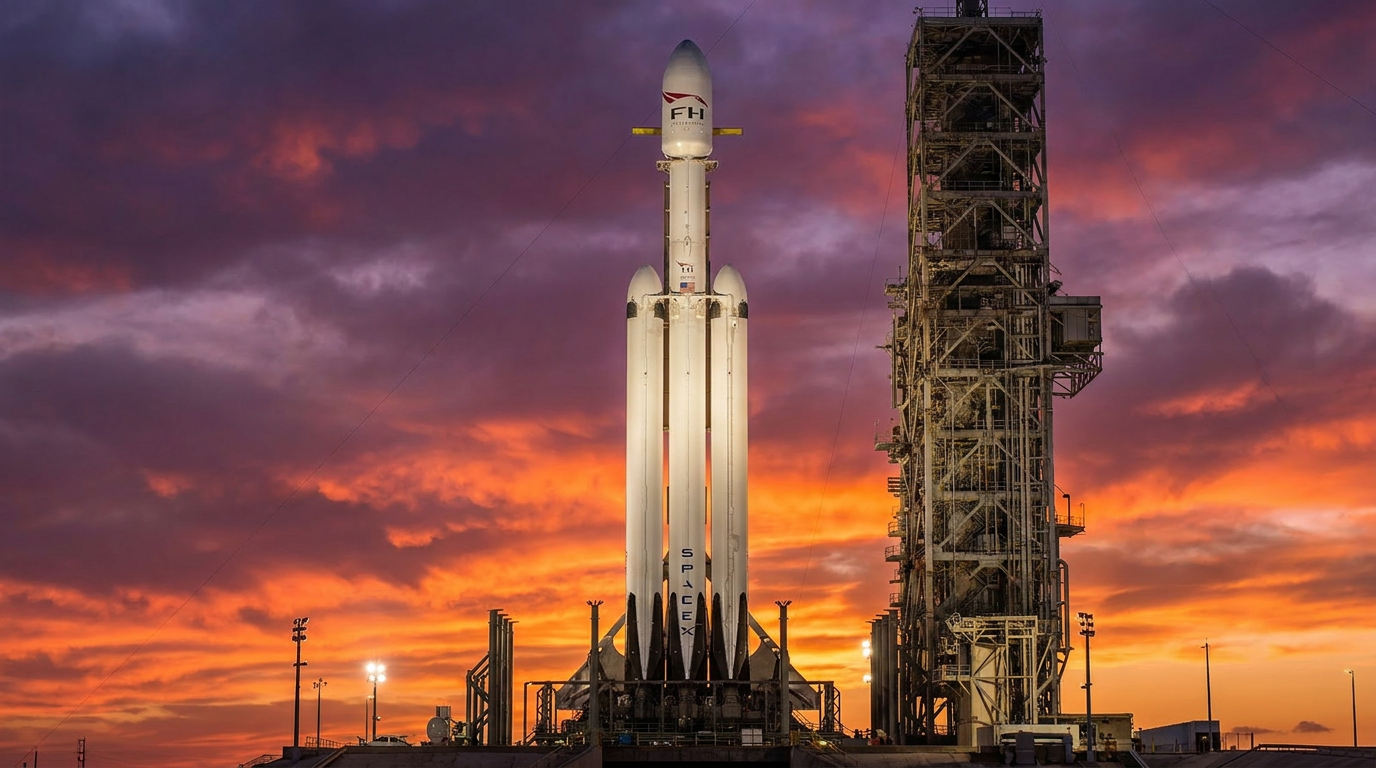
Shares of SpaceX surged another 11% in premarket trading Tuesday, pushing the rocket maker's valuation past $2.5 trillion just days after its historic public debut. The momentum is fueled by retail enthusiasm, index fund inclusion, and Elon Musk's projection of $1 trillion in annual revenue by 2030.
By Factlen Editorial Team
- Momentum Investors
- Retail and growth investors betting on SpaceX's monopoly in space and AI infrastructure.
- Fundamental Analysts
- Institutional skeptics warning of a disconnect between the company's valuation and its current financials.
- Company Leadership
- Executives focused on long-term capital generation to fund interplanetary and AI ambitions.
What's not represented
- · Competitors in the aerospace and defense sectors facing a vastly better-capitalized rival.
- · Regulators monitoring the market concentration of a single company controlling both orbital access and global satellite internet.
Why this matters
SpaceX's explosive public debut is reshaping the hierarchy of the world's most valuable companies, proving that public markets are eager to fund capital-intensive space and AI infrastructure. The rally not only mints a new class of Silicon Valley billionaires but sets a high-stakes precedent for upcoming mega-IPOs in the tech sector.
Key points
- SpaceX shares surged 11% in premarket trading Tuesday, pushing its market cap past $2.5 trillion.
- The company is on track to surpass Amazon as the world's fifth most valuable publicly traded firm.
- CEO Elon Musk projected the company could reach $1 trillion in annual revenue by 2030.
- Wall Street estimates are more conservative, with Morgan Stanley projecting $330 billion by 2030.
- The rally is being driven by retail enthusiasm and forced buying from major index funds.
- SpaceX reported $18.67 billion in revenue in 2025 but operated at a net loss of $4.94 billion.
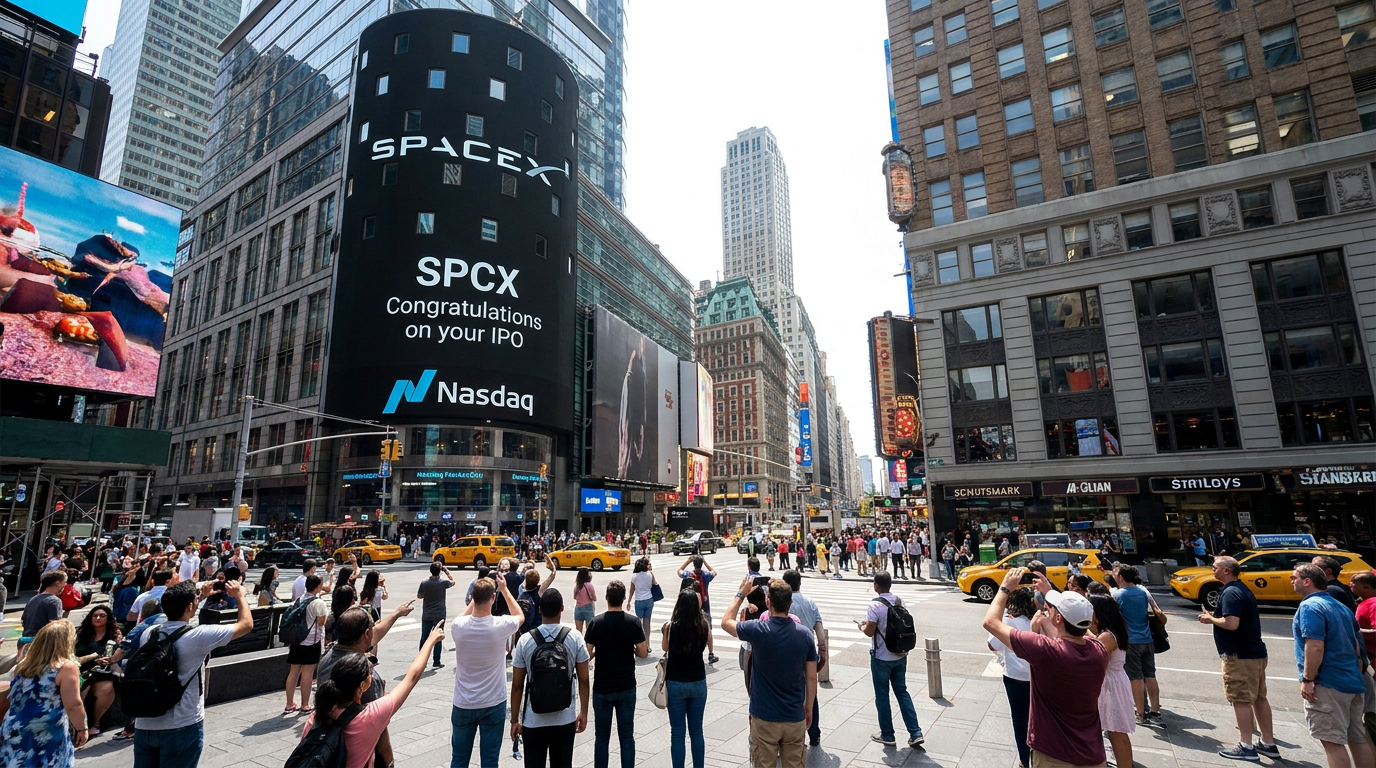
SpaceX's historic public debut has ignited a Wall Street frenzy, with shares surging another 11% in premarket trading on Tuesday. The rally extends a dramatic post-IPO climb that has pushed the rocket manufacturer's market capitalization past $2.5 trillion, placing it on a collision course to overtake Amazon as the world's fifth most valuable company. The surge follows a blockbuster opening on Friday, where SpaceX priced its initial public offering at $135 per share, raising an unprecedented $75 billion. By Monday's close, the stock had surged nearly 20% to $192.46, adding over $412 billion in market value in a single trading session.[1][2][3]
The sheer scale of the offering—and the market's voracious appetite for it—has assuaged early fears that public markets might struggle to absorb such a massive liquidity event. Instead, the debut has triggered a wave of retail enthusiasm and rapid institutional repositioning. A significant driver of the current momentum is the forced buying from passive index funds. Major index providers, including Nasdaq and FTSE Russell, have implemented fast-track inclusion rules for SpaceX, meaning trillions of dollars in global exchange-traded funds must purchase the stock on the open market within the next two weeks, creating a structural tailwind for the share price.[6]
Beyond market mechanics, the rally is being fueled by soaring revenue projections from the company's leadership that paint a picture of unprecedented corporate growth. Over the weekend, CEO Elon Musk posted on his social media platform X that he expects SpaceX to reach approximately $1 trillion in annual revenue by 2030, adding that he would be "surprised" if it did not exceed that mark by 2031. That forecast sits roughly three times higher than the most bullish estimates from Wall Street underwriters. Morgan Stanley, for instance, projects SpaceX's revenue will reach $330 billion by 2030, while Goldman Sachs estimates $470 billion.[5]

Bridging the massive gap between current reality and those trillion-dollar ambitions will require flawless execution and sustained capital investment. In 2025, SpaceX reported $18.67 billion in revenue—a 33% year-over-year increase—but swung to a net loss of $4.94 billion as capital expenditures for its Starship rocket and Starlink satellite network accelerated. The company is currently burning cash to build out the infrastructure required for its next phase of growth, a strategy that public markets are notoriously impatient with. Yet, investors seem willing to overlook the near-term losses in favor of the long-term monopoly potential.[5]
President and Chief Operating Officer Gwynne Shotwell, who historically expressed skepticism about taking the company public due to the pressures of quarterly earnings, has emerged as a central figure in pitching Wall Street on the company's long-term vision. Ringing the Nasdaq opening bell on Friday, Shotwell outlined a staggering $28.5 trillion total addressable market for the firm's services. She emphasized that SpaceX is no longer just a rocket company, but the foundational layer for the next century of digital and physical infrastructure.[1][4]
Ringing the Nasdaq opening bell on Friday, Shotwell outlined a staggering $28.5 trillion total addressable market for the firm's services.
Shotwell argued that the future of artificial intelligence, humanoid robotics, and autonomous vehicles will require constant, uninterrupted global connectivity. Every "digital human" and self-driving car on the planet, she noted, will eventually need to "phone home," positioning Starlink as the indispensable infrastructure for the AI era. This narrative shifts SpaceX's valuation framework away from traditional aerospace peers like Boeing and Lockheed Martin, aligning it instead with high-growth tech megacaps that command massive premiums for their software and services ecosystems.[1][7]

The market's enthusiastic buy-in to this vision has triggered one of the largest wealth-creation events in Silicon Valley history. Musk's personal stake, valued at roughly $750 billion at the opening price, has cemented his status as the world's first trillionaire, validating his strategy of keeping the company private through its riskiest developmental phases. The IPO instantly turned years of private-market gains into liquid public-market wealth for employees, executives, and the venture firms that bought into Musk's vision long before reusable rockets were a proven concept.[4]
Longtime executives and early backers are seeing massive windfalls from the public listing. Shotwell's personal stake is valued at nearly $1.9 billion, while early venture capital partners like Valor Equity Partners and Google have seen their initial investments multiply into tens of billions of dollars. The sheer volume of wealth generated by the offering is expected to have ripple effects throughout the tech industry, potentially sparking a new wave of startup investments as early SpaceX employees diversify their newly liquid portfolios.[4]
Despite the euphoria surrounding these payouts, some market analysts are urging caution. The stock is currently trading at a price-to-sales ratio exceeding 130, a premium that assumes absolute dominance in both the Starlink constellation deployment and the commercialization of the next-generation Starship launch vehicle over the coming decade. Skeptics warn that investing at such elevated valuations typically yields poor long-term returns, especially if broader macroeconomic sentiment deteriorates or if the company encounters unexpected regulatory or technical hurdles in its ambitious launch schedule.[6]
Financial purists point out that while SpaceX holds a near-monopoly in the orbital launch market, its most ambitious revenue projections rely heavily on its AI infrastructure segment and the integration of xAI, the startup Musk acquired and folded into the SpaceX umbrella earlier this year. That artificial intelligence division faces fierce, well-capitalized competition from established tech giants like Microsoft, Google, and OpenAI. Remaining competitive in the generative AI and data center arms race will require hundreds of billions in ongoing capital expenditure.[5]

For now, however, the broader market appears willing to pay almost any premium for a stake in Musk's flagship enterprise. Retail investors, who were allocated roughly 20% to 25% of the IPO shares, have shown exceptionally strong conviction, treating the stock as a generational buy-and-hold asset rather than a short-term trade. This retail diamond-handing, combined with the forced buying from institutional index funds, has created a supply-demand imbalance that continues to drive the share price upward regardless of traditional fundamental analysis.[6]
As options trading for SpaceX launches this week, Wall Street is bracing for continued volatility and potential gamma squeezes. The introduction of derivatives will allow speculators to place highly leveraged bets on the stock's direction, likely amplifying the daily price swings. Whether the company can sustain its multi-trillion-dollar valuation will ultimately depend on its first public earnings report in September, which will serve as the first fundamental test of its sky-high promises and its ability to transition from a visionary startup to a mature, publicly accountable corporation.[6]
How we got here
2002
Elon Musk founds Space Exploration Technologies Corp. (SpaceX) with the goal of reducing space transportation costs.
2015
SpaceX successfully lands a first-stage rocket booster, revolutionizing reusable rocket technology.
2019
The company begins launching its Starlink satellite internet constellation into low Earth orbit.
Feb 2026
SpaceX acquires Musk's AI startup, xAI, integrating its data centers and Grok models into the aerospace company.
June 12, 2026
SpaceX goes public on the Nasdaq at $135 per share, raising $75 billion in the largest IPO in history.
June 16, 2026
Shares surge past $200 in premarket trading, pushing the company's valuation over $2.5 trillion.
Viewpoints in depth
Momentum Investors
Retail and growth investors betting on SpaceX's monopoly in space and AI infrastructure.
This camp views traditional valuation metrics as irrelevant for a company building the foundational infrastructure for the next century. They argue that SpaceX's near-monopoly on orbital launches, combined with Starlink's rapidly expanding global internet service, creates an insurmountable moat. For these investors, the integration of xAI and the projected $28.5 trillion addressable market justify the premium, treating the stock as a rare opportunity to invest in a generational technological leap.
Fundamental Analysts
Institutional skeptics warning of a disconnect between the company's valuation and its current financials.
Financial purists point to the stark reality of SpaceX's balance sheet: $18.67 billion in 2025 revenue and a net loss of nearly $5 billion. They caution that a price-to-sales ratio above 130 leaves zero room for error. This camp warns that the valuation is being artificially inflated by retail FOMO and forced index-fund buying, and that the massive capital expenditures required to scale Starship and compete in the AI data center market could weigh heavily on future profitability.
Company Leadership
Executives focused on long-term capital generation to fund interplanetary and AI ambitions.
For Elon Musk and Gwynne Shotwell, the IPO is less about short-term stock performance and more about securing the massive capital required for their ultimate goals. Leadership frames the current cash burn as necessary investment for a future where autonomous vehicles, humanoid robots, and global communications all rely on SpaceX infrastructure. They project that once the heavy lifting of deploying the Starlink constellation and Starship fleet is complete, the company will generate unprecedented free cash flow.
What we don't know
- Whether SpaceX can achieve the unprecedented 40%+ compound annual growth rate required to hit Musk's $1 trillion revenue target.
- How the stock will react once the initial wave of forced buying from passive index funds subsides.
- The exact timeline for when the company's heavy capital expenditures will translate into consistent net profitability.
Key terms
- Market Capitalization
- The total value of a publicly traded company's outstanding shares of stock, used to measure its size and worth.
- Initial Public Offering (IPO)
- The process of offering shares of a private corporation to the public in a new stock issuance.
- Price-to-Sales (P/S) Ratio
- A valuation metric that compares a company's stock price to its revenues, often used for companies that are not yet profitable.
- Total Addressable Market (TAM)
- The overall revenue opportunity that is available to a product or service if 100% market share is achieved.
- Index Fund Inclusion
- When a stock is added to a major market index like the Nasdaq 100, forcing passive investment funds that track the index to buy the stock.
- Greenshoe Option
- A provision in an IPO underwriting agreement that allows the underwriters to sell more shares than originally planned if demand is high.
Frequently asked
Why is SpaceX's stock price rising so fast?
The surge is driven by massive retail investor demand, forced buying from index funds that must include the stock, and optimism about the company's long-term revenue potential in space and AI.
Is SpaceX currently a profitable company?
No. While SpaceX generated $18.67 billion in revenue in 2025, it reported a net loss of $4.94 billion due to heavy investments in its Starship rocket and Starlink network.
How does SpaceX's value compare to other tech giants?
At over $2.5 trillion, SpaceX is currently the sixth most valuable company in the U.S., trailing only Apple, Microsoft, Nvidia, Alphabet, and Amazon.
What is Elon Musk's revenue goal for the company?
Musk has stated he expects SpaceX to reach $1 trillion in annual revenue by 2030, a target significantly higher than Wall Street's projections.
Sources
Source coverage
7 outlets
3 viewpoints surfaced







[1]CNBCCompany Leadership
SpaceX gains 11% in premarket trading as momentum builds
Read on CNBC →[2]ReutersFundamental Analysts
SpaceX set to surpass Amazon's market cap as post-IPO rally continues
Read on Reuters →[3]Los Angeles TimesMomentum Investors
SpaceX surges 20% in second day to add $412 billion in value
Read on Los Angeles Times →[4]Business InsiderCompany Leadership
The SpaceX IPO just created one of the biggest wealth events in Silicon Valley history
Read on Business Insider →[5]24/7 Wall StFundamental Analysts
Musk's SpaceX $1 Trillion Revenue Goal
Read on 24/7 Wall St →[6]TradingKeyMomentum Investors
SpaceX rises over 40% for three consecutive trading days; can it break $300 in the coming month?
Read on TradingKey →[7]Yahoo FinanceFundamental Analysts
SpaceX set to surpass Amazon's market cap as post-IPO rally continues
Read on Yahoo Finance →
Every angle. Every day.
Get business stories with full source coverage and perspective breakdowns delivered to your inbox.