
How Next-Generation Geothermal is Unlocking 24/7 Clean Energy
Enhanced Geothermal Systems (EGS) are borrowing oil and gas drilling techniques to tap the Earth's heat anywhere, offering a firm, carbon-free baseload to power the AI boom.
By Factlen Editorial Team
- Geothermal Developers
- Argue that EGS is ready for commercial scale and can rapidly drive down costs to provide bankable baseload power.
- Tech Hyperscalers
- View next-generation geothermal as an existential necessity to power the energy-intensive AI boom with 24/7 clean electricity.
- Scientific Researchers
- Focus on the need for rigorous subsurface monitoring to ensure artificial reservoirs operate efficiently and safely without inducing major seismicity.
- Energy Economists
- Emphasize that while the technology works, EGS must drastically lower its $7,000/kW price tag to compete broadly with renewables.
What's not represented
- · Local communities near drilling sites
- · Fossil fuel industry workers transitioning to geothermal
Why this matters
As artificial intelligence and electrification drive up energy demand, the grid desperately needs clean power that runs when the sun isn't shining and the wind isn't blowing. Next-generation geothermal could unlock up to 150 gigawatts of reliable electricity in the U.S. alone, fundamentally changing the math of the energy transition.
Key points
- Enhanced Geothermal Systems (EGS) use oil and gas drilling techniques to create artificial heat reservoirs.
- Fervo Energy's $1.9 billion IPO and $421 million project funding signal EGS is reaching commercial scale.
- Tech giants like Google are signing massive agreements to secure 24/7 clean power for AI data centers.
- Berkeley Lab researchers successfully monitored EGS seismicity at 338°F for a record seven months.
- The industry aims to cut capacity costs from $7,000/kW to $3,000/kW to compete with solar and wind.
For decades, the clean energy transition has wrestled with a fundamental math problem: the sun sets, the wind stops, but modern society never powers down. As the artificial intelligence revolution drives an unprecedented surge in data center construction, the demand for "firm, dispatchable" electricity—power that is available 24/7—has reached a fever pitch.[5]
Traditional renewable sources like solar and wind are cheap but intermittent, requiring massive battery installations to bridge the gaps. Conventional geothermal energy, which taps into naturally occurring underground reservoirs of hot water, provides excellent baseload power but is geographically restricted to volcanic regions like Iceland or specific pockets of the American West.[4]
Now, a technology known as Enhanced Geothermal Systems (EGS) is breaking those geographic boundaries. By engineering artificial reservoirs deep underground, EGS promises to unlock the Earth's virtually limitless subterranean heat almost anywhere on the planet.[3]
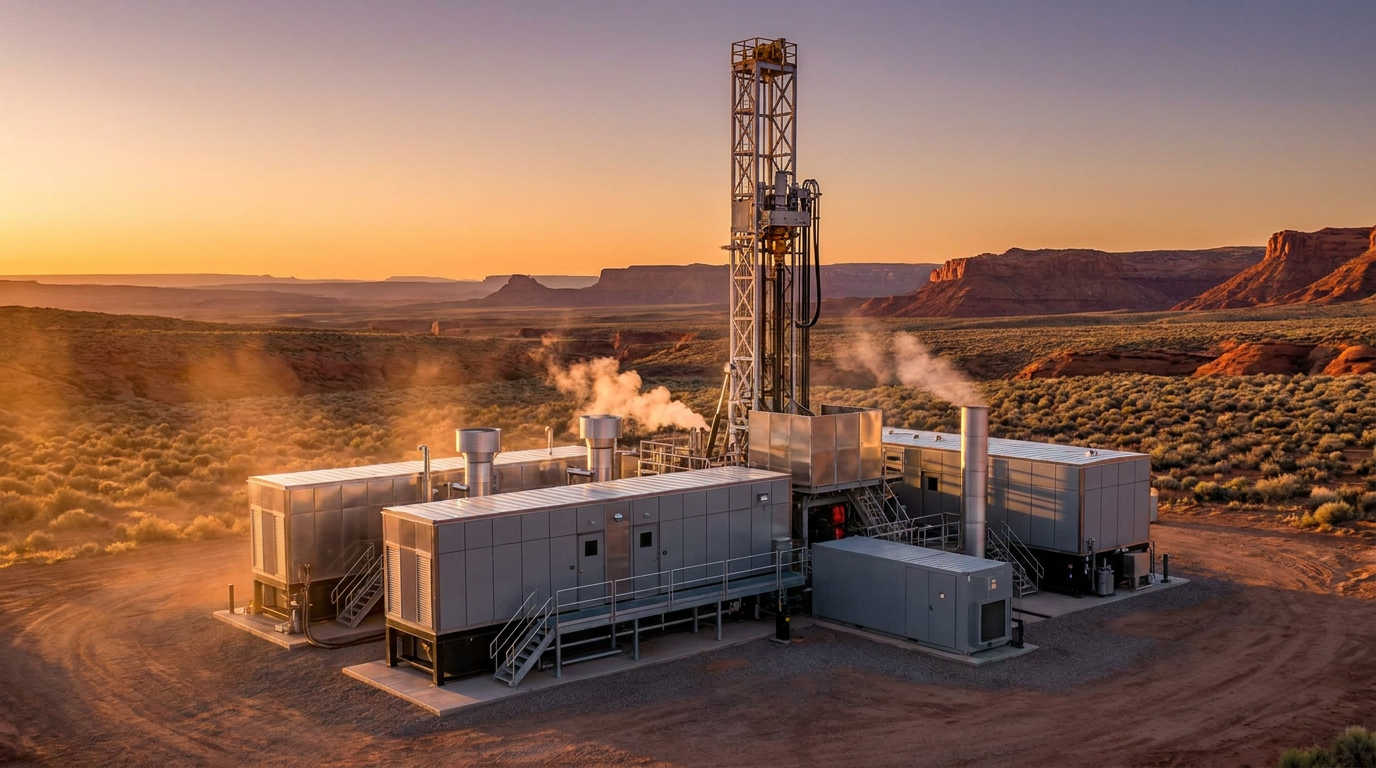
The mechanism behind EGS is an ironic twist in the energy transition: it relies heavily on the horizontal drilling and hydraulic fracturing techniques pioneered by the oil and gas industry. Instead of extracting fossil fuels, developers drill thousands of feet into hot, dry, impermeable rock.[1][3]

Once the well is drilled, water is injected at high pressure to create a network of tiny fractures in the rock. This creates a permeable artificial reservoir. Cold fluid is pumped down an injection well, heated by the surrounding rock, and drawn back up through a production well to drive steam turbines on the surface.[3][4]
The year 2026 has marked a commercial inflection point for this once-experimental technology. In May, Fervo Energy, a leading EGS developer, went public in a highly anticipated IPO that netted $1.9 billion, signaling massive Wall Street appetite for next-generation geothermal.[1]
Fervo's flagship project, Cape Station in Beaver County, Utah, is currently under construction and aims to deliver its first 100 megawatts of continuous power to the grid by late 2026, eventually scaling to 500 megawatts. The project recently secured $421 million in non-recourse project financing, a milestone that proves EGS is maturing into a bankable asset class.[6]

The project recently secured $421 million in non-recourse project financing, a milestone that proves EGS is maturing into a bankable asset class.
The sudden influx of capital is largely driven by what analysts call the "Baseload Imperative." Tech hyperscalers are realizing that capital is no longer the binding constraint on AI expansion—power is. In March 2026, Google signed a massive 3-gigawatt framework agreement with Fervo, securing a structured path to power its data centers with round-the-clock clean energy.[5]
But scaling EGS requires overcoming immense technical hurdles, particularly in monitoring the extreme subsurface environments. Because EGS involves fracturing rock, it creates microseismic events. While these are typically too small to be felt on the surface, precise monitoring is critical to understand fracture formation and mitigate any risks of induced seismicity.[2]
In April 2026, scientists at the Lawrence Berkeley National Laboratory announced a major breakthrough at the Cape Station site. Using a custom-built seismometer deployed nearly 7,000 feet underground, the team continuously monitored microseismic activity at 338°F for seven straight months.[2]

"Such high-temperature measurements are critical for geothermal energy production, and as far as we know, this is the world's longest recorded measurement at this temperature," noted Nori Nakata, a Berkeley Lab staff scientist. This durability proves that operators can safely and effectively manage EGS reservoirs over the long term.[2]
The U.S. Department of Energy is heavily backing these advancements, recently announcing $171.5 million to support next-generation geothermal field tests. The goal is to push drilling deeper and hotter, eventually tapping into "superhot" rock systems that exceed 375°C, where water enters a supercritical state that can multiply power output exponentially.[3][4]
Despite the technical triumphs, the primary hurdle remaining for EGS is economic. Currently, first-of-a-kind EGS projects deliver power at roughly $7,000 per kilowatt of capacity—a price tag comparable to nuclear power.[1]

To compete broadly with solar and wind paired with battery storage, developers aim to drive that cost down to $3,000 per kilowatt. As drilling speeds increase and the supply chain matures, industry experts believe this cost curve will drop rapidly, mirroring the price collapse seen in solar panels over the last decade.[1][7]
If the economics align, the environmental payoff is staggering. Geothermal plants have a fraction of the land footprint of utility-scale solar or wind farms. Furthermore, they rely far less on critical minerals like lithium and zinc, sidestepping the supply chain bottlenecks that plague the battery industry.[4]
Currently, U.S. geothermal capacity sits at a modest 2.7 gigawatts. With the commercialization of EGS, the Department of Energy estimates that capacity could swell to 90 gigawatts, or even 150 gigawatts, by 2050.[4][8]
By turning the Earth itself into a massive, zero-carbon battery, next-generation geothermal is poised to graduate from a niche regional resource into a foundational pillar of the global clean energy grid.[8]
How we got here
2019
The Department of Energy releases its GeoVision report, outlining the potential for 60+ gigawatts of geothermal capacity.
2024
Fervo Energy proves the commercial viability of EGS with successful early pilot tests.
July 2025
Berkeley Lab deploys a high-temperature seismometer at the Cape Station site in Utah.
March 2026
Google signs a 3-gigawatt framework agreement with Fervo Energy to power data centers.
May 2026
Fervo Energy goes public, raising $1.9 billion in a highly anticipated IPO.
Late 2026
The Cape Station project is expected to deliver its first 100 megawatts of continuous power to the grid.
Viewpoints in depth
Geothermal Developers
EGS is ready for prime time and can rapidly scale to provide bankable baseload power.
Industry leaders argue that with the successful application of horizontal drilling and hydraulic fracturing, EGS has moved definitively past the pilot phase. Developers emphasize that the technology is now a highly bankable asset class, pointing to massive non-recourse financing deals. Their primary focus is on economies of scale: by drilling faster and standardizing equipment, they believe they can rapidly drive down the levelized cost of energy to compete directly with fossil fuels and nuclear power.
Tech Hyperscalers
Securing gigawatt-scale, 24/7 clean baseload power is an existential priority for the AI boom.
For data center operators, the "Baseload Imperative" is driving unprecedented investment. The AI boom requires massive, uninterrupted power that solar and wind simply cannot provide without prohibitively expensive battery storage. Tech giants view capital as abundant but firm power as scarce, making them willing to sign massive framework agreements and pay a premium for early EGS projects to ensure their infrastructure expansion isn't bottlenecked by grid limitations.
Scientific Researchers
Rigorous subsurface monitoring is essential to ensure artificial reservoirs operate safely.
While optimistic about the energy potential, geophysicists and national laboratories emphasize the technical risks of engineering the subsurface. Because EGS involves fracturing rock, it inherently induces microseismicity. Researchers argue that long-term, high-temperature sensor data is essential to understand how these fractures behave over time, ensuring that operators can maximize heat extraction without triggering larger, dangerous seismic events.
What we don't know
- Whether the industry can successfully reduce the cost of EGS from $7,000/kW to the $3,000/kW target.
- How local communities will react to the widespread use of hydraulic fracturing for clean energy.
- If the supply chain for specialized high-temperature drilling equipment can scale fast enough to meet demand.
Key terms
- Enhanced Geothermal Systems (EGS)
- A technology that creates artificial underground reservoirs by fracturing hot, dry rock and circulating fluid to extract heat for electricity generation.
- Baseload Power
- The minimum amount of electric power needed to be supplied to the electrical grid at any given time, requiring energy sources that can run continuously.
- Induced Seismicity
- Minor earthquakes and tremors that are caused by human activity, such as the injection of fluids deep underground during hydraulic fracturing.
- Supercritical Fluid
- A state of matter where a substance is held at a temperature and pressure above its critical point, allowing it to carry massive amounts of thermal energy.
Frequently asked
How is EGS different from traditional geothermal?
Traditional geothermal requires naturally occurring underground reservoirs of hot water. EGS creates artificial reservoirs by drilling into hot, dry rock and injecting fluid to create permeable fractures.
Does EGS use fracking?
Yes, EGS borrows hydraulic fracturing and horizontal drilling techniques from the oil and gas industry to create the underground pathways needed for water to circulate and absorb heat.
Why do tech companies want geothermal energy?
Data centers running AI models require massive amounts of electricity 24/7. Geothermal provides "firm" baseload power that doesn't stop when the sun goes down, unlike solar.
Is geothermal energy renewable?
Yes. The Earth's internal heat is virtually limitless, and the water used to extract the heat is typically reinjected into the reservoir in a closed loop, making it a sustainable, zero-carbon resource.
Sources
Source coverage
8 outlets
4 viewpoints surfaced







[1]WAMCGeothermal Developers
Geothermal Energy
Read on WAMC →[2]Lawrence Berkeley National LaboratoryScientific Researchers
Custom Sensor Monitors Seismicity for Months Straight More Than a Mile Below Ground
Read on Lawrence Berkeley National Laboratory →[3]U.S. Department of EnergyScientific Researchers
Enhanced Geothermal Systems
Read on U.S. Department of Energy →[4]World Resources InstituteEnergy Economists
How Do Next-Generation Geothermal Technologies Work?
Read on World Resources Institute →[5]William BlairTech Hyperscalers
Fervo Energy Company: Initiation of Research Coverage
Read on William Blair →[6]ESG TodayGeothermal Developers
Fervo Secures $421 Million to Build U.S. Geothermal Energy Plant
Read on ESG Today →[7]PatSnap InsightsEnergy Economists
Enhanced Geothermal Systems Reaches Its Commercial Inflection Point
Read on PatSnap Insights →[8]Factlen Editorial TeamEnergy Economists
Synthesis by Factlen editorial team
Read on Factlen Editorial Team →
Every angle. Every day.
Get energy stories with full source coverage and perspective breakdowns delivered to your inbox.