
The Science of Yoga Nidra: How 'Non-Sleep Deep Rest' Rewires the Nervous System
Neuroscientists and clinicians are increasingly validating Yoga Nidra, an ancient practice of conscious relaxation, as a powerful tool for reducing anxiety, improving sleep, and restoring cognitive focus.
By Factlen Editorial Team
- Clinical Researchers
- Focused on measurable physiological outcomes and disease treatment.
- Neuroscience Optimizers
- Focused on cognitive performance, neuroplasticity, and dopamine restoration.
- Traditional Yogic Practitioners
- Focused on holistic healing, emotional processing, and spiritual inquiry.
What's not represented
- · Pediatricians
- · Corporate Wellness Directors
Why this matters
Chronic stress and sleep deprivation are primary drivers of burnout and biological aging. Understanding how to deliberately trigger the body's parasympathetic relaxation response offers a free, accessible, and scientifically validated method to protect your mental and physical health.
Key points
- Yoga Nidra, or Non-Sleep Deep Rest (NSDR), is a guided relaxation practice performed while lying completely still.
- The protocol systematically shifts the autonomic nervous system from sympathetic (fight-or-flight) to parasympathetic (rest-and-digest) dominance.
- Practitioners enter Theta and Delta brainwave states—normally associated with deep sleep—while maintaining conscious awareness.
- Clinical trials demonstrate the practice significantly reduces anxiety, lowers cortisol, and improves sleep quality.
- While it can restore cognitive focus and partially compensate for fatigue, experts caution it cannot biologically replace a full night of sleep.
In an era defined by chronic burnout and relentless digital stimulation, the concept of rest has become paradoxically stressful. Millions of people track their sleep cycles, optimize their morning routines, and still wake up feeling fundamentally exhausted. Against this backdrop of systemic fatigue, an ancient yogic practice has quietly infiltrated the modern wellness and neuroscience communities, promising a physiological "reset button" that requires no equipment, no physical exertion, and no subscription fees. It is called Yoga Nidra, though a growing cohort of biohackers and neuroscientists know it by a distinctly clinical acronym: Non-Sleep Deep Rest, or NSDR.[4][6]
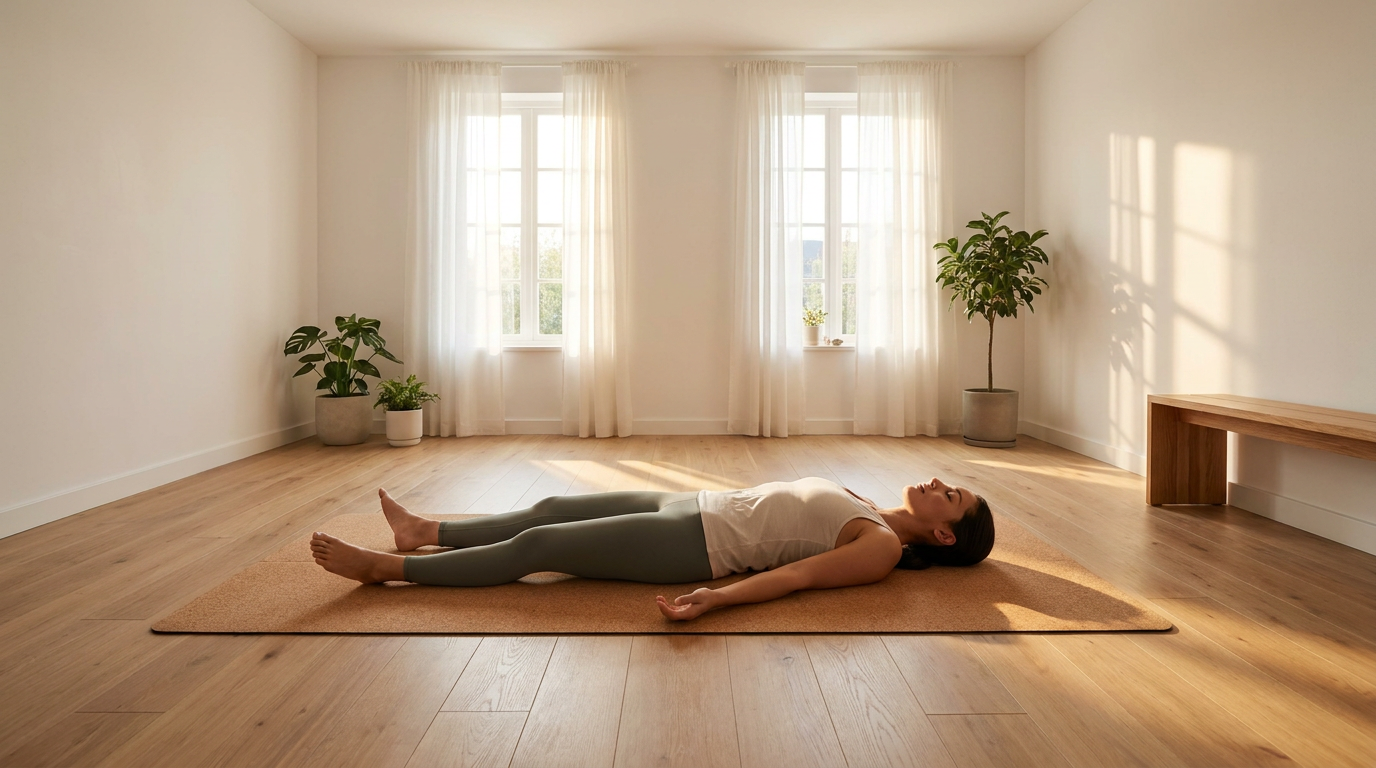
Unlike traditional seated meditation, which often requires active mental focus to observe passing thoughts, Yoga Nidra is practiced lying down in a state of complete physical stillness. The goal is not to empty the mind, but to guide the body into a state of profound relaxation while maintaining a sliver of conscious awareness. Practitioners are led through a highly structured audio protocol—typically lasting between 10 and 30 minutes—that systematically disengages the brain's active waking networks. The result is a unique physiological state that hovers precisely on the boundary between wakefulness and sleep.[1][3]
The practice has surged in popularity largely due to its secular rebranding by Stanford neuroscientist Dr. Andrew Huberman, who coined the term Non-Sleep Deep Rest (NSDR) to describe Yoga Nidra and related clinical hypnosis protocols. By stripping away the Sanskrit terminology and framing the practice through the lens of neurobiology, the NSDR label has made conscious relaxation palatable to Silicon Valley executives, elite athletes, and clinical populations who might otherwise dismiss it as spiritual mysticism. Regardless of the name, the underlying mechanism remains identical: a deliberate, controlled downshifting of the human nervous system.[4][6]
To understand why this practice is so effective, one must look at the autonomic nervous system, which operates in two primary modes. The sympathetic nervous system drives the "fight-or-flight" response, flooding the body with cortisol and adrenaline to handle immediate threats. Conversely, the parasympathetic nervous system governs the "rest-and-digest" functions, slowing the heart rate, lowering blood pressure, and facilitating cellular repair. Modern life, with its constant barrage of emails, news alerts, and deadlines, tends to lock the body in a state of chronic sympathetic arousal.[3][6]

Yoga Nidra acts as a targeted intervention to break this cycle of chronic stress. According to experts at the Cleveland Clinic, the structured body scans and breathing cues of the practice serve as biological signals that the environment is safe, explicitly commanding the brain to deactivate the sympathetic drive and engage the parasympathetic network. As this shift occurs, practitioners experience measurable physiological changes: heart rate variability increases, respiration slows, and the body begins to clear accumulated stress hormones from the bloodstream.[1][3]
This autonomic shift is mirrored by a dramatic change in the brain's electrical activity. During normal waking hours, the brain operates primarily in Beta waves (13–30 Hz), a high-frequency state associated with active problem-solving and alertness. As a Yoga Nidra session begins and the practitioner focuses on their breath, the brain downshifts into Alpha waves (8–13 Hz), the frequency of relaxed awareness. This is the state most people experience just before falling asleep or while daydreaming.[3][6]
As the guided protocol deepens, the brain transitions into Theta waves (4–8 Hz), the signature frequency of the hypnagogic state—the twilight zone where the conscious mind begins to dissolve into the subconscious. Advanced practitioners can even reach Delta waves (0.5–4 Hz), the slow, rolling electrical patterns normally reserved for the deepest, most restorative stages of dreamless sleep. The defining feature of Yoga Nidra is that the practitioner accesses these healing Delta and Theta states while remaining entirely awake, allowing the body to rest deeply without crossing the threshold into unconsciousness.[1][3][6]

The clinical evidence supporting this mechanism is robust, particularly regarding stress and anxiety reduction. In a randomized controlled trial published by the National Institutes of Health, researchers evaluated the mental health of college professors—a high-stress occupation—over a three-month period. The study found that while both seated meditation and Yoga Nidra were effective at managing stress, the Yoga Nidra intervention demonstrated a superior ability to reduce both the cognitive and physiological symptoms of anxiety.[2]
The clinical evidence supporting this mechanism is robust, particularly regarding stress and anxiety reduction.
Beyond general stress reduction, the practice has shown significant promise as a non-pharmacological treatment for sleep disorders. Data highlighted by the Sleep Foundation indicates that regular Yoga Nidra practice can reduce sleep onset latency—the time it takes to fall asleep—and increase the total time spent in deep, restorative sleep stages throughout the night. By preemptively lowering sympathetic nervous system activity before bed, the practice prevents the racing thoughts and physical tension that characterize chronic insomnia.[1]
The potential of Yoga Nidra to treat severe sleep disturbances is currently being investigated at the highest levels of institutional medicine. A clinical trial operating within the Veterans Affairs medical system is assessing whether remotely delivered Yoga Nidra protocols can help older adults reduce or entirely eliminate their reliance on Benzodiazepine sleep medications. Because the practice is free, accessible, and carries zero risk of chemical dependency, it represents a highly attractive alternative to traditional pharmaceuticals for managing comorbid anxiety and insomnia.[5]
While clinical populations use the practice for healing, the neuroscience and biohacking communities have embraced NSDR for cognitive optimization. Proponents point to evidence that deliberately entering these deep states of relaxation can accelerate neuroplasticity—the brain's ability to rewire itself and consolidate new information. A 20-minute NSDR session following a period of intense focus is believed to help the brain process and store learning more efficiently than continuous, uninterrupted study.[4]

The most sensational claim surrounding NSDR is its purported ability to restore motivation and cognitive vigor by replenishing dopamine. This assertion traces back to a highly cited 2002 neuroimaging study which found that participants undergoing a Yoga Nidra protocol experienced a 65 percent increase in endogenous dopamine release within the brain's striatum. This dopaminergic surge is often cited as the reason practitioners emerge from a 20-minute session feeling as refreshed as if they had slept for several hours.[4][6]
However, independent researchers caution against treating the dopamine claim as settled science. The 2002 PET scan study that generated the 65 percent figure involved a sample size of only eight highly experienced yoga teachers. While the mechanism is biologically plausible and aligns with subjective reports of restored energy, sweeping claims about NSDR acting as a universal "dopamine reset" require validation through larger, modern randomized controlled trials before they can be considered definitive.[6]
Despite these scientific caveats, the practical application of Yoga Nidra remains remarkably straightforward. A standard session begins with the practitioner lying on their back in a quiet room, often covered with a blanket as body temperature tends to drop during deep relaxation. The audio guide first asks the listener to set a "Sankalpa," or intention—a short, positive resolve that is planted in the mind while it is highly receptive.[3][6]
The core of the protocol is a systematic "rotation of consciousness," a detailed body scan where the practitioner briefly focuses their attention on specific body parts in a rapid, prescribed sequence. This continuous movement of awareness prevents the mind from latching onto stressful thoughts while simultaneously providing sensory feedback to the brain that the physical body is entirely safe and free of tension.[3][6]

This is followed by breath awareness, where the practitioner observes the natural flow of respiration without attempting to alter it. This passive observation stimulates the vagus nerve, the primary superhighway of the parasympathetic nervous system, further deepening the physiological relaxation response. Finally, the guide slowly brings the practitioner's awareness back to the physical room, ensuring a gentle transition back to a normal waking state.[3][6]
It is crucial to understand what Yoga Nidra cannot do. While a 20-minute session can partially compensate for the cognitive fatigue of a poor night's rest, it is not a biological substitute for actual sleep. The human body requires the prolonged, cyclical architecture of a full night's sleep to perform essential functions like cellular repair, immune system modulation, and the clearing of amyloid plaques from the brain. NSDR is an adjunctive tool for nervous system regulation, not a lifehack to permanently bypass the biological need for eight hours of rest.[1][6]
Ultimately, the rise of Yoga Nidra and NSDR represents a profound shift in how modern society approaches wellness. In a culture that historically equated rest with laziness, science is proving that deliberate, conscious relaxation is a highly active and necessary biological process. Whether viewed through the ancient spiritual lens of yogic tradition or the modern clinical framework of neurobiology, this accessible practice offers a vital sanctuary of stillness in an increasingly frantic world.[4][6]
How we got here
1998
Early neuroimaging studies begin documenting the unique cerebral blood flow patterns of experienced Yoga Nidra practitioners.
2002
A landmark PET scan study reports a 65% increase in striatal dopamine release during a Yoga Nidra session.
2018
The International Journal of Yoga publishes data showing Yoga Nidra outperforms seated meditation in reducing anxiety among college professors.
2022
Dr. Andrew Huberman popularizes the term 'Non-Sleep Deep Rest' (NSDR), bringing the practice to a mainstream neuroscience audience.
2025
The VA medical system launches clinical trials to test Yoga Nidra as a replacement for prescription sleep medications in older adults.
Viewpoints in depth
Clinical Researchers
Focused on measurable physiological outcomes and disease treatment.
For the medical community, the value of Yoga Nidra lies in its measurable impact on the autonomic nervous system. Researchers prioritize data on cortisol reduction, heart rate variability, and sleep onset latency. From this perspective, the practice is a highly scalable, zero-cost, non-pharmacological intervention for the modern epidemics of chronic anxiety and insomnia, with ongoing trials exploring its potential to replace addictive sleep medications.
Neuroscience Optimizers
Focused on cognitive performance, neuroplasticity, and dopamine restoration.
Popularized by figures like Dr. Andrew Huberman under the NSDR label, this camp views the practice as a biological optimization tool. They emphasize the 2002 PET scan data showing increased striatal dopamine and advocate using the protocol strategically during the workday to accelerate learning, consolidate memory, and recover from intense bouts of mental focus. For optimizers, it is less about spiritual healing and more about maximizing neurological efficiency.
Traditional Yogic Practitioners
Focused on holistic healing, emotional processing, and spiritual inquiry.
Traditionalists view the clinical and biohacking frameworks as reductive, arguing that measuring brainwaves and dopamine misses the deeper purpose of the practice. In the yogic tradition, the hypnagogic state accessed during Yoga Nidra is a space for profound self-inquiry and the release of deep-seated emotional blockages (Samskaras). They emphasize the importance of the 'Sankalpa' (intention) and view the physical relaxation merely as a prerequisite for spiritual and psychological integration.
What we don't know
- Whether the 65% dopamine increase observed in a small 2002 study of eight advanced practitioners applies universally to beginners.
- The exact long-term neurobiological differences between decades of Yoga Nidra practice and other forms of deep meditation.
- How effectively remotely-delivered audio protocols can replace pharmaceutical interventions for severe, clinically diagnosed insomnia.
Key terms
- Yoga Nidra
- An ancient yogic practice of conscious relaxation that guides the body into deep rest while the mind remains awake.
- Non-Sleep Deep Rest (NSDR)
- A secular, neuroscience-backed term coined by Dr. Andrew Huberman to describe practices like Yoga Nidra that induce deep relaxation without sleep.
- Parasympathetic Nervous System
- The 'rest and digest' network of the autonomic nervous system, responsible for conserving energy, slowing the heart rate, and facilitating cellular repair.
- Theta Brainwaves
- Slow electrical brainwaves (4–8 Hz) associated with deep relaxation, daydreaming, and the transitional state between wakefulness and sleep.
- Striatal Dopamine
- A neurotransmitter released in the brain's striatum that plays a critical role in motivation, reward processing, and cognitive vigor.
Frequently asked
Is Yoga Nidra the same thing as taking a nap?
No. While a nap involves losing consciousness and actually falling asleep, Yoga Nidra is designed to keep your mind awake and aware while your physical body enters a sleep-like state of deep relaxation.
Do I need any special equipment or flexibility to practice?
None at all. The practice requires zero physical exertion or flexibility. You only need a quiet place to lie down comfortably and an audio guide to walk you through the protocol.
Can NSDR replace a full night of sleep?
No. While a 20-minute session can restore cognitive focus and partially compensate for the mental fatigue of a poor night's rest, it cannot replace the essential physiological repair processes that occur during 8 hours of actual sleep.
What is the difference between Yoga Nidra and NSDR?
They are functionally the same practice. Non-Sleep Deep Rest (NSDR) is simply a secular, scientific term coined by neuroscientist Dr. Andrew Huberman to describe Yoga Nidra protocols without the traditional spiritual terminology.
Sources
Source coverage
6 outlets
3 viewpoints surfaced






[1]Sleep FoundationClinical Researchers
Yoga Nidra for Sleep and Stress Reduction
Read on Sleep Foundation →[2]National Institutes of HealthClinical Researchers
The Impact of Yoga Nidra and Seated Meditation on the Mental Health of College Professors
Read on National Institutes of Health →[3]Cleveland ClinicTraditional Yogic Practitioners
What Is Yoga Nidra? Benefits and How To Do It
Read on Cleveland Clinic →[4]Huberman LabNeuroscience Optimizers
Non-Sleep Deep Rest (NSDR): Science and Protocols
Read on Huberman Lab →[5]ClinicalTrials.govClinical Researchers
Yoga Nidra for Insomnia and Anxiety
Read on ClinicalTrials.gov →[6]Factlen Editorial TeamTraditional Yogic Practitioners
Synthesis by Factlen editorial team
Read on Factlen Editorial Team →

Every angle. Every day.
Get fitness stories with full source coverage and perspective breakdowns delivered to your inbox.