
How Accurate Are Sleep Trackers? The 2026 Evidence Review
Consumer sleep wearables can detect when you fall asleep with over 95% accuracy, but struggle to perfectly map deep and REM sleep stages. A review of recent clinical validations reveals where smart rings and watches succeed, and where they fall short of medical-grade sleep studies.
By Factlen Editorial Team
- Clinical Sleep Specialists
- Medical professionals who rely on polysomnography for diagnosis.
- Quantified Self Advocates
- Data-driven consumers focused on behavioral optimization and trends.
- Wearable Manufacturers
- The technology companies developing and refining sleep algorithms.
What's not represented
- · Patients with diagnosed sleep disorders
- · Health insurance providers evaluating wearable data
Why this matters
Millions of consumers base their daily routines, workout intensity, and health anxiety on the 'sleep scores' generated by their wearables. Understanding the actual scientific accuracy of these devices empowers you to use the data to improve your habits without obsessing over imperfect metrics.
Key points
- Consumer wearables detect basic sleep and wakefulness with over 95% accuracy compared to clinical sleep labs.
- Accuracy drops significantly when devices attempt to classify light, deep, and REM sleep stages.
- Smart rings currently demonstrate a slight accuracy advantage over smartwatches due to more stable pulse signals.
- Wearables often underestimate deep sleep, leading to unnecessary anxiety for some users.
- Accuracy falls to roughly 53% for individuals with diagnosed sleep disorders like insomnia.
- Experts recommend using tracker data for long-term behavioral trends rather than absolute diagnostic truth.
The consumer sleep technology market has transformed from a niche curiosity for biohackers into a ubiquitous presence on our wrists and fingers. In 2026, millions of users wake up and immediately check their nightly metrics—scrutinizing their recovery scores and sleep stage graphs—before deciding how hard to push themselves at the gym or how much coffee to consume. But as these devices increasingly dictate our daily routines and influence our health anxiety, a critical question remains: how closely does a commercial wearable actually match the data gathered from a night in a medical sleep lab? The answer lies in a growing body of independent validation studies that separate marketing claims from physiological reality, revealing exactly what these devices can and cannot do.[4][5]
To understand the accuracy of these devices, researchers evaluate consumer wearables against polysomnography (PSG), which remains the undisputed clinical gold standard for sleep measurement. The fundamental difference between the two approaches lies in what they are actually measuring. While a consumer wearable relies on photoplethysmography (PPG) sensors to measure heart rate and accelerometers to track physical movement, a PSG setup directly measures brain waves via electroencephalogram (EEG), alongside eye movements and muscle activity. The gap between tracking physical movement and tracking actual brainwaves is where the scientific evidence gets complicated. Wearables are forced to use cardiovascular and movement data as proxies for neurological states, a translation process that relies heavily on proprietary machine learning algorithms.[1][3]
When it comes to the basic binary question of whether a user is asleep or awake, the evidence supporting wearables is remarkably strong. A landmark validation study published in the journal Sensors, conducted by researchers at Brigham and Women's Hospital, placed healthy adults under simultaneous PSG observation while they wore an Oura Ring Gen3, an Apple Watch Series 8, and a Fitbit Sense 2. For the fundamental task of detecting sleep versus wakefulness, all three devices demonstrated a sensitivity of 95 percent or higher. This means that when you are actually asleep, the devices are almost universally correct in logging that state, providing a highly reliable measure of your total sleep duration.[1][2]

This high level of baseline accuracy represents a massive leap from the older actigraphy devices used in the previous decade, which relied almost entirely on motion and frequently confused sitting still with sleeping. If a user's primary goal is simply to track their total time in bed and ensure they are getting roughly eight hours of rest, modern wearables are highly reliable tools. They consistently capture sleep onset—the moment you actually drift off—and morning awakenings with clinical-grade precision in healthy adults. For the average person looking to improve their basic sleep hygiene and maintain a consistent schedule, this binary sleep-wake detection is often the most valuable and scientifically sound metric these devices provide.[1][2]
However, the evidence weakens considerably when devices attempt to divide the night into four distinct stages: wake, light sleep, deep sleep, and rapid eye movement (REM) sleep. Because wearables cannot read the specific brainwave frequencies that physiologically define these stages, they must infer them from secondary signals like heart rate variability, skin temperature fluctuations, and micro-movements. This reliance on proxy metrics introduces a significant margin of error into the data. While your heart rate does drop during deep sleep and your breathing becomes more variable during REM, these autonomic nervous system changes are not perfectly synchronized with the brain's activity, leaving room for algorithmic misinterpretation.[1][3]
This reliance on proxy metrics introduces a significant margin of error into the data.
According to the Sensors study and subsequent meta-analyses, accuracy for four-stage classification drops to between 50 and 86 percent, depending heavily on the specific device and the sleep stage being measured. The devices are essentially making highly educated guesses based on your cardiovascular state. While these algorithms have improved dramatically with the integration of larger data sets, they still occasionally misclassify quiet wakefulness as light sleep, or struggle to perfectly differentiate between the deepest stages of non-REM sleep and REM cycles. Consequently, obsessing over a five-minute drop in deep sleep from one night to the next is often an exercise in tracking algorithmic noise rather than actual physiological decline.[1][2]

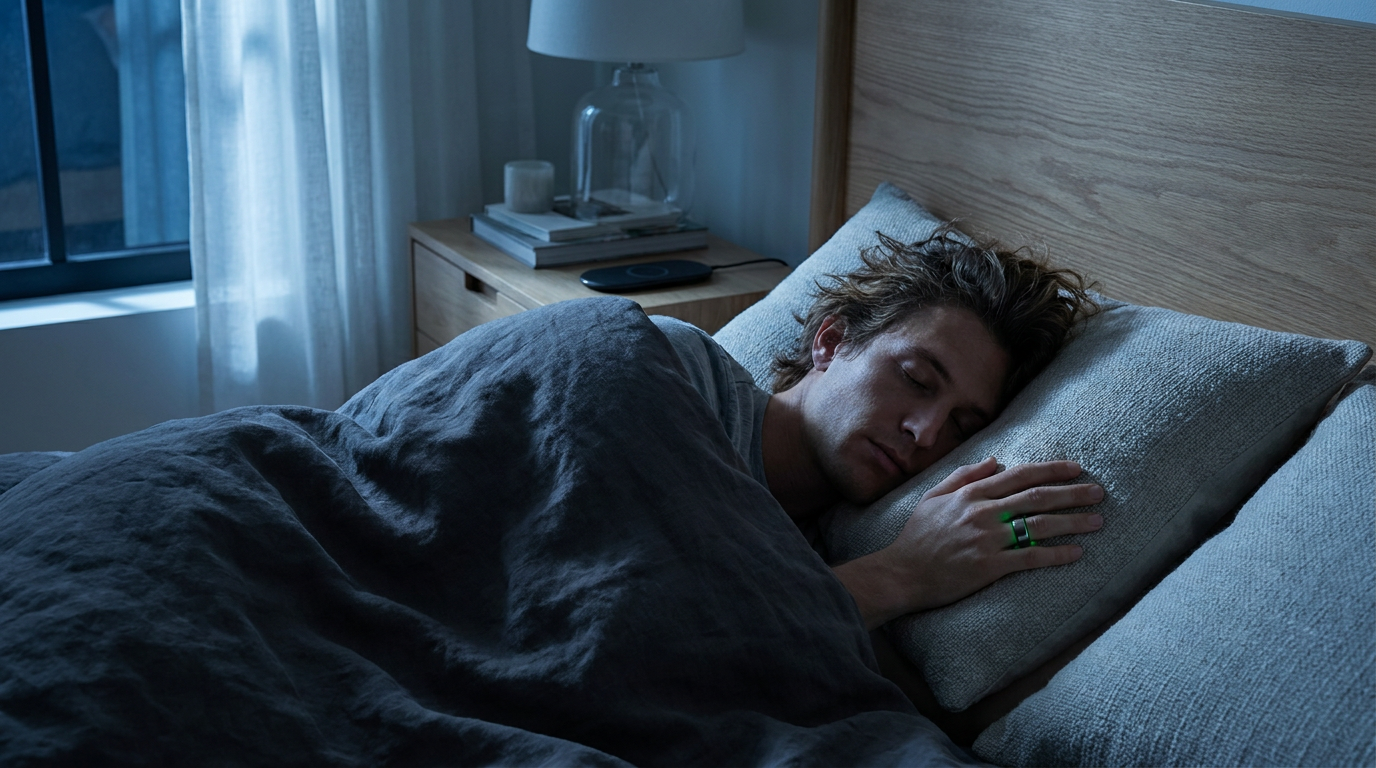
The independent validation data also reveals that not all trackers fail in the same way, with distinct hardware profiles and algorithmic biases emerging across different brands. The Oura Ring consistently demonstrates the highest overall four-stage accuracy among consumer devices, achieving roughly 76 to 79 percent sensitivity across all stages, with no significant overestimation or underestimation compared to PSG. Researchers attribute this slight edge to its finger-based form factor, which provides a stronger and more stable pulse signal than wrist-based alternatives, especially during the night when arms can be slept on or positioned awkwardly.[1][2][7]
Wrist-worn devices show more variance in their staging accuracy, often exhibiting specific directional biases. The Apple Watch, for instance, excels at detecting brief awakenings but tends to underestimate deep sleep by an average of 43 minutes while simultaneously overestimating light sleep. Fitbit devices, conversely, often overestimate light sleep while missing portions of deep sleep. For consumers, this means a low deep sleep warning on a smartwatch might simply be a known hardware quirk rather than a genuine physiological deficit. Understanding these device-specific tendencies is crucial for users who might otherwise experience orthosomnia—an unhealthy obsession with achieving perfect sleep metrics.[1][2][7]

Perhaps the most crucial caveat in the current evidence base involves the test populations used to validate these devices. The high accuracy rates cited by manufacturers and early validation studies are almost exclusively derived from cohorts of healthy young-to-middle-aged adults with normal, predictable sleep architecture. When these devices are tested on clinical populations—people who actually suffer from sleep disturbances—the results shift dramatically, revealing the limitations of consumer-grade algorithms when faced with irregular physiological patterns.[2][6]
A recent evaluation of smart rings in a university sleep-lab population that included individuals with sleep apnea, restless leg syndrome, and insomnia found that all-stage classification accuracy dropped to approximately 53 percent. For individuals who spend long periods lying perfectly still but awake—a hallmark of insomnia—wearables routinely log that time as light sleep. This artificially inflates the total sleep time and can potentially mask the severity of the disorder. For this reason, medical professionals strongly advise against using consumer wearables to self-diagnose or rule out suspected sleep disorders.[2][6]

Because of these limitations, clinical sleep specialists emphasize that while consumer sleep technology cannot diagnose disorders or replace a PSG, it excels at longitudinal tracking. A wearable might be off by 20 minutes of REM sleep every single night, but if a user's REM sleep suddenly drops by an hour after a late meal, a stressful day, or alcohol consumption, that relative trend is real, measurable, and highly actionable. The true value of the device lies in its consistency over time, allowing users to run personal experiments and immediately see how lifestyle variables impact their baseline recovery.[3][8]
Ultimately, the evidence suggests that the most effective way to use a sleep tracker is as a behavioral compass rather than a diagnostic oracle. By focusing on long-term baselines and observing how specific lifestyle changes impact personal data, users can harness these devices to build healthier routines. Recognizing the scientific realities of what these sensors can and cannot measure empowers consumers to utilize the data for positive behavioral nudges, without falling into the trap of chasing a perfect, but mathematically flawed, sleep score.[3][4][8]
How we got here
2015
Early actigraphy trackers like the Fitbit Flex rely primarily on motion, often confusing sitting still with sleeping.
2018
Wearables begin integrating photoplethysmography (PPG) heart rate sensors, significantly improving sleep-wake detection.
2021
Advanced algorithms introduce four-stage sleep classification, attempting to estimate REM and deep sleep.
2024
Major validation studies confirm consumer devices achieve >95% accuracy for basic sleep detection, though staging remains imperfect.
2026
Smart rings emerge as the most accurate form factor for sleep staging due to superior pulse signal stability on the finger.
Viewpoints in depth
Clinical Sleep Specialists
Medical professionals who rely on polysomnography for diagnosis.
Clinical sleep specialists emphasize that consumer wearables are not medical devices and cannot diagnose conditions like sleep apnea or insomnia. They point out that because wearables rely on cardiovascular proxies rather than direct brainwave monitoring (EEG), their sleep staging data is inherently flawed. This camp frequently warns about orthosomnia—a condition where patients develop severe anxiety over imperfect sleep scores, ironically worsening their actual sleep quality. However, many acknowledge the devices are useful for tracking total sleep duration and identifying broad lifestyle trends.
Quantified Self Advocates
Data-driven consumers focused on behavioral optimization and trends.
For quantified self advocates and biohackers, the absolute precision of a sleep tracker is less important than its consistency. This camp argues that even if a device is consistently off by 15% in measuring deep sleep, the relative changes day-to-day are still highly valuable for behavioral modification. They utilize wearables to run personal experiments—such as stopping caffeine intake earlier or changing bedroom temperature—and rely on the directional trends of the data to optimize their daily recovery, viewing the wearable as a coaching tool rather than a diagnostic instrument.
Wearable Manufacturers
The technology companies developing and refining sleep algorithms.
Hardware manufacturers argue that consumer sleep technology is rapidly closing the gap with clinical polysomnography through advanced machine learning and larger datasets. They highlight that their devices offer something a sleep lab cannot: continuous, non-invasive monitoring over months and years in a natural environment. This camp points to continuous improvements in sensor technology, such as multi-wavelength PPG and temperature tracking, asserting that the convenience and longitudinal data provided by wearables far outweigh the minor discrepancies in nightly sleep staging.
What we don't know
- How upcoming non-contact radar and mattress sensors will ultimately compare to wearable accuracy.
- Whether next-generation algorithms can successfully correct for the physiological anomalies of severe sleep disorders.
- The long-term psychological impact of 'orthosomnia' on the general population's actual sleep quality.
Key terms
- Polysomnography (PSG)
- The clinical gold standard for sleep studies, which measures brain waves, blood oxygen, heart rate, and breathing.
- Photoplethysmography (PPG)
- An optical sensor technology used in wearables to measure heart rate and blood flow using light.
- Actigraphy
- The continuous measurement of physical movement, historically used by early trackers to guess sleep patterns.
- Orthosomnia
- An unhealthy obsession with achieving perfect sleep metrics, often triggered by wearable device data.
- Four-Stage Classification
- The division of a night's rest into wakefulness, light sleep, deep sleep, and REM sleep.
Frequently asked
Can a sleep tracker diagnose sleep apnea?
No. While some devices can track blood oxygen drops that indicate potential issues, only a clinical sleep study (polysomnography) can officially diagnose sleep apnea.
Why does my tracker say I get very little deep sleep?
Wrist-worn devices, particularly some smartwatches, have a known algorithmic bias that underestimates deep sleep and overestimates light sleep compared to clinical measurements.
Are smart rings more accurate than smartwatches for sleep?
Current evidence suggests rings have a slight edge in sleep staging accuracy because the finger provides a stronger, more stable pulse signal than the wrist.
Should I worry if my sleep score is low?
Not necessarily. Experts recommend focusing on long-term trends and how you actually feel, rather than stressing over a single night's imperfect algorithmic score.
Sources
Source coverage
8 outlets
3 viewpoints surfaced








[1]SensorsClinical Sleep Specialists
Accuracy of Three Commercial Wearable Devices for Sleep Tracking in Healthy Adults
Read on Sensors →[2]CentraliveQuantified Self Advocates
Ring vs. Watch for Sleep Monitoring: A Practical Comparison of Accuracy, Feasibility, and Fit for Research
Read on Centralive →[3]Journal of Clinical Sleep MedicineClinical Sleep Specialists
Consumer sleep technology: accuracy and impact on behavior among healthy individuals
Read on Journal of Clinical Sleep Medicine →[4]LiveWorkSleepQuantified Self Advocates
Best Sleep Trackers 2026: Tested for Accuracy
Read on LiveWorkSleep →[5]Ubie HealthQuantified Self Advocates
Oura vs. Competitors: The Most Accurate Sleep Rings of 2026
Read on Ubie Health →[6]Scientific ReportsClinical Sleep Specialists
Evaluation of smart rings against polysomnography in clinical populations
Read on Scientific Reports →[7]Oura NewsroomWearable Manufacturers
Most Accurate Consumer Sleep Tracker Tested in Four-Stage Sleep Classification
Read on Oura Newsroom →[8]Factlen Editorial TeamQuantified Self Advocates
Synthesis by Factlen editorial team
Read on Factlen Editorial Team →
Every angle. Every day.
Get shopping stories with full source coverage and perspective breakdowns delivered to your inbox.