
AI Decodes Sperm Whale Communication, Revealing Complex 'Phonetic Alphabet' and Cooperative Care
Using advanced machine learning and underwater robotics, researchers have translated sperm whale vocalizations, uncovering a sophisticated phonetic alphabet and documenting unprecedented cooperative behavior during birth.
By Factlen Editorial Team
- Marine Biologists & Conservationists
- Focus on how decoding whale communication reveals deep social complexity and necessitates stronger habitat protections.
- AI & Computational Linguists
- Fascinated by the technical achievement of adapting large language models to parse non-human, unstructured acoustic data.
- Animal Rights Legal Advocates
- Argue that empirical evidence of language and cooperative care should fundamentally elevate the legal standing of cetaceans.
What's not represented
- · Commercial Shipping Industry
- · Deep-Sea Mining Operators
Why this matters
This breakthrough fundamentally shifts our understanding of animal intelligence, proving that complex language and cooperative societies exist in the deep ocean. Beyond its scientific awe, the discovery provides crucial empirical evidence that could reshape environmental law and mandate stricter protections against marine noise pollution.
Key points
- Artificial intelligence models have successfully decoded sperm whale vocalizations, identifying a structured "phonetic alphabet" of 156 distinct codas.
- The algorithms detected spectral patterns within the whale clicks that closely mirror the vowels and diphthongs found in human speech.
- Analyzing audio and drone footage of a rare birth event, the AI mapped real-time communication shifts as the pod coordinated their actions.
- The data provides the first quantitative evidence of cooperative birth assistance among non-primates, involving over a dozen female whales.
- Legal scholars argue the empirical proof of complex language and social coordination should elevate the legal standing and protections of cetaceans.
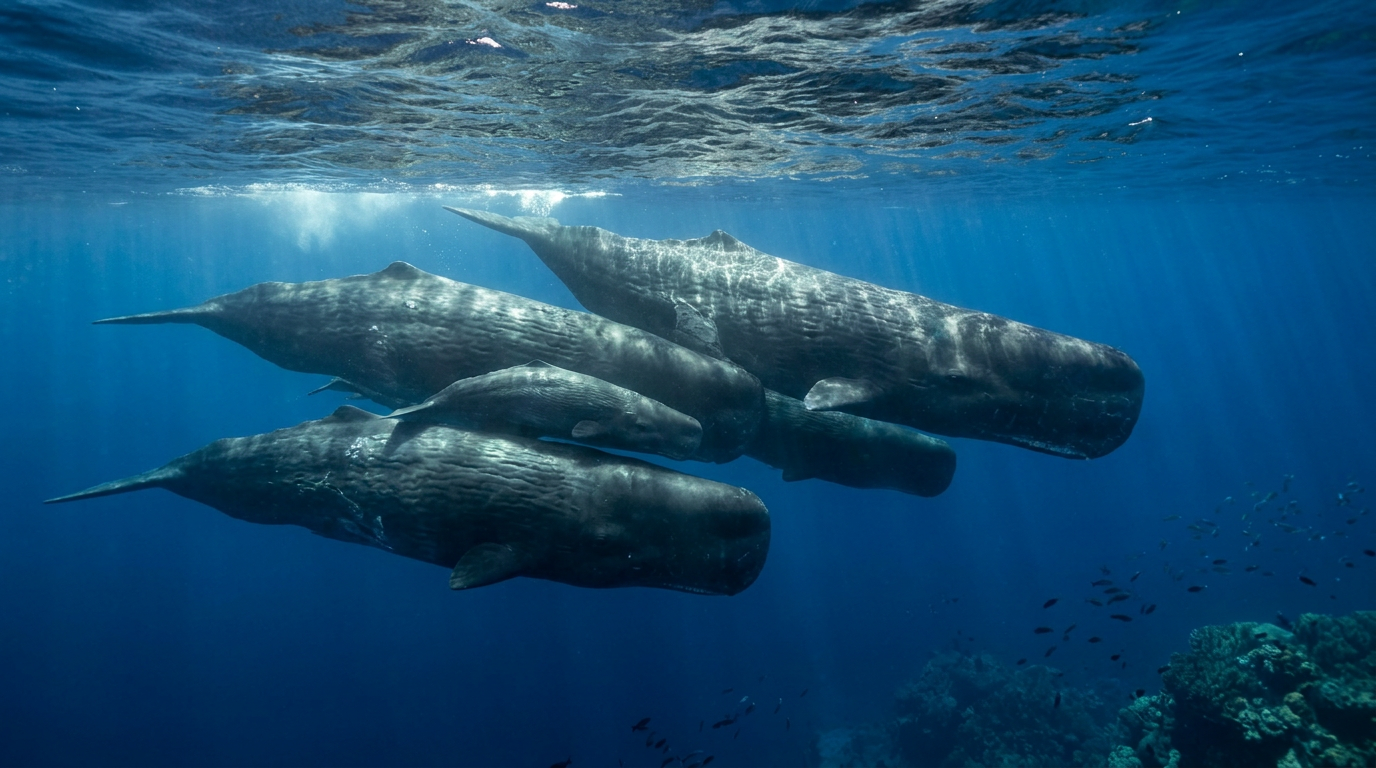
For centuries, the clicking sounds of sperm whales echoing through the ocean deep were an enigma—a complex acoustic web that scientists could record but never truly comprehend. Now, the application of advanced artificial intelligence has pierced that veil, transforming our understanding of marine cognition. In a pair of landmark studies published in Science and Scientific Reports, an interdisciplinary team of researchers has announced the most comprehensive translation of cetacean communication to date. By deploying machine learning algorithms against thousands of hours of underwater audio, the researchers have identified a highly structured "phonetic alphabet" used by sperm whales, fundamentally shifting the paradigm of animal communication.[1][2]
The fascination with cetacean acoustics is not new; the haunting, continuous melodies of humpback whales captured the public imagination in the 1970s and helped launch the modern conservation movement. However, the vocalizations of sperm whales presented a vastly different puzzle. Instead of melodic songs, sperm whales communicate through rapid-fire series of clicks known as codas. For decades, marine biologists could record these percussive bursts but struggled to find underlying syntax or meaning. The clicks sounded identical to the human ear, leaving researchers to wonder if they were merely rudimentary echolocation pings or something far more complex.[5][7]
Recognizing that traditional biological observation had reached its limits, a coalition of scientists launched Project CETI in 2020. The initiative was built on a radical premise: that the same artificial intelligence architectures used to translate human languages could be adapted to decode the clicks of the sperm whale. By bringing together marine biologists with cryptographers, roboticists, and natural language processing experts, CETI aimed to bridge the gap between biological field work and advanced computational data science. The project established a permanent monitoring base off the coast of Dominica, home to a stable, resident population of sperm whales.[4][6]
The technical hurdles were immense. The ocean is a chaotic acoustic environment, filled with the ambient noise of currents, marine life, and increasingly, commercial shipping. Furthermore, sperm whales are highly social, often vocalizing simultaneously in large groups. This created an underwater version of the "cocktail party problem," where researchers needed to isolate individual speakers from a cacophony of overlapping clicks. To solve this, CETI deployed an array of soft robotics and deep-water hydrophones to capture high-fidelity audio, which was then fed into custom machine learning models designed to separate, categorize, and sequence the individual acoustic streams.[4][6]

The results of this computational analysis are staggering. The AI identified 156 distinct "codas"—patterned sequences of clicks that function as the fundamental building blocks of the whales' language. More remarkably, the algorithms detected spectral patterns within these codas that closely mirror the vowels and diphthongs found in human speech. This suggests that sperm whale communication is not merely a collection of rudimentary signals for navigation or basic alerts, but a sophisticated, combinatorial language capable of conveying nuanced information across the pod.[4][5]
The discovery of this phonetic alphabet provides the strongest evidence yet that complex linguistic structures are not exclusive to humanity. Just as human languages combine a limited set of phonemes to create an infinite array of words and sentences, the AI models revealed that sperm whales combine their codas in highly structured, predictable sequences. The algorithms detected rules governing how certain codas could be paired or modified, indicating a level of grammatical syntax previously thought impossible in non-human species.[5][6]
The discovery of this phonetic alphabet provides the strongest evidence yet that complex linguistic structures are not exclusive to humanity.
The implications of these findings extend far beyond the realm of marine biology, sparking profound questions within the fields of cognitive science. For decades, the metric for advanced intelligence has been heavily biased toward terrestrial, tool-using species. However, the sperm whale possesses the largest brain of any known animal, with a massive organ above the jaw entirely devoted to sound generation and reception. The AI-driven revelation that this biological hardware is powering a structured, phonetic language forces a reevaluation of what intelligence looks like in an environment where acoustic communication is the primary medium for survival.[5][7]

The power of this newly decoded language was vividly demonstrated during a rare event captured by the research team: the birth of a sperm whale calf. Analyzing over six hours of synchronized underwater audio and drone footage from July 2023, the AI mapped the acoustic exchanges between the whales in real-time. The data revealed a highly orchestrated symphony of communication as the pod navigated the birth. The models tracked specific shifts in coda vocal styles, indicating that the whales were actively coordinating their movements and roles during the event.[2][4]
This acoustic mapping provided the first quantitative evidence of cooperative birth assistance among non-primates. The footage and translated audio showed at least a dozen female whales—many of them non-kin—working in concert to support the mother and the newborn calf. The whales formed protective formations, adjusted their buoyancy to assist the mother, and maintained a continuous stream of communicative codas that the AI identified as instructional and reassuring signals.[1][4]
This level of synchronized, cooperative care fundamentally rewrites our understanding of sperm whale social complexity. While cooperative breeding and birth assistance are well-documented in certain terrestrial mammals, such as elephants and higher primates, proving its existence in the deep ocean was historically impossible. The AI's ability to link specific acoustic commands to the physical coordination of the pod proves that sperm whale societies are built on deep, communicative bonds and mutual aid, rather than mere proximity.[1][2]

This paradigm shift is already making waves in the legal and ethical spheres. Legal scholars and animal rights advocates argue that the empirical proof of complex language and cooperative social structures should elevate the legal standing of cetaceans. At New York University's School of Law, the MOTH (More Than Human Life) Program is collaborating with Project CETI to explore how these AI-assisted translations could impact environmental law. Advocates suggest that recognizing whales as conscious, communicating entities could provide powerful new legal frameworks.[3]
The immediate application of these legal frameworks would be the protection of marine habitats from anthropogenic threats. If sperm whales rely on a delicate, highly structured acoustic language for survival, social cohesion, and reproduction, then the rising tide of commercial shipping noise and deep-sea mining operations represents an existential threat to their society. By proving that noise pollution is not just an irritant, but a literal disruption of vital communication, conservationists hope to mandate stricter acoustic regulations in international waters.[3][4]
As the algorithms continue to refine their understanding of the sperm whale alphabet, researchers are optimistic about the next phase of discovery. The ultimate goal is not merely to catalog the codas, but to understand the semantic meaning behind the sequences—to grasp what the whales are actually communicating to one another. While true two-way communication remains a distant and ethically complex frontier, the ability to listen to and comprehend the ocean's most ancient residents marks a profound leap forward in humanity's relationship with the natural world.[4][6]
How we got here
2020
Project CETI is founded as an interdisciplinary initiative to decode sperm whale communication.
April 2021
The initiative is selected as a TED Audacious Project, securing major funding for its AI and robotics research.
July 2023
Researchers capture over six hours of unprecedented drone and audio footage of a sperm whale birth off the coast of Dominica.
July 2024
Initial AI analysis reveals the foundational structure of a "sperm whale phonetic alphabet."
March 2026
Landmark studies are published in Science and Scientific Reports, detailing the cooperative birth and the complex linguistic shifts during the event.
Viewpoints in depth
Marine Biologists & Conservationists
Focus on how decoding whale communication reveals deep social complexity and necessitates stronger habitat protections.
For the biological and conservation communities, the AI's findings are a watershed moment that validates decades of observational theories. By proving that sperm whales use a structured phonetic alphabet to coordinate complex behaviors like cooperative birth, biologists argue that these pods must be viewed as highly advanced societies. Conservationists are leveraging this data to argue that acoustic pollution from commercial shipping and deep-sea mining is not merely a nuisance, but a catastrophic disruption of vital, life-sustaining communication. They advocate for immediate, legally binding 'quiet zones' in critical cetacean habitats.
AI & Computational Linguists
Fascinated by the technical achievement of adapting large language models to parse non-human, unstructured acoustic data.
From a technological perspective, researchers view this milestone as proof that machine learning can solve the ultimate 'cocktail party problem' in the natural world. Computational linguists are particularly captivated by the structural similarities between whale codas and human phonemes, noting that the presence of vowel-like and diphthong-like spectral patterns suggests a universal mathematical foundation for complex language. This camp is focused on refining the algorithms to move beyond phonetic cataloging toward actual semantic understanding, paving the way for AI to decode the communication of other highly social species.
Animal Rights Legal Advocates
Argue that empirical evidence of language and cooperative care should fundamentally elevate the legal standing of cetaceans.
Legal scholars, particularly those associated with initiatives like NYU's MOTH program, see the AI translation as a crucial tool for redefining animal rights. They argue that the traditional legal classification of animals as 'property' or 'resources' is untenable when confronted with empirical evidence of a species possessing a phonetic alphabet, complex social coordination, and cooperative non-kin care. This camp is actively working to translate these scientific findings into legal precedents, suggesting that cetaceans should be granted elevated rights that protect their bodily autonomy, social structures, and acoustic environments.
What we don't know
- Researchers have identified the phonetic building blocks of the language, but the semantic meaning—what the whales are actually saying—remains largely unknown.
- It is unclear how much regional variation or "dialects" exist between different sperm whale populations across the globe.
- The ethical boundaries of attempting two-way communication with the whales using AI-generated codas have yet to be fully established.
Key terms
- Coda
- A patterned sequence of clicks used by sperm whales for social communication.
- Phonetic Alphabet
- A set of distinct sounds (phonemes) that serve as the building blocks of a language.
- Machine Learning
- A branch of artificial intelligence where algorithms improve their performance by analyzing large datasets—in this case, thousands of hours of whale acoustics.
- Soft Robotics
- Flexible, non-invasive robotic devices designed to safely interact with living organisms and delicate environments.
- Cetacean
- The marine mammal order that includes whales, dolphins, and porpoises.
Frequently asked
What did the AI discover about whale communication?
It identified a "phonetic alphabet" of 156 distinct codas, including sounds similar to human vowels and diphthongs, revealing a highly structured language.
How did researchers gather the whale data?
Project CETI used soft robotics, aerial drones, and underwater microphones off the coast of Dominica to record thousands of hours of acoustic and visual data.
Why is the documented whale birth significant?
It provides the first quantitative evidence of cooperative birth assistance among non-primates, showing over a dozen female whales coordinating to support the mother and calf.
Could this research change animal rights laws?
Legal scholars argue that proving cetaceans possess complex language and social structures could bolster efforts to grant them elevated legal protections.
Sources
Source coverage
7 outlets
3 viewpoints surfaced







[1]ScienceMarine Biologists & Conservationists
Cooperation by Non-kin During Birth Underpins Sperm Whale Social Complexity
Read on Science →[2]Scientific ReportsMarine Biologists & Conservationists
Description of a Collaborative Sperm Whale Birth and Shifts in Coda Vocal Styles During Key Events
Read on Scientific Reports →[3]NYU LawAnimal Rights Legal Advocates
AI-enabled decoding of whale communication could bolster animal rights, César Rodríguez-Garavito argues
Read on NYU Law →[4]Project CETIMarine Biologists & Conservationists
Studies documenting rare sperm whale birth and ancient cooperative care released
Read on Project CETI →[5]BBC NewsAI & Computational Linguists
The sperm whale 'phonetic alphabet' revealed by AI
Read on BBC News →[6]The New York TimesAI & Computational Linguists
The Animal Translators
Read on The New York Times →[7]National GeographicAI & Computational Linguists
Groundbreaking effort launched to decode whale language
Read on National Geographic →
More in ai
See all 5 stories →AI Provenance
How Invisible Watermarks and Cryptographic Metadata Are Fighting the Deepfake Crisis
0 sources
Language Tech
New AI Training Methods Offer a Digital Lifeline to Endangered Languages
0 sources

Digital Provenance
How Multi-Layered Provenance Standards Are Restoring Digital Trust in 2026
0 sources

Every angle. Every day.
Get ai stories with full source coverage and perspective breakdowns delivered to your inbox.