
How Women's Wrestling Became America's Fastest-Growing Sport—and an Olympic Advantage
Women's wrestling recently crowned its first NCAA champions and is exploding at the high school level. By adopting international freestyle rules, the sport has created a direct pipeline to Olympic gold.
By Factlen Editorial Team
- Collegiate Athletic Directors
- Focused on Title IX compliance, emerging sport status, and building competitive varsity programs.
- Olympic Pipeline Advocates
- Value the freestyle ruleset for its direct translation to international and Olympic success.
- Grassroots Coaches
- Navigate the logistical challenges of transitioning high school athletes from folkstyle to freestyle.
What's not represented
- · Male collegiate wrestlers adjusting to the sport's shifting resource allocation
- · International competitors facing the growing American talent pool
Why this matters
The explosion of women's wrestling is reshaping the collegiate athletic landscape and providing tens of thousands of young women with new scholarship opportunities. Furthermore, its unique ruleset gives the United States a distinct structural advantage in international Olympic competition.
Key points
- Women's wrestling is the fastest-growing high school sport in the US, surpassing 87,000 participants.
- The NCAA hosted its first-ever sanctioned Division I Women's Wrestling Championship in March 2026.
- Unlike men's collegiate wrestling (folkstyle), women compete in the international Olympic format (freestyle).
- This ruleset alignment gives American women a direct, uninterrupted pipeline to global Olympic dominance.
For decades, the doors to the wrestling room were mostly closed to girls. If a young woman wanted to wrestle, she had to join the boys' team, endure the skepticism of opposing coaches, and compete in a style designed entirely for male athletes. Today, those doors have been blown off their hinges. Across the United States, a quiet revolution has taken place on the mats, transforming a historically male-dominated arena into a showcase of female athleticism. The sport is no longer a novelty for girls; it is a fully realized competitive ecosystem with its own heroes, its own ruleset, and a rapidly expanding footprint in higher education.
Women's wrestling is officially the fastest-growing high school sport in the United States. According to data from the National Federation of State High School Associations, participation has skyrocketed at an unprecedented rate. In 1990, barely 100 girls were registered on high school wrestling rosters nationwide. Today, that number has surged past 87,000 registered athletes. This explosive grassroots growth has forced athletic departments across the country to adapt, building dedicated girls' programs rather than forcing them to compete against boys.[3]
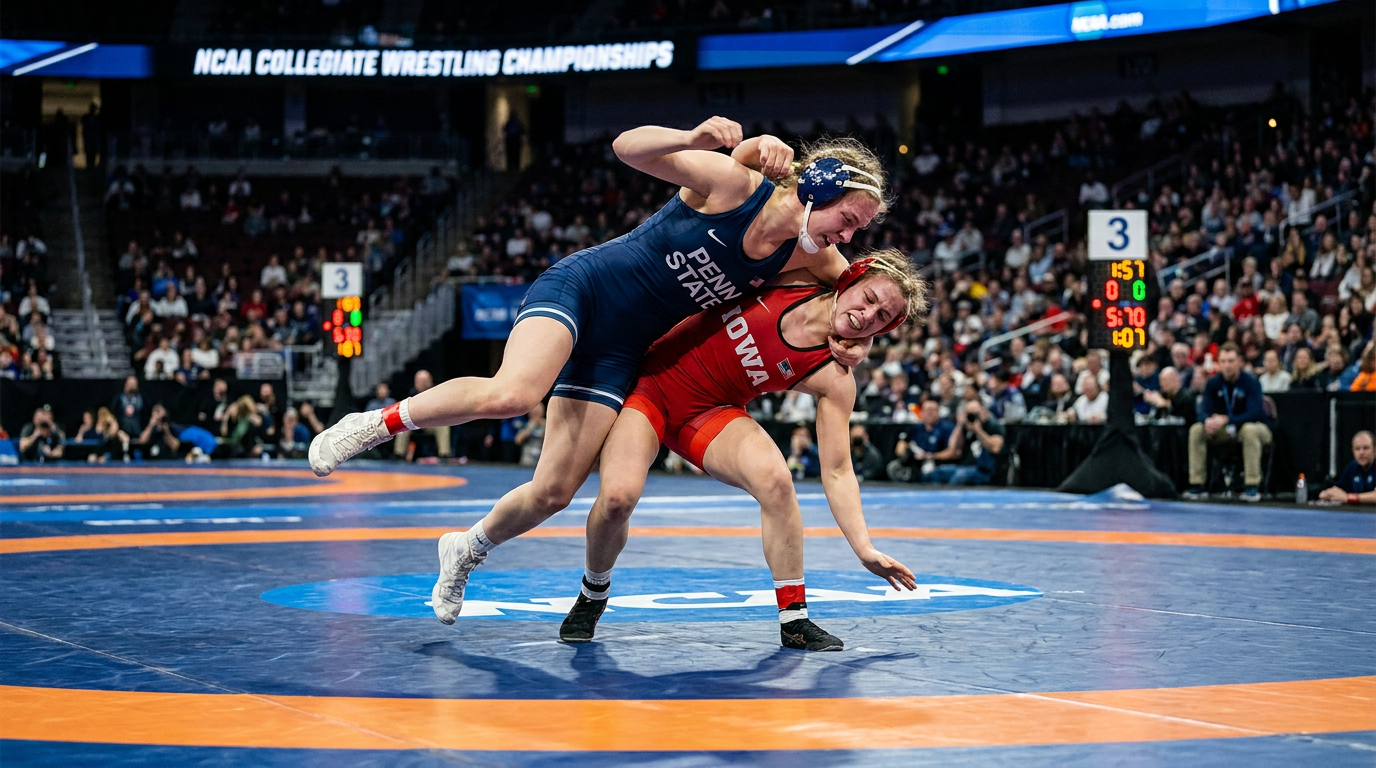
That grassroots explosion has finally forced the collegiate establishment to catch up. In March 2026, the NCAA hosted its first-ever sanctioned Division I Women's Wrestling Championship in Coralville, Iowa. The inaugural event was a massive success, crowning McKendree University as the first national team champion after a fiercely contested battle with the University of Iowa. The tournament featured packed arenas, national television coverage, and a level of technical proficiency that proved the sport had fully arrived on the collegiate stage.[1][6]

The momentum is accelerating rapidly among elite academic institutions as well. Just this month, Columbia University announced it will add women's wrestling as its 32nd varsity sport for the 2027-28 academic year, becoming the first Ivy League institution to make the leap. By elevating its highly successful club program to full varsity status, Columbia is signaling to the rest of the academic elite that women's wrestling is a premier athletic investment. The move is expected to trigger a domino effect among other top-tier universities, opening up prestigious new admission pathways and scholarship opportunities for female grapplers who previously had limited options for combining elite academics with Division I wrestling.[2]
But the rise of women's collegiate wrestling isn't just a story of Title IX compliance or participation trophies. It is fundamentally changing how the United States develops international talent, because women's collegiate wrestling uses an entirely different rulebook than the men's side. This structural divergence has created a fascinating dynamic where the women's collegiate system is actually better aligned with global standards than the century-old men's system, providing American women with a distinct advantage on the world stage.
To understand the revolution, you have to understand the mechanics of the mat. Men's collegiate wrestling in the U.S. utilizes "folkstyle," a distinctly American ruleset that evolved from catch-as-catch-can wrestling in the early 20th century. Folkstyle is deeply ingrained in the American scholastic system, taught in nearly every youth club, middle school, and high school boys' program across the country. It is the style that defines the legendary NCAA men's championships, emphasizing a grueling, grinding approach to combat that prioritizes positional dominance over sudden, explosive scoring.[4]
Folkstyle is fundamentally a game of grinding control. It rewards takedowns, escapes, and "riding time"—the ability to hold an opponent down on the mat and dictate the pace of the match. If a wrestler exposes their opponent's back to the mat, they must hold them there at a 45-degree angle for several seconds to earn "near fall" points. The defensive wrestler's primary goal on the bottom is to escape or reverse the position, leading to long, grueling scrambles on the mat.[4]

Women's collegiate wrestling, however, bypasses folkstyle entirely. Instead, the women compete in "freestyle," the international ruleset used at the Olympic Games and World Championships. Freestyle is the global standard for the sport, practiced by every other wrestling powerhouse from Japan to Russia. By adopting freestyle at the collegiate level, the NCAA has ensured that its female athletes are speaking the same physical language as their international peers. There is no domestic bubble for the women; their collegiate matches look exactly like the matches they will wrestle if they make Team USA.[4]
Women's collegiate wrestling, however, bypasses folkstyle entirely.
Freestyle is explosive, dynamic, and fast-paced. There is no reward for simply holding an opponent down; if action stalls on the mat, the referee quickly stands both wrestlers back up to their feet to resume the action. The defensive wrestler's goal on the bottom is not to escape, but simply to flatten out, defend their core, and avoid having their back turned. This creates a sport that is heavily focused on neutral-position takedowns and rapid, high-stakes turns on the mat, making it highly entertaining for spectators and demanding intense cardiovascular bursts from the athletes.[4]
Scoring in freestyle heavily favors "exposure." A wrestler earns points the moment their opponent's back breaks a 90-degree angle toward the mat, even for a fraction of a second. There is no need to hold the opponent in place; the mere flash of the back is enough to score. Furthermore, high-amplitude throws—lifting an opponent entirely off the mat and bringing them down securely—can score up to five points and instantly change the trajectory of a match. A wrestler can be losing for five minutes, execute one massive throw, and win the bout outright, keeping the stakes incredibly high until the final whistle.[4]

The decision to adopt freestyle for women's collegiate wrestling was born out of historical necessity rather than grand design. Because there was no existing scholastic infrastructure for girls decades ago, early female wrestlers were forced to compete outside the school system. They joined the USA Wrestling freestyle circuit, which aligned with international standards and offered the only viable path to high-level competition. When colleges finally began adding women's programs, they naturally adopted the freestyle ruleset that the girls were already wrestling in club tournaments, bypassing the folkstyle tradition entirely.[4][7]
This historical accident has become America's greatest strategic advantage on the global stage. U.S. male wrestlers who aspire to Olympic gold must spend years unlearning the folkstyle habits ingrained in them through high school and college. They have to learn how to defend their backs in scrambles, stop relying on riding time, and adjust to the rapid stand-ups of international referees. It is a notoriously difficult transition that often delays a male wrestler's international peak, as they must rewire their muscle memory to survive against foreign competitors who have wrestled freestyle since childhood.[4][7]
American women, by contrast, spend their entire collegiate careers mastering the exact ruleset they will use at the Olympics. The pipeline from an NCAA championship mat to an Olympic podium is direct and uninterrupted. A female collegiate champion does not need to spend two years adjusting her style; she is already fluent in the international game. This structural efficiency is a major reason why the U.S. women's freestyle team has become a dominant force in global competition, consistently producing world champions who transition seamlessly from their college wrestling rooms to the international stage.[4][7]
The transition hasn't been entirely seamless at the grassroots level. Because high school wrestling in the U.S. is still overwhelmingly dominated by folkstyle, many girls spend their teenage years wrestling folkstyle during the scholastic winter season, only to switch to freestyle in the summer. This dual-style requirement forces young female athletes to be incredibly adaptable, constantly shifting their tactical approach depending on the time of year and the tournament they are entering. It also places a heavy burden on high school coaches to understand both rulebooks.[3][4]
Grassroots coaches, many of whom only ever wrestled folkstyle themselves, are now having to educate themselves on the intricacies of freestyle exposure and par terre defense to properly prepare their female athletes for college recruiting. A high school girl who is a dominant folkstyle rider may find herself struggling in college if she hasn't developed a potent freestyle arsenal. Consequently, specialized freestyle clubs are springing up across the country to bridge the gap, providing dedicated freestyle training to ensure these young women are ready for the NCAA level.[4]

Yet, the growing pains are eclipsed by the sheer velocity of the sport's expansion. With 45 states now officially sanctioning girls' high school wrestling championships, the talent pool is deepening exponentially. Just a few years ago, in 2018, only six states offered sanctioned girls' championships. The rapid legislative adoption by state athletic associations has legitimized the sport, providing funding, dedicated coaching, and a clear path to the state podium for thousands of young athletes who previously had to wrestle in the shadows.[3]
The 2026 NCAA Championships featured 53 teams and 180 individual qualifiers, a field that will only grow as more Division I powerhouses follow the lead of Iowa and Columbia. The infrastructure is finally catching up to the demand. Universities are building dedicated women's locker rooms, hiring specialized freestyle coaching staffs, and offering full athletic scholarships to a demographic that was largely ignored by collegiate athletics just a decade ago. The arms race for top female wrestling talent has officially begun in the NCAA.[1][6]
For the tens of thousands of young women stepping onto the mat this year, the sport offers something profound: a space where they own 100 percent of their success and failure. They are competing in a style that prepares them to conquer the world, backed by an educational infrastructure that finally recognizes their value. The rise of women's wrestling is not just a triumph of athletic equity; it is the birth of an American dynasty that will dominate the Olympic podium for generations to come.[5]
How we got here
1990
Barely 100 girls are registered on high school wrestling rosters nationwide.
2004
Women's freestyle wrestling makes its official debut at the Athens Olympic Games.
2018
Only six U.S. states officially sanction girls' high school wrestling championships.
2020
The NCAA officially recognizes women's wrestling as part of its Emerging Sports for Women program.
March 2026
The NCAA hosts the first-ever sanctioned Women's Wrestling Championship in Coralville, Iowa.
June 2026
Columbia University becomes the first Ivy League school to add women's wrestling as a varsity sport.
Viewpoints in depth
Collegiate Athletic Directors
Focused on Title IX compliance, emerging sport status, and building competitive varsity programs.
For athletic directors, adding women's wrestling is increasingly seen as a high-value investment. The sport helps universities meet Title IX compliance by adding a large roster of female athletes, while also tapping into a rapidly growing recruiting base. The recent elevation of the sport to full NCAA Championship status has triggered an arms race, with programs rushing to build dedicated facilities and hire specialized freestyle coaching staffs to attract top-tier talent.
Olympic Pipeline Advocates
Value the freestyle ruleset for its direct translation to international and Olympic success.
Advocates for the Olympic pipeline view the collegiate adoption of freestyle as America's greatest structural advantage in the sport. Because American men wrestle folkstyle in college, they often spend years unlearning bad habits to compete internationally. American women, however, spend their entire collegiate careers mastering the exact ruleset they will use at the Olympics, creating a direct and uninterrupted pipeline that consistently produces world champions.
Grassroots Coaches
Navigate the logistical challenges of transitioning high school athletes from folkstyle to freestyle.
At the high school level, coaches face the friction of a dual-style system. Because most state-sanctioned high school wrestling is still folkstyle, girls must wrestle one rulebook during the winter scholastic season and switch to freestyle in the summer to get recruited by colleges. This places a heavy burden on grassroots coaches, who must educate themselves on the intricacies of freestyle exposure and par terre defense to properly prepare their athletes for the next level.
What we don't know
- Whether high school athletic associations will eventually transition girls' scholastic wrestling from folkstyle to freestyle to match the college level.
- How the influx of major Division I programs will affect the competitive balance of smaller universities that pioneered the sport.
Key terms
- Folkstyle
- The traditional American style of scholastic wrestling that emphasizes controlling an opponent on the mat and escaping from the bottom position.
- Freestyle
- The international and Olympic style of wrestling that emphasizes dynamic takedowns, back exposure, and fast-paced action without riding time.
- Amplitude Throw
- A high-scoring maneuver in freestyle wrestling where an opponent is lifted entirely off the mat and brought down in a controlled, sweeping motion.
- Near Fall
- Points awarded when a wrestler holds their opponent's shoulders at a 45-degree angle to the mat, exposing their back without securing a complete pin.
- Par Terre
- The grounded wrestling position where one wrestler is on their hands and knees while the opponent attempts to turn them to expose their back.
Frequently asked
Why do women wrestle freestyle in college instead of folkstyle?
Because early women's wrestling grew outside the scholastic system, it adopted the international freestyle ruleset. This has been maintained because it directly prepares athletes for the Olympics.
When did women's wrestling become an official NCAA championship sport?
It held its first official NCAA Division I Championship in March 2026 in Coralville, Iowa, with McKendree University winning the team title.
What is the main difference between freestyle and folkstyle?
Folkstyle rewards controlling an opponent on the mat (riding time), while freestyle rewards exposing an opponent's back to the mat and executing high-amplitude throws.
How many high school girls wrestle in the US?
As of recent data, over 87,000 girls participate in high school wrestling, making it the fastest-growing sport in the country.
Sources
Source coverage
7 outlets
3 viewpoints surfaced







[1]NCAACollegiate Athletic Directors
2026 National Collegiate Women's Wrestling Championships
Read on NCAA →[2]Columbia University AthleticsCollegiate Athletic Directors
Columbia To Add Women's Wrestling As 32nd Varsity Program
Read on Columbia University Athletics →[3]Fox NewsGrassroots Coaches
Girls' wrestling has become the fastest-growing high school sport in the country
Read on Fox News →[4]Coach ShannynOlympic Pipeline Advocates
Folkstyle vs. Freestyle | Understanding The Key Differences
Read on Coach Shannyn →[5]Factlen Editorial Team
Synthesis by Factlen editorial team
Read on Factlen Editorial Team →[6]Wikipedia
2026 NCAA Women's Wrestling Championships
Read on Wikipedia →[7]USA WrestlingOlympic Pipeline Advocates
The Growth of Women's Freestyle Wrestling
Read on USA Wrestling →


Every angle. Every day.
Get sports stories with full source coverage and perspective breakdowns delivered to your inbox.