
From Sustaining to Healing: How Regenerative Viticulture is Rewriting the Rules of Wine
Winemakers globally are moving beyond organic farming to 'regenerative viticulture,' a holistic approach that actively rebuilds soil health, sequesters carbon, and improves wine quality.
By Factlen Editorial Team
- Certification Advocates
- Argue that strict, third-party verification is necessary to prevent greenwashing and ensure measurable ecological outcomes.
- Context-Driven Practitioners
- Believe regenerative agriculture is a flexible philosophy, warning that rigid certification checklists stifle local adaptation.
- Scientific & Educational Community
- Focus on the empirical data behind carbon sequestration, water retention, and the resulting improvements in wine quality.
What's not represented
- · Conventional agrochemical suppliers facing reduced demand
- · Discount wine producers who rely on high-yield, low-cost farming
Why this matters
As climate change threatens traditional wine regions with extreme heat and drought, regenerative practices offer a proven path to make vineyards more resilient. By turning agricultural land into a carbon sink, this movement not only fights global warming but also produces more complex, terroir-driven wines.
Key points
- Regenerative viticulture shifts the focus from minimizing environmental harm to actively rebuilding vineyard ecosystems.
- Key practices include multi-species cover cropping, eliminating tillage, and integrating livestock to naturally manage weeds.
- Healthier, biologically active soils act as carbon sinks and retain significantly more water, boosting climate resilience.
- Increased biodiversity in the vineyard fosters robust native yeast populations, leading to more complex and stable wine fermentations.
For decades, the wine industry's environmental benchmark was "sustainability"—a pledge to minimize chemical inputs and reduce harm to the surrounding landscape. But as extreme weather, prolonged droughts, and degraded soils increasingly threaten the world's most storied terroirs, a radically different philosophy is taking root among top producers.[3]
Enter regenerative viticulture: an agricultural model that shifts the goalpost from merely sustaining the land to actively healing it. Rather than treating the vineyard as a sterile, highly controlled factory for grape production, this approach manages the estate as a complex, interdependent, and living ecosystem.[1][4]
The distinction between organic and regenerative farming is subtle but profound. While organic certification primarily dictates what a farmer cannot do—such as using synthetic pesticides, herbicides, or fertilizers—regenerative agriculture prescribes what a farmer must do to rebuild ecological health and vitality from the ground up.[1][5]
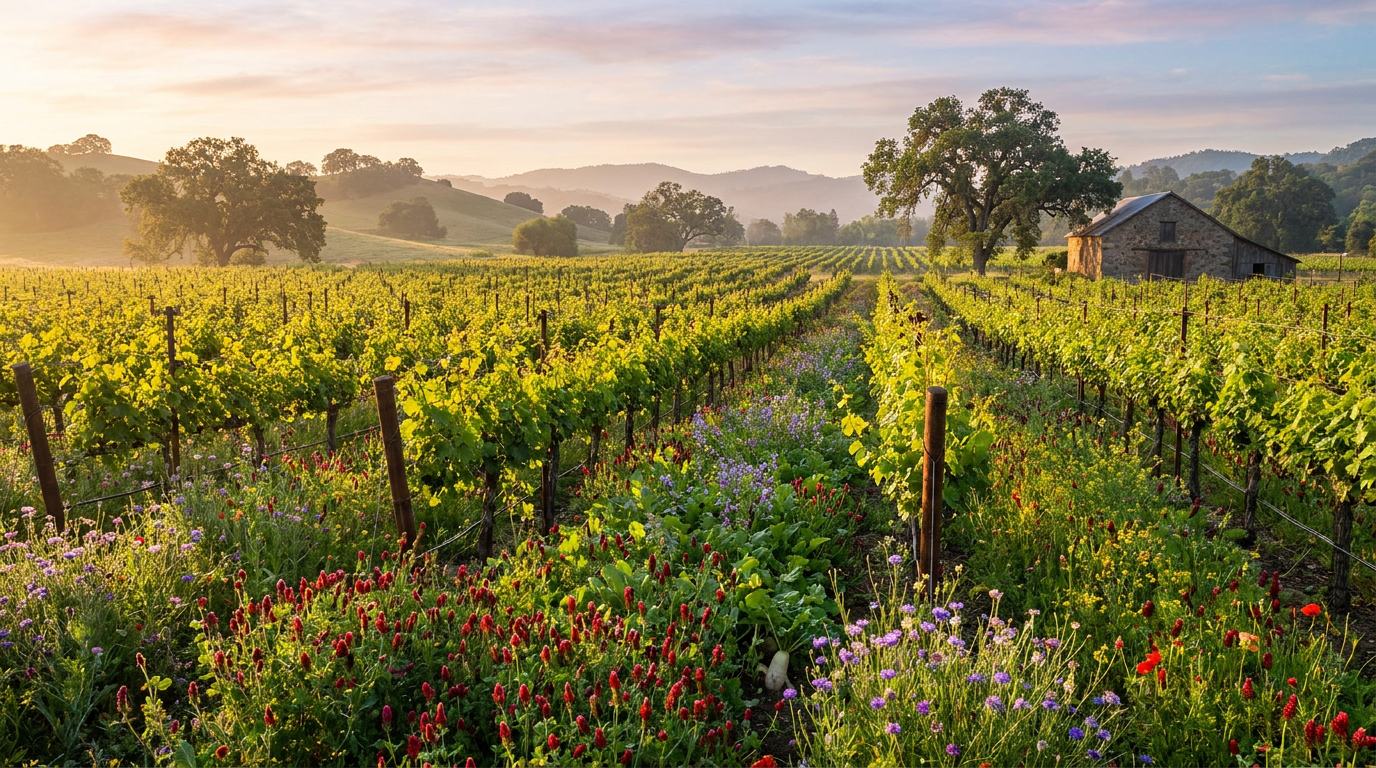
At the ground level, the mechanism relies on abandoning the century-old practice of maintaining bare, tilled soil between vine rows. Instead, growers plant multi-species cover crops—such as radishes, clovers, and native grasses—which prevent erosion, fix nitrogen in the soil, and provide a thriving habitat for beneficial insects.[3][4]

Tillage is heavily reduced or eliminated entirely. Traditional plowing releases stored carbon into the atmosphere and destroys the delicate mycorrhizal fungal networks that help vine roots absorb essential nutrients. By leaving the soil undisturbed, the earth acts as a massive carbon sink, actively drawing down atmospheric CO2 and mitigating climate change.[1][4][7]
Animal integration is another hallmark of the regenerative toolkit. Flocks of sheep, or sometimes even cattle, are frequently rotated through the vineyard during the dormant winter season. They graze on the cover crops, naturally managing weed growth, while their manure provides a potent, biologically active fertilizer that eliminates the need for synthetic alternatives.[5][6]
The benefits of these practices extend far beyond carbon math. Healthy, biologically active soils act like a sponge. In regions facing severe drought, soils rich in organic matter retain significantly more water, allowing dry-farmed vines to survive prolonged heatwaves that would otherwise shut down photosynthesis and ruin a vintage.[4][7]
The benefits of these practices extend far beyond carbon math.
But does this ecological overhaul actually change the wine in the glass? Winemakers overwhelmingly argue that it fundamentally improves quality. A biologically diverse vineyard fosters a much more robust and varied population of native yeasts on the grape skins.[1][3]

This native yeast diversity leads to more stable, complex fermentations in the cellar. It reduces the need for winemaking interventions—like adding commercial yeast strains or adjusting acidity—resulting in a truer, more vibrant expression of the vineyard's specific terroir.[3]
As the movement gains momentum, the landscape of certification is rapidly evolving to keep pace. The Regenerative Viticulture Alliance (RVA), in partnership with the Regenerative Viticulture Foundation, recently launched a global standard specifically tailored to the unique demands of winegrowing.[7]
Other prominent frameworks include Regenerative Organic Certified (ROC), pioneered by the Rodale Institute, and Certified Regenerative by A Greener World (AGW). These programs require rigorous soil testing and continuous improvement metrics, guarding against the risk of "greenwashing" by producers looking to capitalize on a trendy buzzword without doing the hard work.[2][6]
However, the push for strict certification is not universally embraced. Some viticulturists argue that regenerative farming is a philosophy, not a checklist, and is highly context-specific. What works in the damp, cool climate of New Zealand might fail spectacularly in the arid, high-altitude soils of Argentina.[2][5]

The transition itself is not without significant hurdles. Converting a conventional vineyard to a regenerative system requires a steep learning curve and often results in a temporary drop in yields as the vines adapt to competing with cover crops for water and nutrients.[1][5]
This transition period can strain a winery's profitability, requiring financial resilience and a long-term perspective. Furthermore, the specialized knowledge required to manage a complex ecosystem increases labor costs and demands highly skilled vineyard workers who understand ecology as well as they understand agriculture.[1]
Despite these challenges, the momentum appears unstoppable. The Regenerative Viticulture Foundation has set an ambitious target: to see 10% of the world's vineyards farmed regeneratively by 2035, a massive leap from the current landscape.[3]
For an industry deeply tethered to the rhythms of nature, regenerative viticulture offers more than just a climate mitigation strategy. It represents a fundamental rethinking of the relationship between the farmer, the soil, and the glass—proving that the best way to preserve the future of wine is to bring the earth back to life.[3][8]
How we got here
1980s
The Rodale Institute pioneers the broader concept of 'regenerative organic agriculture.'
2010s
Forward-thinking wineries begin experimenting with no-till and cover-cropping under the umbrella of agroecology.
2022
Domaine Bousquet becomes the first South American winery to achieve Regenerative Organic Certified (ROC) status.
2023
The Regenerative Viticulture Alliance (RVA) is formed to create wine-specific global standards.
April 2024
The RVA's international certification officially comes into force, providing a dedicated framework for vineyards.
Viewpoints in depth
Certification Advocates
Argue that without strict, third-party verification, 'regenerative' will become a meaningless marketing buzzword.
Proponents of formal certification frameworks, such as the Regenerative Viticulture Alliance (RVA) and Regenerative Organic Certified (ROC), believe that accountability is essential for the movement's credibility. They argue that without rigorous soil testing, independent audits, and continuous improvement metrics, producers will inevitably use 'regenerative' as a greenwashing tool to charge premium prices. By standardizing the definition, they aim to provide consumers with absolute confidence that the wine they purchase is genuinely contributing to carbon drawdown and biodiversity restoration.
Context-Driven Practitioners
Argue that regenerative agriculture is a philosophy, not a checklist, and resist rigid certification.
Many viticulturists who practice regenerative farming are wary of formal certification, arguing that a one-size-fits-all standard cannot account for the vast differences between global terroirs. A practice that works perfectly in the damp, cool climate of New Zealand might be disastrous in the arid, high-altitude soils of Argentina. These practitioners advocate for a flexible, localized approach where farmers are empowered to experiment and adapt to their specific ecosystems, rather than being forced to comply with a rigid set of rules designed in a boardroom.
What we don't know
- How climate change will shift the baseline metrics for soil carbon sequestration in traditionally arid wine regions.
- Whether consumers are willing to pay a premium for regenerative certifications compared to established organic labels.
- The long-term economic impact on large-scale commercial vineyards transitioning away from high-yield conventional farming.
Key terms
- Regenerative Viticulture
- An agricultural approach that actively restores vineyard soil health and biodiversity, rather than just minimizing environmental harm.
- Cover Cropping
- The practice of planting diverse plant species between vine rows to prevent erosion, fix nitrogen, and support insect life.
- No-Till Farming
- Growing crops without disturbing the soil through tillage, which helps preserve fungal networks and keep carbon locked in the ground.
- Mycorrhizal Fungi
- Beneficial fungi in the soil that form a symbiotic relationship with vine roots, helping them absorb water and nutrients.
- Terroir
- The complete natural environment in which a particular wine is produced, including factors such as the soil, topography, and climate.
Frequently asked
What is the difference between organic and regenerative wine?
Organic farming primarily restricts the use of synthetic chemicals. Regenerative farming goes further by requiring active improvement of the ecosystem, such as rebuilding soil carbon and increasing biodiversity.
Does regenerative farming make wine taste better?
Many winemakers report that healthier soils and increased biodiversity lead to better native yeast populations, resulting in more complex and stable fermentations.
Why do regenerative vineyards use sheep?
Sheep are used to naturally graze down cover crops and weeds, while their manure provides a biologically active, natural fertilizer, eliminating the need for tractors and synthetic chemicals.
Sources
Source coverage
8 outlets
3 viewpoints surfaced








[1]Wine & Spirit Education TrustScientific & Educational Community
An introduction to regenerative viticulture
Read on Wine & Spirit Education Trust →[2]Regenerative Viticulture FoundationContext-Driven Practitioners
Certification
Read on Regenerative Viticulture Foundation →[3]International Wine ChallengeScientific & Educational Community
The Rise of Regenerative Viticulture
Read on International Wine Challenge →[4]OENO OneScientific & Educational Community
Regenerative viticulture and climate change resilience
Read on OENO One →[5]New Zealand WineContext-Driven Practitioners
Regenerative Viticulture
Read on New Zealand Wine →[6]A Greener WorldCertification Advocates
Certified Regenerative
Read on A Greener World →[7]Familia TorresCertification Advocates
The first international certification in regenerative viticulture comes into force
Read on Familia Torres →[8]Factlen Editorial TeamScientific & Educational Community
Synthesis by Factlen editorial team
Read on Factlen Editorial Team →


Every angle. Every day.
Get food drink stories with full source coverage and perspective breakdowns delivered to your inbox.