
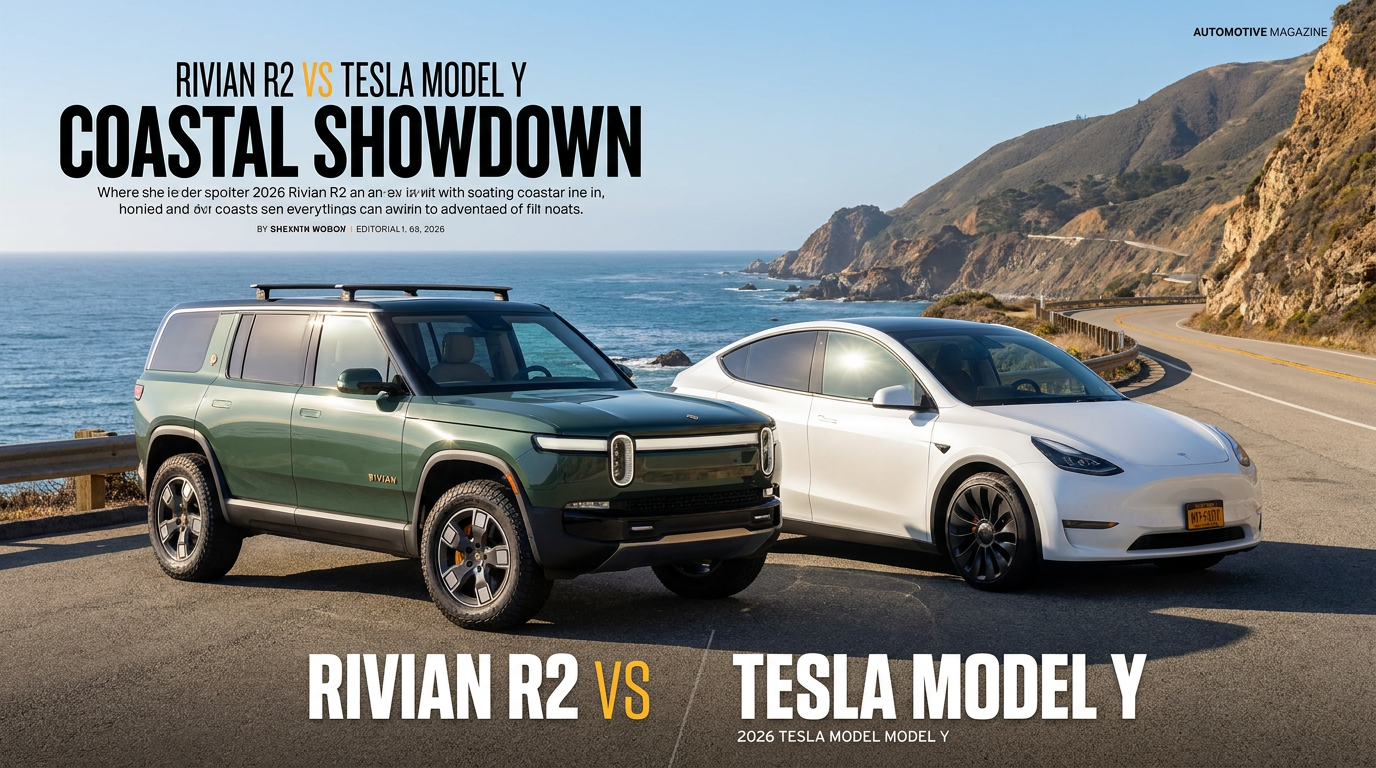
2026 Rivian R2 vs. Tesla Model Y: Comparing the Leading Midsize Electric SUVs
As Rivian's highly anticipated R2 hits the market to challenge Tesla's refreshed Model Y, buyers face a choice between rugged off-road utility and aerodynamic on-road efficiency.
By Factlen Editorial Team
- On-Road Efficiency Advocates
- Prioritize aerodynamic design, highway range, and sports-sedan handling.
- Outdoor Utility Seekers
- Value ground clearance, cargo volume, and rugged versatility over wind tunnel metrics.
- Value and Availability Shoppers
- Focus on immediate delivery timelines, starting prices, and proven manufacturing scale.
What's not represented
- · Traditional legacy automakers
- · Buyers requiring three rows of seating
Why this matters
The midsize SUV is the most popular vehicle segment in the world. As electric vehicle adoption matures, choosing between the Model Y and the R2 dictates whether your daily driver is optimized for highway commuting or weekend wilderness adventures.
Key points
- The 2026 Tesla Model Y and Rivian R2 represent two distinct approaches to the midsize electric SUV segment.
- Tesla's Model Y prioritizes aerodynamic efficiency, sports-sedan handling, and a lower starting price of $39,990.
- Rivian's R2 focuses on rugged utility, offering 9.6 inches of ground clearance and 90.1 cubic feet of cargo space.
- Both vehicles feature native NACS charging ports, granting seamless access to the Tesla Supercharger network.
- The R2 Performance is currently available for $57,990, with more affordable trims delayed until 2027.
The 2026 electric vehicle market has matured, and the midsize SUV segment is now a definitive two-horse race for premium buyers. Tesla's Model Y, fresh off its comprehensive "Juniper" update, defends its crown as the world's best-selling electric vehicle by addressing its most persistent historical criticisms. Meanwhile, Rivian's highly anticipated R2 has officially arrived on public roads, bringing the brand's rugged, outdoor-focused ethos to a more accessible footprint. These two vehicles represent the pinnacle of current EV engineering, yet they cater to entirely different lifestyles.[2][11]
While both vehicles occupy a similar physical footprint and target the exact same demographic, their engineering philosophies could not be more different. The Model Y prioritizes aerodynamic slipperiness and on-road driving dynamics, utilizing a sleek, teardrop shape to cut through the air with minimal resistance. The R2 intentionally sacrifices wind resistance in favor of boxy utility, maximum cargo volume, and genuine off-road capability. This fundamental divergence in design dictates every trade-off a prospective buyer must weigh when choosing between the two platforms, setting the stage for a fascinating comparison.[8]
When evaluating price and availability, the trade-offs are immediate. The case for the Tesla Model Y rests on its lower barrier to entry and immediate availability; the rear-wheel-drive model starts at a highly competitive $39,990 today. The case against the Rivian R2 is its top-down launch strategy. While Rivian promises a $44,990 standard model, the evidence shows that only the $57,990 Performance Launch Edition is available in mid-2026. This forces budget-conscious buyers to either stretch their finances for the top-tier Rivian or wait until the summer of 2027 for the entry-level trims to arrive.[2][6]

In the realm of straight-line performance, both SUVs deliver staggering numbers that rival traditional sports cars. The case for the Rivian R2 Performance is its sheer brute force, utilizing a dual-motor setup to produce an immense 656 horsepower and 609 pound-feet of torque. The case against it is its heavier curb weight, which blunts that power slightly off the line. The evidence shows the lighter Tesla Model Y Performance is actually quicker, hitting 60 mph in roughly 3.3 seconds compared to the Rivian's 3.6 seconds, giving the Tesla a slight edge in pure acceleration.[4][6]
Range and efficiency present a fascinating engineering battle between aerodynamics and battery management. The case for the Model Y is its teardrop shape, which achieves a remarkably low 0.22 drag coefficient, allowing the AWD Premium trim to extract 327 miles of range. The case against the R2 is its upright, boxy greenhouse, which theoretically requires more energy to push through the air. However, the evidence reveals a surprising triumph for Rivian: the R2 Performance achieves a 109 MPGe rating, eking out 330 miles of range on 21-inch wheels, narrowly beating the Tesla despite carrying an extra 370 pounds.[7][8][11]
Range and efficiency present a fascinating engineering battle between aerodynamics and battery management.
Charging infrastructure, once a decisive and exclusive advantage for Tesla, is now a dead heat. Both the Model Y and the Rivian R2 feature native North American Charging Standard (NACS) ports built directly into the vehicles. The evidence confirms that Rivian owners can plug seamlessly into Tesla's sprawling Supercharger network without needing a cumbersome adapter. Both vehicles are capable of charging from a 10 percent to 80 percent state of charge in under 30 minutes, effectively neutralizing charging anxiety as a deciding factor between the two brands.[5]
Off-road capability is where the two vehicles diverge completely, highlighting their distinct target audiences. The case for the Rivian R2 is its purpose-built trail geometry. The evidence includes 9.6 inches of ground clearance, a 25-degree approach angle, and a 26-degree departure angle, making it genuinely capable of crawling over rocks and deep ruts. The case against the Model Y is its 6.0-inch ground clearance, which strictly limits the Tesla to paved roads and well-graded gravel driveways, leaving it vulnerable to undercarriage damage on serious trails.[3][8]

Interior space and cargo utility heavily favor the boxy challenger. The case for the R2 is its cavernous, van-like interior when the seats are folded completely flat. The evidence shows the Rivian offers 90.1 cubic feet of total storage, including a 5.2 cubic-foot front trunk, easily swallowing lumber, bicycles, or extensive camping gear. The case against the Model Y is its sloping roofline, which restricts taller cargo and caps total storage at 76 cubic feet, though its lower load floor does make lifting heavy items slightly easier for daily errands.[3][7][12]
Cabin technology and comfort reveal different priorities for daily driving. The case for the Model Y "Juniper" update is its refined, minimalist luxury. The evidence points to new acoustic glass that drastically reduces wind noise, a dedicated 8-inch rear passenger screen, and customizable ambient lighting. The case against the Tesla remains its stubborn refusal to include a driver's instrument cluster. The Rivian R2 counters by providing a dedicated digital driver display, tactile steering wheel dials, and a rugged, nature-inspired cabin built with materials designed for easy cleaning after a weekend outdoors.[9][11][13]
Driving dynamics highlight the contrast between a raised sports sedan and a traditional sport utility vehicle. The case for the Model Y is its sharp, direct steering and planted cornering, making it genuinely fun and engaging on a twisty mountain road. The case against it is a firmer ride that transmits more road imperfections into the cabin. The evidence shows the Rivian R2 utilizes a sophisticated semi-active suspension that absorbs potholes and trail bumps beautifully, though it exhibits noticeably more body roll when pushed hard in tight corners.[9]

Ultimately, choosing between these two exceptional electric SUVs comes down to a buyer's specific lifestyle and purchasing timeline. The Tesla Model Y fits well when a buyer prioritizes maximum on-road efficiency, sports-car handling, immediate availability across all trims, and a sub-$45,000 purchase price. It does not fit well when the owner regularly tackles rough terrain, needs to haul bulky, boxy furniture, or prefers a traditional dashboard layout with a dedicated screen behind the steering wheel for crucial driving information.[6]
Conversely, the Rivian R2 fits well when a buyer wants distinctive, rugged styling, genuine off-road capability, and maximum interior volume for outdoor gear or car-camping. It does not fit well when the buyer is shopping on a strict budget in 2026, as the affordable trims remain a year away, or when maximum aerodynamic efficiency for high-speed cross-country driving is the absolute top priority. Both vehicles prove that the electric vehicle market has evolved to offer zero-compromise solutions tailored to highly specific consumer needs.[10]
How we got here
2020
Tesla launches the original Model Y, which eventually becomes the world's best-selling vehicle.
March 2024
Rivian officially unveils the R2 midsize SUV, promising a more accessible price point.
Late 2025
Tesla rolls out the comprehensive 'Juniper' refresh for the Model Y, improving ride quality and cabin noise.
Spring 2026
Rivian begins customer deliveries of the top-tier R2 Performance Launch Edition.
Summer 2027
Rivian is scheduled to release the entry-level $44,990 Standard trim of the R2.
Viewpoints in depth
On-Road Efficiency Advocates
Prioritize aerodynamic design, highway range, and sports-sedan handling.
This camp argues that the vast majority of SUV owners never take their vehicles off-road, making the aerodynamic penalties of boxy designs unnecessary. They point to the Model Y's 0.22 drag coefficient and lighter weight as the ideal engineering solution for daily commuting and high-speed highway travel, where wind resistance is the primary enemy of electric range.
Outdoor Utility Seekers
Value ground clearance, cargo volume, and rugged versatility over wind tunnel metrics.
This perspective champions the Rivian R2's design, arguing that an SUV should actually be capable of sport and utility. They highlight the 9.6 inches of ground clearance and 90.1 cubic feet of flat-folding cargo space as essential for camping, hauling gear, and navigating rough trails. To this camp, the slight hit to high-speed efficiency is a worthy trade-off for a vehicle that can genuinely go anywhere.
Value and Availability Shoppers
Focus on immediate delivery timelines, starting prices, and proven manufacturing scale.
For buyers focused on the bottom line, the debate is settled by the calendar and the window sticker. This camp emphasizes that while the R2 is an impressive machine, its $57,990 launch price in 2026 puts it out of reach for mainstream buyers. They argue the Model Y's $39,990 entry point and immediate availability make it the only realistic choice for families shopping on a strict budget today.
What we don't know
- How the Rivian R2's long-term reliability will compare to the mature, highly iterated manufacturing process of the Tesla Model Y.
- Whether Rivian will hit its exact summer 2027 delivery target for the entry-level $44,990 Standard trim.
- How the resale values of both vehicles will hold up as the EV market continues to experience rapid depreciation.
Key terms
- NACS
- North American Charging Standard, the charging plug design originally developed by Tesla and now adopted by Rivian and other automakers.
- MPGe
- Miles Per Gallon Equivalent, a metric used by the EPA to compare the energy efficiency of electric vehicles to traditional gas-powered cars.
- Drag Coefficient
- A measurement of how aerodynamic a vehicle is; a lower number means the car slips through the air with less wind resistance.
- Frunk
- A front trunk, utilizing the space under the hood where a traditional gas engine would normally sit.
Frequently asked
Does the Rivian R2 use the Tesla Supercharger network?
Yes, the Rivian R2 comes equipped with a native NACS port, allowing it to plug directly into Tesla Superchargers without an adapter.
Which SUV is faster from 0 to 60 mph?
The Tesla Model Y Performance is slightly quicker, hitting 60 mph in roughly 3.3 seconds, compared to the Rivian R2 Performance's 3.6 seconds.
How much cargo space does the Rivian R2 have?
The Rivian R2 offers a total of 90.1 cubic feet of cargo space with the seats folded flat, which includes a 5.2 cubic-foot front trunk.
Is the $45,000 Rivian R2 available now?
No, Rivian is launching the R2 with the $57,990 Performance trim in 2026. The $44,990 Standard trim is expected to arrive in summer 2027.
Sources
Source coverage
13 outlets
3 viewpoints surfaced












[1]TrueCarValue and Availability Shoppers
2026 Rivian R2 Specs & Features
Read on TrueCar →[2]CleanTechnicaValue and Availability Shoppers
Rivian R2 Delivery Timeline
Read on CleanTechnica →[3]RivianOutdoor Utility Seekers
Rivian R2: Size it up
Read on Rivian →[4]Car and DriverValue and Availability Shoppers
2027 Rivian R2 Details, Pricing, and Specs
Read on Car and Driver →[5]EdmundsValue and Availability Shoppers
The Rivian R2 hits the heart of the EV market
Read on Edmunds →[6]Road EthosOn-Road Efficiency Advocates
Tesla Model Y: An Honest Comparison For 2026 Buyers
Read on Road Ethos →[7]CarBuzzOutdoor Utility Seekers
Here's every way the new SUV is ready to beat the Model Y
Read on CarBuzz →[8]ElectrekOutdoor Utility Seekers
Rivian R2 vs Tesla Model Y spotted side-by-side: Detailed size comparison
Read on Electrek →[9]carwowValue and Availability Shoppers
Rivian R2 vs Tesla Model Y: prices and standard equipment
Read on carwow →[10]AutoblogOutdoor Utility Seekers
Tesla Model Y vs Rivian R2
Read on Autoblog →[11]EVXLOn-Road Efficiency Advocates
2026 Tesla Model Y Juniper refresh
Read on EVXL →[12]Auto TVOn-Road Efficiency Advocates
2026 Tesla Model Y Juniper Review
Read on Auto TV →Model Y Juniper 6 Month Review
Read on Matt in Tech →
Every angle. Every day.
Get automotive stories with full source coverage and perspective breakdowns delivered to your inbox.