
The Science of Gymnastics Longevity: How the Sport's Peak Age is Defying History
Advances in biomechanics, load management, and the rise of NCAA opportunities are allowing elite gymnasts to compete safely into their mid-twenties, fundamentally changing the sport's timeline.
By Xia Wu

For decades, the timeline of an elite female gymnast was as rigid as the balance beam she competed on. The sport demanded early specialization, with athletes often reaching their absolute peak by age 16 and retiring before they could legally vote. The prevailing wisdom was that the acrobatic demands of the sport were strictly a young teenager's game, reliant on pre-pubescent biomechanics and fearless repetition.[3]
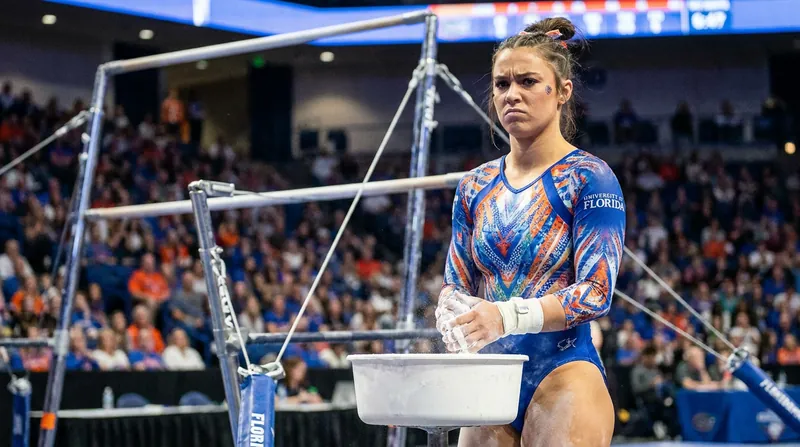
But a profound demographic and scientific shift is rewriting the rules of gymnastics. Today, the sport's biggest stars are competing—and winning—well into their twenties. The 2025 NCAA women's gymnastics season featured 14 recent Olympians or Olympic alternates competing at the collegiate level, many of whom are now actively training to return to the elite international stage for the World Championships in Jakarta.
This evolution from a "teenage-only" sport to one that supports long, sustainable careers is not an accident. It is the result of a quiet revolution in sports science, biomechanics, and collegiate athletics that has fundamentally changed how gymnasts train, recover, and compete.[5]
Historically, the data painted a stark picture of early peaks. Research published in The Journal of Human Sport and Exercise analyzing Olympic data found that the average age of a successful female artistic gymnast was historically just 19 years old, compared to 24 for male gymnasts. This disparity was largely attributed to the physiological changes that occur during female puberty, which coaches previously viewed as a career-ending hurdle rather than a natural developmental phase.[3]
The turning point in injury prevention came when sports medicine began treating the adolescent growth spurt—known clinically as Peak Height Velocity (PHV)—as a critical risk window rather than a training obstacle. According to research in the British Journal of Sports Medicine, the probability of injury in young gymnasts spikes significantly when they reach approximately 90% of their predicted adult height.[1]
During this period, bones grow faster than the surrounding muscles and tendons can lengthen, leading to temporary losses in flexibility, relative strength, and even spatial awareness. In the past, coaches would push athletes through this clumsy phase, resulting in catastrophic overuse injuries. Today, evidence-based programs emphasize monitoring training load and reducing high-impact landings during PHV, allowing the athlete's neuromuscular system to adapt safely.[1][4]
Modern training facilities have replaced the brute-force repetition of the 1990s with sophisticated load management. Instead of simply counting the hours spent in the gym, sports scientists now track the exact number of rotations and the height of landings. Some programs even utilize wearable accelerometers to measure the cumulative G-forces absorbed by a gymnast's joints over a week, ensuring they do not cross the threshold into overtraining.[1][5]
The International Gymnastics Federation (FIG) has also stepped in to protect the developmental pipeline. Their updated Age Group Program explicitly prioritizes the quality of movement and the long-term health of children over the early acquisition of high-difficulty skills. By discouraging extreme difficulty before an athlete's body is mature enough to handle the sheer forces involved, the sport is preserving its athletes for their adult years.[4]
But perhaps the most surprising revelation about gymnastics training is its long-term impact on human health. While the sport is undeniably grueling, surviving its elite ranks appears to confer a massive biological advantage. A massive 2024 study published in GeroScience analyzed the lifespans of over 95,000 elite athletes across various disciplines to determine which sports actually move the needle on human longevity.[2]
The results challenged the traditional dominance of "pure cardio" sports. Gymnasts topped the longevity leaderboard, living an average of 8.2 years longer than the general population. They outpaced endurance cyclists, who gained 2.0 years, and were matched only by pole vaulters. Researchers attributed this to the "Broad Skill Hypothesis"—the idea that diverse, complex movement patterns build a more resilient human body.[2]
Unlike repetitive, linear sports such as running or cycling, gymnastics demands a unique combination of high-level neuromuscular coordination, explosive power, and full-body load-bearing. This diverse physical portfolio builds exceptional bone density and balance, which serve as the ultimate insurance policy against age-related physical decline and falls later in life.[2][5]
Beyond the science of training, the cultural landscape of the sport has been transformed by the NCAA. In the United States, collegiate gymnastics has become a massive commercial success, offering a vibrant, team-oriented environment that contrasts sharply with the isolating pressure of elite international competition.
The advent of Name, Image, and Likeness (NIL) rights has further changed the calculus for top athletes. Gymnasts no longer have to choose between turning professional to secure endorsements and maintaining their collegiate eligibility. They can now earn substantial incomes while competing for their universities, removing the financial pressure to retire early and cash in on a fleeting Olympic moment.
This collegiate pipeline has created a "boomerang" effect. Athletes are competing in the Olympics at 16 or 18, enjoying a four-year NCAA career where they compete weekly in front of sold-out arenas, and then returning to the elite international stage in their early-to-mid twenties with renewed passion and physical maturity.[5]
The psychological benefits of this dual-track system cannot be overstated. By providing a joyful, team-centric outlet for their talents, the NCAA system helps prevent the severe burnout that historically plagued the sport. Athletes are learning that their worth is not tied to a single quadrennial event, allowing them to approach competition with a healthier, more sustainable mindset.[5]
The evolution of gymnastics scoring has also played a subtle but vital role. The shift from the "Perfect 10" to an open-ended Code of Points initially sparked fears that athletes would destroy their bodies chasing infinite difficulty. Instead, mature athletes have learned to strategically construct routines that maximize their specific strengths—whether that is explosive power or artistic execution—while minimizing unnecessary wear and tear.[5]
Ultimately, the narrative of the broken, discarded teenage gymnast is being replaced by a new archetype: the resilient, empowered adult athlete. By embracing biomechanical science, respecting the adolescent growth spurt, and providing viable collegiate pathways, gymnastics has engineered a blueprint for athletic longevity. It is a profound victory not just for the sport, but for the athletes who can now spend their prime years actually enjoying the heights they have reached.[5]
The essentials
- Historically, female gymnasts peaked at age 19 and retired early due to the physical toll of the sport.
- Modern sports science now manages training loads during the adolescent growth spurt to prevent catastrophic injuries.
- A 2024 study found that elite gymnasts live an average of 8.2 years longer than the general population.
- The NCAA provides a financially viable, team-oriented environment that keeps athletes in the sport longer.
- Many gymnasts are now returning to elite international competition in their mid-twenties after successful college careers.
Timeline
1990s
The era of early specialization, where female gymnasts routinely peaked at age 16 and retired shortly after.
2006
The International Gymnastics Federation abandons the 'Perfect 10' in favor of the open-ended Code of Points.
2021
The NCAA implements NIL rules, allowing collegiate gymnasts to earn endorsement income without turning professional.
2024
A major GeroScience study reveals that elite gymnasts live an average of 8.2 years longer than the general population.
2025
The NCAA gymnastics season features 14 recent Olympians, cementing the dual-track pipeline for adult athletes.
- Sports Scientists
- Focus on load management, the 'Broad Skill Hypothesis,' and navigating the adolescent growth spurt to prevent injury.
- NCAA & Elite Athletes
- Emphasize the cultural shift, the financial viability of NIL, and the psychological benefits of competing joyfully into adulthood.
- Youth Development Programs
- Prioritize the long-term health of children over early difficulty, aligning with updated international guidelines.
Perspectives this story doesn't cover
- Recreational gymnasts who do not reach the elite or NCAA level
Sources
Source coverage
5 outlets
3 viewpoints surfaced





- [1]British Journal of Sports MedicineSports Scientists
Coach awareness and practice in relation to growth/maturation and training load in young competitive gymnasts
Read on British Journal of Sports Medicine → - [2]GeroScienceSports Scientists
Elite athlete longevity and the broad skill hypothesis
Read on GeroScience → - [3]The Journal of Human Sport and ExerciseSports Scientists
Age of peak performance in Olympic sports
Read on The Journal of Human Sport and Exercise → - [4]International Gymnastics FederationYouth Development Programs
FIG Age Group Program: Health and Safety
Read on International Gymnastics Federation → - [5]Factlen Editorial TeamNCAA & Elite Athletes
Synthesis by Factlen editorial team
Read on Factlen Editorial Team →
More in Sports
See all →Injury
Abi Martin's Resilient Return: British Gymnast Overcomes Injury to Headline Commonwealth Games
6 sources
Standings
Pan American Gymnastics Standings: USA, Brazil, and Canada Secure World Championship Berths After Rio Showdown
5 sources
Injury
Gymnastics Injury Report: Rebeca Andrade and Adam Tobin Headline a Summer of Strategic Returns
2 sources
Injury
NCAA Gymnastics Injury Report: Alexis Jeffrey and Creslyn Brose Headline a Season of Resilient Returns
6 sources
Comments
Every angle. Every day.
Get Sports stories with full source coverage and perspective breakdowns, free every day.