
The Era of the 7-Year Smartphone: How Extended Software Updates Are Changing How We Buy Phones
Apple, Google, and Samsung now guarantee seven years of software updates for their flagship devices. This industry-wide shift is saving consumers money, reducing e-waste, and making battery replacements the new standard for phone maintenance.
By Factlen Editorial Team
- Consumer Advocates
- Emphasize the financial savings and security benefits of long-term support.
- Environmental Organizations
- Focus on the reduction of e-waste and the massive carbon savings of delayed upgrades.
- Tech Manufacturers & Analysts
- Frame the extended support as a premium feature that justifies higher upfront device costs.
- Enterprise IT Managers
- Value the extended security patches for managing corporate device fleets over longer cycles.
What's not represented
- · Independent repair shops facing changing battery replacement demand
- · Budget smartphone manufacturers struggling to meet the 5-year EU mandate
Why this matters
For the first time, the limiting factor on your smartphone's lifespan is no longer the software, but the physical battery. Understanding this shift allows you to save thousands of dollars over the next decade by prioritizing a $100 battery replacement over a $1,000 phone upgrade.
Key points
- Flagship smartphones from Apple, Google, and Samsung now come with a guaranteed seven years of software and security updates.
- The extended support effectively eliminates software obsolescence as the primary reason consumers need to buy a new device.
- Up to 80% of a smartphone's lifetime carbon emissions occur during manufacturing, making delayed upgrades a massive environmental win.
- Consumers are advised to replace their phone's battery after three to four years to comfortably reach the end of the seven-year software lifecycle.
The era of the two-year smartphone upgrade cycle is officially dead. For the better part of a decade, consumers were conditioned to replace their devices the moment their mobile contract expired, driven by degrading batteries and the sudden cessation of software updates.[1][6]
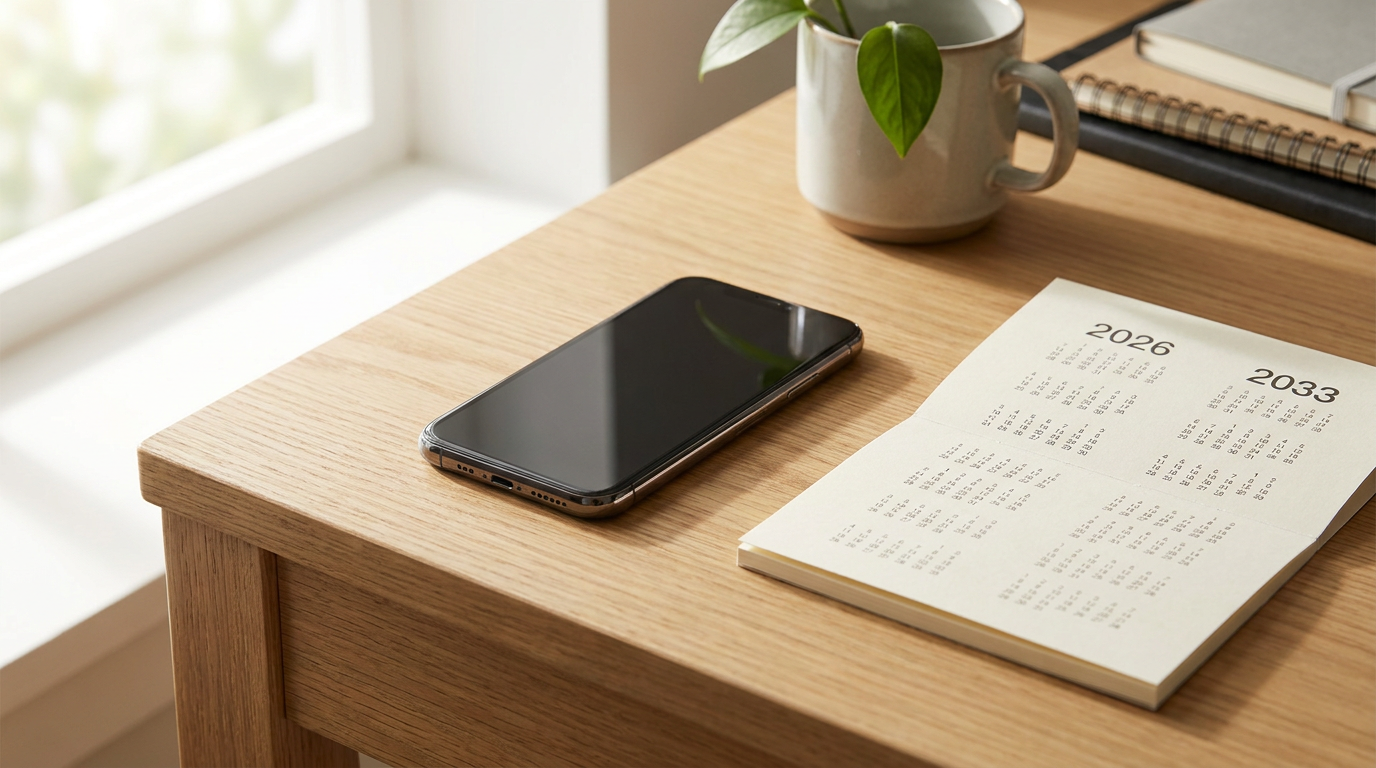
In 2026, the math of smartphone ownership has fundamentally changed. The new industry standard for flagship devices is a staggering seven years of guaranteed software support, effectively extending the viable lifespan of a phone purchased today well into the 2030s.[1][3][6]
Apple, Google, and Samsung have all aligned on this extended timeline, transforming the smartphone from a disposable gadget into a durable appliance. This shift represents one of the most significant consumer victories in modern consumer electronics, saving buyers thousands of dollars and drastically reducing environmental impact.[3][4]
Historically, the Android ecosystem was notorious for its fragmented and short-lived software support. While Apple consistently provided five to seven years of updates for its iPhones, many Android manufacturers abandoned their devices after just two or three years.[2][4]

This artificial expiration date left older Android phones vulnerable to cyberattacks and eventually incompatible with essential applications like mobile banking. Google changed the paradigm with the Pixel 8, and by 2026, both the Pixel 10 and Samsung's Galaxy S26 series guarantee operating system and security updates for a full seven years.[1][2][3]
Apple has officially matched this commitment in writing for its iPhone 17 series, ensuring parity across the premium market. Furthermore, the European Union's Ecodesign for Sustainable Products Regulation (ESPR), which took effect in mid-2025, now legally mandates a minimum of five years of software support for all new smartphones sold in the bloc, forcing even budget manufacturers to extend their lifecycles.[2][4]
The environmental implications of this shift are massive. The world is projected to generate nearly 75 million tonnes of electronic waste in 2026, with discarded smartphones, tablets, and laptops contributing significantly to the toxic buildup in global landfills.[7]
The true environmental cost of a smartphone, however, lies not in its disposal, but in its creation. Research indicates that up to 80% of a smartphone's total lifetime carbon emissions occur before the device ever reaches the consumer's pocket.[8]

The true environmental cost of a smartphone, however, lies not in its disposal, but in its creation.
Manufacturing requires mining rare earth elements like cobalt and palladium, refining metals at extreme temperatures, and operating highly energy-intensive fabrication plants for microchips. By extending the life of a device from three years to six, consumers effectively halve the environmental footprint associated with their mobile technology.[7][8]
With software no longer serving as the primary bottleneck for longevity, the limiting factor has shifted entirely to physical hardware degradation—specifically, the lithium-ion battery.[1][5]
No matter how advanced the software, modern smartphone batteries naturally lose their capacity to hold a charge after three to four years of daily use. In the past, a dying battery was the primary catalyst for buying a new phone, but the new seven-year software paradigm changes the financial calculus.[1][5]
Consumers must now weigh the cost of a battery replacement—typically ranging from $40 to $150 depending on the model—against the $1,000 or more required for a brand-new flagship device.[1]

Consumer advocates and repair experts suggest a simple rule of thumb: if the cost of repairing the device is less than 50% of its current resale value, fixing it is the smarter financial move. Replacing a battery at the four-year mark can easily breathe another three years of life into a supported device.[1]
The ripple effects of extended lifespans are also reshaping the corporate world. Enterprise IT departments, which traditionally refreshed employee phones every 24 months, are now stretching their upgrade cycles to 36 or even 48 months.[9]
Using Mobile Device Management (MDM) platforms, businesses can securely operate mixed fleets of older Pixels and Galaxies, knowing the devices will continue to receive critical day-one security patches. This significantly lowers overhead costs while maintaining compliance with strict corporate data security standards.[9]
Despite the clear benefits, the seven-year promise does carry an element of uncertainty. While a phone purchased in 2026 will technically receive an operating system update in 2033, there is no guarantee that the aging hardware will run that future software smoothly.[6]

Software power creep is a persistent reality in the tech industry. As operating systems become more demanding—particularly with the deep integration of on-device artificial intelligence like Google's Gemini and Apple Intelligence—older processors and limited RAM may struggle to keep pace.[6]
A device that feels lightning-fast today may experience noticeable lag when running the software of the next decade. However, for core functionalities like communication, web browsing, and media consumption, the hardware will remain more than capable.[6]
How we got here
2023
Google announces 7 years of software support starting with the Pixel 8, disrupting the Android market.
2024
Samsung matches Google's commitment, offering 7 years of updates starting with the Galaxy S24 series.
June 2025
The EU's Ecodesign for Sustainable Products Regulation (ESPR) takes effect, mandating a minimum of 5 years of updates for all smartphones.
2026
Apple officially commits to a 7-year update timeline for the iPhone 17, aligning the three major premium smartphone manufacturers.
Viewpoints in depth
Consumer Advocates
Focus on the financial savings and security benefits of long-term support.
Consumer watchdogs argue that the shift to seven-year support is one of the most significant pro-consumer victories in modern tech history. For years, buyers were forced into expensive upgrades simply because their perfectly functional hardware stopped receiving security patches, rendering the devices unsafe for banking and daily use. Advocates stress that consumers should now view battery replacements as routine maintenance—much like changing the oil in a car—rather than a signal to buy a new device.
Environmental Organizations
Emphasize the massive carbon savings and e-waste reduction of delayed upgrades.
Environmental groups point out that the true ecological cost of a smartphone is incurred before it ever leaves the factory. With up to 80% of a device's lifetime carbon emissions generated during the mining and manufacturing phases, extending a phone's lifespan from three years to six effectively halves its environmental footprint. These organizations view the seven-year software guarantee as a critical weapon against the 75 million tonnes of e-waste projected to accumulate globally in 2026.
Tech Manufacturers & Analysts
Frame extended support as a premium feature that justifies higher upfront costs.
Industry analysts note that while manufacturers are keeping phones alive longer, they are also using these extended lifespans to justify higher initial price tags for flagship models. By offering seven years of support, companies like Apple, Google, and Samsung can market their $1,000+ devices as long-term investments rather than disposable tech. However, analysts caution that software power creep—driven by demanding on-device AI features—may still push power users to upgrade long before the seven-year window closes.
What we don't know
- Whether the processors and RAM in today's smartphones will be powerful enough to smoothly run the advanced, AI-heavy operating systems of 2033.
- How the extended upgrade cycle will impact the long-term profitability and pricing strategies of major smartphone manufacturers.
Key terms
- Planned Obsolescence
- The practice of designing products to break or become unusable quickly to force consumers to buy replacements.
- E-waste
- Discarded electronic devices, which often contain toxic materials that can leak into the environment if not recycled properly.
- Security Patch
- A software update designed to fix vulnerabilities and protect a device from hackers and malware.
- ESPR
- The European Union's Ecodesign for Sustainable Products Regulation, which mandates minimum repairability and software support standards.
- On-device AI
- Artificial intelligence tasks processed directly on the phone's hardware rather than relying on cloud servers, requiring significant processing power.
Frequently asked
Which phones currently offer 7 years of updates?
Google's Pixel 8, 9, and 10 series, Samsung's Galaxy S24, S25, and S26 series, and Apple's iPhone 15, 16, and 17 series all offer 7 years of guaranteed support.
Does the 7-year guarantee include free battery replacements?
No. The guarantee covers software updates and security patches. Batteries physically degrade over time and will likely need to be replaced at the user's expense after 3 to 4 years.
What happens when a phone stops getting updates?
It no longer receives security patches, making it vulnerable to cyberattacks. Eventually, banking apps and other secure services will refuse to run on the outdated operating system.
Is it worth repairing a 4-year-old phone?
Experts recommend repairing a device if the cost of the repair (like a battery replacement) is less than 50% of the phone's current resale value.
Sources
Source coverage
10 outlets
4 viewpoints surfaced










[1]PCMagTech Manufacturers & Analysts
Your Phone's Battery Sucks. Here's How to Fix It.
Read on PCMag →[2]Tech AdvisorConsumer Advocates
Your Android phone has an expiry date. Here's how to find it.
Read on Tech Advisor →[3]ForbesTech Manufacturers & Analysts
Samsung's 2026 Strategy: The Galaxy S26 Ultra
Read on Forbes →[4]Which?Consumer Advocates
How long will your smartphone get security updates?
Read on Which? →[5]Unilad TechTech Manufacturers & Analysts
Experts reveal maximum amount of time you should hold onto phone before upgrading
Read on Unilad Tech →[6]StuffConsumer Advocates
How long should you keep a smartphone in 2026?
Read on Stuff →[7]GreenTek SolutionsEnvironmental Organizations
2026: New Challenges Ahead for E-Waste and Sustainable Technology
Read on GreenTek Solutions →[8]ChargieEnvironmental Organizations
The True Cost of Constant Upgrades
Read on Chargie →[9]Connection TechnologiesEnterprise IT Managers
Business Mobile Solutions UK: Everything Your Company Needs in 2026
Read on Connection Technologies →[10]Factlen Editorial TeamConsumer Advocates
Synthesis by Factlen editorial team
Read on Factlen Editorial Team →



Every angle. Every day.
Get shopping stories with full source coverage and perspective breakdowns delivered to your inbox.