
The 2026 Handheld PC Landscape: Steam Deck OLED vs. ROG Ally X vs. Legion Go S
As portable PC gaming matures, choosing between Valve, ASUS, and Lenovo comes down to a strict trade-off between software simplicity, raw power, and screen size.
By Factlen Editorial Team
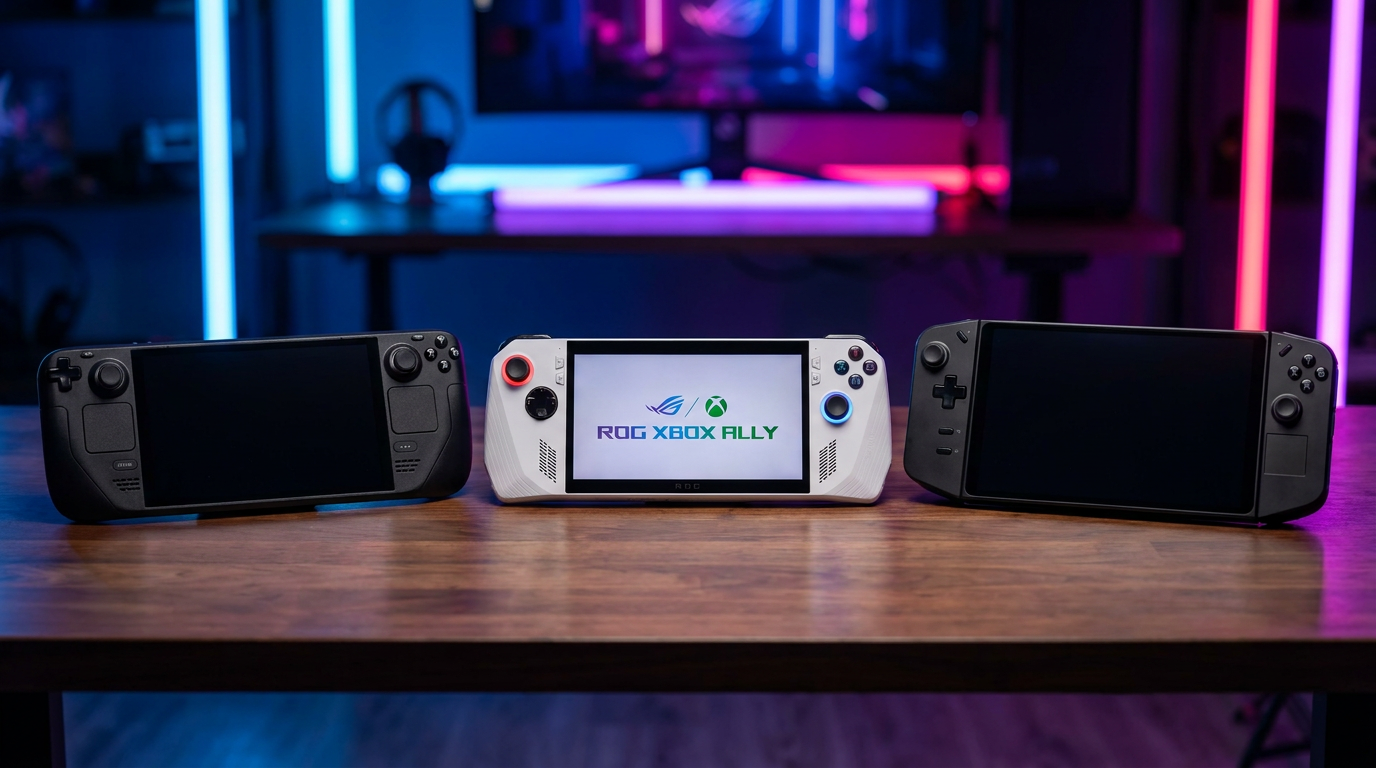
- Console Purists
- Gamers who prioritize a frictionless, plug-and-play experience over raw graphical power.
- Performance Maximizers
- Enthusiasts who demand the highest possible frame rates and complete ecosystem freedom.
- Hybrid Adopters
- Players seeking a middle ground between software simplicity and premium hardware features.
What's not represented
- · Game developers optimizing for lower-spec handhelds
- · Budget-conscious gamers priced out of the $500+ market
Why this matters
Handheld PCs have officially bridged the gap between desktop performance and portable convenience, allowing players to take massive game libraries anywhere. Understanding the distinct ecosystems and hardware trade-offs prevents buyers from spending upwards of $800 on a device that doesn't fit their specific gaming habits.
Key points
- The Steam Deck OLED remains the best choice for battery life and software simplicity.
- The ASUS ROG Ally X offers the highest raw performance and full Windows compatibility.
- The Lenovo Legion Go S provides a middle ground with an 8-inch screen and SteamOS.
- Windows handhelds support Game Pass and anti-cheat software, unlike Linux-based devices.
- Battery life varies drastically depending on the graphical intensity of the game.
The handheld PC market in 2026 has matured from a niche enthusiast experiment into a legitimate, mainstream alternative to traditional desktop gaming. What began just a few years ago as a novelty has rapidly evolved into a fiercely competitive hardware category, with major manufacturers refining their designs to balance thermal power, portability, and software stability. For consumers looking to take their extensive PC libraries on the go, the choices have never been more capable or diverse. However, the sheer variety of operating systems, processor architectures, and form factors can make purchasing decisions incredibly complex, as no single device manages to conquer every use case perfectly.[1][3]
Three specific devices currently dominate the industry conversation and represent the distinct design philosophies driving the portable market forward: Valve’s highly refined Steam Deck OLED, the sheer horsepower of the ASUS ROG Ally X, and the hybrid approach of the Lenovo Legion Go S. Each of these machines targets a specific type of player, offering unique and unavoidable trade-offs between raw graphical performance, battery endurance, and user-interface friction. Choosing the right device in 2026 requires looking past the marketing jargon and understanding exactly what each platform prioritizes, and more importantly, where it forces the user to compromise.[2][4]
The case for the Steam Deck OLED centers entirely on its unmatched simplicity and visual efficiency. Valve’s custom Linux-based operating system, SteamOS, completely strips away the bloat and unpredictability of traditional desktop environments. It offers a highly curated, console-like interface where games launch instantly without the need for driver updates, launcher logins, or background interference. Furthermore, its custom OLED display delivers perfect black levels and vibrant HDR colors that effectively mask the hardware’s lower rendering resolution, making games look stunning even when running at lower graphical settings.[1][6]
The argument against Valve’s machine is its aging raw performance and its inherently closed-off software ecosystem. Because it relies on a Linux compatibility layer to run Windows games, titles that utilize aggressive, kernel-level anti-cheat software—such as many of the world's most popular competitive multiplayer shooters—simply will not boot. Furthermore, the internal processor has not seen a significant architectural upgrade since the device’s original inception, meaning that the most demanding modern releases often require aggressive visual downgrades and upscaling just to maintain a barely playable thirty frames per second.[2][5]

The evidence shows that despite its older silicon, the Steam Deck OLED remains the undisputed champion of power efficiency. For indie games, retro emulation, and older blockbuster titles, its 50Wh battery routinely outlasts its more powerful competitors, often pushing well past the five-hour mark on a single charge. It achieves this remarkable endurance by capping its native resolution at 800p and its refresh rate at 90Hz, ensuring the hardware is never pushed beyond its optimal thermal limits and keeping the internal fans whisper-quiet during extended play sessions.[1][3]
The case for the ASUS ROG Ally X is built entirely on raw processing power and absolute ecosystem freedom. Running a full, native installation of Windows 11, this device acts exactly like a miniature desktop PC, allowing users to install Xbox Game Pass, the Epic Games Store, and any anti-cheat software without a single restriction. It is explicitly designed for players who refuse to be locked into Valve's single storefront and who demand the highest possible frame rates and graphical fidelity available on a portable seven-inch screen.[2][4]
The case for the ASUS ROG Ally X is built entirely on raw processing power and absolute ecosystem freedom.
The argument against the Ally X involves its premium price tag and the inherent, unavoidable clunkiness of navigating a desktop operating system on a small touchscreen. While ASUS has introduced a heavily streamlined, full-screen overlay to mitigate these interface issues, users still inevitably encounter sudden Windows updates, driver conflicts, and background processes that interrupt the gaming experience. It requires a level of patience and technical troubleshooting that console players may find deeply frustrating when they simply want to wake the device and immediately resume their game.[4][5]
The evidence highlights the Ally X’s brute-force approach to portable performance. Equipped with a massive 80Wh battery and a crisp 1080p, 120Hz Variable Refresh Rate display, it can push demanding titles significantly further than any rival on the market. Independent benchmarks demonstrate that even when running heavy, graphically intense workloads, the Ally X can deliver roughly an hour more battery life than its competitors at matched settings, easily justifying its higher cost for performance-focused buyers who want desktop-tier results on the go.[2][5]

The case for the Lenovo Legion Go S rests on its strategic "Goldilocks" positioning, successfully combining premium hardware dimensions with Valve’s highly streamlined software. By adopting SteamOS natively for this specific 2026 iteration, Lenovo completely bypassed the Windows interface friction that plagued its earlier models. This bold move offers users the exact plug-and-play simplicity of a Steam Deck, but pairs it with a significantly larger, more immersive eight-inch display that makes reading in-game text and spotting distant enemies vastly easier.[1][6]
The argument against the Legion Go S is its reliance on slightly older processing architecture compared to the absolute bleeding-edge Windows handhelds, as well as its noticeably bulkier physical footprint. The larger screen and heavier chassis make it slightly less travel-friendly for daily commuters trying to play on crowded trains, and while it comfortably outperforms the Steam Deck, it cannot quite match the maximum frame rates of the Ally X when pushed to the absolute limit in the year's most punishing graphical showcases.[4][6]
The evidence points to its highly competitive $649 price tag, which aggressively undercuts premium Windows rivals while offering a noticeably sharper 1200p screen resolution. Hardware reviewers consistently note that the combination of Lenovo’s highly ergonomic grips and Valve’s lightweight, gaming-focused operating system creates a highly stable, immersive experience. It strikes a rare and highly sought-after balance in the portable space, providing enough processing power to run modern games beautifully while requiring absolutely zero technical tinkering out of the box, making it a favorite among critics in 2026.[1][6]

Ultimately, the Steam Deck OLED fits well when users want a seamless, console-like experience for their existing Steam library and prioritize maximum battery life for lighter, less demanding games. It is the perfect travel companion for players who want their technology to disappear into the background so they can simply focus on playing. It does not fit when players rely heavily on subscription services like Xbox Game Pass, play competitive multiplayer shooters with strict anti-cheat requirements, or demand high-fidelity graphics and ray tracing in the latest blockbuster releases.[1][5]
The ASUS ROG Ally X fits well when gamers want a portable powerhouse capable of running any PC launcher natively, and when they highly value a high-refresh-rate screen for fluid, responsive motion in fast-paced titles. It is the ultimate device for the uncompromising enthusiast who wants desktop-level freedom in their hands. It does not fit when budget is a primary concern, or when users despise troubleshooting Windows updates, updating specific graphics drivers, and managing background applications on a handheld device just to get a game running smoothly.[2][4]

The Lenovo Legion Go S fits well when buyers want the software simplicity and stability of SteamOS but crave a larger, higher-resolution screen than Valve currently offers. It represents the smartest middle ground in the current market, blending excellent hardware with a frictionless user interface. It does not fit when maximum portability is required for cramped airplane seats or small bags, or when users need the absolute highest processing power available to push maximum frame rates in the most demanding, graphically intensive titles of the year.[3][6]
How we got here
Feb 2022
Valve releases the original Steam Deck, proving that a Linux-based handheld PC can be a mainstream success.
Jun 2023
ASUS launches the original ROG Ally, introducing a powerful Windows 11 alternative to Valve's ecosystem.
Nov 2023
Valve introduces the Steam Deck OLED, significantly improving battery life, screen quality, and thermal efficiency.
Jul 2024
ASUS releases the ROG Ally X, doubling the battery capacity and fixing the ergonomic flaws of its predecessor.
Early 2026
Lenovo releases the Legion Go S with native SteamOS, bridging the gap between premium hardware and console-like software.
Viewpoints in depth
Console Purists
Gamers who prioritize a frictionless, plug-and-play experience over raw graphical power.
This camp argues that a handheld device should feel like a dedicated gaming console, not a miniature desktop computer. They champion Valve's SteamOS for its ability to suspend and resume games instantly, manage power profiles automatically, and eliminate the need for driver updates. For these users, the Steam Deck OLED is the gold standard because it removes the friction of PC gaming, even if it means sacrificing compatibility with certain multiplayer titles or accepting lower frame rates in demanding games.
Performance Maximizers
Enthusiasts who demand the highest possible frame rates and complete ecosystem freedom.
This perspective views handhelds as true PC replacements and refuses to be locked into a single storefront. They advocate for Windows-based devices like the ROG Ally X because it allows them to install Xbox Game Pass, Epic Games, and essential anti-cheat software for competitive shooters. While they acknowledge the clunkiness of Windows on a small screen, they argue that the trade-off is entirely worth it for the ability to utilize 120Hz displays and push modern AAA titles to their graphical limits.
Hybrid Adopters
Players seeking a middle ground between software simplicity and premium hardware features.
This group believes that consumers shouldn't have to choose between a good operating system and a great screen. They gravitate toward devices like the Lenovo Legion Go S, which pairs the frictionless experience of SteamOS with larger, higher-resolution displays. They argue that an eight-inch screen fundamentally changes the portability equation, making text-heavy RPGs and strategy games far more playable, even if the device itself is slightly heavier and less travel-friendly than its smaller competitors.
What we don't know
- Whether Valve will announce a true 'Steam Deck 2' with upgraded processing power before the end of 2026.
- How Microsoft's ongoing software updates will further optimize the Windows 11 handheld experience.
Key terms
- SteamOS
- A Linux-based operating system developed by Valve, designed specifically to provide a console-like, controller-friendly interface for PC games.
- Variable Refresh Rate (VRR)
- A display technology that syncs the screen's refresh rate with the game's frame rate, eliminating screen tearing and making lower frame rates feel smoother.
- Wh (Watt-hour)
- A unit of measurement for battery capacity; a higher number indicates a larger battery that can theoretically power a device for longer.
- Anti-Cheat Software
- Security programs required by many online multiplayer games to prevent hacking, many of which only function on Windows operating systems.
Frequently asked
Can I play Xbox Game Pass on a Steam Deck?
Not natively. Because the Steam Deck runs Linux, you cannot install the native Xbox app. You can, however, stream Game Pass titles via the cloud using a web browser.
Which handheld has the best battery life?
For lightweight indie games, the Steam Deck OLED lasts the longest. However, for heavy AAA gaming, the ROG Ally X's massive 80Wh battery allows it to outlast the competition.
Do I have to rebuy my games for these devices?
No. These are fully functional PCs. If you own a game on Steam, Epic, or Xbox (depending on the device's OS compatibility), you can download and play it without purchasing it again.
Why do some multiplayer games not work on SteamOS?
Many competitive shooters use kernel-level anti-cheat software that is only compatible with Windows. Because SteamOS is based on Linux, these games will actively block you from playing.
Sources
Source coverage
6 outlets
3 viewpoints surfaced






[1]PC GamerConsole Purists
The best handheld gaming PC in 2026
Read on PC Gamer →[2]Tom's HardwarePerformance Maximizers
Best Handheld Gaming PCs 2026
Read on Tom's Hardware →[3]Rock Paper ShotgunHybrid Adopters
The best handheld PCs
Read on Rock Paper Shotgun →[4]XDA DevelopersHybrid Adopters
Best Handhelds 2026
Read on XDA Developers →[5]Tech TimesPerformance Maximizers
Compare Steam Deck OLED, ROG Ally X, and Lenovo Legion Go for 1080p 60fps handheld gaming in 2026
Read on Tech Times →[6]GizmodoConsole Purists
Lenovo Legion Go S with SteamOS: the one to buy
Read on Gizmodo →
Every angle. Every day.
Get entertainment stories with full source coverage and perspective breakdowns delivered to your inbox.