
Engineering the Zero-Emission Cruise Ship: How the Industry is Decarbonizing the Seas
Facing mounting regulatory pressure and environmental concerns, the cruise industry is investing billions in shore power, LNG, and hydrogen fuel cells to achieve net-zero emissions by 2050.
By Factlen Editorial Team
- Cruise Industry Leadership
- Emphasizes the billions being invested in transitional technologies like LNG and shore power, advocating for a phased approach to net-zero by 2050.
- Environmental Advocates
- Focuses on the immediate climate damage caused by mega-ships, arguing that transitional fuels like LNG still lock in fossil fuel infrastructure.
- Maritime Engineers & Researchers
- Views decarbonization as a monumental engineering challenge, highlighting the efficiency of fuel cells while acknowledging massive infrastructure hurdles.
What's not represented
- · Port City Residents
- · Alternative Fuel Producers
Why this matters
Cruising is one of the most carbon-intensive forms of tourism, with a single mega-ship emitting as much CO2 as a small town. Transitioning these floating cities to clean energy is critical not only for global climate targets but for the immediate air quality of port communities worldwide.
Key points
- The average cruise passenger generates roughly 421kg of CO2 per day, making cruising highly carbon-intensive.
- The industry has committed to achieving net-zero carbon emissions by 2050 to align with international climate targets.
- Shore power (cold ironing) allows docked ships to plug into local grids, reducing at-berth emissions by up to 80 percent.
- Liquefied Natural Gas (LNG) is currently being used as a bridge fuel to reduce sulfur and carbon emissions while zero-emission tech matures.
- Next-generation ships launching in the late 2020s will utilize hydrogen fuel cells and advanced battery storage to eliminate underway emissions.
Modern cruise ships are marvels of engineering, functioning as floating cities complete with water parks, theaters, and thousands of staterooms. But this scale comes with a staggering environmental cost. The average cruise passenger generates approximately 421 kilograms of carbon dioxide per day—roughly eight times the footprint of a land-based vacation. At the macro level, the numbers are even more daunting. Carnival Corporation, the world's largest cruise operator, emits an estimated 9.5 million tonnes of CO2 annually, a figure that surpasses the total emissions of the entire city of Glasgow. With the industry projecting over 33 million passengers in the coming years, the environmental pressure on the world's oceans and port cities has reached an unprecedented peak.[4]
Faced with these figures, the maritime tourism sector is undergoing a forced evolution. The International Maritime Organization (IMO) has mandated a 70 percent reduction in greenhouse gas emissions by 2040, while the European Union’s "Fit for 55" initiative is implementing strict regulations on maritime fuels. In response, the Cruise Lines International Association (CLIA), which represents the vast majority of global operators, has committed to achieving net-zero carbon cruising by 2050. Meeting this target requires fundamentally redesigning how ships generate and consume power, shifting the industry away from a century-long reliance on heavy fuel oil.[1][8]
To understand the decarbonization challenge, it is necessary to look beyond propulsion. A cruise ship's energy demand is divided between moving the vessel through the water and the "hotel load"—the massive amount of electricity required to run HVAC systems, commercial kitchens, lighting, and refrigeration. Even when a ship is stationary at a dock, its hotel load remains immense. Historically, vessels met this demand by keeping their auxiliary diesel engines running while berthed, blanketing port communities in noise, particulate matter, and nitrogen oxides.[2]

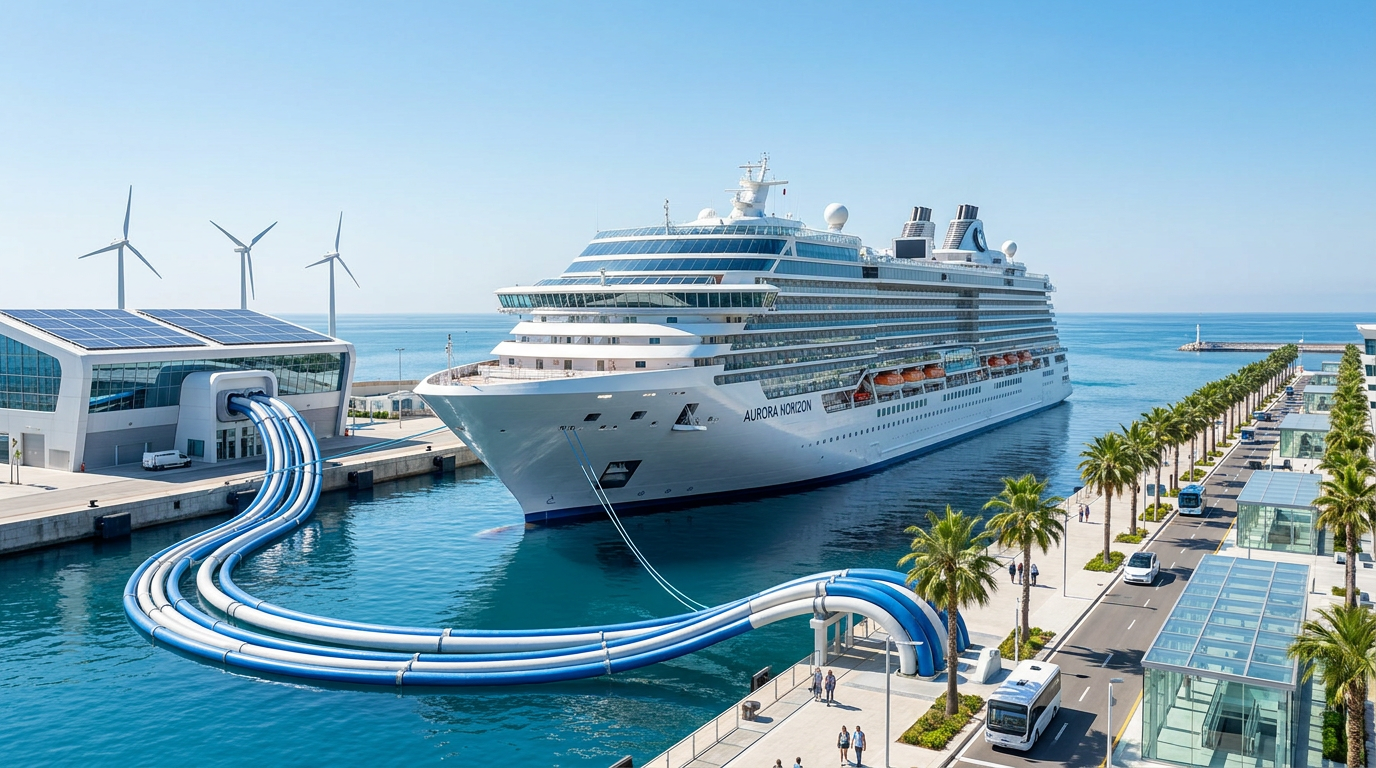
The first major technological shift addressing this issue is shore-side electricity, commonly known as "cold ironing" or shore power. At its core, the concept is simple: ships plug into the local land-based electrical grid while at the quay, allowing them to shut down their onboard diesel generators entirely. However, the engineering required to execute this is highly complex. Modern shore power systems must safely deliver megawatts of high-voltage electricity to massive vessels, utilizing sophisticated switchgear to synchronize the land power with the ship's internal grid before transferring the load, ensuring there is no blackout during the transition.[2][8]
When implemented, the environmental benefits of cold ironing are immediate and localized. A single cruise ship connecting to shore power can reduce its at-berth diesel emissions by up to 80 percent. If the local grid is powered by renewable sources like wind, solar, or hydroelectricity, the carbon footprint of the vessel’s port stay drops effectively to zero. The Port of Seattle, which aims to be the greenest port in North America, estimates that its expanded shore power infrastructure will eliminate an additional 3,000 metric tons of CO2 annually by allowing home-ported ships to connect to clean electricity.[3][8]
When implemented, the environmental benefits of cold ironing are immediate and localized.
While shore power solves the emissions problem at the dock, the greater challenge lies in powering the ships while they are at sea. The industry's current stepping stone away from heavy fuel oil is Liquefied Natural Gas (LNG). LNG is a fossil fuel, but it burns significantly cleaner than traditional maritime diesel. It virtually eliminates sulfur oxide emissions, cuts nitrogen oxides by 85 percent, and reduces overall greenhouse gas emissions by up to 20 percent. For the current generation of new builds, LNG is the dominant alternative fuel, with dozens of LNG-powered mega-ships entering service in the mid-2020s.[1][7]

However, environmental advocates and industry engineers alike acknowledge that LNG is only a transitional technology. Because it still releases carbon dioxide and carries the risk of methane slip during combustion, it cannot achieve the 2050 net-zero mandate on its own. Instead, LNG infrastructure is viewed as a bridge. Ships designed with LNG engines and cryogenic fuel supply systems will theoretically be able to swap to bio-LNG or synthetic LNG—fuels created from organic waste or captured carbon—once those alternatives become available at a global commercial scale.[1][7]
To achieve true zero-emission propulsion, naval architects are turning to hydrogen fuel cells. Unlike traditional combustion engines that burn fuel to create mechanical energy, fuel cells generate electricity through an electrochemical reaction between hydrogen and oxygen, with the only byproduct being pure water and heat. A joint study by the Italian research agency ENEA and Sapienza University demonstrated that integrating solid oxide fuel cells (SOFC) into large cruise ships could boost overall energy efficiency to 60 percent, while completely eliminating particulate matter and sulfur emissions.[5]
The transition to fuel cells is already moving from academic models to shipyard construction. Luxury line Silversea's "Project Evolution" class of ships utilizes a hybrid system of LNG, batteries, and hydrogen fuel cells, allowing the vessels to operate with zero local emissions while in port. Looking further ahead, Viking is pushing the boundary with the anticipated launch of the Viking Libra and Viking Astrea in the late 2020s. These vessels are being designed to run on proton exchange membrane (PEM) fuel cells capable of generating up to six megawatts of power, supporting both the hotel load and the ship's main propulsion.[6][7]

Beyond hydrogen, the expedition cruise sector—which operates smaller ships in highly sensitive environments like Antarctica and the Arctic—is pioneering other novel technologies. Hurtigruten recently completed a climate-neutral voyage along the Norwegian coast using advanced hydro-treated vegetable oil, a sustainable biofuel. Meanwhile, French operator Ponant and upcoming line Selar are integrating wind and solar power directly into their vessel designs. Selar’s planned ship features massive rigid sails covered in thousands of square feet of solar panels, aiming for "close-to-zero" emissions by harnessing the elements directly.[6][7]
Despite these technological breakthroughs, the path to a fully decarbonized cruise industry faces monumental economic and logistical hurdles. Transitioning the global fleet to green methanol, hydrogen, and advanced battery storage will require an estimated $150 billion to $200 billion in industry-wide investment. Furthermore, the success of these technologies depends on the global supply chain; a hydrogen-powered ship is only viable if the ports it visits have the infrastructure to safely bunker liquid hydrogen.[4][9]
The era of the diesel-belching mega-ship is slowly coming to an end. Driven by stringent regulations and a growing demand for sustainable tourism, the cruise industry is being forced to reinvent its core engineering. While the ultimate goal of a completely zero-emission global fleet remains decades away, the rapid deployment of shore power, hybrid fuel systems, and early-stage hydrogen fuel cells proves that the transition from floating polluters to floating green-energy hubs is finally underway.[1][8][9]
How we got here
2018
The IMO adopts its initial strategy to reduce greenhouse gas emissions from international shipping.
2023
The EU introduces the 'Fit for 55' mandate, requiring ships to use shore-side electricity in major ports by 2030.
2025
Hurtigruten completes a climate-neutral voyage along the Norwegian coast using advanced biofuels.
2026-2027
Viking is slated to launch the world's first cruise ships powered by hydrogen fuel cells for both propulsion and hotel load.
Viewpoints in depth
Environmental Advocates' view
Focuses on the immediate climate damage caused by mega-ships and the risks of transitional fossil fuels.
Environmental groups argue that the cruise industry's massive carbon footprint requires immediate, aggressive regulation rather than voluntary targets. They view Liquefied Natural Gas (LNG) as an insufficient half-measure, pointing out that while it reduces sulfur, it still locks the industry into decades of fossil fuel infrastructure and carries the risk of methane slip—a greenhouse gas far more potent than CO2. This camp demands a faster pivot to true zero-emission technologies and stricter port regulations to protect local air quality.
Cruise Industry Leadership's view
Highlights the massive capital expenditure required to overhaul global fleets and the necessity of bridge fuels.
Industry executives emphasize that decarbonizing a fleet of floating cities is an unprecedented logistical challenge. They argue that LNG and shore power are the only viable, scalable solutions available today, serving as necessary stepping stones. The industry points to the billions of dollars currently being invested in flexible engine designs, which will allow ships built today to seamlessly transition to bio-LNG or synthetic fuels once the global supply chain catches up to demand.
Maritime Engineers' view
Views the decarbonization of cruising as one of the hardest engineering challenges of the century.
Naval architects and maritime researchers focus on the raw physics of moving a 100,000-ton vessel across an ocean. While they celebrate the efficiency gains of solid oxide fuel cells (SOFC) and advanced battery tech in trials, they acknowledge that the energy density of current green fuels remains a formidable hurdle. This camp stresses that a hydrogen-powered ship is only viable if the ports it visits have the highly specialized, cryogenic infrastructure required to safely bunker liquid hydrogen.
What we don't know
- Whether the global production of green hydrogen and synthetic methanol can scale fast enough to meet the cruise industry's 2050 targets.
- How the massive costs of retrofitting fleets and developing new propulsion systems will impact the price of consumer cruise tickets.
- If emerging technologies like massive solar sails can provide reliable auxiliary power across diverse and unpredictable global weather routes.
Key terms
- Cold Ironing
- The process of providing shoreside electrical power to a ship at berth while its main and auxiliary engines are turned off.
- Hotel Load
- The electrical power required by a ship to run onboard services like air conditioning, lighting, and kitchens, distinct from the power needed for propulsion.
- Liquefied Natural Gas (LNG)
- Natural gas cooled to a liquid state, used as a cleaner-burning alternative to traditional heavy marine fuel.
- Hydrogen Fuel Cell
- A device that generates electricity through an electrochemical reaction between hydrogen and oxygen, producing only water and heat as byproducts.
- Methane Slip
- The escape of unburned methane gas into the atmosphere during the combustion of LNG, which acts as a potent greenhouse gas.
Frequently asked
What is shore power or cold ironing?
Shore power is the process of connecting a docked ship to the local land-based electrical grid. This allows the vessel to shut down its onboard diesel engines while maintaining power for lighting, air conditioning, and other essential services.
Why is LNG considered a bridge fuel?
Liquefied Natural Gas (LNG) burns cleaner than traditional marine diesel, reducing CO2 emissions by up to 20% and eliminating sulfur. However, because it is still a fossil fuel, it is viewed as a stepping stone until zero-emission technologies mature.
Are there any zero-emission cruise ships today?
Not entirely, though the industry is getting closer. Several ships operate with zero local emissions while in port using batteries and fuel cells, and the first fully hydrogen-powered cruise ships are slated to launch in the late 2020s.
How much CO2 does a cruise ship emit?
A large mega-ship can emit as much CO2 annually as a small town. On average, a single cruise passenger generates roughly 421 kilograms of CO2 per day, significantly more than a land-based vacation.
Sources
Source coverage
9 outlets
3 viewpoints surfaced









[1]Cruise Lines International Association (CLIA)Cruise Industry Leadership
Pursuing Net Zero Emissions by 2050
Read on Cruise Lines International Association (CLIA) →[2]MDPI EnergiesMaritime Engineers & Researchers
Exploring Onshore Power for Cruise Ships
Read on MDPI Energies →[3]Port of SeattleCruise Industry Leadership
Toward the Greenest Cruise Port in North America
Read on Port of Seattle →[4]Solar Tech OnlineEnvironmental Advocates
By the Numbers: Cruise Ship Emission Statistics for 2025
Read on Solar Tech Online →[5]RinnovabiliMaritime Engineers & Researchers
Fuel cells for cruise ships: greater efficiency, lower impact
Read on Rinnovabili →[6]Mundy AdventuresCruise Industry Leadership
The Future of Sustainable Expedition Cruising
Read on Mundy Adventures →[7]Ocean EventCruise Industry Leadership
Environmentally Friendly Cruise Ships
Read on Ocean Event →[8]SP HinarMaritime Engineers & Researchers
Setting Sail Toward Zero Emissions: The Shore Power Concept
Read on SP Hinar →[9]Factlen Editorial TeamMaritime Engineers & Researchers
Synthesis by Factlen editorial team
Read on Factlen Editorial Team →

Every angle. Every day.
Get travel stories with full source coverage and perspective breakdowns delivered to your inbox.