
Meta Quest 3 vs. Apple Vision Pro: The 2026 Spatial Computing Trade-Off
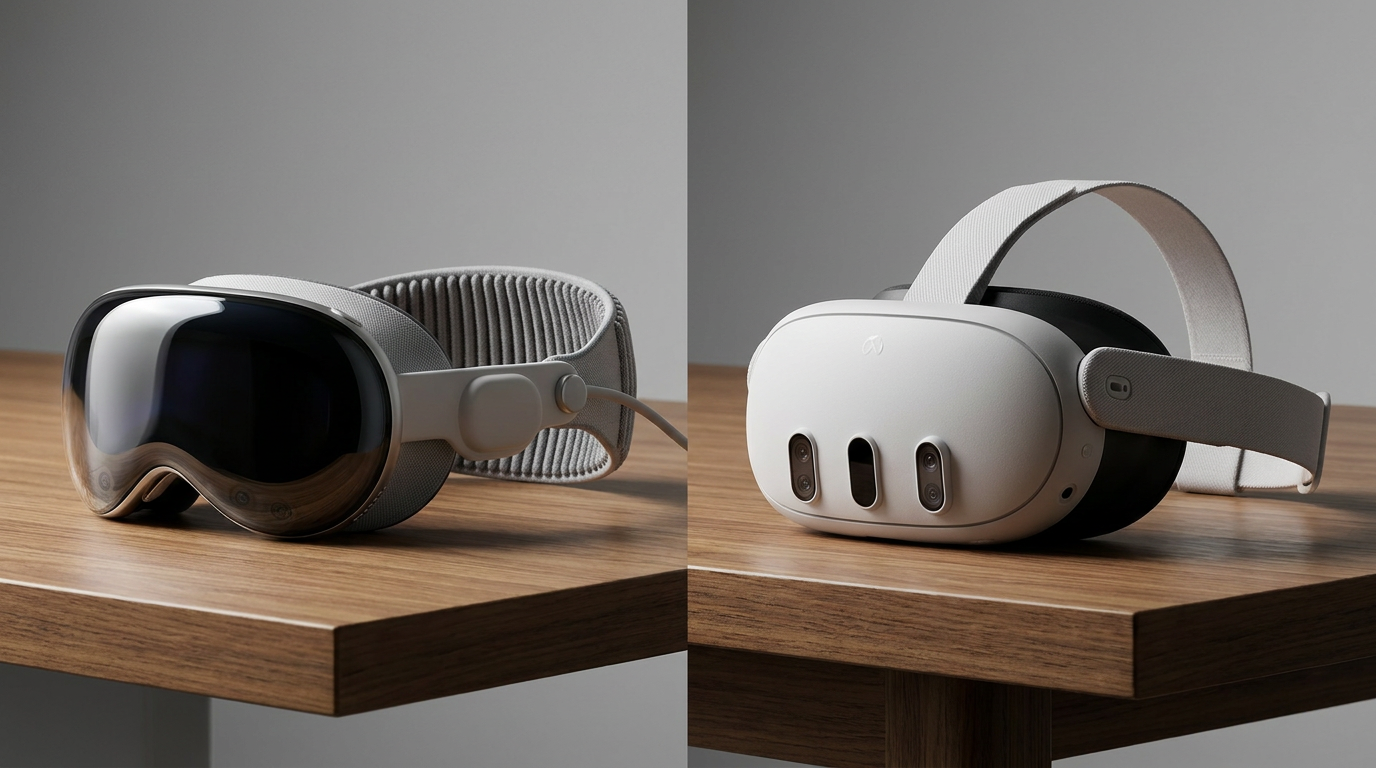
Two years after Apple entered the mixed-reality market, the choice between the $3,499 Vision Pro and the $499 Meta Quest 3 comes down to a strict trade-off between laptop-class productivity and accessible, comfortable gaming.
By Factlen Editorial Team
- Spatial Computing Power Users
- Professionals who view headsets as laptop replacements and premium media consumption devices.
- VR Gamers & Enthusiasts
- Users focused on interactive entertainment, fitness, and established virtual reality ecosystems.
- Enterprise & IT Deployers
- Organizations looking to scale mixed reality for training, design, and collaboration.
What's not represented
- · Budget-Conscious Consumers
- · Augmented Reality Purists
Why this matters
Choosing the right mixed-reality headset dictates whether you are buying a dedicated gaming console or a high-end spatial monitor. Understanding the precise trade-offs prevents users from wasting thousands of dollars on hardware that doesn't fit their daily workflow.
Key points
- The Apple Vision Pro excels as a premium productivity and media device, featuring unparalleled Micro-OLED displays.
- The Meta Quest 3 dominates gaming and interactive entertainment, supported by dedicated motion controllers and a massive software library.
- Vision Pro's tethered battery and 650-gram weight make it less comfortable for long, active sessions compared to the Quest 3.
- Enterprise testing shows the Quest 3 is significantly easier to deploy and share among multiple users than the biometrically-locked Vision Pro.
- The $3,000 price gap reflects a fundamental difference in design philosophy rather than a direct feature-for-feature competition.
Two years after Apple disrupted the mixed-reality market, the dust has settled on the industry's two flagship devices. The 2026 landscape is defined by a stark philosophical and financial divide: Apple's $3,499 Vision Pro and Meta's $499 Quest 3. Rather than converging into a single ideal headset, these two devices have carved out entirely different lanes. The Vision Pro champions spatial computing, prioritizing high-end productivity, seamless ecosystem integration, and premium materials. Meta, meanwhile, has doubled down on accessible virtual reality, focusing on gaming, fitness, and mass-market appeal. For consumers and enterprise buyers alike, choosing between them is no longer a question of which is objectively better, but rather a strict trade-off between laptop-class visual fidelity and untethered, comfortable versatility.[1][7]
When evaluating display quality, the argument for the Apple Vision Pro centers on absolute visual supremacy. The evidence is found in its dual Micro-OLED panels, which pack 23 million pixels and deliver roughly 34 pixels per degree. Reviewers consistently note that text appears as sharp as printed paper, making it uniquely suited for reading and high-end media consumption. The argument against this approach is the sheer cost and a slightly narrower 100-degree field of view. Conversely, the case for the Meta Quest 3's display is its wider 110-degree field of view and reliable LCD performance. The evidence shows that while its 18 pixels per degree makes the pixel grid visible to discerning eyes, it is more than sufficient for gaming and casual video, avoiding the massive premium markup of Micro-OLED technology.[1][4][6]

In the realm of passthrough and mixed reality, the case for the Vision Pro is its ability to seamlessly blend digital objects with the real world without disorientation. The evidence lies in its ultra-low-latency R1 chip and high-resolution cameras, which allow users to read a physical smartphone screen through the headset with ease. The argument against Apple's passthrough is its performance in low light, where graininess still creeps in. The argument for the Meta Quest 3's passthrough is its massive improvement over previous generations, offering full-color environmental awareness that keeps users grounded. However, the evidence against the Quest 3's mixed reality is its noticeable depth distortion and noise; attempting to read physical text through the Quest 3's cameras remains a frustrating, eye-straining experience.[6][7]
For productivity and remote work, the case for the Vision Pro is its capability to function as a genuine laptop alternative. The evidence is its M2 silicon, which enables seamless Mac virtual display mirroring—effectively wrapping two 5K monitors around the user in a 32:9 aspect ratio without latency. The case against the Vision Pro's productivity is its isolating nature and the lack of shared-screen collaboration tools. The argument for the Meta Quest 3 in a work setting is its accessibility and support for basic virtual desktop applications like Immersed. However, the evidence against using the Quest 3 as a primary workstation is its lower resolution; users report that reading small text causes eye strain over long shifts, and the Snapdragon XR2 Gen 2 chip cannot match Apple's laptop-class multitasking.[1][5][6]
When it comes to gaming and interactive entertainment, the argument for the Meta Quest 3 is overwhelming. The evidence is its massive library of thousands of standalone VR titles, native support for PC VR streaming, and the inclusion of precision motion controllers with haptic feedback. The case against the Quest 3 here is minimal, save for its LCD black levels looking slightly gray in dark horror games. The argument for the Vision Pro's entertainment value relies entirely on passive media consumption, such as 8K immersive spatial videos and Dolby Atmos integration. The evidence against the Vision Pro as a gaming device is its total reliance on hand and eye tracking; without dedicated controllers, complex VR gaming is virtually impossible, leaving it sidelined for interactive experiences.[1][2][5]
When it comes to gaming and interactive entertainment, the argument for the Meta Quest 3 is overwhelming.
In terms of software ecosystems and user interface, the case for the Vision Pro is its magical, frictionless navigation. The evidence is Apple's eye-and-hand tracking paradigm, which allows users to select apps simply by looking at them and pinching their fingers—a system that feels genuinely futuristic and intuitive for casual computing. The argument against visionOS is its current lack of native spatial applications, with many experiences still relying on flat iPad apps floating in space. The argument for the Meta Quest 3's ecosystem is its maturity and openness. The evidence points to Meta's Horizon OS, which has had years to cultivate a deep library of purpose-built VR applications and allows for easy sideloading of third-party software. The case against Meta's interface is that its hand-tracking, while improved, still lacks the flawless precision of Apple's hardware, often forcing users to reach for their controllers.[2][6]

Assessing comfort and physical design, the case for the Meta Quest 3 focuses on wearability and active use. The evidence shows that the Quest 3 weighs a balanced 515 grams with an internal battery, making it ideal for untethered movement, fitness apps, and long gaming sessions. The argument against the Vision Pro's design is its front-heavy ergonomics and tethered power source. Evidence from 2026 enterprise testing reveals that 67 percent of users find the Vision Pro's 650-gram aluminum and glass chassis too heavy for sessions exceeding 45 minutes. Furthermore, the Vision Pro's external battery pack requires constant cable management, which detracts from the illusion of spatial computing and limits physical mobility. The case against the Quest 3's comfort is merely its stock fabric strap, which many users replace with rigid aftermarket alternatives.[3][6]
Looking at enterprise deployment and shared use, the argument for the Meta Quest 3 is its scalability and frictionless onboarding. The evidence from corporate training centers highlights that the Quest 3 can be easily wiped down, adjusted, and passed between dozens of employees in a single day. The case against the Vision Pro in enterprise settings is its rigid, single-user design philosophy. The evidence shows that the Vision Pro requires custom light seals and relies heavily on individual biometric calibration, making it incredibly cumbersome to share among a team. Additionally, enterprise developers report that building custom applications for visionOS takes up to 65 percent longer due to the platform's newer, more restrictive ecosystem.[3][5]

Ultimately, the Apple Vision Pro fits well when a user is deeply entrenched in the Mac ecosystem, requires pixel-perfect passthrough for specialized tasks like medical imaging or design, and treats the headset as a stationary, premium productivity monitor. It is the definitive choice for those who want a private, high-fidelity cinema experience and for whom budget is not a primary constraint. The Vision Pro does not fit when the user wants to play interactive VR games, needs to share the device with family members or coworkers, or requires untethered mobility for fitness applications and active movement.[1][4]
Conversely, the Meta Quest 3 fits well when the user seeks the best overall value in mixed reality, prioritizes gaming and social experiences, and needs a lightweight, comfortable headset for active movement. It is the ideal choice for enterprise training centers that need to deploy hardware at scale and share devices across a large workforce. The Quest 3 does not fit when the primary goal is reading fine text for eight hours a day, replacing a high-end laptop, or consuming cinematic media with absolute OLED color accuracy.[2][3]
How we got here
Oct 2023
Meta launches the Quest 3, bringing full-color passthrough and improved lenses to the $499 mainstream market.
Feb 2024
Apple releases the Vision Pro, introducing high-end spatial computing at a $3,499 price point.
Mid 2025
Enterprise testing reveals the logistical challenges of deploying the single-user Vision Pro at scale compared to the Quest 3.
Early 2026
The XR market solidifies into two distinct tiers: Apple dominating premium productivity and Meta owning gaming and accessible mixed reality.
Viewpoints in depth
Spatial Computing Power Users
Professionals who view headsets as laptop replacements and premium media consumption devices.
This camp argues that the Vision Pro's $3,499 price tag is justified if it replaces a multi-monitor setup and a home theater. They point to the M2 chip and Micro-OLED displays as evidence that Apple has solved the resolution bottleneck that previously prevented headsets from being used for serious text-based work. For them, the lack of VR gaming is irrelevant, as the device is fundamentally a spatial computer rather than a traditional console.
VR Gamers & Enthusiasts
Users focused on interactive entertainment, fitness, and established virtual reality ecosystems.
This group maintains that a headset without dedicated motion controllers is fundamentally broken for interactive media. They cite the Quest 3's massive library of native games and seamless PC VR streaming as evidence that Meta understands the core use case for face-mounted hardware. From their perspective, the Vision Pro is an overpriced developer kit that fails to deliver the tactile feedback and untethered freedom required for true immersion.
Enterprise & IT Deployers
Organizations looking to scale mixed reality for training, design, and collaboration.
Enterprise buyers evaluate headsets purely on return on investment and deployment logistics. They argue that the Quest 3 is the superior enterprise device because it can be easily shared among employees and costs a fraction of the Vision Pro. Evidence from 2026 deployment tests shows that Apple's reliance on custom light seals and individual biometric profiles makes the Vision Pro a logistical hurdle for training centers, relegating it to niche, single-user executive or specialized medical roles.
What we don't know
- Whether Apple will release a cheaper, non-Pro Vision headset to compete directly with Meta's pricing.
- How quickly Meta can improve its Horizon OS to match the seamless ecosystem integration of Apple's visionOS.
Key terms
- Spatial Computing
- Apple's term for mixed reality, emphasizing the integration of digital interfaces and applications into the physical environment rather than fully escaping it.
- Passthrough
- Technology that uses external cameras on a headset to display the real world on the internal screens, allowing users to see their surroundings.
- Micro-OLED
- An advanced display technology used in the Vision Pro that packs millions of pixels into a tiny physical area, offering extreme sharpness and true black levels.
- Pixels Per Degree (PPD)
- A measurement of display sharpness in VR headsets; higher numbers indicate clearer text and a less visible pixel grid.
- Foveated Rendering
- A technique that tracks where the user's eyes are looking and renders that specific area in high resolution while reducing detail in the peripheral vision to save processing power.
Frequently asked
Can I use the Meta Quest 3 for work and productivity?
Yes, the Quest 3 supports virtual desktop apps like Immersed, but its lower resolution makes reading small text uncomfortable over long periods compared to the Vision Pro.
Does the Apple Vision Pro have VR games?
The Vision Pro has a limited selection of spatial games, but it lacks dedicated motion controllers, meaning it cannot play the vast majority of popular interactive VR titles found on the Quest.
Do I need a Mac to use the Apple Vision Pro?
No, the Vision Pro functions as a standalone spatial computer, but its most powerful productivity feature is its ability to seamlessly mirror a Mac's display.
Which headset is better for watching movies?
The Apple Vision Pro is significantly better for media consumption due to its Micro-OLED displays, which offer true blacks, HDR support, and a cinema-quality viewing experience.
Sources
Source coverage
7 outlets
3 viewpoints surfaced







[1]Reality AtlasVR Gamers & Enthusiasts
Meta Quest 3 and Apple Vision Pro compared — gaming vs spatial computing
Read on Reality Atlas →[2]PCMagVR Gamers & Enthusiasts
Our Top Tested Picks: Best VR Headsets
Read on PCMag →[3]AgileSoftLabsEnterprise & IT Deployers
Enterprise XR Testing: Is Vision Pro Worth 7x the Price?
Read on AgileSoftLabs →[4]MulticoreSpatial Computing Power Users
Apple Vision Pro: the 2026 review
Read on Multicore →[5]AutoVRseEnterprise & IT Deployers
Meta Quest 3 vs. Apple Vision Pro for Enterprise
Read on AutoVRse →[6]Tech VibesSpatial Computing Power Users
Apple Vision Pro vs Meta Quest 3 full comparison
Read on Tech Vibes →[7]360 VR PhotographyVR Gamers & Enthusiasts
Ultimate 2026 XR Headset Comparison
Read on 360 VR Photography →

Every angle. Every day.
Get meta stories with full source coverage and perspective breakdowns delivered to your inbox.