
How Neuroaesthetics is Turning Interior Design into a Science of Brain Health
The emerging field of neuroaesthetics is proving that interior design is not just about aesthetics, but a biological intervention that measurably impacts stress, productivity, and emotional well-being.
By Factlen Editorial Team
- Neuroscience Researchers
- Scientists focused on the measurable, biological impact of spatial design on the human body.
- Interior Designers & Architects
- Practitioners translating clinical data into functional, beautiful, and restorative spaces for clients.
- Public Health Advocates
- Voices pushing to democratize evidence-based design for schools, hospitals, and underserved communities.
What's not represented
- · Real Estate Developers
- · Building Code Regulators
Why this matters
Because humans spend the vast majority of their lives indoors, understanding how room shapes, lighting, and textures biologically alter our nervous systems empowers us to create homes and workplaces that actively fight burnout and promote mental health.
Key points
- Neuroaesthetics is the scientific study of how the brain and body respond to beauty and spatial design.
- Functional MRI scans reveal that interior environments can lower heart rates, reduce cortisol, and elevate serotonin.
- Biophilic design uses natural materials and fractal patterns to soothe the nervous system and boost productivity.
- Curvilinear spaces activate the brain's pleasure centers, while sharp angles can trigger low-level stress.
- The movement is shifting design from a luxury aesthetic to an evidence-based tool for preventive mental healthcare.
Everyone knows the feeling of walking into a specific room and instantly exhaling. For decades, interior designers and homeowners alike attributed this phenomenon to intuition, "good vibes," or simply a well-decorated space. But the architecture and design industries are currently undergoing a profound paradigm shift. What was once considered an abstract art form is now being quantified by science. Welcome to the era of neuroaesthetics—the study of how the human brain and body biologically respond to beauty, art, and spatial design.[1][3]
Sitting at the intersection of cognitive science, psychology, and architecture, neuroaesthetics is proving that our surroundings are not passive backdrops. Instead, they are active agents that continuously shape our nervous systems. When a person steps into a room, their brain processes the emotional landscape in milliseconds, long before conscious thought catches up. This immediate assessment is governed by the limbic system, the brain's emotional and memory center, which constantly scans the environment to determine whether a space is safe and calming, or chaotic and threatening.[4][7]
The implications of this research are transforming how professionals approach the built environment. According to a 2026 report by the global design firm HOK, design can no longer be viewed as a mere aesthetic choice; it is a biological intervention. Functional magnetic resonance imaging (fMRI) and advanced biometric sensors now allow researchers to measure exactly what happens inside the human body when it encounters thoughtful design. The results are striking: heart rates slow, blood pressure drops, serotonin levels rise, and the production of stress hormones like cortisol decreases.[4][6]

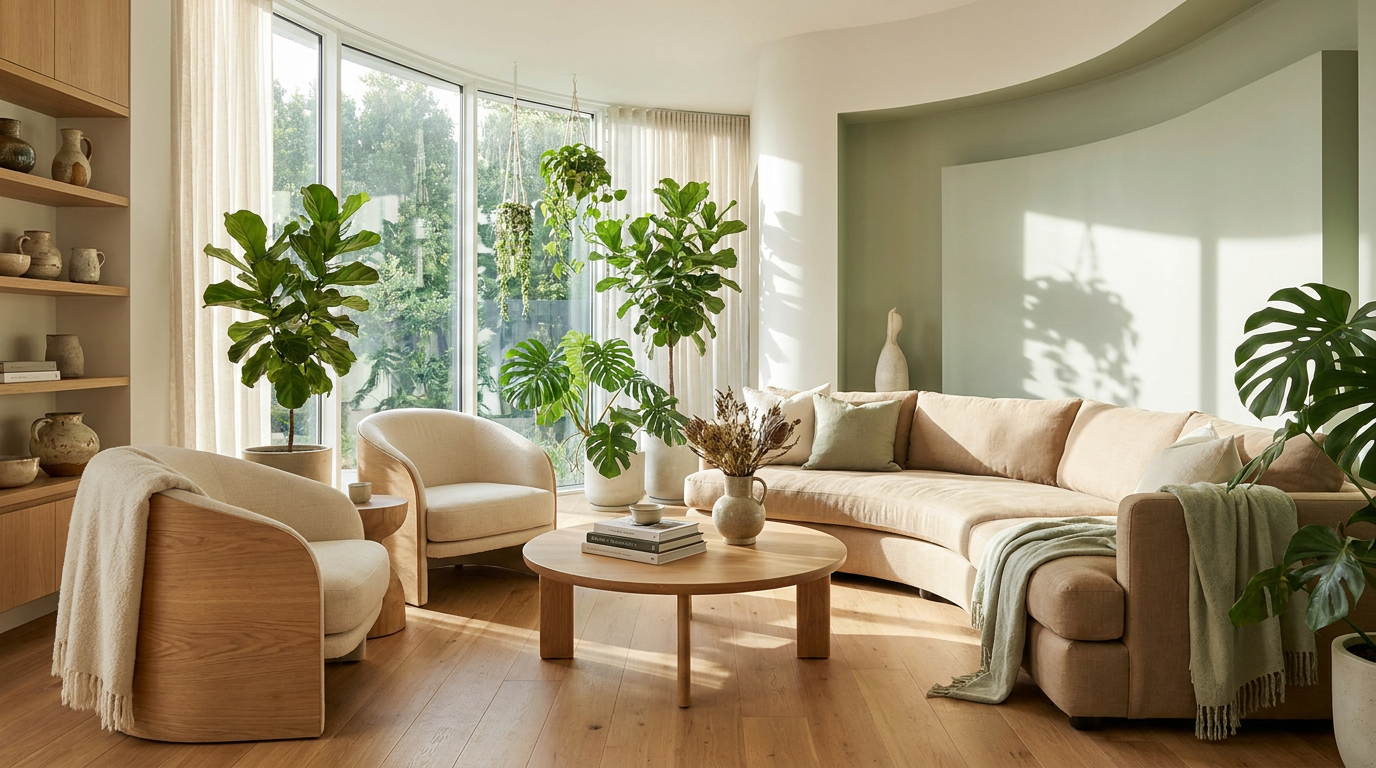
One of the most heavily researched pillars of neuroaesthetics is biophilic design, which goes far beyond simply placing a potted plant in a corner. It involves integrating the complex, underlying patterns of the natural world into the built environment. The human brain evolved outdoors, and it remains hardwired to recognize and relax in the presence of natural elements. When interiors incorporate wood grains, woven fibers, stone finishes, or dynamic daylighting, they stimulate the somatosensory cortex and produce feelings of belonging and comfort.[5][6]
Crucially, the brain does not require these inputs to be literally alive; it responds positively to the mere representation of nature. Exposure to fractal patterns—the repeating, self-similar geometries found in leaves, snowflakes, and tree branches—has been shown to significantly reduce physiological stress. In commercial settings, the measurable benefits of these biophilic interventions are undeniable. Studies indicate that employees working in biophilic offices report up to a 15 percent increase in productivity and a marked reduction in daily fatigue.[3][6]
Spatial geometry also plays a massive role in emotional regulation. Research utilizing fMRI technology has demonstrated that curvilinear spaces and rounded furniture activate the brain's pleasure and reward centers. Conversely, rooms dominated by sharp angles, harsh lighting, and excessive visual contrast can inadvertently trigger low-level stress responses, leading to mental fatigue over time. By utilizing symmetry, balanced negative space, and soft transitions, designers can actively lower a room's cognitive load, allowing the brain to rest and restore depleted attention.[3][6]

Spatial geometry also plays a massive role in emotional regulation.
However, neuroaesthetics extends far beyond visual stimuli. Experts emphasize that humans possess anywhere from 21 to over 50 specialized senses, including proprioception (the awareness of body position) and thermoception (the perception of temperature). A truly restorative space engages this multisensory network in a balanced way. Unpredictable acoustic noise, for instance, elevates cortisol and maintains a heightened state of alertness. Incorporating soft furnishings that absorb sound, alongside pleasant ambient textures, creates a layered sensory experience that promotes deep cognitive calm.[1][6]
The healthcare sector has been one of the earliest and most enthusiastic adopters of these principles. Foundational studies have long shown that hospital patients with access to natural light and views of nature heal faster and require less pain medication than those staring at brick walls. Today, neuroarchitecture is being deployed to optimize patient recovery, provide psychological comfort to visiting families, and reduce the severe burnout experienced by clinical staff in sterile, hyper-clinical environments.[3][4]
In the residential sphere, the post-pandemic era has fundamentally altered what people demand from their homes. As the boundaries between work, rest, and play have blurred, there is a growing consensus that domestic spaces must actively care for their inhabitants. Industry publications note that consumers are increasingly decorating from the "inside out," prioritizing tactile comfort, morning light exposure, and acoustic privacy over fleeting visual trends. The home is now viewed as an extension of the resident's emotional landscape.[1]
Despite the robust data, researchers acknowledge a degree of inherent uncertainty and subjectivity in neuroaesthetics. Because aesthetic responses are shaped by individual biology, personal history, and cultural background, there is no universal formula for a "perfect" room. What one person finds deeply soothing—such as a minimalist, monochromatic space—might feel under-stimulating or cold to another. This variability is a central focus for modern neuroscientists studying the built environment.[1][7]

This subjectivity has sparked a vital conversation around neurodiversity and inclusive design. Because individuals have vastly different sensory thresholds, a space that feels vibrant and energizing to a neurotypical person might be overwhelmingly chaotic to someone with sensory processing sensitivities. Organizations like BIFMA advocate for designing for the full spectrum of humanity, ensuring that environments offer a variety of sensory zones—from highly collaborative, stimulating areas to quiet, low-stimulus retreats.[5]
The ultimate goal of the neuroaesthetics movement is democratization. Historically, access to optimized, health-promoting design has been treated as a luxury reserved for high-end corporate headquarters and wealthy homeowners. Public health advocates and design leaders are now pushing to embed these evidence-based principles into public policy, affordable housing, and underfunded public schools.[2][5]
Initiatives like the Intentional Spaces Roadmap, recently highlighted at the Global Wellness Summit, aim to provide a science-backed framework to ensure that wellness is built into our environments by default, rather than as an expensive add-on. If environments shape health outcomes, then intentional design becomes a profound ethical responsibility.[2]

As the convergence of neuroscience and architecture continues to mature, the interior design industry is shedding its reputation as a purely decorative profession. By grounding creativity in empirical evidence, designers are proving that beauty and wellness are inseparable. Thoughtful, science-backed spaces are no longer just about looking good; they are essential allies in human flourishing, transforming the buildings we inhabit into engines of preventive mental healthcare.[2][4][7]
How we got here
1984
Researcher Roger Ulrich publishes a foundational study showing hospital patients with nature views heal faster.
1990s
Advances in fMRI technology allow scientists to measure real-time brain responses to aesthetic beauty.
2013
Neurologist Anjan Chatterjee publishes 'The Aesthetic Brain', bringing neuroaesthetics into mainstream science.
2025
Major design organizations like BIFMA begin formally integrating neurodiversity and inclusive design into industry standards.
2026
The Global Wellness Summit launches the Intentional Spaces Roadmap, cementing design as a biological health intervention.
Viewpoints in depth
Neuroscience Researchers
Scientists focused on the measurable, biological impact of spatial design on the human body.
For researchers, the built environment is a series of biological triggers. Using fMRI scans and biometric sensors, this camp has moved interior design from a subjective art to an empirical science. They focus on quantifiable metrics: how specific wavelengths of light regulate circadian rhythms, how acoustic dampening lowers cortisol, and how fractal patterns increase serotonin. Their primary argument is that humans are constantly reacting to their environments on a subconscious, physiological level, making design a critical component of preventive healthcare.
Interior Designers & Architects
Practitioners translating clinical data into functional, beautiful spaces.
Designers are tasked with turning clinical neuroscience into livable reality. While they embrace the data, they emphasize that spaces must remain deeply personal and culturally resonant. This camp argues that neuroaesthetics provides a powerful new vocabulary to explain why certain designs work, validating their long-held intuitions. They focus on sensory layering—balancing visual beauty with tactile comfort, acoustic privacy, and spatial flow—to create homes and offices that actively nurture the inhabitants' well-being without feeling like sterile laboratories.
Public Health Advocates
Voices pushing to democratize evidence-based design for all communities.
This perspective views neuroaesthetics through the lens of equity and public policy. Advocates argue that if the built environment measurably impacts mental health, cognitive development, and physical healing, then access to good design is a fundamental human right. They push back against the idea that biophilic design and optimized acoustics should be luxury amenities reserved for corporate headquarters and high-end real estate. Instead, they advocate for embedding these principles into building codes, affordable housing, and public schools to support collective resilience.
What we don't know
- How to perfectly standardize neuroaesthetic principles given that sensory processing varies wildly across neurodiverse populations.
- The exact long-term epigenetic effects of living in highly optimized biophilic environments versus standard urban housing.
- How quickly commercial real estate developers will adopt these evidence-based standards given the higher initial design costs.
Key terms
- Neuroaesthetics
- The scientific study of how aesthetic experiences and design affect the brain, physiology, and behavior.
- Biophilic Design
- An architectural approach that connects building occupants to nature by incorporating natural light, materials, and fractal patterns.
- Proprioception
- The body's subconscious ability to sense its movement, action, and location, which is heavily influenced by spatial layouts.
- Fractal Patterns
- Repeating, self-similar geometric shapes found in nature (like leaves or snowflakes) that have been shown to reduce physiological stress.
- Limbic System
- The emotional and memory center of the brain that subconsciously assesses whether a room feels safe or threatening.
Frequently asked
What exactly is neuroaesthetics?
It is the scientific study of how the brain and nervous system biologically respond to beauty, art, and spatial design.
How does biophilic design work?
It incorporates natural elements and fractal patterns into interiors, which the brain recognizes as familiar and safe, thereby lowering cortisol and stress.
Can the shape of a room affect my mood?
Yes. fMRI studies show that curvilinear spaces and rounded furniture activate the brain's pleasure centers, while sharp angles can trigger low-level stress.
Is neuroaesthetics only for luxury homes?
No. While popular in high-end design, public health advocates are increasingly using these principles to improve schools, hospitals, and affordable housing.
Sources
Source coverage
7 outlets
3 viewpoints surfaced







[1]LivingetcInterior Designers & Architects
Neuroaesthetics Explains How Your Home Makes You Feel
Read on Livingetc →[2]ArchiExpoPublic Health Advocates
Neuroaesthetics Is Reshaping Wellness and the Built Environment
Read on ArchiExpo →[3]ArchDailyInterior Designers & Architects
Neuroesthetics: The Influence of Design on Human Experience
Read on ArchDaily →[4]HOKNeuroscience Researchers
Wired for Beauty—Neuroaesthetics in the Built Environment
Read on HOK →[5]BIFMAPublic Health Advocates
Designing for the Mind: How Neuroaesthetics is Reshaping the Built Environment
Read on BIFMA →[6]Science in DesignNeuroscience Researchers
Neuroaesthetics for Interior Designers
Read on Science in Design →[7]Factlen Editorial TeamPublic Health Advocates
Synthesis by Factlen editorial team
Read on Factlen Editorial Team →

Every angle. Every day.
Get home stories with full source coverage and perspective breakdowns delivered to your inbox.