
Rivian R2 vs. Tesla Model Y: The 2026 Trade-Off Analysis
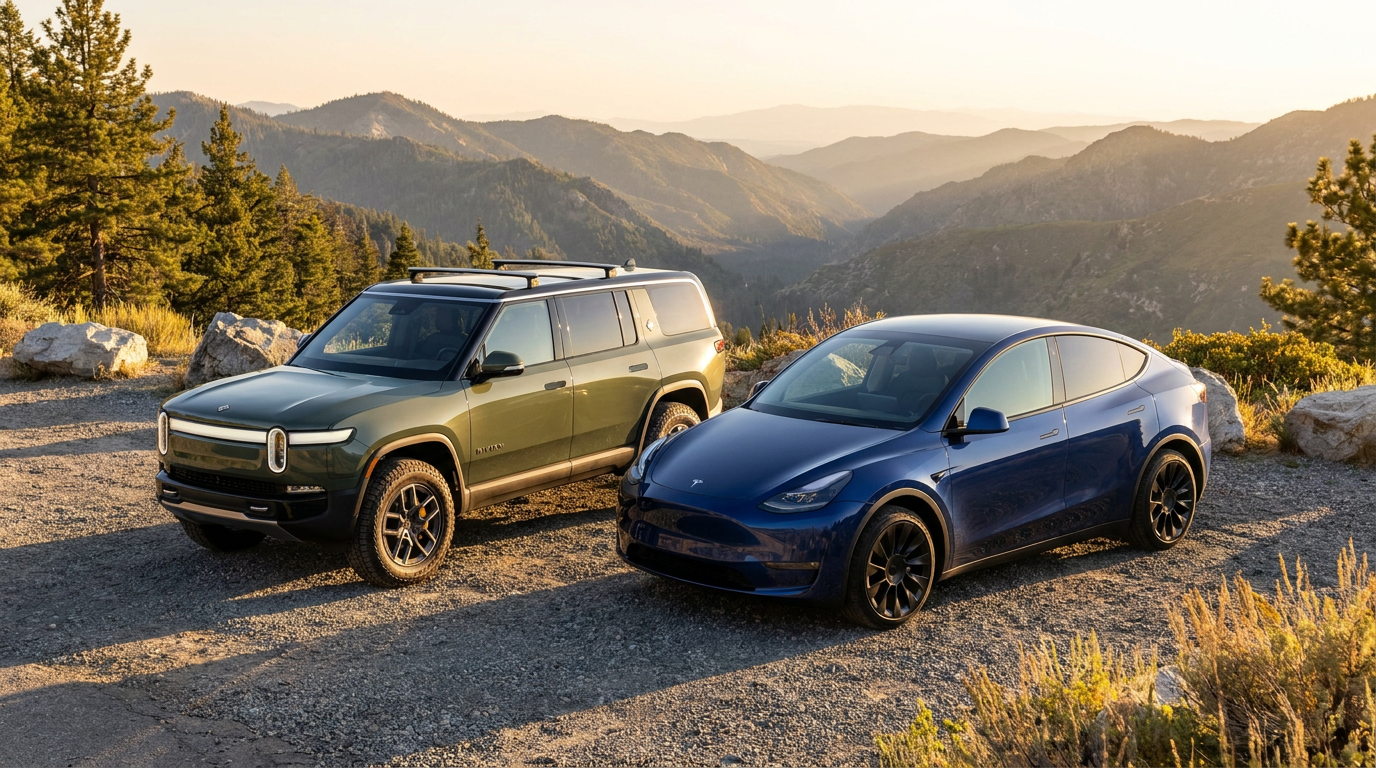
As the Rivian R2 arrives to challenge the Tesla Model Y, buyers face a stark choice between rugged off-road utility and aerodynamic highway efficiency.
By Factlen Editorial Team
- Efficiency & Value Buyers
- Focus on starting price, aerodynamic range, and proven charging infrastructure.
- Adventure & Utility Seekers
- Prioritize ground clearance, cargo space, and off-road capability over pure highway efficiency.
- Driving Dynamics Enthusiasts
- Value sporty handling, firm suspension, and straight-line acceleration on paved roads.
What's not represented
- · Traditional auto manufacturers losing market share to both EV brands
- · Used EV buyers waiting for these models to depreciate
Why this matters
For consumers entering the electric vehicle market in 2026, the midsize SUV segment is the most practical and hotly contested space. Understanding the stark trade-offs between Tesla's aerodynamic efficiency and Rivian's rugged utility ensures buyers choose a vehicle that actually matches their daily lifestyle and budget.
Key points
- The Tesla Model Y starts at $39,990, significantly undercutting the Rivian R2's initial $57,990 launch price.
- Rivian's R2 offers 9.6 inches of ground clearance and 90.1 cubic feet of cargo space, dominating in off-road utility.
- Tesla maintains an edge in pure highway efficiency, offering up to 357 miles of range on its Premium RWD trim.
- Both vehicles now use the NACS charging port, granting the Rivian adapter-free access to Tesla Superchargers.
- The Model Y delivers a firmer, sportier ride, while the R2 provides softer, bump-absorbing suspension.
The midsize electric SUV segment in 2026 is defined by a heavyweight matchup between the established incumbent and a highly anticipated challenger. Tesla’s Model Y, fresh off its Juniper refresh, continues to dominate global sales with its sleek aerodynamics, proven software ecosystem, and aggressive pricing strategy. Arriving to contest that crown is the Rivian R2, a boxier, rugged alternative that promises to bring the brand’s outdoor-focused ethos to a more accessible price point. For consumers, this rivalry represents the most consequential choice in the current automotive landscape.[1][6]
Buyers in this segment are no longer just choosing between two electric vehicles with slightly different badges; they are choosing between two fundamentally different design philosophies regarding what a modern crossover should be. The trade-off analysis between these two vehicles reveals stark contrasts in how they prioritize aerodynamic efficiency, cargo volume, and driving dynamics. This forces consumers to honestly evaluate their daily driving habits, separating the fantasy of off-road adventure from the reality of highway commuting. Understanding these compromises is essential before signing a purchase agreement, as neither vehicle is a perfect solution for every driver.[1]
The case for the Tesla Model Y centers heavily on proven efficiency, immediate availability, and a significantly lower barrier to entry for the average consumer. Tesla has spent years refining its electric powertrain, and the 2026 iteration represents the pinnacle of that aerodynamic focus. The vehicle is meticulously designed to slip through the air with minimal resistance, maximizing every kilowatt-hour of battery capacity. For drivers who spend the vast majority of their time on paved highways and suburban streets, this relentless pursuit of efficiency translates directly into lower daily running costs and less time spent at charging stations.[1][4]
The evidence supporting the Model Y’s value proposition is difficult to ignore when looking at the raw numbers. The rear-wheel-drive base model starts at an aggressive $39,990, dramatically undercutting the initial launch trims of its newest rival. Furthermore, the Premium RWD trim achieves an impressive EPA-estimated 357 miles of range, making it one of the most efficient vehicles in its class for long highway commutes. This combination of a sub-$40,000 starting price and class-leading range makes the Tesla an incredibly rational choice for budget-conscious families looking to transition to electric power without range anxiety.[1]

Against the Model Y is its inherent limitation as a true lifestyle and utility vehicle. It remains primarily an on-road crossover, featuring a relatively modest 6.0 inches of ground clearance that makes it unsuitable for anything more treacherous than a well-graded gravel driveway. Its sloping, teardrop roofline—while excellent for wind resistance and highway range—severely compromises absolute cargo volume. This aerodynamic shape makes the Model Y less accommodating for bulky camping gear, tall furniture, or large dogs compared to boxier rivals, forcing owners to play a game of spatial Tetris when packing for a long weekend.[4][5]
The case for the Rivian R2 centers on rugged versatility, superior cargo capacity, and genuine off-road legitimacy that honors the brand's adventurous heritage. Rivian designed the R2 to be a true sport utility vehicle in the traditional sense, prioritizing a commanding, upright driving position and a cabin that can swallow an immense amount of equipment. Rather than chasing absolute aerodynamic perfection, the R2 is built to enable outdoor lifestyles, appealing to buyers who view their vehicle as a basecamp for hiking, skiing, and off-grid exploration rather than just a commuter pod.[2][4]
The evidence for the Rivian’s superior utility is clearly found in its physical dimensions and clever engineering. The R2 boasts a towering 9.6 inches of ground clearance and a 25-degree approach angle, allowing it to clear trail obstacles that would easily damage the Tesla's undercarriage. Inside, it offers a cavernous 90.1 cubic feet of total storage when both the second and first rows are folded completely flat. It also features a spacious 5.2 cubic-foot front trunk, providing 19 percent more total storage volume than the Model Y, making it the undisputed champion of cargo hauling in this matchup.[2][4][5][7]

The evidence for the Rivian’s superior utility is clearly found in its physical dimensions and clever engineering.
Against the R2 is its steep initial pricing structure and a heavier, less aerodynamic footprint that impacts overall efficiency. The vehicle launches in spring 2026 exclusively in its fully loaded $57,990 Performance trim, meaning budget-conscious buyers must wait until the summer of 2027 for the promised $45,000 base models to arrive. Additionally, pushing a taller, boxier vehicle through the air inherently requires more energy. While Rivian’s new platform engineering is highly impressive, the R2 simply cannot match the highway efficiency of a teardrop-shaped vehicle, resulting in slightly higher charging costs over the lifespan of the SUV.[1][6][7]
When comparing raw performance metrics, the numbers reveal an interesting split between sheer horsepower and weight-to-power ratios. The Rivian R2 Performance outputs a staggering 656 horsepower from its dual-motor setup, significantly more than its rival can muster. Yet, the lighter, more aerodynamic Tesla Model Y Performance still manages to edge it out in a straight-line sprint, hitting 60 mph in a blistering 3.3 seconds versus the Rivian’s 3.6 seconds. Both vehicles offer acceleration that rivals traditional supercars, but the Tesla's weight advantage makes it feel slightly more nimble off the line.[1][7]
Interior design philosophies between the two automakers also diverge sharply, catering to different aesthetic preferences. Tesla’s Juniper refresh brought much-needed acoustic glass for quieter cabins and upgraded soft-touch materials, but it stubbornly maintains its stark, minimalist single-screen ethos without a dedicated driver display behind the wheel. Rivian counters with a 'nature-inspired' cabin featuring a highly praised dual-screen layout, tactile physical scroll wheels on the steering wheel, and a rugged yet premium material palette. Furthermore, the Rivian's seats are designed to fold entirely flat, creating a level in-car sleeping platform for camping.[1][2][5]

Ride quality and handling characteristics further separate the two vehicles on the road. Automotive reviewers consistently note that the Tesla Model Y feels firmer and sportier, excelling on twisty mountain roads with highly direct steering and minimal body roll. Conversely, the Rivian R2 offers a softer, more compliant ride that absorbs urban potholes and trail ruts effortlessly. However, this off-road tuned suspension means the R2 can feel slightly floaty or disconnected at high highway speeds unless the driver specifically dials the semi-active suspension into its firmest sport setting.[3]
One major historical differentiator between these brands has been completely neutralized for the 2026 model year: charging infrastructure. Both the Rivian R2 and the Tesla Model Y now roll off the assembly line equipped with the native North American Charging Standard (NACS) port. This critical standardization means Rivian drivers have seamless, adapter-free access to the vast and highly reliable Tesla Supercharger network. For consumers, this levels the playing field for cross-country road trips, removing the charging anxiety that previously pushed many buyers exclusively toward the Tesla ecosystem.[1][7]
Ultimately, the trade-off analysis shows that the Rivian R2 fits well when buyers prioritize an active outdoor lifestyle and need maximum, flat-folding cargo space for bulky gear. It is the superior choice for anyone who regularly navigates rutted dirt roads, deep snow, or remote trailheads. The R2 also appeals strongly to drivers who want a vehicle that stands out visually from the ubiquitous aerodynamic teardrop shape that has come to define the modern electric crossover segment.[2][4]
However, the Rivian does not fit well when buyers are strictly budget-conscious in the immediate 2026 timeframe, as the more affordable trims remain over a year away. It is also a less ideal choice for drivers who prioritize maximum highway efficiency and lower charging costs, or those who prefer a low-slung, car-like driving dynamic that hugs the pavement during aggressive cornering on paved roads. For pure urban commuters, the R2's rugged capabilities may go entirely unused, making its aerodynamic penalties harder to justify.[1][3]

The Tesla Model Y fits well when consumers want the absolute best range-per-dollar ratio currently available on the electric vehicle market. It is the logical choice for drivers who prefer a sporty, agile daily commute and desire a highly refined, proven software ecosystem. With immediate delivery availability and a sub-$40,000 starting price for the base model, the Model Y remains the undisputed champion of accessible, high-efficiency electric driving for the masses. Its vast production scale ensures that buyers can get exactly the configuration they want without enduring a lengthy waitlist.[1][5]
Conversely, the Tesla does not fit well when the weekend itinerary includes actual trail driving or navigating significant off-road obstacles where ground clearance is mandatory. It also falls short when boxy, vertical cargo volume is a daily necessity for hauling large items. Finally, the Model Y remains a dealbreaker for traditionalists who strongly prefer having physical instrumentation, tactile buttons, and a dedicated gauge cluster directly behind the steering wheel rather than glancing at a central tablet.[3][4]
How we got here
March 2024
Rivian officially unveils the R2 midsize SUV to the public.
Late 2024
Tesla introduces the 'Juniper' refresh for the Model Y, upgrading interior materials and cabin insulation.
Spring 2026
Initial customer deliveries begin for the $57,990 Rivian R2 Performance trim.
Summer 2027
Targeted release window for the $45,000 base model Rivian R2.
Viewpoints in depth
The Utility and Off-Road Camp
Buyers and reviewers who view the electric SUV as a tool for outdoor access and heavy cargo.
For this camp, the Rivian R2 is the clear victor. They point to the 9.6 inches of ground clearance and the 90.1 cubic feet of flat-folding cargo space as transformative features that the Model Y cannot match. This perspective argues that an SUV should be able to handle rutted trails and bulky camping gear without compromise, making the R2's boxier, less aerodynamic shape a worthwhile trade-off for genuine versatility.
The Efficiency and Value Camp
Consumers focused on the daily commute, budget constraints, and energy maximization.
This perspective heavily favors the Tesla Model Y. Proponents emphasize that the vast majority of SUV owners rarely leave paved roads, making the Model Y's aerodynamic teardrop shape and 357-mile maximum range far more practical for daily life. Furthermore, with the Model Y starting nearly $18,000 cheaper than the initial Rivian R2 launch trims in 2026, this camp argues that Tesla remains the undisputed champion of accessible electric value.
The Driving Dynamics Camp
Enthusiasts who prioritize handling, acceleration, and a sporty feel on paved roads.
This viewpoint appreciates the Tesla Model Y's lower center of gravity and firmer suspension tuning. Reviewers in this camp note that the Model Y feels more like a nimble sports sedan when navigating twisty roads, whereas the Rivian R2's softer, off-road-oriented suspension can feel slightly disconnected at high highway speeds. For drivers who value cornering precision over trail capability, the Tesla remains the preferred choice.
What we don't know
- How the Rivian R2's long-term reliability will compare to the highly mature manufacturing process of the Tesla Model Y.
- Whether Rivian will hit its exact production volume targets for the lower-priced R2 trims in 2027.
- How Tesla's Full Self-Driving software updates will compete with Rivian's new Autonomy+ system in real-world highway conditions.
Key terms
- NACS (North American Charging Standard)
- The charging plug design originally developed by Tesla, now adopted by Rivian and other automakers to allow universal access to the Supercharger network.
- Frunk
- A front trunk located where an internal combustion engine would traditionally sit, offering additional enclosed cargo space for electric vehicles.
- Approach Angle
- The maximum angle of a steep incline or obstacle a vehicle can climb without the front bumper scraping the ground.
- MPGe
- Miles Per Gallon Equivalent, a metric used by the EPA to compare the energy efficiency of electric vehicles to traditional gas-powered cars.
Frequently asked
Can the Rivian R2 use Tesla Superchargers?
Yes. The 2026 Rivian R2 comes equipped with a native NACS port, allowing it to plug directly into compatible Tesla Superchargers without needing an adapter.
Which SUV is faster from zero to 60?
Despite the Rivian R2 Performance having more horsepower (656 hp), the lighter Tesla Model Y Performance is slightly quicker, reaching 60 mph in 3.3 seconds compared to the R2's 3.6 seconds.
When will the cheaper Rivian R2 be available?
While the high-end Performance trim launched in spring 2026, the entry-level Rivian R2 priced around $45,000 is not scheduled to begin deliveries until the summer of 2027.
Which vehicle has more cargo space?
The Rivian R2 offers significantly more space, with 90.1 cubic feet of total storage when the seats are folded flat, compared to the Model Y's 76 cubic feet.
Sources
Source coverage
7 outlets
3 viewpoints surfaced







[1]Road EthosEfficiency & Value Buyers
Rivian R2 Vs. Tesla Model Y: An Honest Comparison For 2026 Buyers
Read on Road Ethos →[2]CarBuzzAdventure & Utility Seekers
Here's every way the new SUV is ready to beat the Model Y at its own game
Read on CarBuzz →[3]CarwowDriving Dynamics Enthusiasts
Rivian R2 vs Tesla Model Y: prices and standard equipment
Read on Carwow →[4]ElectrekAdventure & Utility Seekers
Rivian R2 efficiency and dimensions compared to Model Y
Read on Electrek →[5]AutoblogDriving Dynamics Enthusiasts
Rivian R2 vs Tesla Model Y: How the specs compare
Read on Autoblog →[6]CleanTechnicaEfficiency & Value Buyers
Rivian R2 Deliveries Begin: Timeline & Specs
Read on CleanTechnica →[7]RivianAdventure & Utility Seekers
R2: The soul of a Rivian, sized for every adventure
Read on Rivian →
Every angle. Every day.
Get automotive stories with full source coverage and perspective breakdowns delivered to your inbox.