
JWST Solves the Cosmic 'Chicken or Egg' Problem: Black Holes Came Before Galaxies
New data from the James Webb Space Telescope reveals a supermassive black hole that predates its host galaxy, upending decades of cosmological theory. The discovery suggests that giant black holes acted as the foundational seeds of the early universe, rather than forming from the remnants of dead stars.
By Factlen Editorial Team
- Direct Collapse Advocates
- Argue that early black holes formed directly from massive clouds of pristine gas.
- Observational Skeptics
- Emphasize the need for larger sample sizes before rewriting cosmological models.
- Primordial Cosmology Theorists
- Suggest these black holes formed fractions of a second after the Big Bang.
What's not represented
- · Theoretical physicists studying alternative gravity models
- · Researchers focused on the role of dark matter halos in early galaxy formation
Why this matters
This discovery fundamentally rewrites our understanding of how the universe was built. By proving that supermassive black holes acted as the foundational seeds of galaxies rather than their byproducts, scientists are one step closer to unraveling the origins of our own Milky Way and the fundamental laws of cosmic evolution.
Key points
- JWST discovered a supermassive black hole that existed just 700 million years after the Big Bang.
- The black hole accounts for roughly 66% of its host galaxy's total mass, compared to 0.1% in modern galaxies.
- The findings prove that supermassive black holes could form before their host galaxies fully matured.
- The data strongly supports the theory that early black holes formed from the direct collapse of massive gas clouds.
- Researchers are currently analyzing dozens of similar 'Little Red Dots' to confirm if this was a universal phenomenon.
Every large galaxy in the modern universe, including our own Milky Way, harbors a supermassive black hole at its center. For decades, astrophysicists have debated the sequence of their creation: did a massive swirl of stars form a galaxy first, eventually birthing a black hole from stellar corpses, or did the black hole come first, acting as a gravitational anchor that pulled the galaxy together?[1][4]
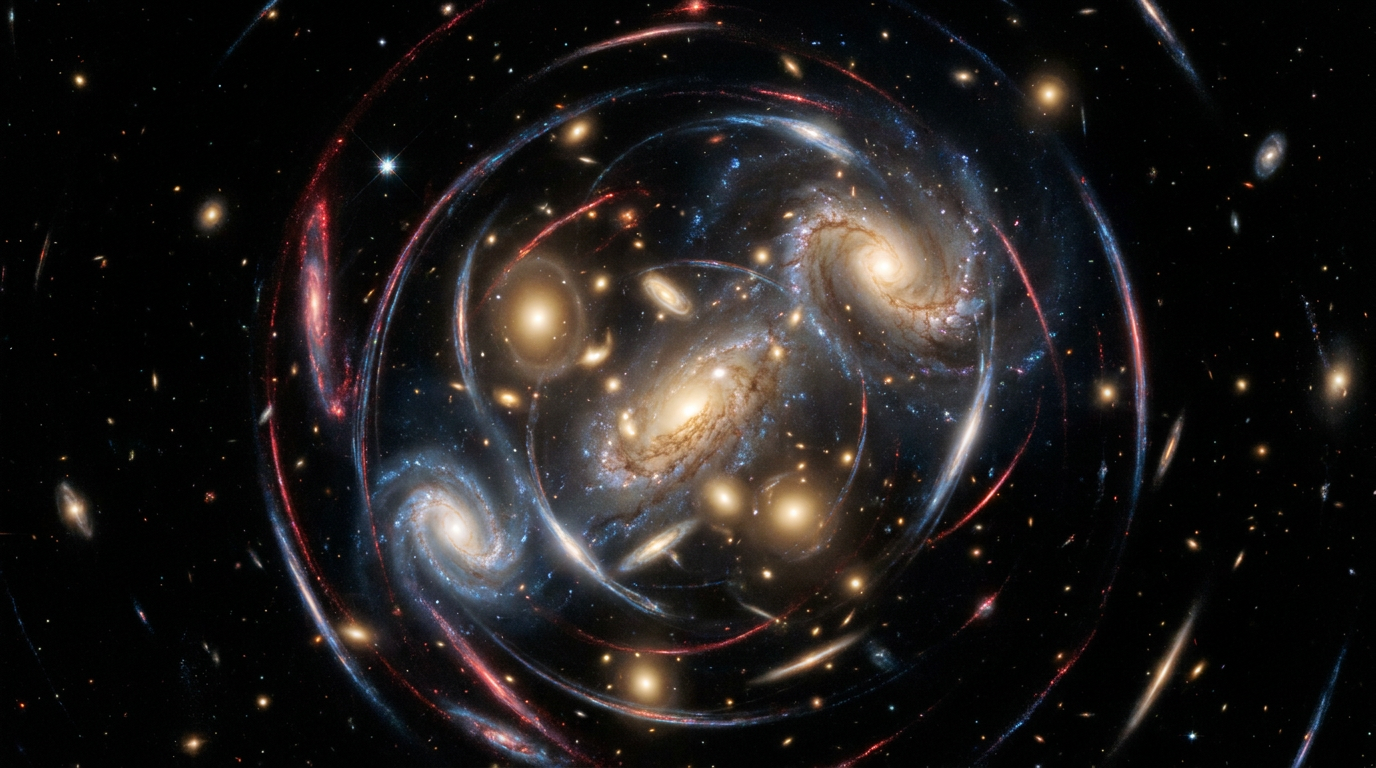
The James Webb Space Telescope (JWST) has now provided the most definitive answer to date. By peering deep into the early universe, astronomers have identified a supermassive black hole that clearly predates the bulk of its host galaxy, effectively solving cosmology's ultimate chicken-or-egg problem.[2][3]
The object at the center of this paradigm shift is known as Abell2744-QSO1, or simply QSO1. It is categorized as a "Little Red Dot"—a class of compact, highly redshifted objects that JWST has uncovered in staggering numbers since it began its deep-space observations.[5][6]
QSO1 existed just 700 million years after the Big Bang, a period when the universe was merely 5% of its current age. Because its light has traveled for over 13 billion years, its wavelengths have been stretched into the infrared spectrum, making it invisible to older observatories like Hubble but perfectly suited for JWST's specialized sensors.[2][4]

The primary claim of the research rests on the sheer mass of the black hole. The evidence comes from the motion of hydrogen and helium gas swirling around the object. Using JWST's Near Infrared Spectrograph (NIRSpec), researchers mapped the velocity of this gas with unprecedented precision.[2][7]
The gas is whipping around the center at thousands of kilometers per second. By applying basic gravitational physics to this kinematic data, the research team calculated that the central object must possess a mass roughly 40 to 50 million times that of our Sun.[3][5]
This leads to the second major claim: the host galaxy is disproportionately tiny. This is where the discovery shatters existing models. In the modern, local universe, a supermassive black hole typically accounts for about 0.1% (or a ratio of 1:1,000) of its host galaxy's total mass.[4][6]
This leads to the second major claim: the host galaxy is disproportionately tiny.
In stark contrast, the black hole in QSO1 accounts for an astonishing two-thirds (roughly 66%) of the entire mass of its host galaxy. The black hole is not a small occupant of a vast stellar city; it is the overwhelming dominant feature, with only a meager smattering of stars and gas surrounding it.[3][5]

"It seems that we have found a black hole that does not have a substantial host galaxy and that has predated stellar processes," noted Ignas Juodžbalis, a researcher at the University of Cambridge. This confirms that the black hole was "born big" rather than growing slowly alongside a maturing galaxy.[5][7]
The mechanism behind this rapid growth represents a major theoretical hurdle. The traditional model of black hole formation relies on "light seeds." In this scenario, the earliest massive stars burn through their fuel, go supernova, and collapse into black holes of perhaps 10 to 100 solar masses.[1][4]
However, the universe was simply not old enough at the 700-million-year mark for a light seed to consume enough matter to reach 50 million solar masses. Even feeding at the absolute maximum theoretical limit—known as the Eddington limit—a stellar-mass black hole would require billions of years to reach this size.[2][4]
The evidence from QSO1 strongly supports the "heavy seed" hypothesis. In this model, colossal clouds of pristine hydrogen gas in the early universe bypassed the star-formation phase entirely. Instead, they collapsed directly under their own immense gravity to form black holes of 10,000 to 100,000 solar masses right out of the gate.[4][5]
An alternative, even more exotic explanation is the "primordial black hole" theory. This suggests that microscopic fluctuations in the density of the universe fractions of a second after the Big Bang collapsed into black holes before atoms even existed, giving them a massive head start on their galactic counterparts.[5][7]
Despite the compelling data, researchers maintain transparent uncertainty regarding the broader implications. While the kinematic data from QSO1 is robust, astrophysicists caution against rewriting all cosmological textbooks based on a single, albeit spectacular, object. QSO1 was uniquely observable because it was gravitationally lensed—magnified by a foreground cluster of galaxies.[2][3]
It remains uncertain whether QSO1 is a typical representative of early-universe black holes or a bizarre outlier. Furthermore, mass measurements derived from gas kinematics rely on assumptions about the geometry of the gas disk; if the disk is tilted differently than modeled, the mass estimates could shift.[6][7]
Despite these caveats, the sheer volume of "Little Red Dots" being cataloged by JWST suggests that overmassive black holes were a common feature of the cosmic dawn. The telescope is currently targeting dozens of similar objects to build a statistically significant sample and verify these early findings.[1][5]

The implications for our understanding of the cosmos are profound. Rather than being the destructive end-products of galactic evolution, supermassive black holes appear to have been the foundational seeds. They likely acted as gigantic gravitational amplifiers, pulling in the gas that would eventually ignite the first stars and shape the galaxies we see today.[1][4]
How we got here
13.8 Billion Years Ago
The Big Bang marks the beginning of the universe.
13.1 Billion Years Ago
The supermassive black hole QSO1 and its minimal host galaxy exist in the state currently observed by JWST.
Dec 2021
The James Webb Space Telescope launches, equipped with infrared sensors capable of peering into the cosmic dawn.
2023–2024
Astronomers begin identifying thousands of mysterious 'Little Red Dots' in deep-field JWST images.
May–June 2026
Researchers publish definitive kinematic data proving the black hole in QSO1 predates its host galaxy's stellar mass.
Viewpoints in depth
Direct Collapse Advocates
Argue that early black holes formed directly from massive clouds of pristine gas.
This camp points to the sheer mass of QSO1 as proof that 'light seeds' (stellar collapse) are mathematically insufficient. They argue that in the pristine, metal-free environment of the early universe, massive clouds of hydrogen could bypass star formation entirely, collapsing under their own weight to instantly form black holes of 10,000 to 100,000 solar masses. These 'heavy seeds' would then have the necessary head start to reach 50 million solar masses by the 700-million-year mark.
Primordial Cosmology Theorists
Suggest these black holes formed fractions of a second after the Big Bang.
Pushing the timeline even further back, this perspective argues that the seeds for supermassive black holes didn't require gas clouds at all. Instead, they posit that microscopic density fluctuations in the immediate aftermath of the Big Bang collapsed into black holes before atoms even formed. For this camp, the discovery of overmassive black holes in the early universe is the smoking gun for primordial black holes, a theory that could also help explain the nature of dark matter.
Observational Skeptics
Emphasize the need for larger sample sizes before rewriting cosmological models.
While acknowledging the groundbreaking nature of the JWST data, this camp cautions against drawing universe-wide conclusions from a single, highly magnified object. They highlight the inherent uncertainties in measuring black hole mass via gas kinematics, noting that assumptions about the geometry and inclination of the gas disk could skew the results. They advocate for characterizing dozens of 'Little Red Dots' before officially declaring the chicken-or-egg problem solved.
What we don't know
- Whether QSO1 is a typical example of an early-universe black hole or a rare statistical outlier.
- The exact mechanism that allowed the initial 'heavy seeds' to form without fragmenting into smaller stars.
- How the geometry and inclination of the gas disk might be subtly skewing the mass calculations.
Key terms
- Supermassive Black Hole
- A black hole containing millions to billions of times the mass of our Sun, typically found at the center of a galaxy.
- Gravitational Lensing
- A phenomenon where the immense gravity of a massive object, like a galaxy cluster, bends and magnifies the light from more distant objects behind it.
- Heavy Seed Hypothesis
- The theory that early supermassive black holes formed directly from the collapse of massive clouds of pristine gas, bypassing the star-formation phase.
- Redshift
- The stretching of light waves into longer, redder wavelengths as they travel across the expanding universe over billions of years.
- Eddington Limit
- The theoretical maximum rate at which a black hole can consume matter and grow, balanced by the outward pressure of the radiation it emits.
Frequently asked
What is the cosmic chicken-or-egg problem?
For decades, astronomers debated whether galaxies formed first and eventually birthed supermassive black holes at their centers, or if the black holes formed first and pulled the galaxies together.
How did JWST measure the black hole's mass?
The telescope's NIRSpec instrument mapped the velocity of hydrogen and helium gas swirling around the black hole. By measuring how fast the gas is moving, physicists can calculate the gravitational mass required to keep it in orbit.
Why couldn't this black hole have formed from a dying star?
A black hole formed from a single dying star (a 'light seed') would take billions of years to consume enough matter to reach 50 million solar masses. At just 700 million years after the Big Bang, there simply wasn't enough time.
What is a Little Red Dot?
It is a class of compact, highly redshifted objects discovered by JWST in the early universe. Their light has been stretched into the infrared spectrum by the expansion of the universe, making them appear red to the telescope's sensors.
Sources
Source coverage
7 outlets
3 viewpoints surfaced






[1]New ScientistObservational Skeptics
We may have finally solved cosmology's chicken-or-the-egg problem
Read on New Scientist →[2]NASADirect Collapse Advocates
NASA's Webb Reveals Black Hole That Formed Before Its Galaxy
Read on NASA →[3]GizmodoObservational Skeptics
James Webb Telescope Discovers Supermassive Black Hole That Formed Before Its Galaxy
Read on Gizmodo →[4]Big ThinkPrimordial Cosmology Theorists
JWST solves the 'chicken or egg' problem for black holes and galaxies
Read on Big Think →[5]Sci.NewsDirect Collapse Advocates
Webb Finds Enormous Black Hole in Early Universe That Predates Its Host Galaxy
Read on Sci.News →[6]NatureDirect Collapse Advocates
A 40-million solar mass black hole in the early Universe
Read on Nature →[7]University of CambridgePrimordial Cosmology Theorists
Webb delivers strongest-ever case for 'black hole stars' lurking in early universe
Read on University of Cambridge →

Every angle. Every day.
Get science stories with full source coverage and perspective breakdowns delivered to your inbox.