
At-Home Brain Implant Restores Communication for Patient with Severe ALS
A landmark clinical trial has demonstrated that a patient with motor neuron disease can use a brain-computer interface autonomously at home, achieving 97.5% accuracy over nearly two years of use.
By Factlen Editorial Team
- Neuroengineering Researchers
- Focused on the technical milestone of moving BCIs from controlled labs to autonomous at-home use.
- Medical & Clinical Community
- Emphasizes the clinical safety, efficacy, and the profound improvement in patient quality of life.
- Patient Advocacy & Public Interest
- Views the breakthrough as a beacon of hope for restoring autonomy to those with severe paralysis.
What's not represented
- · Health Insurance Providers
- · Bioethicists
Why this matters
This breakthrough proves that brain-computer interfaces can function reliably in a patient's living room without constant technical support. It marks a critical step toward making neural implants a practical, accessible treatment for severe paralysis.
Key points
- A patient with severe ALS successfully used a brain-computer interface (BCI) at home for nearly two years without constant technical support.
- The system translated the patient's brain signals into text and synthesized speech with a 97.5% accuracy rate.
- The BCI granted the patient access to a 125,000-word vocabulary, allowing for open-ended, naturalistic communication.
- The breakthrough marks a major milestone in moving neuroprosthetics from highly controlled lab environments to practical, daily use.
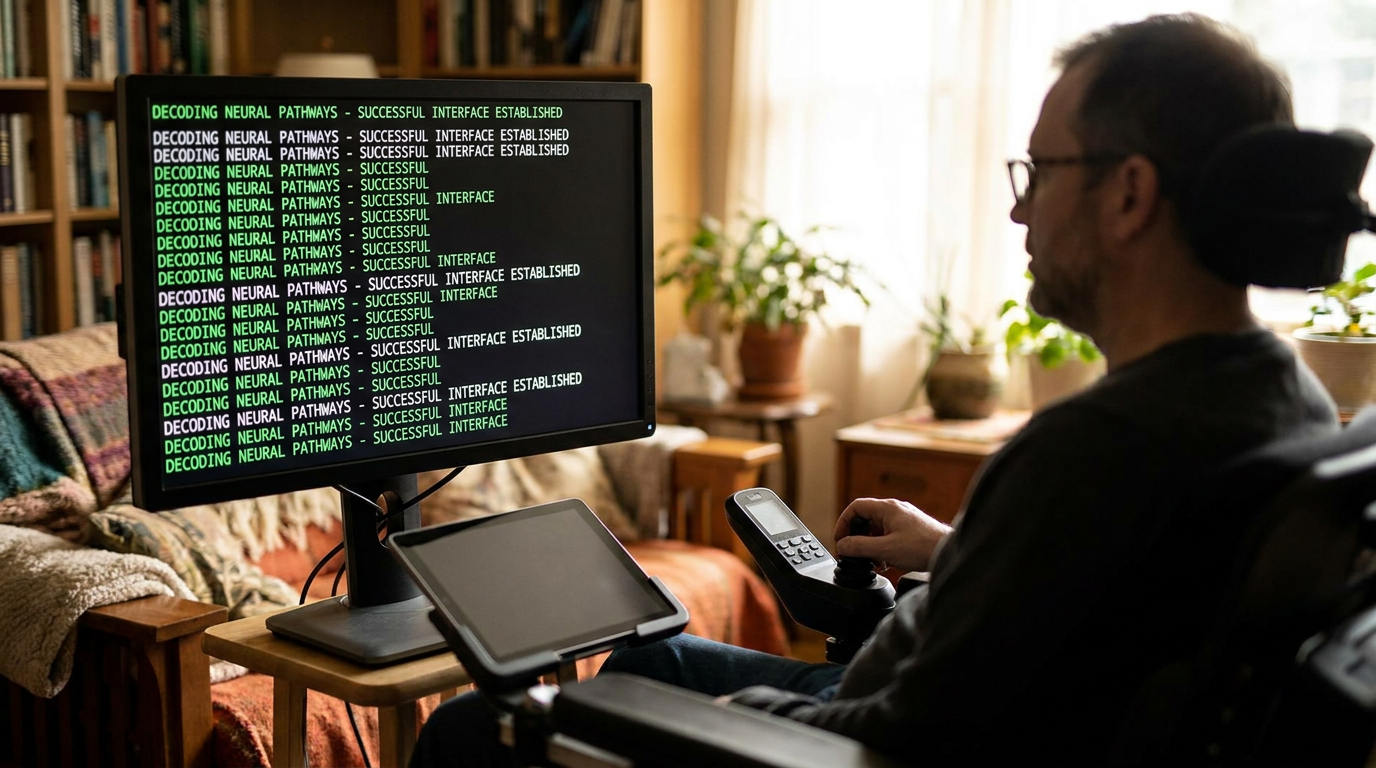
For individuals living with amyotrophic lateral sclerosis (ALS), the progression of the disease often leads to a devastating endpoint: locked-in syndrome, where cognitive function remains intact but the ability to move or speak is entirely lost. For decades, restoring communication has been the holy grail of neuroengineering. Now, a landmark study has demonstrated that a patient with severe paralysis can use a brain-computer interface (BCI) to communicate autonomously from his own living room, without the constant presence of a team of scientists.[1][2]
The patient, Ian Harrell, has lived with motor neuron disease for years. According to a newly published paper in Nature Medicine, Harrell has successfully used a surgically implanted neuroprosthesis for nearly two years to translate his brain signals into text and synthesized speech. The results represent a paradigm shift in assistive technology, moving BCIs out of highly controlled laboratory environments and into the messy, unpredictable reality of daily life.[1][2][3]
The core claim of the study rests on unprecedented performance metrics. Over a tracking period of 397 days, Harrell used the system on 364 days, logging more than 3,800 hours of independent, at-home use. This sustained, autonomous operation is what separates this trial from previous BCI milestones, which typically required researchers to calibrate the system daily and monitor the hardware during use.[1][2][4]
The evidence for the system's efficacy is robust. The BCI granted Harrell access to a staggering 125,000-word vocabulary, effectively allowing for open-ended, naturalistic expression rather than forcing him to select from a limited menu of pre-programmed phrases. Even more remarkably, the system achieved a 97.5% decoding accuracy rate. This level of precision rivals standard smartphone dictation software and represents a massive leap over earlier neural decoding attempts, which often struggled with high error rates.[1][3][4]

The mechanism behind this breakthrough relies on a tiny microelectrode array implanted directly into the regions of Harrell's brain responsible for voluntary movement and speech articulation. When Harrell attempts to speak, his brain generates specific electrical patterns. The implant captures these neural spikes and transmits them to an external computer.[5][7]
From there, advanced machine learning algorithms take over. The AI models were trained to recognize the unique neural signatures associated with Harrell's attempts to form specific phonemes and words. Over time, the software became highly adept at translating these intended movements into digital text in real-time, which is then displayed on a screen or read aloud by a voice synthesizer.[3][4][6]
The AI models were trained to recognize the unique neural signatures associated with Harrell's attempts to form specific phonemes and words.
The impact on Harrell's daily life has been profound. The Nature summary highlights that the device essentially gave the man his daily life back, allowing him to converse with his family, control his computer, and interact with the digital world independently. For a patient population that often faces total isolation as their disease progresses, the ability to maintain a digital presence and communicate complex thoughts is life-altering.[1][5][7]
However, as an evidence pack, the study also presents transparent uncertainties and limitations. The most glaring caveat is that this is an N=1 clinical trial—a study of a single patient. While the results are undeniably historic, the scientific community must now determine whether this specific BCI architecture and decoding algorithm will generalize to other patients with different neurological profiles and varying stages of ALS progression.[2][3][4]

Another area of uncertainty involves hardware longevity. The brain is a hostile environment for electronics. Over time, the body's natural immune response can cause scar tissue to form around the microelectrodes, a process known as gliosis, which can degrade the quality of the neural signals. While Harrell's system has functioned reliably for 19 months, researchers do not yet know the maximum lifespan of the implant before signal degradation requires recalibration or surgical replacement.[2][3][7]
Furthermore, the current iteration of the technology remains highly bespoke and expensive. The system requires complex neurosurgery, specialized hardware, and custom-trained AI models. Scaling this technology from a multi-million-dollar research prototype to a commercially viable medical device that insurance companies will cover is a monumental engineering and economic challenge.[3][4][6]
Despite these hurdles, the medical and clinical communities are viewing the Nature Medicine publication as a watershed moment. Previous BCI trials have proven that neural decoding is possible; this trial proves that it is practical. By demonstrating that a patient can turn the system on, use it accurately, and turn it off without a technician in the room, the researchers have crossed the critical threshold from experimental science to functional medicine.[2][4][6]
The regulatory path forward will require larger, multi-center clinical trials to establish a broader safety and efficacy profile. The U.S. Food and Drug Administration (FDA) and equivalent international bodies will need to see data from diverse patient cohorts before granting widespread approval for at-home BCI systems.[3][4]

For patient advocacy groups, the timeline cannot move fast enough. ALS is a rapidly progressive disease, and the window for intervention is often tragically short. The success of Harrell's implant provides a tangible beacon of hope that a diagnosis of motor neuron disease will not inevitably mean the loss of one's voice.[5][6][7]
Ultimately, the achievement detailed in this study marks the beginning of a new era in neuroengineering. The fusion of high-density neural interfaces with advanced artificial intelligence has finally reached a level of maturity where it can seamlessly integrate into a patient's daily routine. As researchers work to miniaturize the hardware and refine the algorithms, the dream of restoring full autonomy to those with severe paralysis is no longer just a theoretical possibility—it is a proven reality.[1][2][4]
How we got here
Early 2000s
Initial brain-computer interface trials demonstrate that paralyzed patients can move computer cursors in highly controlled lab settings.
Late 2024
Ian Harrell undergoes neurosurgery to implant a microelectrode array in his motor cortex.
June 2026
Researchers publish data in Nature Medicine showing Harrell successfully used the BCI autonomously at home for nearly two years.
Viewpoints in depth
Neuroengineering Researchers
Focused on the technical milestone of moving BCIs from controlled labs to autonomous at-home use.
For the engineers who design these systems, the primary victory is stability. Historically, neural implants required daily recalibration by experts because the brain's electrical signals shift slightly from day to day. By developing machine learning algorithms that can adapt to these shifts automatically, researchers have solved one of the biggest bottlenecks preventing BCIs from becoming practical consumer medical devices.
Medical & Clinical Community
Emphasizes the clinical safety, efficacy, and the profound improvement in patient quality of life.
Clinicians view this trial as a massive quality-of-life intervention. For patients with late-stage ALS, the loss of communication often leads to severe depression and isolation. Doctors emphasize that restoring a patient's ability to converse with family, browse the internet, and express complex thoughts is just as critical as managing their physical symptoms. The fact that the implant caused no severe adverse effects over 19 months is also a major clinical win.
Patient Advocacy Groups
Views the breakthrough as a beacon of hope for restoring autonomy to those with severe paralysis.
Advocates for those with motor neuron diseases see this technology as the ultimate tool for preserving human dignity. However, they also stress the urgency of accelerating the regulatory process. Because ALS is rapidly progressive, advocates argue that experimental, life-altering technologies like BCIs should be made accessible to patients through compassionate use programs much faster than the traditional decade-long FDA approval timeline.
What we don't know
- Whether the specific decoding algorithms will generalize effectively to other patients with different neurological profiles.
- The maximum lifespan of the implanted microelectrode array before scar tissue degrades the neural signal quality.
- The timeline for when this bespoke, highly expensive technology might become an accessible, FDA-approved commercial medical device.
Key terms
- Amyotrophic Lateral Sclerosis (ALS)
- A progressive neurodegenerative disease that affects nerve cells in the brain and spinal cord, leading to loss of muscle control.
- Brain-Computer Interface (BCI)
- A system that connects the brain to external technology, allowing a person to control devices using their thoughts.
- Neuroprosthesis
- An implanted device designed to replace or improve the function of an impaired nervous system.
- Microelectrode Array
- A tiny grid of sensors implanted in the brain to detect the electrical signals generated by neurons.
Frequently asked
Does the patient need a scientist present to use the device?
No. The major breakthrough of this study is that the patient was able to use the system autonomously at home, without researchers needing to calibrate or monitor the equipment daily.
How accurate is the text decoding?
The system achieved a 97.5% accuracy rate, allowing the patient to communicate using a 125,000-word vocabulary.
Is this technology available to the public yet?
Not yet. The device is currently part of an experimental clinical trial and will require larger studies and FDA approval before it becomes widely available.
Sources
Source coverage
7 outlets
3 viewpoints surfaced






[1]NatureMedical & Clinical Community
At-home brain implant gives man with motor neuron disease his daily life back
Read on Nature →A high-performance neuroprosthesis for independent, at-home communication
Read on Nature Medicine →[3]MIT Technology ReviewNeuroengineering Researchers
Brain Computer Interface: ALS Patient Uses Brain Implant for 19 Months
Read on MIT Technology Review →[4]Medical XpressMedical & Clinical Community
Brain-computer interface enables independent, accurate communication for man living with ALS
Read on Medical Xpress →[5]NOSPatient Advocacy & Public Interest
Paralyzed ALS Patient Can Communicate Again Thanks to Brain Implant
Read on NOS →[6]20minutosPatient Advocacy & Public Interest
A Historic Breakthrough Returns Speech to a Patient with Severe Paralysis From Home
Read on 20minutos →[7]Il Fatto QuotidianoPatient Advocacy & Public Interest
Chip in the Brain for ALS: Patient Communicates From Home for 2 Years
Read on Il Fatto Quotidiano →

Every angle. Every day.
Get science stories with full source coverage and perspective breakdowns delivered to your inbox.