
Smart Ring vs. Smartwatch: Which Health Tracker Fits Your Life in 2026?
As smart rings challenge the dominance of smartwatches, choosing the right wearable comes down to a trade-off between passive sleep tracking and active workout data.
By Factlen Editorial Team
- Digital Minimalists
- Prioritize passive tracking, sleep comfort, and screen-free health data without notification fatigue.
- Active Athletes
- Require real-time pacing, GPS mapping, and on-device workout controls to guide their training.
- Data-Driven Optimizers
- Use both devices simultaneously to capture the best metrics from each form factor.
What's not represented
- · Traditional watchmakers
- · Medical professionals diagnosing sleep disorders
Why this matters
Wearable health trackers are significant investments that shape how you understand your body and manage your stress. Choosing the right form factor ensures you actually wear the device consistently, leading to better insights into your sleep, recovery, and overall fitness.
Key points
- Smart rings excel at passive resting metrics, offering superior sleep and recovery tracking due to their stable fit on the finger.
- Smartwatches dominate active fitness tracking, providing real-time pacing, GPS, and better heart rate accuracy during dynamic movement.
- Rings offer 6 to 8 days of battery life and digital minimalism, while watches require daily charging and introduce screen notifications.
- Many users are adopting a dual-wearable approach, using a watch for daytime workouts and a ring for overnight sleep analysis.
The wearable technology landscape in 2026 has officially bifurcated. For years, the default answer to consumer health tracking was strapping a glowing screen to your wrist. Now, a surge of advanced smart rings from companies like Oura, Samsung, RingConn, and Ultrahuman has challenged the smartwatch's dominance, offering a screenless, passive alternative. This shift has forced consumers to reevaluate what they actually want from a wearable device. Choosing between a smart ring and a smartwatch is no longer just a matter of budget or brand loyalty; it is a fundamental choice about how you want to interact with your personal health data on a daily basis. One philosophy demands your attention with notifications and real-time dashboards, while the other quietly collects metrics in the background without adding to your daily screen time.[1][4]
To understand which device is right for you, it is essential to look past the marketing claims and examine the physiological realities of where these devices sit on your body. The finger and the wrist offer entirely different advantages for biometric sensors. Both form factors rely on the same underlying optical technology—photoplethysmography, or PPG—which uses green and red LEDs alongside a photodiode to measure blood volume changes through the skin. However, the finger has thinner soft tissue and a denser concentration of capillaries near the surface compared to the back of the wrist. This anatomical difference gives the smart ring a structural advantage for capturing clean, consistent cardiovascular data when the body is at rest.[2][7]
Because a ring sits in firm, circumferential contact with a single finger, it is far less prone to shifting or losing contact with the skin. This stability makes rings exceptionally accurate for tracking resting heart rate, heart rate variability (HRV), and overnight blood oxygen levels. HRV, in particular, is a highly sensitive metric used to gauge physical recovery and central nervous system stress. The snug, stable fit of a ring ensures that these micro-fluctuations in heart rhythm are captured without the noise introduced by a loose watch band sliding up and down the arm.[2][5]

Sleep tracking is where the smart ring decisively beats the smartwatch. Independent sleep lab studies comparing consumer wearables to clinical polysomnography consistently show that premium rings excel at detecting sleep stages, particularly REM and light sleep, capturing night-to-night variations with high fidelity. The algorithms powering these rings benefit immensely from the uninterrupted, high-quality data stream provided by the finger. While smartwatches can detect awake times accurately, they frequently struggle to differentiate between deep and light sleep, often overestimating the amount of restorative rest a user actually achieved.[3]
Beyond sensor accuracy, the ring wins on pure nighttime ergonomics. Premium smartwatches like the Apple Watch Ultra or Garmin Fenix can weigh between 61 and 89 grams, with thick cases that make them bulky and uncomfortable for many users to wear to bed. In contrast, a modern smart ring weighs roughly three grams and is easily forgotten within minutes of putting it on. For users who suffer from sleep anxiety or simply cannot tolerate a heavy device on their wrist while trying to rest, the smart ring removes a major point of friction, ensuring that overnight data is actually collected rather than abandoned on a nightstand.[1][6]
Smart rings also hold a distinct advantage in women's health and cycle tracking. Because rings take continuous overnight skin-temperature readings from a highly stable location, they provide the precise baseline shifts required for ovulation and menstrual cycle prediction. While modern smartwatches also feature temperature sensors, wrist temperature is notoriously susceptible to environmental factors—like an arm hanging outside the blankets—making the data noisier and slightly less reliable for reproductive health algorithms.[2][7]
Smart rings also hold a distinct advantage in women's health and cycle tracking.
However, the moment you transition from resting to active movement, the smartwatch reclaims the throne. Smart rings are notoriously poor at tracking high-intensity workouts, weightlifting, or activities involving heavy wrist flexion. The pressure of gripping a barbell or a bicycle handlebar against a metal ring is not only uncomfortable but can physically push the sensors away from the skin, resulting in dropped heart rate readings. Furthermore, the lack of a screen means that a ring cannot provide the real-time feedback that many athletes rely on to guide their training sessions.[1][2]

Smartwatches dominate active fitness tracking. Devices from Apple and Garmin feature advanced algorithms specifically designed to filter out the "noise" of arm movement during dynamic exercises like running, swimming, or tennis. They also offer built-in GPS for mapping routes and calculating precise pacing without needing to carry a smartphone—a feature that is currently impossible to engineer into a three-gram ring. For athletes who train by heart rate zones, track their VO2 max, or need to glance at their wrist to adjust their effort mid-stride, a smartwatch's display is an indispensable tool.[4][6]
Clinical-grade health features also remain exclusive to the smartwatch domain. If you are looking for an electrocardiogram (ECG) to detect atrial fibrillation, or on-demand blood pressure monitoring, you must opt for a premium smartwatch. These features require a larger surface area and often involve completing an electrical circuit by touching the watch case with your opposite hand. Smart rings, while excellent at passive monitoring, simply do not have the hardware real estate to support these FDA-cleared medical diagnostics.[1][2]
Battery life represents another major dividing line between the two form factors. The standard smartwatch requires daily charging, which often creates a frustrating gap in data collection. Users frequently take their watch off to charge before bed or during a morning shower, inadvertently missing crucial sleep or recovery metrics. Smart rings, lacking power-hungry displays, GPS chips, and constant vibration motors, typically last six to eight days on a single charge. This extended battery life enables true 24/7 health baselining, giving the device's algorithms a much more complete and uninterrupted picture of your physiological trends over time.[5][6]

Yet, prospective buyers must be wary of hidden costs and subscription models. While a smartwatch is generally a one-time hardware purchase—barring optional fitness class subscriptions—the smart ring market has heavily embraced recurring revenue. Some leading rings require a $10 to $20 monthly fee to unlock your own health data, adding hundreds of dollars to the total cost of ownership over a two- or three-year lifespan. Fortunately, the market is shifting in 2026, with competitors like RingConn and Samsung's Galaxy Ring introducing subscription-free models, forcing consumers to carefully weigh upfront hardware costs against long-term software fees.[2][5]
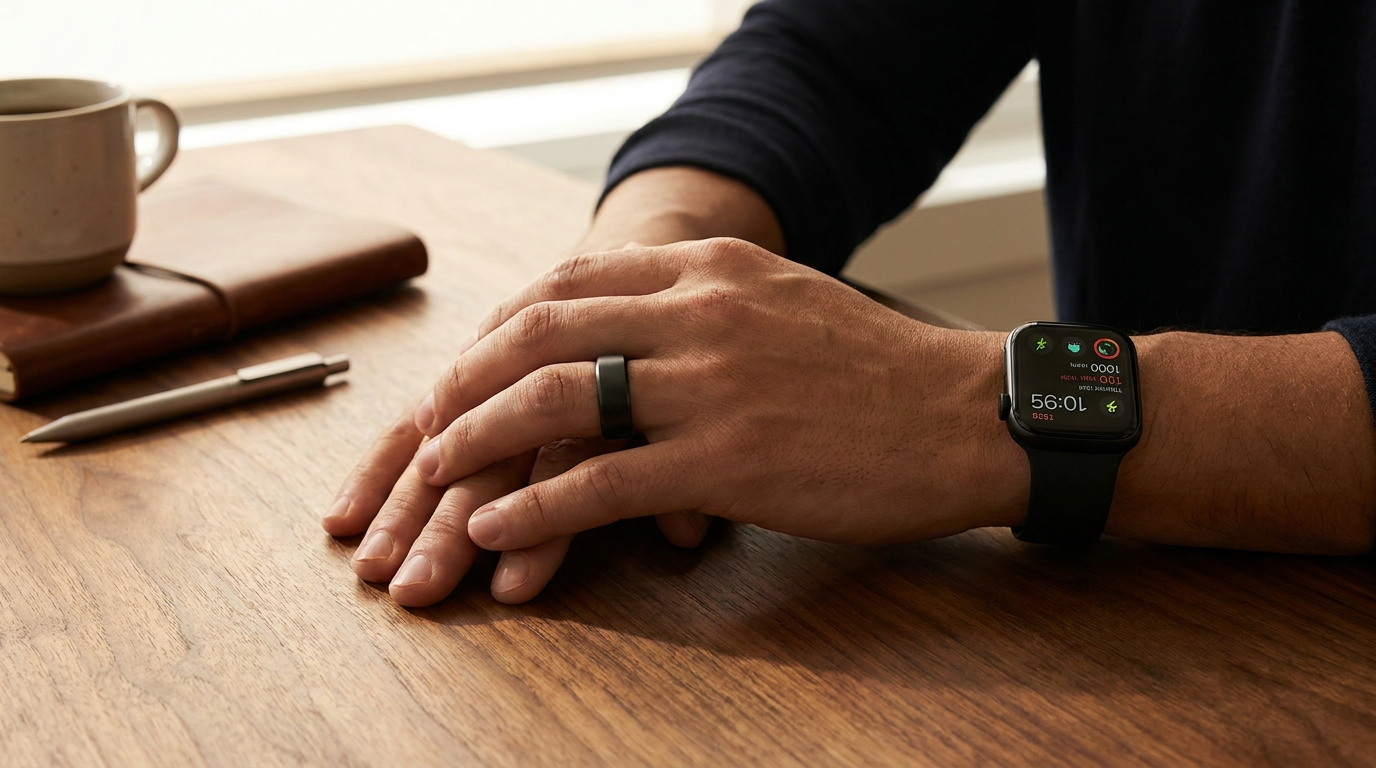
Interestingly, the rise of the smart ring has not necessarily cannibalized the smartwatch market; instead, it has created a new category of "dual wearers." Many fitness enthusiasts and data-driven optimizers now wear a Garmin or Apple Watch during the day for notifications, contactless payments, and precise workout tracking, then switch to a smart ring at night for comfortable, high-fidelity sleep analysis. The two devices serve complementary roles, allowing users to capture the best metrics from each form factor without compromising on comfort or capability.[2][6]
Ultimately, the decision comes down to a trade-off between friction and features. A smart ring fits perfectly when you want low-friction health tracking, prioritize sleep and recovery metrics, and prefer digital minimalism. It is the ideal choice for someone who wants to understand their body's baseline without being constantly interrupted by a glowing screen. It does not fit well if you need on-device GPS, contactless payments, or live workout coaching.[5][7]

Conversely, a smartwatch fits perfectly when you want a wrist-based command center, real-time exercise metrics, and the ability to leave your phone at home. It remains the superior choice for active training, provided you are willing to manage the daily charging routine and the bulkier form factor. It does not fit well if you suffer from screen fatigue, find heavy wearables uncomfortable at night, or simply prefer the aesthetic of traditional mechanical watches.[1][5]
How we got here
2015
The first generation of consumer smart rings launches, focusing primarily on basic step counting and simple notifications.
2021
Smartwatches introduce advanced clinical health sensors, including ECG and blood oxygen monitoring, solidifying their dominance.
2024
Major tech companies enter the ring market, with Samsung launching the Galaxy Ring to compete with established players like Oura.
2026
The wearable market solidifies into a dual-device ecosystem, with users increasingly adopting both form factors for specialized tracking.
Viewpoints in depth
Digital Minimalists
Advocates for reducing screen time and notification fatigue through passive tracking.
This camp argues that health tracking should be invisible. They value smart rings because the devices capture essential baselines—like sleep quality and recovery—without demanding the user's attention. For minimalists, the lack of a screen is a feature, not a bug, allowing them to disconnect from digital noise while still maintaining a comprehensive log of their physical well-being.
Active Athletes
Focuses on actionable, real-time data to guide physical training and performance.
Athletes argue that a health tracker is fundamentally limited if it cannot guide a workout mid-stride. They rely on smartwatches for live pacing, heart rate zone alerts, and phone-free GPS mapping. To this group, the bulk and daily charging requirements of a watch are acceptable trade-offs for the ability to actively interact with their performance data while in motion.
Data-Driven Optimizers
Focuses on maximizing accuracy across all metrics by utilizing multiple devices.
This perspective acknowledges that no single wearable is perfect. Optimizers advocate for a hybrid approach: wearing a smartwatch during the day to capture accurate workout data and handle notifications, then switching to a smart ring at night to ensure high-fidelity sleep tracking without the discomfort of a bulky wrist device. They view the two form factors as complementary tools rather than direct competitors.
What we don't know
- Whether smart rings will eventually be able to incorporate FDA-cleared ECG sensors given their limited hardware space.
- How the long-term durability of smart rings compares to smartwatches when exposed to daily wear and tear like weightlifting or manual labor.
Key terms
- Photoplethysmography (PPG)
- The optical technology used by wearables to measure blood volume changes using green and red LED lights.
- Heart Rate Variability (HRV)
- The variation in time between each heartbeat, used as a key indicator of physical recovery and central nervous system stress.
- Polysomnography
- A comprehensive sleep study used as the clinical gold standard for measuring sleep stages and quality.
- SpO2
- A measure of the amount of oxygen-carrying hemoglobin in the blood, tracked overnight by most modern wearables.
Frequently asked
Can a smart ring track my runs without my phone?
No. Smart rings currently lack built-in GPS and screens, meaning you must carry your smartphone to map your route or see your pacing data in real-time.
Are smart rings more accurate than smartwatches?
It depends on the activity. For resting metrics like sleep stages and heart rate variability (HRV), rings are generally more accurate. For active heart rate during exercise, smartwatches perform significantly better.
Do all smart rings require a monthly subscription?
No. While some established brands require a monthly fee to view your health data, newer options like the Samsung Galaxy Ring and RingConn offer subscription-free models.
Can I wear both a smart ring and a smartwatch?
Yes. Many users have adopted a dual-device strategy, wearing a smartwatch during the day for notifications and workouts, and switching to a smart ring at night for comfortable sleep tracking.
Sources
Source coverage
7 outlets
3 viewpoints surfaced







[1]WareableActive Athletes
Samsung Galaxy Ring vs Galaxy Watch 7: Which is right for you?
Read on Wareable →[2]SmartRingHQData-Driven Optimizers
Smart Ring vs Smartwatch: The Honest 2026 Comparison
Read on SmartRingHQ →[3]WeLoveCyclingData-Driven Optimizers
Which Wearables Actually Track Sleep Accurately?
Read on WeLoveCycling →[4]SamsungActive Athletes
Smart ring vs smartwatch: Which is best for fitness & health tracking?
Read on Samsung →[5]RingConnDigital Minimalists
Smart Ring vs Smartwatch: Which Is Better for Sleep and Health Tracking?
Read on RingConn →[6]VyraringDigital Minimalists
Why combine a ring and a smartwatch? The ultimate health tracking strategy
Read on Vyraring →[7]Factlen Editorial TeamData-Driven Optimizers
Synthesis by Factlen editorial team
Read on Factlen Editorial Team →
More in shopping
See all 5 stories →

Every angle. Every day.
Get shopping stories with full source coverage and perspective breakdowns delivered to your inbox.