
The Best Smart Rings of 2026: Oura, Samsung, and Ultrahuman Compared
The smart ring market has matured beyond a single dominant player, offering subscription-free alternatives and deep ecosystem integrations. We compare the top contenders to help you find the right fit for your finger and your wallet.
By Factlen Editorial Team
- Data-Driven Biohackers
- Users who prioritize raw data, circadian rhythms, and no paywalls.
- Holistic Health Seekers
- Users who value polished, scientifically validated insights and simplicity.
- Ecosystem Loyalists
- Users who prefer seamless integration with their existing devices.
What's not represented
- · Traditional watchmakers entering the wearable space
- · Medical professionals prescribing wearables
Why this matters
Choosing the right smart ring dictates not just your upfront cost, but your ongoing monthly expenses and which smartphone ecosystem you are locked into. Making the right choice ensures you get actionable health data without paying for features you don't need.
Key points
- The smart ring market now features strong, subscription-free alternatives to Oura.
- Oura Ring 4 remains the gold standard for sleep and fertility tracking, but requires a $5.99 monthly fee.
- Samsung Galaxy Ring offers seamless integration and no fees, but is restricted to Android users.
- Ultrahuman Ring Air provides ultra-lightweight, subscription-free tracking tailored for biohackers.
- RingConn Gen 2 leads the market in battery life, lasting up to 12 days on a single charge.
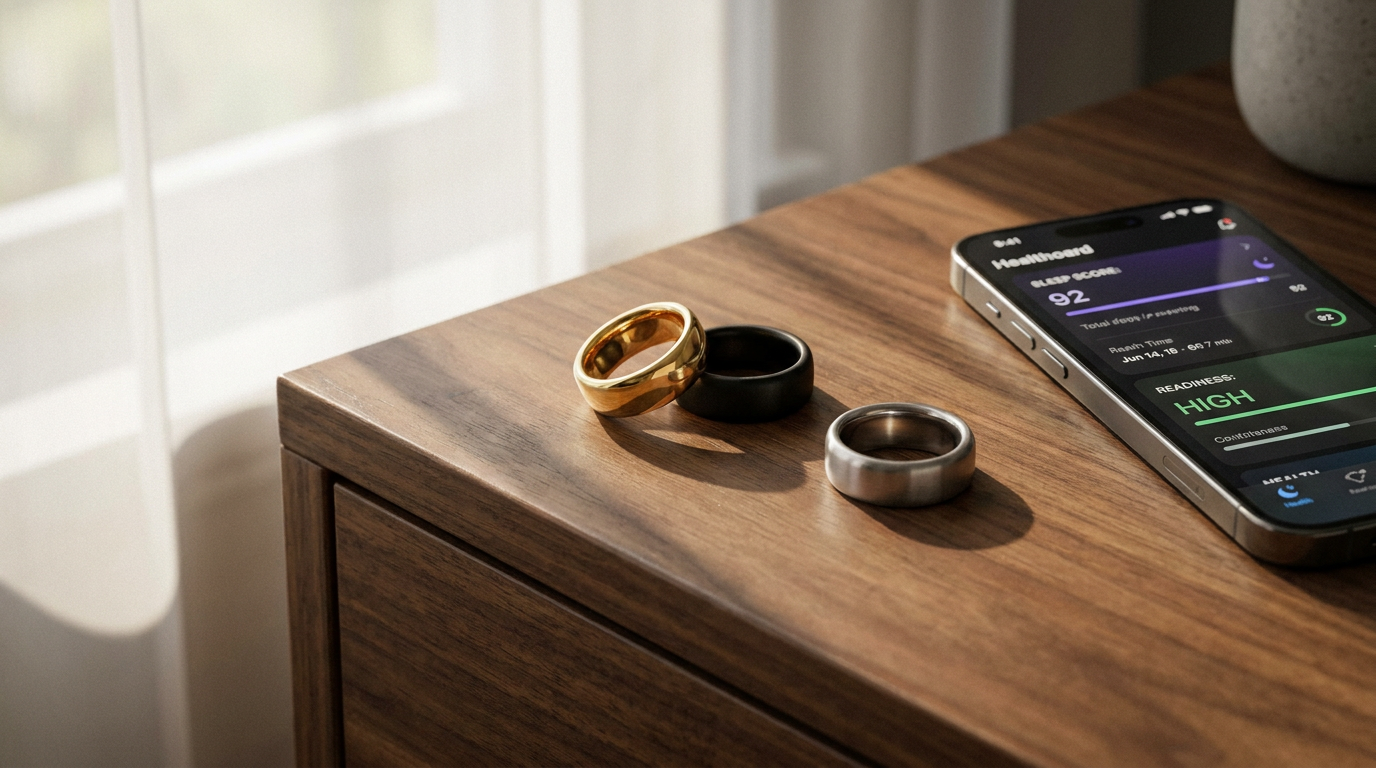
For years, the smart ring market was synonymous with a single brand. If you wanted to track your sleep without wearing a bulky smartwatch to bed, you bought an Oura ring. But by mid-2026, the landscape has fundamentally shifted. Major tech giants and agile startups have flooded the market with highly capable, subscription-free alternatives, turning a monopoly into a fierce competition.[1][3]
The appeal of smart rings lies in their unobtrusive form factor. Packed with miniaturized photoplethysmography (PPG) sensors, temperature monitors, and accelerometers, these devices gather medical-grade data from the blood vessels in your finger—a location that often yields a stronger, more reliable signal than the wrist. Today, choosing the right ring requires navigating a complex web of upfront costs, recurring fees, and smartphone ecosystem lock-ins.[2][6]
When evaluating the Oura Ring 4, the case for the device centers on its unmatched sleep architecture and holistic health insights. Oura has been refining its algorithms longer than anyone else, utilizing an 18-path PPG sensor array that dynamically adjusts to individual finger physiology. It remains the gold standard for scientifically validated sleep tracking and FDA-cleared fertility predictions.[1][6]
However, the case against the Oura Ring 4 is entirely financial. While the hardware starts at $349, unlocking the detailed analytics requires a mandatory $5.99 monthly subscription. The evidence, as noted by Mashable, confirms that while Oura offers the most expansive biometric tracking on the market, the recurring cost is a significant barrier for users who simply want to own their data outright.[1][3]

This brings us to the Samsung Galaxy Ring. The case for Samsung’s entry is its seamless integration and lack of recurring fees. Retailing at a flat $399, it offers a durable titanium build and introduces a unified Energy Score that aggregates sleep, activity, and heart rate data. If you already own a Galaxy Watch, the two devices communicate to extend the ring's battery life up to 30 percent.[1][5]
The case against the Samsung Galaxy Ring is its strict platform exclusivity. It natively rejects Apple iPhones and functions optimally only within the Android ecosystem, specifically with Samsung Health. The evidence suggests that while the fitness and wellbeing tracking is mostly solid, its stress tracking can occasionally be erratic compared to its peers.[2][4]
For those seeking a platform-agnostic alternative, the Ultrahuman Ring Air presents a compelling option. The case for the Ultrahuman centers on its ultra-lightweight design—weighing just 2.4 grams—and its absolute lack of subscription fees. It caters heavily to data-driven individuals, offering deep circadian rhythm tracking and actionable advice on when to cut off caffeine intake.[1][3]
For those seeking a platform-agnostic alternative, the Ultrahuman Ring Air presents a compelling option.
The case against the Ultrahuman Ring Air involves its occasional sensor quirks and a highly dense app interface. Some users report that its no-contact temperature sensor can read slightly lower than Oura's baseline. Yet, the evidence shows that its core sleep and recovery metrics are remarkably accurate, making it a powerful tool for biohackers who want granular data without a paywall.[3][6]
A fourth contender, the RingConn Gen 2, dominates the endurance category. The case for RingConn is its unbeatable 10 to 12-day battery life and budget-friendly $299 price tag. It also features built-in sleep apnea monitoring, a rarity in this form factor. The case against it is a slightly less refined app experience and lower brand recognition. Evidence confirms, however, that it is the most practical choice for continuous, uninterrupted tracking.[2]

Quantifying these trade-offs reveals stark differences in long-term ownership costs. Over three years, the Oura Ring 4 will cost a user approximately $564 when factoring in the monthly membership. In contrast, the Samsung Galaxy Ring and Ultrahuman Ring Air cap out at their initial purchase prices of $399 and $349, respectively.[1]
Battery life also presents a quantifiable divide. While Oura and Samsung hover around a respectable seven days per charge, Ultrahuman averages closer to four to six days depending on the tracking mode. RingConn nearly doubles the industry standard, ensuring users rarely miss a night of temperature data due to a dead battery.[2][5]
Ultimately, deciding which device reigns supreme requires matching the hardware to your specific lifestyle. The Oura Ring 4 fits well when you prioritize medical-grade sleep data, require advanced fertility tracking, and do not mind paying a monthly premium for a highly polished app experience. It does not fit when you are strictly budget-conscious or philosophically opposed to subscription models.[6]

The Samsung Galaxy Ring fits well when you are deeply embedded in the Samsung ecosystem, already use a Galaxy Watch, and want a durable, one-time purchase. It does not fit when you use an iPhone or plan to switch away from Android in the near future, as the hardware will become effectively useless.[2][5]
The Ultrahuman Ring Air fits well when you want the lightest possible wearable, demand zero subscription fees, and prefer actionable, biohacker-style recovery data. It does not fit when you prefer a simple, minimalist app interface that hides the raw numbers behind a single daily readiness score.[3][6]

The era of the default smart ring is over. With three distinct definitions of success—Oura for premium insights, Samsung for ecosystem synergy, and Ultrahuman for lightweight data sovereignty—consumers finally have the leverage to choose exactly what goes on their finger.[1]
How we got here
2015
Oura launches its first-generation smart ring via Kickstarter, establishing the consumer smart ring category.
2021
Oura releases the Gen 3 ring and controversially introduces a mandatory monthly subscription model for its data.
2023
Ultrahuman launches the Ring Air, offering a lightweight, subscription-free alternative targeting biohackers.
2024
Samsung enters the market with the Galaxy Ring, validating the form factor for mainstream Android users.
Late 2024
Oura releases the Ring 4, featuring an upgraded 18-path sensor array to maintain its premium market position.
2026
The market fragments into specialized niches, with brands competing on battery life, ecosystem integration, and AI coaching.
Viewpoints in depth
Data-Driven Biohackers
Users who prioritize raw data, circadian rhythms, and no paywalls.
This camp favors devices like the Ultrahuman Ring Air and RingConn Gen 2. They argue that health data belongs to the user and should not be locked behind a monthly subscription. They value granular metrics—such as real-time temperature shifts and precise HRV readings—over simplified daily readiness scores, using this data to actively adjust their diet, training, and sleep schedules.
Ecosystem Loyalists
Users who prefer seamless integration with their existing devices over cross-platform flexibility.
For this group, the Samsung Galaxy Ring is the ultimate wearable. They argue that a smart ring shouldn't exist in a vacuum; it should communicate directly with their smartphone and smartwatch to provide a unified health picture. They are willing to sacrifice iOS compatibility for features like shared battery optimization and a single, centralized health dashboard.
Holistic Health Seekers
Users who value polished, scientifically validated insights and simplicity.
This camp remains fiercely loyal to the Oura Ring. They argue that raw data is useless without context, and they are willing to pay a monthly premium for an app that translates complex biometrics into plain-language advice. For them, the peace of mind provided by FDA-cleared algorithms and long-term trend analysis outweighs the ongoing financial cost.
What we don't know
- Whether Apple will eventually release an 'Apple Ring' to compete directly with Samsung and Oura.
- How long smaller startups like Ultrahuman and RingConn can maintain their subscription-free models as server and AI costs scale.
- If future FDA clearances will allow smart rings to officially diagnose conditions like sleep apnea or atrial fibrillation, rather than just monitoring them.
Key terms
- PPG Sensor
- A photoplethysmography sensor that uses light to measure blood flow and heart rate directly from the blood vessels.
- HRV (Heart Rate Variability)
- The variation in time between each heartbeat, used as a key indicator of physical stress and recovery.
- SpO2
- A measure of the amount of oxygen-carrying hemoglobin in the blood, indicating overall respiratory efficiency.
- Circadian Rhythm
- The natural, internal process that regulates the sleep-wake cycle and repeats roughly every 24 hours.
Frequently asked
Are smart rings as accurate as smartwatches?
Yes, especially for sleep and resting heart rate. The blood vessels in the finger provide a stronger, more reliable pulse signal than the wrist, making rings highly accurate for cardiovascular metrics.
Do I have to pay a monthly fee to use a smart ring?
It depends on the brand. The Oura Ring requires a $5.99 monthly subscription for full access, while the Samsung Galaxy Ring, Ultrahuman Ring Air, and RingConn Gen 2 offer all features subscription-free.
Does the Samsung Galaxy Ring work with an iPhone?
No. The Samsung Galaxy Ring is strictly compatible with Android devices and performs best when paired with a Samsung Galaxy smartphone.
Can I wear a smart ring while lifting weights?
Yes, most premium smart rings are made of durable titanium. However, heavy knurling on barbells can scratch the finish, so some users prefer to remove them or wear a protective cover during heavy lifting.
Sources
Source coverage
6 outlets
3 viewpoints surfaced





[1]The GadgeteerHolistic Health Seekers
Best Smart Ring 2026: Oura Isn't the Default Anymore
Read on The Gadgeteer →[2]PendiumData-Driven Biohackers
2026 Best Smart Rings for Health and Sleep Tracking
Read on Pendium →[3]MashableHolistic Health Seekers
The best smart rings of 2026 — Oura, Ultrahuman, and Samsung
Read on Mashable →[4]Tech AdvisorEcosystem Loyalists
Best Smart Ring 2026: Oura, Samsung, Amazfit & More
Read on Tech Advisor →[5]Best Buy BlogEcosystem Loyalists
Ultrahuman Ring Air vs Galaxy Ring vs Oura 3 Compared
Read on Best Buy Blog →[6]VertuData-Driven Biohackers
Most Accurate Smart Ring 2025: Oura vs. Ultrahuman vs. Samsung
Read on Vertu →


Every angle. Every day.
Get shopping stories with full source coverage and perspective breakdowns delivered to your inbox.