
SpaceX Stock Surges 50% Following Record-Shattering $75 Billion IPO
Shares of SpaceX are soaring in their first days of trading after the aerospace giant executed the largest initial public offering in history, achieving a $1.77 trillion valuation.
By Factlen Editorial Team
- Space Economy Bulls
- Argue that the $1.77 trillion valuation is justified by SpaceX's absolute monopoly on reusable launch infrastructure and Starlink's recurring revenue.
- Retail Investors
- View the IPO as a historic democratization of wealth, celebrating the unprecedented 30% allocation that allowed everyday traders to participate.
- Value Analysts
- Express caution over the company's $4.28 billion Q1 net loss and massive AI capital expenditures, warning the stock is priced for flawless execution.
What's not represented
- · Competitor Launch Providers
- · Telecommunications Incumbents
Why this matters
SpaceX's record-shattering $75 billion public debut not only democratizes access to the world's most valuable aerospace company, but it also injects massive liquidity into the tech sector, potentially thawing a years-long freeze on startup IPOs. The capital secures funding for next-generation space infrastructure while fundamentally proving that the commercial space economy can generate trillion-dollar valuations.
Key points
- SpaceX shares are surging toward a 50% gain just three trading sessions after the company's historic Nasdaq debut.
- The $75 billion offering unseated Saudi Aramco as the largest capital raise in stock market history.
- The IPO cemented a $1.77 trillion valuation, making SpaceX the seventh-largest company in the world by market capitalization.
- In a rare move for a mega-cap listing, 30% of the initial shares were allocated directly to retail investors.
- The successful debut pushed CEO Elon Musk's estimated net worth past $1 trillion, making him the world's first trillionaire.
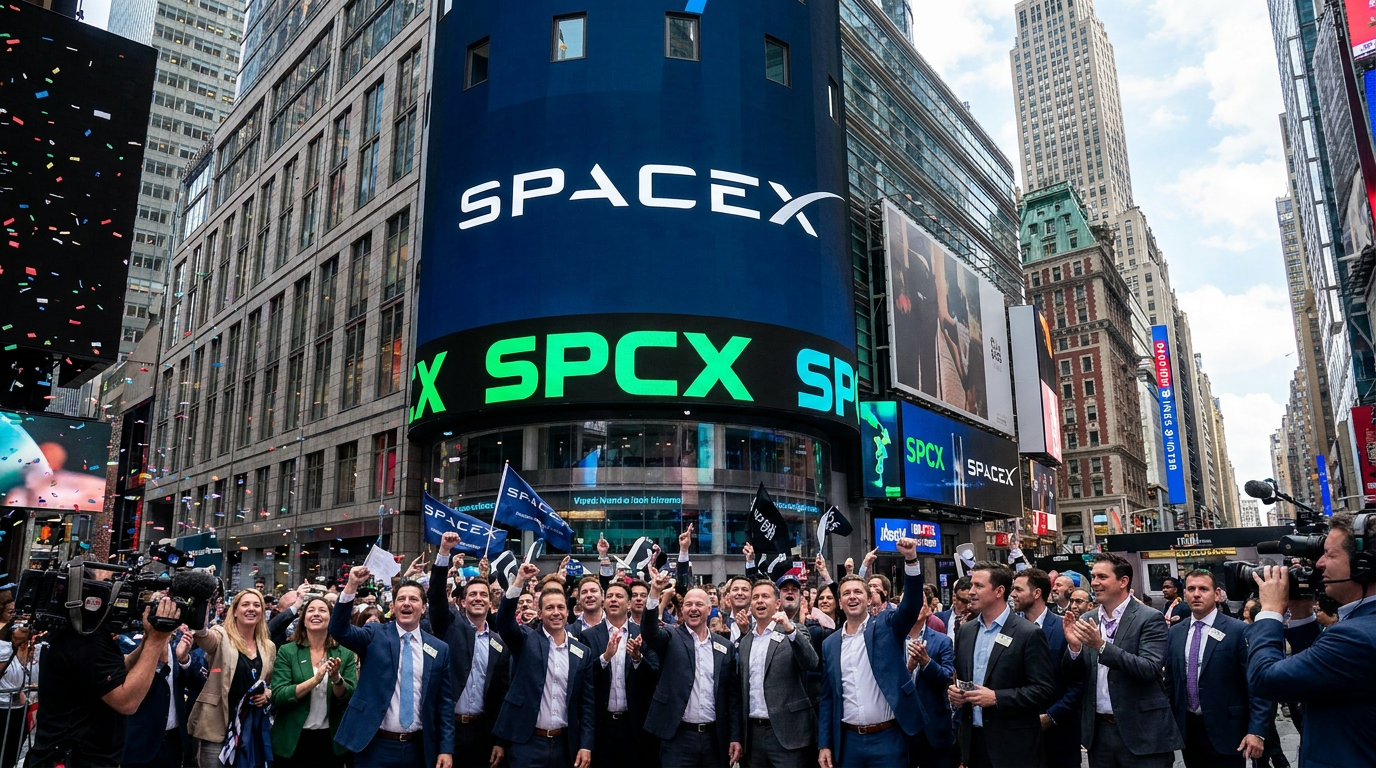
SpaceX's blockbuster public debut is defying gravity. Just three trading sessions after executing the largest initial public offering in stock market history, shares of the aerospace giant are on track for a 50% surge. Trading under the ticker SPCX on the Nasdaq, the stock opened at $150 last Friday—well above its fixed $135 offering price—and has continued to climb as institutional and retail investors scramble for a piece of the commercial space race.[1][6]
The sheer scale of the offering has rewritten Wall Street record books. By raising $75 billion, SpaceX comfortably unseated Saudi Aramco's $29 billion offering to claim the title of the largest capital raise ever recorded. The pricing cemented a staggering $1.77 trillion valuation for the company, instantly making it the seventh-largest firm in the world by market capitalization, ranking ahead of legacy titans like Broadcom and even Elon Musk's other flagship enterprise, Tesla.[3][5]

Unlike traditional mega-cap offerings that spend weeks narrowing an indicative price range through institutional bookbuilding, SpaceX bypassed the standard playbook entirely. The company went straight to the market with a fixed price of $135 per share, presenting a take-it-or-leave-it proposition to Wall Street. Demand proved overwhelming, with the deal attracting more than $250 billion in investor interest—roughly three and a half times the amount of equity available.[3]
Perhaps the most revolutionary aspect of the IPO was its structural democratization. In a highly unusual move for a marquee tech listing, SpaceX allocated 30% of its float directly to retail investors. This represents at least three times the standard 5% to 10% typically reserved for non-institutional buyers in standard public offerings. Individual investors responded by placing orders for more than $100 billion in shares, effectively forcing brokerages to lower participation minimums to handle the unprecedented volume.[4]
Institutional heavyweights were equally aggressive in their positioning. BlackRock alone placed an order for at least $5 billion in SpaceX shares ahead of the debut. To put that institutional appetite into perspective, BlackRock's single order was nearly equivalent to the entire $5.5 billion raised by AI chipmaker Cerebras in its own highly anticipated IPO earlier this month, which had previously been the largest of 2026.[2][4]
Institutional heavyweights were equally aggressive in their positioning.
The financial mechanics underpinning the $1.77 trillion valuation present a complex picture of massive revenue growth paired with heavy capital expenditure. SpaceX generated $18.7 billion in total revenue for the full year of 2025, representing a 33% year-over-year increase. The company's Starlink satellite internet constellation is the primary economic engine, accounting for an estimated 61% of that total revenue as its global subscriber base continues to expand.[3]

However, the company is prioritizing aggressive expansion over immediate GAAP profitability. In the first quarter of 2026 alone, SpaceX posted a $4.28 billion net loss, contributing to an accumulated deficit of over $41 billion. This gap is largely driven by massive depreciation on the Starlink constellation, stock-based compensation, and a reported $2.5 billion per quarter in artificial intelligence infrastructure capital expenditures. Investors, however, appear entirely willing to underwrite these losses in exchange for market dominance.[3][5]
The successful listing has profound implications for the broader venture capital and startup ecosystem. Global venture funding had bottomed out near $304 billion in 2023, and late-stage startups have faced a largely frozen IPO window for years. SpaceX's triumphant debut is widely viewed as the catalyst needed to thaw the market, potentially clearing the runway for other highly valued private companies—such as Stripe, Databricks, and Anthropic—to finally test public waters.[6]
On a personal level, the IPO has catapulted CEO Elon Musk into unprecedented financial territory. With a 42% equity stake and 85% voting control over the newly public entity, the surge in SPCX shares pushed Musk's estimated net worth past the $1 trillion mark. This milestone officially makes him the world's first trillionaire, a wealth concentration that highlights the immense economic leverage generated by the commercialization of space.[2]

Looking ahead, the $75 billion war chest provides SpaceX with virtually unlimited runway to execute its most ambitious projects. The capital is expected to accelerate the development of the next-generation Starship rocket, expand the Starlink network's bandwidth and global reach, and fund the foundational infrastructure required for Musk's long-stated goal of establishing a sustainable human presence on Mars. For now, the market has delivered a resounding vote of confidence in that extraterrestrial vision.[1][6]
How we got here
May 20, 2026
SpaceX publicly files its S-1 prospectus with the SEC, revealing its internal finances and an $18.7 billion revenue figure for 2025.
June 4, 2026
The company launches its investor roadshow, bypassing traditional price ranges to offer a fixed $135 per share.
June 11, 2026
SpaceX officially prices its IPO after market close, cementing a $75 billion raise and a $1.77 trillion valuation.
June 12, 2026
SPCX debuts on the Nasdaq, opening at $150 and pushing Elon Musk's net worth past $1 trillion.
June 16, 2026
Shares continue to surge in premarket trading, putting the stock on track for a 50% gain in its first three sessions.
Viewpoints in depth
Retail Investors' view
Retail traders view the SpaceX IPO as a watershed moment for market fairness.
For years, the most lucrative gains in tech decacorns were captured exclusively by venture capitalists and institutional funds before companies went public. By reserving 30% of the float for individual brokerage accounts, SpaceX allowed retail investors to participate in the initial pop, fundamentally challenging the traditional Wall Street gatekeeping model.
Value Analysts' view
Traditional financial analysts point to the staggering disconnect between SpaceX's valuation and its bottom line.
While $18.7 billion in revenue is impressive, the company burned through $4.28 billion in a single quarter due to Starlink depreciation and AI infrastructure costs. Skeptics argue that a $1.77 trillion market cap—larger than most highly profitable legacy tech giants—leaves zero margin for error if satellite internet growth slows or the Starship program faces regulatory delays.
Space Economy Bulls' view
Proponents argue that applying traditional valuation metrics to SpaceX misses the point entirely.
They view the company not just as an aerospace manufacturer, but as the foundational infrastructure provider for the next century of human expansion. With Starlink generating utility-like recurring revenue and the Falcon 9 operating as a near-monopoly in orbital delivery, bulls believe the company's total addressable market is effectively uncapped.
What we don't know
- How the stock will perform once the initial post-IPO retail frenzy cools and institutional lock-up periods eventually expire.
- Whether the massive $2.5 billion quarterly AI infrastructure expenditures will translate into near-term revenue.
- When the company expects to achieve consistent GAAP profitability given the ongoing depreciation of the Starlink constellation.
Key terms
- Initial Public Offering (IPO)
- The process by which a private company offers shares to the public for the first time, transitioning to a publicly traded entity.
- Float
- The total number of shares of a corporation that are available for trading by the general public.
- Bookbuilding
- The traditional process by which underwriters determine the price at which an IPO will be offered by assessing institutional investor demand.
- GAAP
- Generally Accepted Accounting Principles, the standard framework of guidelines for financial accounting used to measure a company's bottom line.
- Decacorn
- A privately held startup company with a valuation of over $10 billion.
Frequently asked
What is the SpaceX stock ticker symbol?
SpaceX trades on the Nasdaq exchange under the ticker symbol SPCX.
How much did SpaceX raise in its IPO?
The company raised $75 billion, making it the largest initial public offering in stock market history.
Can regular people buy SpaceX stock?
Yes, the stock is now publicly traded. The company notably allocated 30% of its initial offering directly to retail investors, allowing everyday traders to participate.
Is SpaceX a profitable company?
While it generates positive adjusted EBITDA, SpaceX reported a GAAP net loss of $4.28 billion in Q1 2026 due to heavy infrastructure investments and satellite depreciation.
Sources
Source coverage
6 outlets
3 viewpoints surfaced






[1]BloombergSpace Economy Bulls
SpaceX Stock Set for More Than 50% Jump in Just Three Sessions
Read on Bloomberg →[2]ForbesValue Analysts
SpaceX Opens Trading Following Largest-Ever IPO, Making Musk World's First Trillionaire
Read on Forbes →[3]ReutersValue Analysts
SpaceX prices IPO at $135 per share, targets $1.77 trillion valuation
Read on Reuters →[4]Wall Street JournalRetail Investors
Retail Investors and BlackRock Pile Into SpaceX's Historic Offering
Read on Wall Street Journal →[5]Financial TimesValue Analysts
SpaceX unseats Saudi Aramco for largest capital raise in history
Read on Financial Times →[6]CNBCSpace Economy Bulls
SpaceX shares surge in Nasdaq debut, validating commercial space economy
Read on CNBC →
Every angle. Every day.
Get business stories with full source coverage and perspective breakdowns delivered to your inbox.