
The Science of Aquafaba: How Chickpea Water Became a Culinary Miracle
Once discarded as a useless byproduct, the viscous liquid from canned chickpeas has revolutionized egg-free baking. Food scientists are now uncovering the complex protein and saponin structures that give aquafaba its remarkable foaming power.
By Factlen Editorial Team
- Food Scientists & Chemists
- Focuses on the molecular mechanisms, saponins, and protein structures that enable the liquid to foam and emulsify.
- Culinary Professionals & Bakers
- Focuses on the practical application, substitution ratios, and the structural limitations of aquafaba in heavy baking.
- Plant-Based & Allergy Advocates
- Focuses on the accessibility, low cost, and inclusivity aquafaba brings to dietary restrictions and vegan cooking.
What's not represented
- · Commercial Egg Producers
- · Industrial Food Manufacturers
Why this matters
Understanding the science behind aquafaba empowers home cooks to confidently execute egg-free and allergy-friendly recipes. By upcycling a common pantry byproduct, consumers can reduce food waste while expanding their culinary repertoire.
Key points
- Aquafaba, the liquid from canned chickpeas, functions as a highly effective plant-based substitute for egg whites.
- Its foaming ability is driven by a combination of unfolding proteins, starches, and natural surfactants called saponins.
- Three tablespoons of aquafaba replaces one whole egg, while two tablespoons replaces a single egg white.
- While excellent for aerated desserts and mayonnaise, aquafaba lacks the fat needed to support heavy, structurally demanding cakes.
- Adding an acid like cream of tartar lowers the pH and helps stabilize the whipped foam.
For generations, home cooks and professional chefs alike treated the viscous liquid inside a can of chickpeas as a mildly unpleasant byproduct. It was something to be rinsed away down the kitchen sink as quickly as possible before tossing the legumes into a salad or a food processor for hummus. But over the past decade, that discarded brine has undergone a dramatic culinary rebranding. Today, it is known as aquafaba, a portmanteau of the Latin words for water and bean, and it stands as one of the most significant plant-based culinary discoveries of the twenty-first century.[3][5]
The transformation of chickpea water from waste product to miracle ingredient began around 2014, when a French tenor named Joël Roessel discovered that the liquid from canned beans could be whipped into a foam. Shortly after, an American software engineer named Goose Wohlt refined the technique, successfully using the whipped liquid and sugar to bake stable, egg-free meringues. Wohlt coined the term "aquafaba" in 2015, sharing his findings in a vegan Facebook group. The discovery triggered a viral wave of kitchen experimentation, fundamentally altering the landscape of egg-free baking.[5][6]
Before aquafaba, replicating the delicate, airy structure of whipped egg whites was the holy grail of vegan and allergen-free cooking. Traditional substitutes like flaxseed meal, mashed bananas, or applesauce worked adequately as binding agents in dense muffins and cookies, but they were entirely useless for aerated desserts. Aquafaba shattered that barrier. Suddenly, delicate confections like macarons, lemon meringue pies, fluffy chocolate mousses, and perfectly emulsified plant-based mayonnaises were accessible to those avoiding eggs.[3][4]
What began as a viral internet hack quickly caught the attention of the scientific community. Food chemists and researchers began subjecting the liquid to rigorous peer-reviewed analysis to understand exactly why bean water behaves so remarkably like egg whites. Studies published by the National Institutes of Health and various food science journals revealed that aquafaba is not simply starch-thickened water, but a complex, precisely tunable colloidal foam system.[1][2][8]
The chemical composition of aquafaba is formed through the diffusion of molecules from the seeds into the water during the cooking process. Under the high heat and pressure of commercial canning, the chickpea's cellular structure weakens. Approximately 5 to 8 percent of the seed's initial dry weight transfers into the surrounding liquid. This resulting brine is roughly 90 percent water, with the remaining fraction composed of a unique blend of starches, proteins, sugars, and specialized plant compounds.[1][7]

The secret to aquafaba's foaming capacity lies primarily in its protein structure. Chickpeas contain heat-stable seed storage globulins, specifically proteins known as vicilin and legumin. During the boiling or canning process, these proteins undergo partial denaturation—they begin to unfold from their tightly packed natural state. This unfolding exposes hydrophobic, or water-hating, regions of the protein that are normally buried deep within their molecular structure.[1][2]
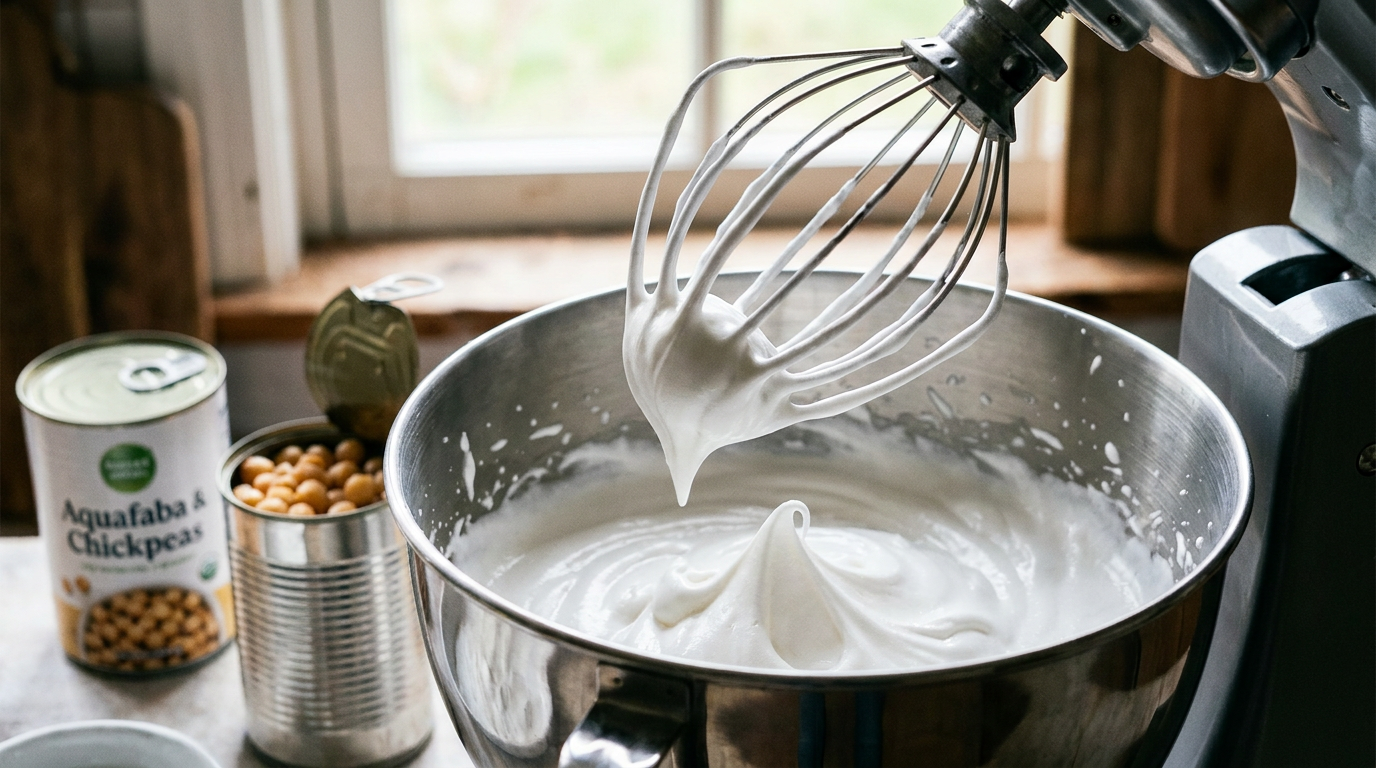
When a cook takes a whisk or a stand mixer to the aquafaba, mechanical energy is introduced into the liquid. The unfolded proteins, which are amphiphilic—meaning they possess both water-loving and water-hating properties—rush to the surface of the newly created air bubbles. The water-hating ends point inward toward the trapped air, while the water-loving ends remain anchored in the liquid. This alignment creates a stable, viscoelastic network that prevents the air bubbles from popping.[2][8]
When a cook takes a whisk or a stand mixer to the aquafaba, mechanical energy is introduced into the liquid.
However, proteins are not working alone. Scientific analysis has identified saponins as a critical co-pilot in the foaming process. Saponins are naturally occurring plant compounds that act as powerful surfactants. Much like soap, they drastically reduce the interfacial tension between water and air, or water and oil. This surfactant property is what allows aquafaba to whip up into a voluminous foam so rapidly, and it is the same mechanism that allows it to perfectly emulsify oil and vinegar into a stable, creamy vegan mayonnaise.[1][2][6]

While proteins and saponins build the foam, carbohydrates ensure it survives the journey from the mixing bowl to the oven. The soluble polysaccharides and starches that leach out of the chickpeas increase the overall viscosity of the aqueous phase. This thickened water acts as a structural scaffold, slowing down the drainage of liquid from the bubble walls and preventing the foam from collapsing before it can be baked and set.[2][7]
For home cooks eager to harness this science, the application is surprisingly straightforward, though it requires an understanding of ratios. As a general culinary rule, three tablespoons—or roughly 45 grams—of aquafaba replaces one whole egg in a recipe. For recipes calling strictly for egg whites, two tablespoons, or 30 grams, is the standard equivalent. When used purely as a binder in dense recipes like brownies or veggie burgers, the liquid can be added straight from the can without any whipping.[3][4]

Viscosity, however, is the most common point of failure for beginners. The liquid drained from a standard can of chickpeas is usually the perfect consistency, mimicking the slightly gelatinous texture of raw egg whites. But cooks who boil their own dried chickpeas at home often end up with a liquid that is far too watery. To achieve the necessary concentration of proteins and starches, homemade aquafaba must be simmered and reduced on the stovetop until it thickens, then chilled completely before use.[3][5]
The whipping process itself demands patience. Unlike egg whites, which can form stiff peaks in a matter of a minute or two, aquafaba often requires three to six minutes of continuous high-speed beating with an electric mixer. Food scientists and experienced bakers strongly recommend adding a small amount of an acid, such as cream of tartar or lemon juice, before whipping. The acid lowers the pH of the liquid, which neutralizes the electrical charges on the proteins, allowing them to pack together more tightly and form a much more stable foam.[3][4]
Despite its miraculous properties, aquafaba is not a flawless, universal replacement for eggs in every culinary scenario. Its primary limitation stems from its complete lack of fat. A whole egg contains a yolk rich in fats and emulsifiers like lecithin, which provide tenderness, moisture, and rapid coagulation in heavy baked goods. Because aquafaba is virtually fat-free, substituting it directly into a rich pound cake or a structurally demanding sponge cake often results in a dense, gummy texture.[4][8]
To bridge this gap in complex baking, culinary professionals often have to engineer workarounds. They might pair aquafaba with additional external fats, or incorporate stabilizers like guar gum or soy lecithin to replicate the structural support normally provided by an egg yolk. Aquafaba excels in environments where it acts primarily as an aerator or a simple binder, but it struggles when asked to carry the structural weight of a heavy, fat-rich batter.[8]

Beyond the kitchen, the rise of aquafaba represents a significant victory for food sustainability. By upcycling a byproduct that was previously discarded by the millions of gallons worldwide, consumers are actively reducing food waste. The environmental footprint of producing a can of chickpeas is vastly lower than the resource-intensive process of commercial egg production, making aquafaba an attractive ingredient for environmentally conscious consumers and climate-focused food startups.[2][6]
The commercial food industry has already recognized this potential. Ingredient manufacturers are now developing methods to dehydrate aquafaba into a shelf-stable powder, standardizing its protein and starch concentrations for industrial use. This advancement is paving the way for a new generation of mass-market, plant-based products, proving that one of the most versatile ingredients in modern food science was hiding in our pantries all along.[1][8]
How we got here
2014
French tenor Joël Roessel discovers that the liquid from canned beans can be whipped into a foam.
Early 2015
Software engineer Goose Wohlt successfully bakes vegan meringues using the liquid and coins the term 'aquafaba'.
2018
Peer-reviewed studies begin detailing the specific protein and saponin structures responsible for aquafaba's unique properties.
2020s
Commercial ingredient manufacturers begin developing dehydrated, shelf-stable aquafaba powders for industrial food production.
Viewpoints in depth
Food Scientists & Chemists
Focuses on the molecular mechanisms, saponins, and protein structures that enable the liquid to foam and emulsify.
For food chemists, aquafaba is a fascinating study in colloidal physics. Researchers point out that it is not 'magic bean water,' but rather a highly specific combination of heat-stable globulins (vicilin and legumin) and saponins. When mechanical energy is applied, these amphiphilic proteins unfold and align at the air-water interface, while the saponins reduce surface tension. The starches dissolved in the water increase the viscosity of the liquid phase, preventing the trapped air bubbles from collapsing. This delicate balance of proteins for structure and carbohydrates for stability is what makes chickpea water uniquely suited for culinary foams.
Culinary Professionals & Bakers
Focuses on the practical application, substitution ratios, and the structural limitations of aquafaba in heavy baking.
Bakers view aquafaba as a revolutionary tool, but one with distinct boundaries. While it perfectly mimics the aeration of egg whites for meringues, macarons, and mousses, professionals caution against treating it as a universal egg replacement. Because aquafaba is 90 percent water and contains zero fat, it cannot replicate the tenderizing and rapid-coagulation properties of an egg yolk. In heavy batters like pound cakes, substituting aquafaba without adding external fats or stabilizers often results in a dense, gummy crumb. Culinary experts emphasize that successful vegan baking requires understanding when to use aquafaba for air, and when to rely on other substitutes for structure.
Plant-Based & Allergy Advocates
Focuses on the accessibility, low cost, and inclusivity aquafaba brings to dietary restrictions and vegan cooking.
For the vegan community and those managing severe egg allergies, aquafaba represents culinary liberation. Prior to its discovery, aerated desserts were largely off-limits or required expensive, hard-to-find commercial egg replacers. Advocates celebrate aquafaba because it democratizes plant-based baking—it utilizes a cheap, globally available byproduct that most households already have in their pantries. Furthermore, environmental advocates highlight the sustainability aspect, noting that upcycling millions of gallons of discarded bean water significantly reduces food waste while offering a climate-friendly alternative to commercial egg production.
What we don't know
- While chickpeas are the gold standard, the exact chemical reasons why other legume waters (like black beans or lentils) fail to produce consistently stable foams are still being researched.
- The long-term commercial viability of scaling up dehydrated aquafaba powder for mass-market industrial food production remains to be fully tested.
Key terms
- Aquafaba
- The viscous liquid left over from cooking legumes, most commonly chickpeas, used as a plant-based egg substitute.
- Saponins
- Naturally occurring plant compounds that act as surfactants, helping to reduce surface tension and create stable foams.
- Denaturation
- The process where proteins unfold from their natural state when subjected to heat or mechanical force, allowing them to form new structures.
- Amphiphilic
- Molecules that possess both water-loving (hydrophilic) and water-hating (hydrophobic) properties, essential for trapping air bubbles in a foam.
- Globulins
- A family of globular seed storage proteins, like vicilin and legumin found in chickpeas, that contribute heavily to aquafaba's foaming capacity.
Frequently asked
Can I use the liquid from any canned beans?
Yes, but chickpea liquid is the most popular due to its neutral flavor and optimal protein-starch ratio. White beans also work well, while black beans can yield unpredictable results and a darker color.
Do I need to whip aquafaba for every recipe?
No. For binding in dense recipes like cookies, brownies, or veggie burgers, aquafaba can be used straight from the can. Whipping is only required for recipes needing aeration, like meringues or mousses.
Does aquafaba make baked goods taste like chickpeas?
No. While the raw liquid has a distinct bean aroma, the flavor bakes out completely, especially when combined with sugar and vanilla extract.
How long does aquafaba last in the fridge?
Stored in an airtight container, aquafaba typically lasts up to five days in the refrigerator. It can also be frozen in ice cube trays for longer storage.
Sources
Source coverage
8 outlets
3 viewpoints surfaced








[1]National Institutes of HealthFood Scientists & Chemists
Composition and Properties of Aquafaba: Water Recovered from Commercially Canned Chickpeas
Read on National Institutes of Health →[2]MDPIFood Scientists & Chemists
Aquafaba: A Review of Its Composition, Properties, and Applications
Read on MDPI →[3]The Vegan SocietyPlant-Based & Allergy Advocates
Aquafaba 101: Everything you need to know
Read on The Vegan Society →[4]King Arthur BakingCulinary Professionals & Bakers
How to substitute aquafaba for egg whites
Read on King Arthur Baking →[5]FoodalCulinary Professionals & Bakers
The Exact Science of Aquafaba
Read on Foodal →[6]Future KindPlant-Based & Allergy Advocates
The Science Behind Aquafaba
Read on Future Kind →[7]ResearchGateFood Scientists & Chemists
Chemical composition of aquafaba
Read on ResearchGate →[8]Factlen Editorial TeamCulinary Professionals & Bakers
Synthesis by Factlen editorial team
Read on Factlen Editorial Team →
Every angle. Every day.
Get lifestyle stories with full source coverage and perspective breakdowns delivered to your inbox.