
Tennis-Court Sized 'Micro-Forests' Are Transforming Concrete Urban Spaces Worldwide
A rapid-growth planting technique pioneered in Japan is empowering communities to turn vacant lots and schoolyards into dense, biodiverse urban forests.
By Factlen Editorial Team
- Community Organizers
- Value micro-forests for their ability to bring neighbors together, educate children, and provide green space in marginalized areas.
- Urban Planners
- Focus on the practical benefits of cooling city streets and absorbing stormwater in highly constrained urban footprints.
- Urban Ecologists
- Study the rapid biodiversity gains and thermal cooling effects, though some caution against viewing the method as a flawless carbon-capture solution.
What's not represented
- · Traditional commercial foresters who manage large-scale timber and carbon-offset plantations.
- · Municipal maintenance workers responsible for the long-term upkeep and pruning of hyper-dense urban plots.
Why this matters
As cities face rising temperatures and biodiversity loss, these community-planted micro-forests offer a scalable, localized solution that cools neighborhoods, absorbs stormwater, and reconnects residents with nature.
Key points
- Cities worldwide are rapidly adopting 'micro-forests' to transform small, vacant urban lots into dense green spaces.
- The Miyawaki method involves planting 3 to 5 native saplings per square meter to encourage rapid, competitive growth.
- These pocket forests can mature in decades rather than centuries, providing fast relief from urban heat islands.
- Community volunteers and school groups are driving the movement, using the plantings as hands-on environmental education.
- Micro-forests can be up to 50 degrees Fahrenheit cooler than adjacent asphalt, while also absorbing stormwater and supporting wildlife.
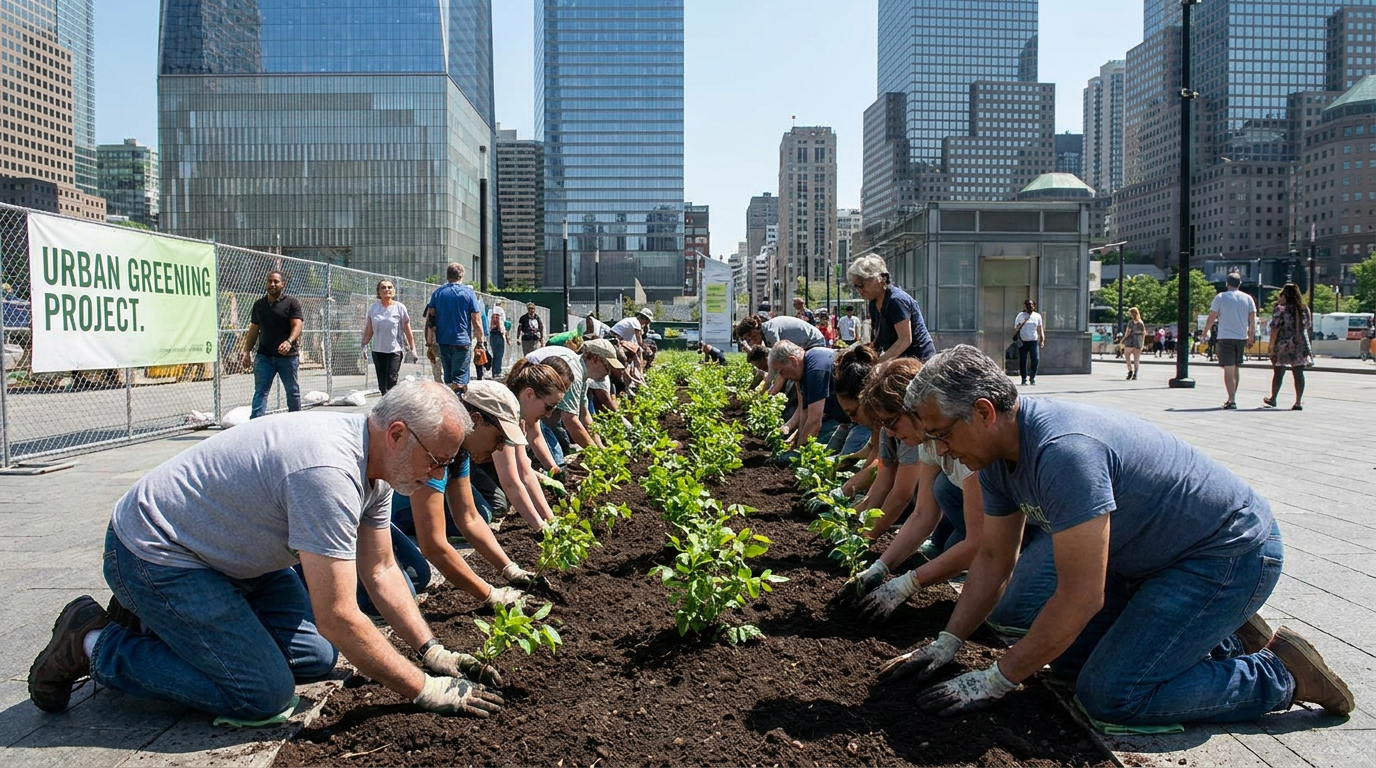
In a neglected lot behind a public library in Elizabeth, New Jersey, a dense thicket of native serviceberry, persimmon, and elderberry bushes has entirely obscured the concrete wall behind it. Just a few yards from a busy street and under the flight path of Newark Liberty International Airport, this 40-by-50-foot patch of greenery is teeming with life. It is one of thousands of "micro-forests" sprouting up in urban centers across the globe, driven by a coalition of community organizers, city planners, and environmentalists.[3]
The micro-forest movement has reached a critical mass in 2026, transforming vacant lots, schoolyards, and median strips into hyper-dense, self-sustaining ecosystems. Organizations like Earthwatch Europe have recently celebrated the planting of their 300th "Tiny Forest" in the UK alone, while similar initiatives are taking root from Massachusetts to São Paulo, Brazil. These projects are proving that nature does not require vast tracts of untouched wilderness to thrive; it can flourish in spaces no larger than a tennis court.[1][4][5]
The science behind this urban greening explosion is rooted in the "Miyawaki Method," pioneered in the 1970s by the late Japanese botanist Akira Miyawaki. Originally designed to restore degraded industrial sites in Japan, the technique eschews the traditional forestry practice of spacing trees far apart. Instead, it involves planting a highly diverse mix of native species incredibly close together—often three to five saplings per square meter.[1][2][6]

This intentional crowding forces the young plants to compete fiercely for sunlight. The canopy species race upward, while the understory and ground-cover plants adapt to the shade, creating a multi-layered forest structure. Proponents note that this competition accelerates growth dramatically, allowing a micro-forest to reach a level of maturity in 20 years that might take a conventional forest two centuries to achieve.[1][5]
For cities grappling with the escalating impacts of climate change, the environmental benefits of these pocket forests are highly attractive. The dense canopy provides profound localized cooling. When researchers flew thermal drones over the micro-forest in Elizabeth, New Jersey, they found the shaded area could be up to 50 degrees Fahrenheit cooler than the adjoining paved parking lot. In São Paulo, soil temperatures inside community mini-forests during recent heat waves were measured at 20 degrees Celsius cooler than nearby streets.[3][4]
For cities grappling with the escalating impacts of climate change, the environmental benefits of these pocket forests are highly attractive.
Beyond temperature control, the dense root systems act as massive sponges, soaking up stormwater runoff that frequently overwhelms aging municipal sewer systems. They also serve as vital "stepping stones" for urban wildlife. A micro-forest in an otherwise concrete-heavy neighborhood provides critical rest stops for migratory birds, pollinators, and insects. Observers at the New Jersey site counted 21 avian species returning to the area within just a few years of planting.[3][6]

But the true engine of the micro-forest movement is community engagement. Planting a Miyawaki forest is highly labor-intensive, requiring extensive soil preparation and the careful placement of hundreds of saplings. Municipalities are increasingly relying on local volunteers, school children, and neighborhood associations to do the literal heavy lifting. In Cambridge, Massachusetts, city officials noted that the Miyawaki plantings have become by far their most well-received urban forestry program, drawing hundreds of eager residents to planting days.[1][4]
These planting events often take on the atmosphere of a neighborhood festival. For children growing up in dense urban environments with limited access to green space, getting their hands in the dirt to plant a tree is a profound educational experience. Earthwatch Europe explicitly designs its programs as "living laboratories," where students monitor soil health, track carbon sequestration, and observe returning wildlife over the years.[4][5]
The movement also carries a strong element of environmental justice. Historically, low-income neighborhoods and communities of color have suffered from a severe lack of tree canopy, leaving them disproportionately vulnerable to urban heat islands and poor air quality. Because micro-forests require so little land, they can be slotted into the dense, marginalized neighborhoods that need them most—turning barren schoolyards and abandoned lots into climate refuges.[2][4]

Despite the widespread enthusiasm, the Miyawaki method does face some skepticism within the scientific community. Some forestry experts caution that the technique requires vigorous, expensive soil preparation and a massive volume of saplings, leading to a high upfront price tag. Others point out that while the forests grow quickly, there is still limited long-term data proving they capture significantly more carbon than traditional planting methods over a multi-decade horizon.[1]
However, for the communities planting them, the immediate localized benefits far outweigh the academic debates over long-term carbon metrics. Whether or not a tiny forest solves global emissions, it undeniably cools the street, quiets the traffic noise, and brings neighbors together. As one urban geographer noted, in concrete-filled environments desperate for relief, any type of greenery is better than none—and a dense, thriving pocket of wilderness is a profound victory.[1][3]
How we got here
1970s
Japanese botanist Akira Miyawaki develops his high-density planting method to restore degraded industrial land in Japan.
2014
The first Miyawaki-style forests are planted in the United States on industrial sites in the Midwest.
2021
Local nonprofits and municipalities begin widely adopting the method for urban schoolyards and parks.
2025
Earthwatch Europe reaches a milestone of 300 'Tiny Forests' planted across the UK and Europe.
2026
Micro-forests become a mainstream urban planning tool, with cities integrating them into official climate resilience strategies.
Viewpoints in depth
Community Organizers
Advocates who view micro-forests primarily as tools for social cohesion and environmental justice.
For community leaders, the act of planting the forest is just as important as the ecological outcome. They emphasize that bringing neighbors together to dig in the dirt fosters a sense of shared ownership and civic pride. In marginalized neighborhoods that have historically been deprived of green infrastructure, these projects are seen as acts of climate justice—reclaiming neglected land to provide immediate relief from urban heat and pollution.
Urban Planners
Municipal officials focused on the practical, space-saving benefits of nature-based infrastructure.
City planners are drawn to the Miyawaki method because it solves a fundamental urban geometry problem: a lack of available land. Because these forests require only the footprint of a tennis court, they can be integrated into existing city grids without displacing housing or commercial zoning. Planners value the dense root systems as highly efficient, low-cost stormwater management tools that reduce the burden on aging municipal sewer systems.
Forestry Skeptics
Scientists who caution against viewing the trendy method as a universal climate solution.
While acknowledging the localized benefits, some forestry experts and ecologists warn that the Miyawaki method is expensive and labor-intensive compared to traditional planting. They point out that the required soil excavation and dense sapling counts drive up upfront costs. Furthermore, they argue that while the forests grow quickly in their first decade, long-term data on their ultimate carbon sequestration capacity remains sparse, cautioning cities not to abandon broader canopy-preservation efforts in favor of trendy micro-plantings.
What we don't know
- Whether Miyawaki forests sequester significantly more carbon over a 50-year horizon compared to traditional urban forestry methods.
- How well these hyper-dense plantings will survive extreme, prolonged urban droughts without ongoing municipal irrigation.
Key terms
- Miyawaki Method
- A technique for ecological restoration that involves densely planting a diverse mix of native species to accelerate forest growth.
- Urban Heat Island
- An urban area that is significantly warmer than its surrounding rural areas due to human activities and heat-absorbing infrastructure like concrete.
- Nature-Based Solutions
- Actions that protect, sustainably manage, or restore natural ecosystems to address societal challenges like climate change.
- Understory
- The underlying layer of vegetation in a forest, growing beneath the main canopy of taller trees.
Frequently asked
How big is a typical micro-forest?
Most urban micro-forests are roughly the size of a tennis court, or about 200 square meters, allowing them to fit into small vacant lots and schoolyards.
Why are the trees planted so close together?
Dense planting forces the saplings to compete for sunlight, which accelerates their upward growth and creates a mature forest structure much faster than traditional spacing.
Can I plant a Miyawaki forest in my backyard?
Yes, though the method requires significant initial effort to prepare the soil and source a diverse, highly specific mix of native plants suited to your exact local ecosystem.
Sources
Source coverage
6 outlets
3 viewpoints surfaced






[1]WBURUrban Planners
Tiny forests are a growing trend in Mass. and beyond
Read on WBUR →[2]EuronewsUrban Planners
A new wave of tiny, densely planted forests is spreading through cities worldwide
Read on Euronews →[3]AudubonUrban Ecologists
How Pocket-Size Forests Are Bringing Nature Back to Cities
Read on Audubon →[4]The Nature of CitiesCommunity Organizers
Mini-Forests as Climate Refuges and Community Builders
Read on The Nature of Cities →[5]Earthwatch EuropeCommunity Organizers
Greening our cities: 300 Tiny Forests planted
Read on Earthwatch Europe →[6]MDPIUrban Ecologists
The Tiny Forests of the RIMM: Environmental and Educational Benefits
Read on MDPI →
Every angle. Every day.
Get community stories with full source coverage and perspective breakdowns delivered to your inbox.