
How Nuclear Thermal Rockets Will Cut the Journey to Mars in Half
NASA and DARPA are preparing to launch the world's first nuclear-powered spacecraft, a leap in propulsion technology that could revolutionize deep-space travel.
By Factlen Editorial Team
- Aerospace Engineers & NASA
- Focusing on the physical limits of chemical rockets and the necessity of nuclear propulsion for Mars.
- Defense Strategists
- Prioritizing the ability to maneuver heavy assets quickly in the space between Earth and the Moon.
- Nuclear Safety Advocates
- Emphasizing the strict protocols required to prevent radioactive contamination during launch.
What's not represented
- · Environmental Watchdogs
- · Commercial Space Startups
Why this matters
Chemical rockets have reached their physical limits, requiring nine-month transit times to Mars that expose astronauts to dangerous radiation. Nuclear thermal propulsion breaks this bottleneck, promising faster, safer, and more capable exploration of the solar system.
Key points
- NASA and DARPA are collaborating on the DRACO mission to demonstrate nuclear thermal propulsion in orbit by late 2026.
- Nuclear thermal rockets use a fission reactor to heat liquid hydrogen, offering two to five times the efficiency of chemical rockets.
- The technology could cut the travel time to Mars from nine months to just three or four months, reducing astronaut radiation exposure.
- To ensure safety, the reactor will launch in a 'cold' inactive state and will only be turned on once it reaches a safe high orbit.
For more than six decades, human spaceflight has been bound by the physical limits of fire. Chemical rockets—which generate thrust by combusting a fuel and an oxidizer—have taken humanity to the Moon and placed rovers on Mars. But the underlying chemistry has reached its maximum theoretical efficiency. To push deeper into the solar system, aerospace engineers face a mathematical wall known as the rocket equation: carrying more fuel requires heavier rockets, which in turn require even more fuel just to lift off.[8]
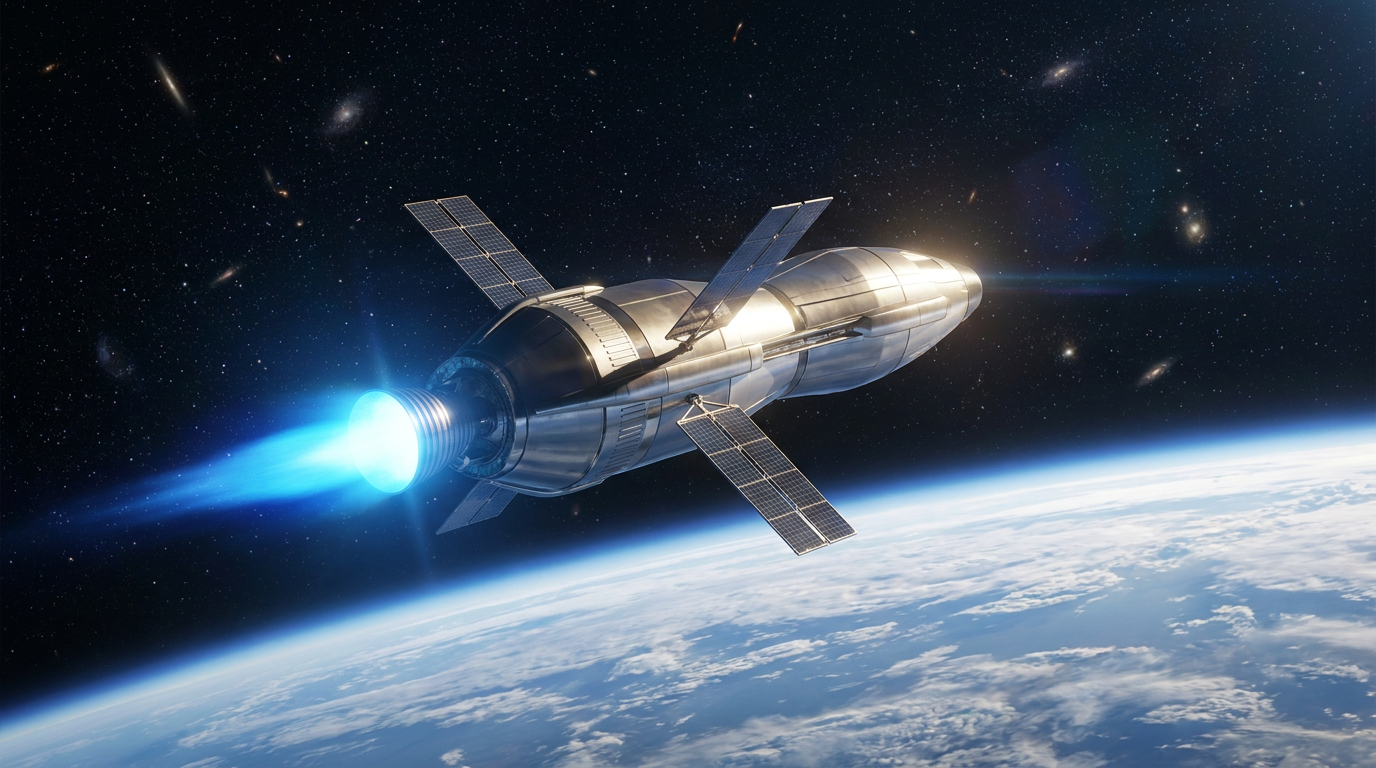
Breaking that bottleneck requires a fundamental shift in how spacecraft generate thrust. Enter the Demonstration Rocket for Agile Cislunar Operations, or DRACO. A joint initiative between NASA and the Defense Advanced Research Projects Agency (DARPA), the program is currently preparing to launch the world’s first nuclear-powered spacecraft.[1][2]
Built by Lockheed Martin with a reactor supplied by BWX Technologies, the DRACO mission aims to conduct an in-orbit demonstration of Nuclear Thermal Propulsion (NTP) by late 2026. If successful, the test will mark the most significant leap in space propulsion since the dawn of the Apollo era, fundamentally altering the timeline and logistics of deep-space exploration.[2][3][6]
To understand the leap, it helps to look at the limitations of current technology. In a traditional chemical rocket, liquid hydrogen and liquid oxygen are mixed and ignited in a combustion chamber. The resulting explosion creates superheated water vapor that expands out of a nozzle, pushing the rocket forward. While powerful enough to escape Earth's gravity, this process consumes massive amounts of propellant very quickly.[5]

Nuclear Thermal Propulsion discards the combustion chamber entirely. Instead of burning fuel, an NTP engine uses a compact nuclear fission reactor to generate intense, sustained heat. Liquid hydrogen is pumped directly from a cryogenic storage tank into the reactor core, where the splitting of uranium atoms transfers immense thermal energy into the fluid.[1][5]
As the liquid hydrogen passes through the reactor, it is instantly heated to temperatures exceeding 4,800 degrees Fahrenheit. The hydrogen rapidly expands into a high-pressure gas and is expelled through the exhaust nozzle to create thrust. Because hydrogen is the lightest element in the universe, it accelerates out of the nozzle much faster than the heavier water vapor produced by chemical combustion.[1][5]
The result is a staggering increase in efficiency. Aerospace engineers measure propellant efficiency using a metric called specific impulse. Nuclear thermal rockets boast a specific impulse two to five times greater than the best chemical engines in existence. This means a spacecraft can travel significantly farther and faster using a fraction of the propellant.[1][2]
For NASA, this efficiency is the key to unlocking human missions to Mars. Using conventional chemical propulsion, a journey to the Red Planet requires an optimal planetary alignment that occurs only once every 26 months, and the transit itself takes roughly nine months each way. NTP could cut that transit time down to just three or four months.[1]

Speed is not merely a matter of convenience; it is a critical matter of astronaut survival. Deep space is an inherently hostile environment, bombarding spacecraft with high-energy cosmic rays and solar radiation. By cutting the journey time in half, nuclear propulsion drastically reduces the crew's exposure to radiation and minimizes the physical degradation caused by prolonged microgravity.[1]
Speed is not merely a matter of convenience; it is a critical matter of astronaut survival.
Furthermore, the sheer power of an NTP system expands the safety margins for deep-space missions. With chemical rockets, once a spacecraft commits to a Mars trajectory, it lacks the fuel to turn around; the crew must continue to Mars and wait months for a return window. A nuclear thermal rocket carries enough propulsive capability to execute an abort maneuver, allowing astronauts to return to Earth months after their initial departure if an emergency arises.[1]
While NASA focuses on Mars, DARPA’s interest in the DRACO program lies closer to home. The military research agency is focused on cislunar space—the vast orbital theater between the Earth and the Moon. Currently, satellites and spacecraft in this region rely on solar electric propulsion or limited chemical thrusters, forcing them to coast along predictable, slow-moving orbital trajectories.[2]
Nuclear thermal propulsion changes the paradigm from 'coasting' to 'driving.' An NTP-equipped spacecraft can execute rapid, sustained maneuvers across vast distances, allowing the United States to reposition heavy assets quickly. DARPA views this capability as essential for maintaining technological superiority and securing strategic interests in an increasingly contested cislunar environment.[2]
Despite the clear advantages, the prospect of launching a nuclear reactor into space naturally raises significant safety concerns. The primary fear is the risk of a launch failure that could scatter radioactive material across the atmosphere or the ground. To mitigate this, the DRACO mission relies on a strict 'cold launch' protocol.[3][4]

When the DRACO spacecraft lifts off from Earth—likely aboard a SpaceX Falcon 9 or a United Launch Alliance Vulcan Centaur—its nuclear reactor will be completely inert. The system is designed with neutron-absorbing control rods and 'poison wires' that physically prevent the uranium fuel from achieving a fission chain reaction during the violent ascent phase.[3][4]
If the conventional launch vehicle were to explode on the pad or during ascent, the reactor would not detonate. Because the High-Assay Low-Enriched Uranium (HALEU) fuel has not yet undergone fission, it remains only mildly radioactive—comparable to natural uranium ore—and poses no severe radiological threat to the public.[4]
The reactor will only be activated once the spacecraft reaches a safe, high orbit, operating at an altitude between 700 and 2,000 kilometers above Earth. At this height, the spacecraft is well above the drag of the Earth's atmosphere.[4]

This specific orbital altitude is chosen for a critical reason: orbital decay. If the spacecraft were to lose power or fail after the reactor is activated, it would take roughly 300 years for the vehicle to slowly fall back to Earth. By the time it re-enters the atmosphere, the radioactive byproducts of the fission process will have decayed to safe background levels.[4]
The concept of nuclear rockets is not entirely new. In the 1960s, NASA and the Atomic Energy Commission successfully built and tested nuclear thermal engines in the Nevada desert under the NERVA program. The engines proved the physics worked, but the program was ultimately canceled in 1973 due to budget cuts and shifting political priorities following the Apollo program.[1][5]
Today, the DRACO program revives that legacy with the benefit of modern technology. Advanced materials that can withstand the blistering 4,800-degree heat of the reactor core, combined with high-fidelity supercomputer modeling by contractors like General Atomics, have solved many of the engineering bottlenecks that plagued the original 1960s designs.[5][7]
As the 2026 launch window approaches, the aerospace industry is watching closely. If the DRACO mission successfully demonstrates that nuclear thermal propulsion can be operated safely and effectively in orbit, it will shatter the chemical limits that have constrained spaceflight for decades, opening a fast lane to Mars and the broader solar system.[8]
How we got here
1961–1973
NASA and the Atomic Energy Commission successfully test nuclear thermal engines under the NERVA program before it is canceled.
April 2021
DARPA awards initial Phase 1 contracts to explore modern nuclear thermal propulsion concepts.
January 2023
NASA formally joins DARPA's DRACO program to collaborate on deep-space applications.
July 2023
Lockheed Martin and BWX Technologies are selected to design and build the spacecraft and its nuclear reactor.
Late 2026
Target launch window for the DRACO spacecraft's first in-orbit demonstration.
Viewpoints in depth
Aerospace Engineers & NASA
Focusing on the physical limits of chemical rockets and the necessity of nuclear propulsion for Mars.
For space agencies, the math of chemical rockets is a dead end for deep-space human exploration. The rocket equation dictates that carrying more fuel requires heavier rockets, which in turn require even more fuel. NASA argues that Nuclear Thermal Propulsion is the only viable way to break this cycle, providing the specific impulse needed to cut Mars transit times in half and drastically reduce astronaut exposure to cosmic radiation.
Defense Strategists
Prioritizing the ability to maneuver heavy assets quickly in the space between Earth and the Moon.
Military researchers at DARPA view nuclear propulsion through the lens of strategic advantage in cislunar space. Currently, satellites must coast along predictable orbital trajectories because they lack the fuel for sustained maneuvers. Defense strategists argue that an NTP-equipped spacecraft changes the paradigm from 'coasting' to 'driving,' allowing the United States to rapidly reposition assets and maintain technological superiority in an increasingly contested domain.
Nuclear Safety Advocates
Emphasizing the strict protocols required to prevent radioactive contamination during launch.
Placing uranium on a rocket naturally invites scrutiny regarding launch failures and atmospheric contamination. Safety advocates and the contractors building the system emphasize that the reactor will never be active in the atmosphere. By utilizing a 'cold launch' protocol and ensuring the spacecraft reaches an orbit where it would take 300 years to decay, they argue the radiological risks are mitigated to background levels.
What we don't know
- Whether the complex super-chilled liquid hydrogen storage systems can survive the months-long journey in deep space without boiling off.
- The exact final cost of scaling the DRACO demonstration engine into a full-sized Mars transit vehicle.
- How international space treaties might evolve to regulate the routine use of nuclear fission reactors in Earth orbit.
Key terms
- Nuclear Thermal Propulsion (NTP)
- A technology that uses a nuclear fission reactor to heat a liquid propellant, expanding it through a nozzle to create thrust.
- Specific Impulse (Isp)
- A metric used by aerospace engineers to measure how efficiently a rocket uses its propellant.
- Cislunar Space
- The vast region of space between the Earth and the Moon.
- High-Assay Low-Enriched Uranium (HALEU)
- A type of nuclear fuel enriched to provide high energy density while remaining well below weapons-grade levels.
- Cold Launch
- A safety protocol where a nuclear reactor is launched in an inactive state and only turned on once in a safe orbit.
Frequently asked
Will the rocket launch from Earth using nuclear power?
No. The spacecraft will launch using a conventional chemical rocket, and the nuclear reactor will remain completely turned off until it reaches a safe orbit.
What happens if the rocket explodes on the launch pad?
Because the reactor is launched 'cold' and hasn't undergone fission yet, the uranium fuel is only mildly radioactive and would not cause a nuclear explosion or severe radiation hazard.
How much faster is nuclear thermal propulsion?
It is roughly two to five times more efficient than chemical rockets, potentially cutting the nine-month trip to Mars down to just three or four months.
Has this technology been tested before?
Yes, NASA successfully tested nuclear thermal engines on the ground in the 1960s under the NERVA program, but the project was canceled before a spaceflight could occur.
Sources
Source coverage
8 outlets
3 viewpoints surfaced







[1]NASAAerospace Engineers & NASA
Space Nuclear Propulsion
Read on NASA →[2]DARPADefense Strategists
Demonstration Rocket for Agile Cislunar Operations (DRACO)
Read on DARPA →[3]BWX TechnologiesNuclear Safety Advocates
BWXT to Provide Nuclear Reactor Engine and Fuel for DARPA Space Project
Read on BWX Technologies →[4]Space.comNuclear Safety Advocates
NASA, DARPA to launch nuclear rocket to orbit by early 2026
Read on Space.com →[5]National Academies of SciencesAerospace Engineers & NASA
Space Nuclear Propulsion for Human Mars Exploration
Read on National Academies of Sciences →[6]Lockheed MartinNuclear Safety Advocates
Nuclear Thermal Propulsion: The Key to Deep Space Exploration
Read on Lockheed Martin →[7]General AtomicsDefense Strategists
GA’s delivery of DRACO nuclear rocket design supports FY 2026 in-orbit demo goal
Read on General Atomics →[8]Factlen Editorial Team
Synthesis by Factlen editorial team
Read on Factlen Editorial Team →
Every angle. Every day.
Get transportation stories with full source coverage and perspective breakdowns delivered to your inbox.