
The NFL's $32 Million Push to Make Flag Football an Olympic Spectacle
With flag football set to debut at the LA 2028 Olympics, the NFL is launching a professional league to bridge the gap—but tackle stars are quickly learning that the non-contact game requires an entirely different skill set.
By Factlen Editorial Team
- NFL Leadership & Investors
- Argues that flag football is the ultimate vehicle for global expansion and accessibility, justifying massive investment to build a professional pipeline.
- Flag Football Specialists
- Emphasizes that the 5v5 non-contact format is a distinct sport requiring specialized agility and flag-pulling techniques, warning that tackle stars cannot simply walk on and dominate.
- International Competitors
- Views the Olympic format as a great equalizer, allowing nations without heavy tackle-football infrastructure to compete for gold against the United States.
What's not represented
- · Grassroots youth flag football coaches adapting to the new Olympic rules
- · Sports medicine professionals analyzing injury rates in flag versus tackle football
Why this matters
Flag football's inclusion in the 2028 Olympics is transforming a recreational pastime into a highly funded global sport. The NFL's massive investment signals a shift in how American football will be exported worldwide, prioritizing accessibility and speed over physical contact.
Key points
- Flag football will make its Olympic debut at the Los Angeles 2028 Summer Games.
- The NFL is investing $32 million to launch a professional flag football league ahead of the Olympics.
- The Olympic format features 5v5 gameplay with no linemen, no blocking, and a 70-yard field.
- Strict 'no-run zones' force teams to pass when within five yards of midfield or the end zone.
- A recent exhibition saw the US Men's National Flag Football Team rout a squad of NFL veterans 43-16.
- Mexico, Japan, and Austria have emerged as major international contenders in the sport.
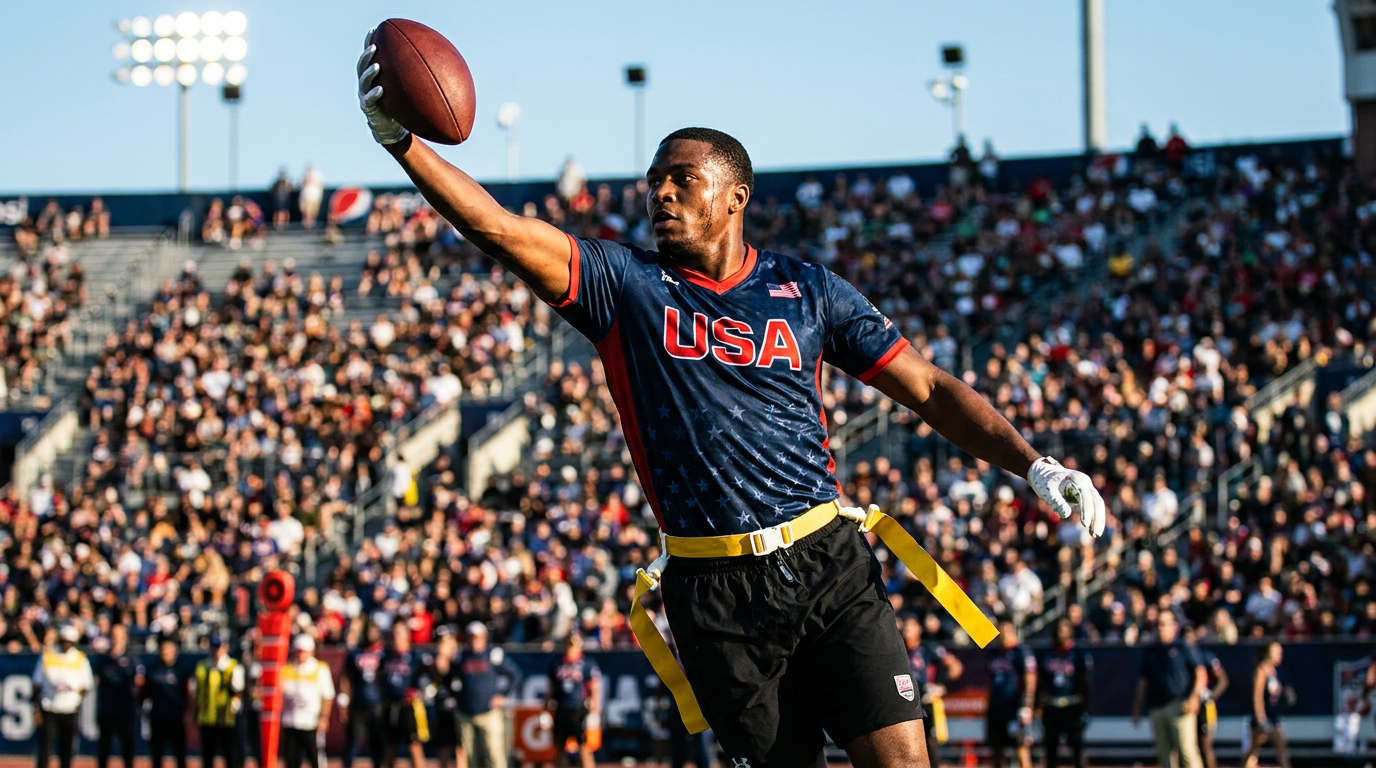
The 2028 Summer Olympics in Los Angeles will feature a sport born on American military bases during World War II, but which has since evolved into a high-speed, global phenomenon. Flag football is officially joining the Olympic program, bringing a non-contact, highly tactical variant of gridiron football to the world's biggest stage. For the International Olympic Committee, it represents a youth-friendly, accessible addition. For the National Football League, it represents the ultimate vehicle for international expansion—a version of the game unburdened by expensive equipment or concussion concerns.[1][2]
The NFL is not waiting until the Olympic torch is lit to capitalize on the momentum. In March 2026, the league officially announced a partnership with TMRW Sports to launch a co-ed professional flag football league. The initiative is backed by a unanimous vote from NFL owners, who committed $32 million in seed funding, alongside a star-studded investor group that includes Tom Brady, Peyton Manning, and Serena Williams. The goal is to establish a premier professional pipeline that bridges the gap between grassroots youth leagues and the 2028 Games.[3][4][7][8]
But what exactly will Olympic audiences be watching? The International Federation of American Football (IFAF) governs the official format, which is a far cry from a casual backyard scrimmage. Olympic flag football is played five-on-five on a field measuring 70 yards long and 25 yards wide, including two 10-yard end zones. Games consist of two 20-minute halves with a running clock, demanding relentless cardiovascular endurance and rapid-fire execution.[2][5]

The most jarring adjustment for traditional football fans is the complete absence of the trenches. There are no offensive or defensive linemen, and all forms of blocking are strictly prohibited. The center snaps the ball to the quarterback and immediately releases into a route, meaning every single offensive play is essentially a five-man passing concept. Without the physical barrier of a pocket, the game prioritizes elite agility, quick-twitch route running, and spatial awareness over sheer size and brute strength.[5]
To prevent the game from devolving into chaotic goal-line scrums, IFAF rules enforce strict "no-run zones." When an offense reaches the five-yard area before midfield or before the end zone, they are forbidden from handing the ball off; every play must be a forward pass. This forces teams to execute highly precise, tight-window passing concepts in the most critical areas of the field.[5]
The defensive side of the ball requires equal precision. Defenders are permitted to blitz the quarterback, but they must line up at least seven yards behind the line of scrimmage and raise a hand to identify themselves before the snap. Instead of delivering a crushing tackle to end a play, defenders must cleanly remove one of the two vinyl flags attached to the ball carrier's waist—a skill that requires exceptional hand-eye coordination while moving at full speed.[5]
Scoring mirrors the traditional game, with touchdowns worth six points. However, there are no goalposts and no kicking game. After a touchdown, teams must choose to attempt a one-point conversion from the five-yard line or a two-point conversion from the 10-yard line. If a game is tied at the end of regulation, it moves into a sudden-death overtime period where teams receive equal possessions.[2]

Scoring mirrors the traditional game, with touchdowns worth six points.
The announcement of flag football's Olympic inclusion immediately sparked a "Dream Team" debate across the American sports landscape. Fans and analysts began fantasy-booking a 2028 Team USA roster featuring NFL superstars like Lamar Jackson, Justin Jefferson, and Micah Parsons. NFL commissioner Roger Goodell has confirmed that active players will be permitted to compete, provided they earn a roster spot.[3][6]
However, the assumption that tackle football stars can simply walk onto a flag football field and dominate is already being tested. At the Fanatics Flag Football Classic held at Los Angeles' BMO Stadium in March 2026, a team of NFL veterans captained by Tom Brady and Jalen Hurts faced off against the reigning US Men's National Flag Football Team. The result was a stark reality check for the tackle professionals.[6][7]
The specialized flag athletes routed the NFL veterans by a score of 43-16. The national team players demonstrated that flag football is a distinct discipline. Their mastery of defensive angles, specialized flag-pulling techniques, and lightning-fast offensive processing proved too much for the tackle stars, who found themselves outmaneuvered in open space. The exhibition underscored that transitioning to the Olympic format will require NFL players to dedicate significant offseason time to unlearning tackle habits.[7]

While the United States men are the reigning world champions, the global landscape is fiercely competitive, boasting an estimated 20 million players across 100 countries. Because flag football does not require the massive financial investment of tackle football programs, nations without traditional gridiron infrastructure have rapidly developed elite national teams.[2]
The most prominent example is Mexico's women's national team, led by superstar quarterback Diana Flores. Mexico famously defeated the heavily favored United States squad to capture the gold medal at the 2022 World Games, establishing themselves as the preeminent force in the women's game. Japan's women's team and Austria's men's team have also emerged as major contenders in recent global competitions, proving that the 2028 Olympic podium is far from a foregone conclusion.[2]

As the countdown to Los Angeles continues, the launch of the NFL-backed professional league will serve as a crucial proving ground. It will provide specialized flag athletes with a platform to earn a living playing their sport, while offering transitioning tackle players a competitive environment to adapt to the 5v5 rules.[4][8]
Ultimately, the Olympic debut of flag football represents a transformative moment for American football as a whole. By stripping away the helmets, pads, and collisions, the sport is distilling its most thrilling elements—speed, strategy, and spectacular catches—into a highly accessible package. Whether the gold medals are ultimately claimed by specialized flag veterans or crossover NFL stars, the 2028 Games are poised to introduce a new, globally inclusive era of the gridiron.[1][2]
How we got here
July 2022
Flag football is featured at the World Games, with Mexico's women and the USA's men winning gold.
October 2023
The International Olympic Committee officially approves flag football for the LA 2028 sports program.
December 2025
NFL owners unanimously vote to invest $32 million to support the launch of a professional flag football league.
March 2026
The NFL officially partners with TMRW Sports to launch the co-ed Pro Flag Football League.
March 2026
The Fanatics Flag Football Classic in Los Angeles highlights the skill gap as USA flag specialists defeat NFL veterans.
Viewpoints in depth
NFL Leadership & Investors
Argues that flag football is the ultimate vehicle for global expansion and accessibility, justifying massive investment to build a professional pipeline.
For decades, the NFL has struggled to export American football globally due to the massive costs of equipment, the need for specialized coaching, and growing concerns over concussions. Flag football solves all of these problems. By investing $32 million into a new professional league, NFL owners and high-profile investors like Tom Brady and Peyton Manning are betting that a fast-paced, non-contact version of the sport can capture international audiences. They view the 2028 Olympics not just as a tournament, but as a global commercial for the sport's future, hoping to create a clear pathway from youth leagues to professional play that doesn't require putting on a helmet.
Flag Football Specialists
Emphasizes that the 5v5 non-contact format is a distinct sport requiring specialized agility and flag-pulling techniques, warning that tackle stars cannot simply walk on and dominate.
Veterans of the international flag football circuit are quick to point out that their sport is not merely 'football lite'—it is a highly specialized discipline. Without the physical barrier of linemen, the game operates at a frantic pace where spatial geometry and quick-twitch agility reign supreme. Specialists argue that the defensive art of pulling a flag in open space is entirely different from delivering a tackle, and that offensive players must master rapid, synchronized route combinations. The recent 43-16 blowout of NFL veterans by the US Men's National Team serves as their primary evidence: tackle experience does not automatically translate to flag football dominance.
International Competitors
Views the Olympic format as a great equalizer, allowing nations without heavy tackle-football infrastructure to compete for gold against the United States.
Outside of North America, the Olympic inclusion of flag football is seen as a rare opportunity to challenge American gridiron supremacy. Because the sport requires minimal infrastructure—just a field, a ball, and flag belts—countries that lack the resources to field 53-man tackle rosters can still develop elite 5v5 squads. International federations point to Mexico's women's team, which won gold at the 2022 World Games, as proof that the playing field is surprisingly level. For nations like Japan and Austria, the 2028 Games represent a chance to showcase their homegrown talent and prove that American football is no longer exclusively American.
What we don't know
- How many active NFL players will actually commit the offseason time required to master the flag format and make the 2028 Olympic roster.
- When exactly the new NFL-backed professional flag football league will play its inaugural season.
Key terms
- No-Run Zone
- A five-yard area before midfield and before the end zone where the offense is strictly prohibited from running the ball and must attempt a pass.
- IFAF
- The International Federation of American Football, the global governing body that sets the official 5v5 rules used in the Olympics.
- Down
- A single play or attempt by the offense to advance the ball. Teams have four downs to reach midfield, and four more to score.
- Blitz
- When a defensive player rushes the quarterback. In flag football, blitzers must line up at least seven yards behind the line of scrimmage.
Frequently asked
Will current NFL players be allowed to play in the 2028 Olympics?
Yes, NFL owners have voted to allow active players to participate, though they will have to earn roster spots against specialized flag football athletes.
How big is an Olympic flag football field?
The field measures 70 yards long by 25 yards wide, which includes two 10-yard end zones.
Are there linemen in Olympic flag football?
No. The 5v5 format eliminates linemen and blocking entirely; the center snaps the ball and immediately becomes an eligible receiver.
How does scoring work?
Touchdowns are worth six points. Teams can then attempt a one-point conversion from the five-yard line or a two-point conversion from the 10-yard line.
Sources
Source coverage
8 outlets
3 viewpoints surfaced








[1]NFL.comNFL Leadership & Investors
Flag Football is Coming to the LA28 Olympic Games
Read on NFL.com →[2]Olympics.comFlag Football Specialists
Flag Football: FAQs about the sport set to debut at Los Angeles 2028
Read on Olympics.com →[3]NBC SportsFlag Football Specialists
Roger Goodell says NFL could start a professional flag football league
Read on NBC Sports →[4]Front Office SportsNFL Leadership & Investors
NFL Owners Vote to Spend $1 Million Per Team on New Flag League
Read on Front Office Sports →[5]USA FootballFlag Football Specialists
Flag Football Rules & Rulebooks
Read on USA Football →[6]CBS SportsInternational Competitors
Tom Brady to join several current NFL stars in 2026 competitive flag football tournament
Read on CBS Sports →[7]EssentiallySportsInternational Competitors
NFL Launches New Flag Football League Backed by Tom Brady, Peyton Manning & Star-Studded Investor Group
Read on EssentiallySports →[8]The AthleticNFL Leadership & Investors
NFL Lines Up Investors For Professional Flag Football League
Read on The Athletic →

Every angle. Every day.
Get sports stories with full source coverage and perspective breakdowns delivered to your inbox.