
The End of Iron: How AI-Driven Digital Weight is Rewiring Strength Training
Adaptive resistance machines use digital motors instead of metal plates to dynamically adjust weight mid-rep. The technology promises safer, faster workouts, but comes with high hardware costs and subscription fees.
By Factlen Editorial Team
- Fitness Technologists
- Argue that digital weight is vastly superior to iron because it optimizes tension at every point in the lift and safely enables eccentric overload.
- Home Gym Consumers
- Value the space-saving designs and the safety of having a digital spotter, allowing them to train heavily without a partner.
- Traditional Strength Advocates
- Maintain that free weights are necessary for developing stabilizer muscles and warn against the high costs of subscription-locked hardware.
What's not represented
- · Commercial Gym Owners
- · Physical Therapists
Why this matters
For decades, building strength required bulky iron plates, dedicated floor space, and the risk of injury without a spotter. Digital weight systems condense an entire commercial gym into a footprint the size of a yoga mat, making elite-level resistance training accessible and safe for home users.
Key points
- Digital weight uses electromagnetic motors to dynamically adjust resistance mid-rep.
- Adaptive resistance safely enables eccentric overload, adding weight as you lower the load.
- Machines act as digital spotters, instantly releasing tension if you fail a lift.
- Studies show adaptive resistance can deliver superior results in 15-minute sessions.
- Newer platform models offer up to 440 pounds of resistance without wall mounting.
- Most systems require ongoing monthly subscriptions to access their AI features.
The fundamental flaw of traditional strength training is gravity. When you lift a 50-pound dumbbell, it weighs exactly 50 pounds at the bottom of a bicep curl, 50 pounds in the middle, and 50 pounds at the top. But human muscles do not have a flat strength curve. You are mechanically stronger in certain phases of a lift and weaker in others.[4][7]
For decades, strength training has been limited by this static reality. You can only lift as much weight as your weakest point in the range of motion can handle. If you fail at the bottom of a squat, you cannot complete the rep, even if your legs could easily handle 20 percent more weight at the top of the movement.[4]
Enter digital weight. A new generation of smart home gym equipment is replacing cast iron and gravity with electromagnetic motors and artificial intelligence. Known broadly as adaptive resistance, this technology dynamically alters the load you are lifting in real-time, adjusting the tension millisecond by millisecond to match your exact strength output.[4][5]
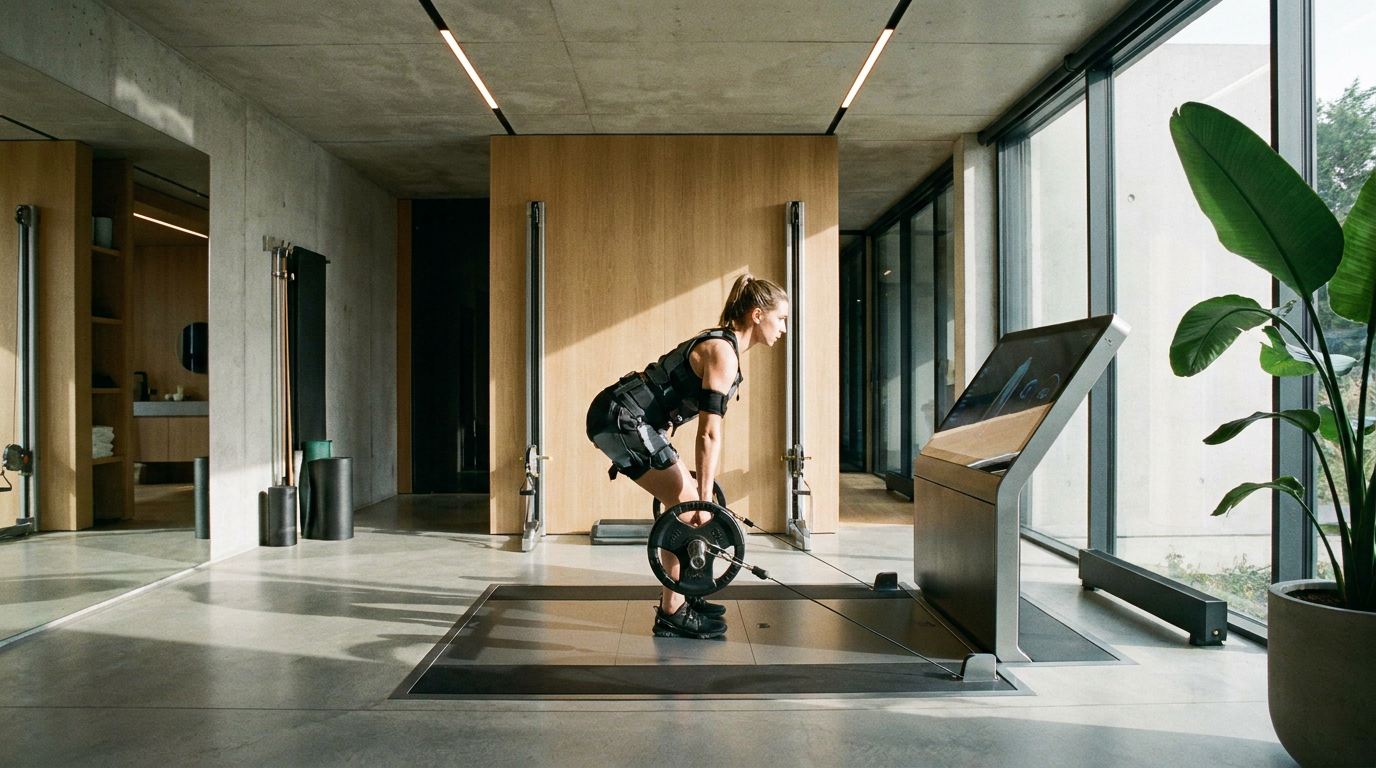
Instead of loading physical plates onto a barbell, users pull against cables attached to high-torque motors. These motors are controlled by algorithms that read the user's force, speed, and fatigue. If you struggle halfway through a bench press, the machine instantly drops the weight by a few pounds so you can finish the rep without breaking form.[4][5]

This real-time adjustment solves the "spotter" problem for home gym users. In a traditional gym, pushing to absolute muscular failure on a heavy bench press or squat is dangerous without a training partner to catch the bar. With digital weight, the machine acts as an infallible digital spotter, instantly releasing the tension the moment the bar stops moving upward.[1][4]
But safety is only the baseline. The true physiological advantage of adaptive resistance lies in a concept called eccentric overload. Every lift has two phases: the concentric phase, where you lift the weight, and the eccentric phase, where you lower it. Humans are naturally up to 40 percent stronger during the eccentric phase.[3][7]
With traditional weights, you are limited by your concentric strength. If you can only lift 100 pounds, you can only lower 100 pounds. Digital weight systems exploit this biological quirk by artificially adding resistance the moment you start lowering the weight. You might push 100 pounds up, but the machine will force you to resist 130 pounds on the way down.[3][5]
With traditional weights, you are limited by your concentric strength.
Sports scientists have long known that eccentric training is highly effective for stimulating muscle hypertrophy and building strength. By automating eccentric overload, smart machines deliver a stimulus that would normally require two human spotters physically pushing down on your barbell during the lowering phase.[2][7]
The result is a dramatic increase in time efficiency. A study commissioned by the American Council on Exercise compared adaptive resistance training to traditional moderate-intensity resistance exercise. The researchers found that the adaptive group achieved superior results—including greater strength gains and fat loss—in roughly one-third of the time.[2]
The study noted that the average adaptive resistance session lasted just 15 minutes, compared to 45 minutes for the traditional weightlifting group. Because the muscle is optimally loaded at every single inch of the movement, fatigue accumulates much faster, eliminating the need for endless sets and long rest periods.[2]

The hardware landscape delivering this technology has rapidly matured. Tonal pioneered the consumer category with its wall-mounted system, utilizing electromagnetic resistance to provide up to 200 pounds of digital weight. Its sleek profile and guided coaching made it a staple in premium home gyms, though it requires permanent wall installation.[3]
Newer competitors have solved the installation hurdle while dramatically increasing the weight capacity. The Vitruvian Trainer+ utilizes a flat, portable floor platform that generates up to 440 pounds of resistance. Because the user stands on the platform, the machine uses the lifter's own body weight as an anchor, allowing for massive loads without bolting anything to a wall.[1][3]
Meanwhile, freestanding systems like Speediance have emerged, offering a middle ground. These units feature dual-motor cable systems and fold up for storage, providing up to 220 pounds of resistance without the need for professional installation. They mimic the versatility of a commercial functional trainer while taking up a fraction of the floor space.[3][6]

Despite the technological leaps, digital weight is not without its critics. Traditional strength coaches argue that pulling against a perfectly smooth, motorized cable does not replicate the neurological demands of stabilizing a physical barbell. Free weights force the body to engage countless tiny stabilizer muscles to keep the load balanced—a chaotic variable that motors intentionally smooth out.[7]
Then there is the financial reality. The hardware alone typically costs between $2,500 and $4,000. More critically, almost all of these systems require a monthly subscription—often around $40 to $50—to access the AI features, data tracking, and adaptive modes. If a user stops paying, or if the parent company goes out of business, these expensive machines can lose their smartest features, becoming little more than heavy, expensive cable pulleys.[6][7]

Still, for busy professionals, data-driven athletes, and those intimidated by the traditional weight room, the appeal is undeniable. By stripping away the iron and replacing it with algorithms, adaptive resistance has transformed strength training from a static battle against gravity into a dynamic conversation between human muscle and digital motor.[4][7]
How we got here
2018
Tonal launches, popularizing wall-mounted electromagnetic resistance for the consumer market.
2020
Vitruvian introduces its platform-based Trainer, pushing digital weight limits without requiring wall installation.
2023
Speediance and other freestanding smart gyms enter the market, offering all-in-one cable systems.
2026
Digital weight systems reach up to 440 pounds of resistance, rivaling the capacity of commercial gym equipment.
Viewpoints in depth
The Efficiency Argument
Tech advocates believe digital weight fundamentally improves how humans build muscle.
Proponents of adaptive resistance argue that traditional weightlifting is inherently inefficient because it caters to the weakest point of a lift. By using algorithms to load the muscle optimally at every single millimeter of the movement, digital weight forces the muscle to work harder in less time. This camp points to studies showing that 15 minutes of adaptive resistance can yield better hypertrophy and cardiovascular results than 45 minutes of traditional iron lifting.
The Free Weight Purists
Traditionalists argue motors cannot replicate the raw neurological demands of balancing a barbell.
Strength coaches and powerlifting purists maintain that while digital weight is excellent for building raw muscle tissue, it falls short in developing functional, real-world strength. When a lifter balances a 300-pound barbell on their back, countless tiny stabilizer muscles must fire in a chaotic, unpredictable pattern to keep the lifter upright. Because digital cables pull in a perfectly smooth, motorized line, purists argue they fail to train these crucial stabilizing systems.
The Subscription Skeptics
Consumers express concern over hardware that requires a monthly fee to function properly.
A growing segment of the home gym market is pushing back against the connected fitness business model. While users acknowledge the brilliance of the hardware, they point out that a $3,000 machine can become effectively useless if the user stops paying the $40 monthly subscription fee. This camp advocates for "dumb" functional trainers or digital systems that do not paywall their basic resistance features behind a recurring cost.
What we don't know
- How the long-term durability of high-torque digital motors compares to traditional cast iron plates.
- Whether the lack of stabilizer muscle engagement in digital weight training leads to higher injury rates in real-world physical tasks.
- How the secondary market for used smart gyms will hold up given the reliance on proprietary software and subscriptions.
Key terms
- Adaptive Resistance
- Technology that automatically adjusts the weight you are lifting in real-time based on your force, speed, and fatigue.
- Eccentric Overload
- A training method where the resistance is artificially increased during the lowering phase of a lift, taking advantage of the body's natural strength in that phase.
- Digital Spotter
- A software feature that detects when a user is struggling to complete a repetition and automatically reduces the weight to prevent injury.
- Concentric Phase
- The portion of a lift where the muscle shortens and contracts to move the weight, such as pushing the bar up during a bench press.
- Progressive Overload
- The principle of gradually increasing the stress placed upon the body during exercise to continuously build muscle and strength.
Frequently asked
What is digital weight?
Digital weight uses electromagnetic motors controlled by algorithms to create resistance, rather than relying on the physical mass of iron plates and gravity.
Does digital weight feel heavier than real weights?
Yes, it often feels heavier because the machine maintains constant tension and eliminates the momentum you normally use to swing a physical weight.
Can you build muscle without lifting actual iron?
Absolutely. Muscles respond to mechanical tension, not the material providing it. Studies show adaptive resistance can build muscle faster than traditional weights.
What happens if the machine loses power mid-lift?
Digital weight systems are designed to fail safely. If power is cut, the electromagnetic motors instantly release the tension, dropping the weight to zero.
Sources
Source coverage
7 outlets
3 viewpoints surfaced







[1]Garage Gym ReviewsHome Gym Consumers
A Quick Look at the Vitruvian Form Trainer+
Read on Garage Gym Reviews →[2]ACE FitnessFitness Technologists
Adaptive Resistance Training vs. Traditional Resistance Training
Read on ACE Fitness →[3]The Body BlueprintHome Gym Consumers
Speediance vs Tonal vs Vitruvian: The 2026 Smart Home Gym Breakdown
Read on The Body Blueprint →[4]Village GymFitness Technologists
What is Adaptive Resistance?
Read on Village Gym →[5]Speediance EUFitness Technologists
How Smart Resistance Machines Enhance Progressive Overload
Read on Speediance EU →[6]FitTransformerHome Gym Consumers
Best Tonal Alternatives 2026: Resistance, Costs, and Training Modes Compared
Read on FitTransformer →[7]Factlen Editorial TeamTraditional Strength Advocates
Synthesis by Factlen editorial team
Read on Factlen Editorial Team →

More in fitness
See all 5 stories →Rucking Science
The Science of Rucking: Why Weighted Walking is Replacing High-Impact Cardio
0 sources

Rucking Science
The Science of Rucking: Why Weighted Walking is Replacing Running for Joint-Conscious Athletes
0 sources

Nervous System
The Science of Yoga Nidra: How 'Non-Sleep Deep Rest' Rewires the Nervous System
0 sources

Every angle. Every day.
Get fitness stories with full source coverage and perspective breakdowns delivered to your inbox.