
Comparing Premium TV Display Technologies: OLED and Mini-LED
As the premium television market crystallizes into a two-horse race, choosing between OLED and Mini-LED comes down to a strict set of optical trade-offs. We break down the evidence for both panel types to help you match the right technology to your living space.
By Factlen Editorial Team
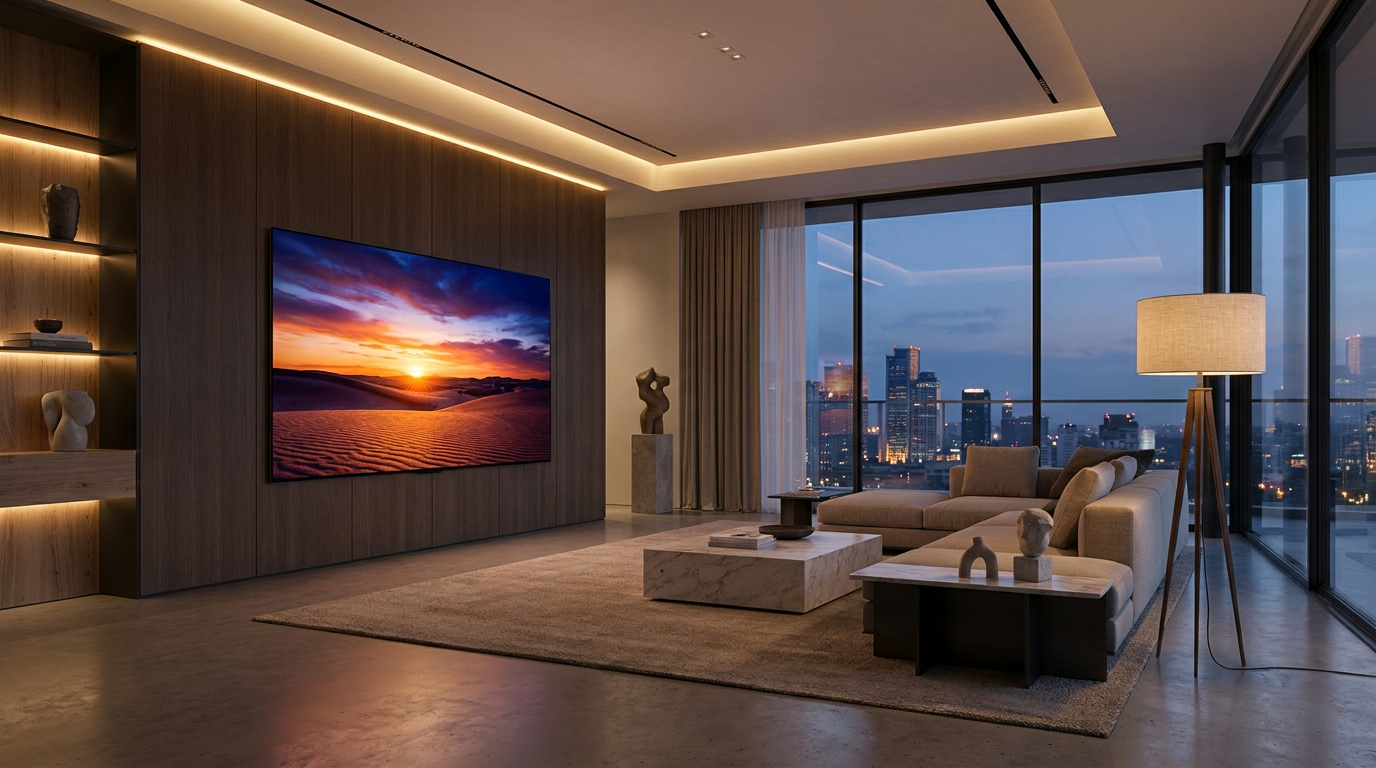
- Dark-Room Cinephiles
- Prioritize perfect black levels, infinite contrast, and pixel-level precision for cinematic viewing.
- Bright-Room Viewers
- Value massive peak brightness and glare reduction to overpower sunlit living spaces.
- Heavy-Use Gamers
- Focus on burn-in immunity for static HUDs, high refresh rates, and long-term panel durability.
What's not represented
- · Budget-Conscious Buyers
- · Professional Color Graders
Why this matters
A flagship television is a multi-year investment that dictates how you experience entertainment daily. Choosing the wrong panel technology for your specific room lighting and viewing habits can result in washed-out daylight viewing or distracting visual artifacts in the dark.
Key points
- OLED panels use self-emissive pixels to achieve perfect black levels and infinite contrast.
- Mini-LED TVs use thousands of tiny backlight zones to reach extreme peak brightness levels.
- OLED is the superior choice for dark rooms, cinematic viewing, and wide seating arrangements.
- Mini-LED excels in bright, sunlit rooms and offers total immunity to permanent burn-in.
- The performance gap is narrowing in 2026, with OLEDs getting brighter and Mini-LEDs reducing blooming.
- Mini-LED remains significantly more affordable at massive screen sizes like 85 and 98 inches.
The premium television market in 2026 has crystallized into a definitive two-horse race between OLED and Mini-LED display technologies. While marketing jargon often obscures the reality of what consumers are actually buying, the underlying engineering of these two panel types dictates entirely different viewing experiences. Shoppers are no longer choosing between a universally 'good' and a 'bad' television; they are choosing between two distinct sets of optical trade-offs. Understanding how light behaves in your specific living space, and how each technology responds to that environment, is now the single most important factor in selecting a flagship display.[1][4]
At the core of the debate is exactly how each technology generates light. OLED, which stands for Organic Light Emitting Diode, features millions of self-emissive pixels that produce their own illumination and color independently. When an OLED television needs to display absolute black, it simply turns the corresponding pixels completely off, emitting zero light. Mini-LED, conversely, is a highly evolved form of traditional LCD technology. It relies on a powerful backlight composed of thousands of microscopic inorganic light-emitting diodes, which shine through a liquid crystal layer and quantum dot color filters to produce the final vibrant image.[1][2]
The case for OLED rests almost entirely on its unparalleled contrast and pixel-level precision. Because each pixel operates entirely independently of its neighbors, an OLED panel can place a blindingly bright star directly next to the pitch-black vacuum of space without any light bleeding between the two zones. This infinite contrast ratio creates a profound sense of three-dimensional depth that traditional backlights simply struggle to replicate. Furthermore, OLED panels maintain their pristine color accuracy and contrast even when viewed from extreme side angles, making them the ideal choice for wide seating arrangements in large living rooms.[2][6]
The evidence supporting OLED's dominance in dark environments is definitive and easily measured. Independent testing consistently measures OLED black levels at an absolute 0.000 nits, a physical impossibility for any screen relying on a backlight that must block light to create darkness. Additionally, OLED pixels can change state in roughly 0.03 milliseconds, virtually eliminating motion blur during fast-paced action movies or competitive gaming. For purists building a dedicated, light-controlled home theater, the optical characteristics of OLED remain the undisputed gold standard for cinematic fidelity.[2][5]

However, the case against OLED centers heavily on its brightness limitations and the inherent vulnerabilities of organic materials. To protect the panel from overheating and premature aging, OLED televisions employ an Auto Brightness Limiter (ABL). When a scene requires the entire screen to be bright—such as a hockey game or a snow-covered landscape—the television automatically dims the overall image to protect the pixels. Furthermore, while 2026 mitigation software is highly advanced, the risk of permanent burn-in remains a lingering factor for users who leave static elements like news tickers or video game interfaces on screen for hours at a time.[2][5]
The case for Mini-LED is built on brute-force brightness and structural invincibility. By utilizing inorganic gallium nitride semiconductors, Mini-LED backlights can be driven to extreme luminance levels without the risk of biological decay or permanent image retention. These televisions group their thousands of tiny LEDs into 'local dimming zones' that can brighten or darken independently based on the scene. This architecture allows the display to punch through severe ambient glare, making the image pop with incredible saturation even in a sun-drenched living room with open blinds.[1][6]
The evidence for Mini-LED's daylight supremacy is easily quantified in raw output. While flagship OLEDs typically sustain full-screen brightness around 700 to 1,000 nits, premium 2026 Mini-LED models routinely push past 3,000 nits, with some high-end units hitting an astonishing 5,000 nits. This massive thermal headroom means a Mini-LED television can hold a brilliant, full-field white screen indefinitely without triggering any protective dimming algorithms. For daytime sports viewing or brightly lit open-concept homes, this sustained luminance is a transformative advantage that fundamentally changes daytime viewing.[1][3]

The evidence for Mini-LED's daylight supremacy is easily quantified in raw output.
The primary argument against Mini-LED is the visual phenomenon known as 'blooming' or 'haloing.' Because the backlight zones are physically larger than individual pixels, illuminating a small bright object on a dark background inevitably causes some light to spill into the surrounding dark areas. While a flagship 2026 Mini-LED television might feature upwards of 20,000 distinct dimming zones, it still cannot match the 8.3 million independent zones of a 4K OLED. Additionally, Mini-LED panels—particularly those using VA (Vertical Alignment) liquid crystals—often suffer from noticeable color shifting and contrast degradation when viewed from off-center angles.[2][5]
The technological gap between the two formats is narrowing rapidly as manufacturers push the boundaries of both architectures. In the OLED camp, the introduction of 'Tandem' or dual-stack panels has significantly increased peak brightness by layering multiple emissive materials, allowing them to compete more aggressively in moderately lit rooms. Simultaneously, Mini-LED engineers are deploying increasingly sophisticated system-on-chip (SoC) processors to control their massive arrays of dimming zones, effectively suppressing blooming to levels that are nearly imperceptible to the casual viewer during standard content.[3][4]
For gamers, the trade-offs require careful consideration of individual play styles and habits. OLED's near-instantaneous response time provides a flawless, ghost-free experience that competitive esports players covet above all else. However, gamers who dedicate 12-hour sessions to a single title with a static heads-up display (HUD) often gravitate toward Mini-LED. The inorganic nature of the Mini-LED backlight provides absolute peace of mind, allowing players to leave health bars and minimaps on screen indefinitely without the lingering anxiety of permanent panel damage.[4][5]
Pricing and physical scaling also heavily influence the decision matrix for most households. Manufacturing massive sheets of flawless organic material remains exponentially expensive. As a result, while 55-inch and 65-inch OLEDs are competitively priced against their Mini-LED counterparts, stepping up to 83-inch or 97-inch models carries a severe financial premium. Mini-LED technology scales much more affordably, making it the default choice for buyers looking to fill a massive wall with an 85-inch or 98-inch display without exhausting their entire home theater budget.[4][6]

Power consumption presents another nuanced divergence between the two technologies. Because OLED pixels draw power based on their individual brightness, they are incredibly efficient when displaying dark, cinematic content. A moody thriller will sip electricity on an OLED screen. Mini-LED power consumption, however, is dictated by the intensity of the backlight; while it fluctuates less dramatically from scene to scene, driving thousands of LEDs to 3,000 nits inherently requires substantial wattage and generates more ambient heat, which can be a factor in enclosed media cabinets.[4][6]
Ultimately, an OLED display fits well when the viewing environment is strictly controlled and cinematic fidelity is the ultimate goal. If your primary use case involves watching prestige television and cinematic movies in a dim or pitch-black room, the infinite contrast and pixel-perfect shadow detail of OLED will provide a religious viewing experience. It is also the superior choice for wide seating arrangements where guests will be viewing the screen from sharp angles, ensuring everyone sees the exact same perfect contrast.[2][4]
Conversely, OLED does not fit well when the television acts as a passive background monitor in a brightly lit space. If your living room features massive, unshaded windows, or if your household habits include leaving static news networks, sports tickers, or music player interfaces on screen for the entire day, the protective dimming and burn-in risks make OLED a stressful and suboptimal investment. In these harsh environments, the organic panel is constantly fighting against its own protective mechanisms, leading to a compromised and overly dim picture.[2][4]
A Mini-LED television fits well when it must compete directly with the sun. If your screen sits opposite a wall of windows, or if you primarily watch weekend afternoon sports with the blinds wide open, the sheer brute force of a Mini-LED backlight will ensure the image remains vibrant and heavily saturated. It is also the definitive choice for users who use their television as a massive PC monitor or play HUD-heavy video games for extended durations, offering total immunity to static image retention.[1][4]

Mini-LED does not fit well when absolute optical purity in the dark is your highest priority. If you are a dedicated cinephile who watches space epics in total darkness and finds yourself distracted by faint gray halos around white subtitles, streetlights, or starfields, the mechanical limitations of local dimming zones will eventually frustrate you. In these specific, highly controlled scenarios, the perfect blacks and pixel-level light control of a self-emissive organic panel remain the only acceptable standard for true visual perfection.[2][5]
The 2026 television landscape proves that there is no single universally 'best' display technology, only the best technology for a specific room and lifestyle. By ignoring the marketing hyperbole and honestly assessing your ambient lighting, seating layout, and daily viewing habits, you can confidently select the panel architecture that will elevate your entertainment experience. Whether you choose the infinite contrast of OLED for your dark home theater or the blinding brilliance of Mini-LED for your sunlit living room, modern flagship televisions have never been more capable of delivering breathtaking visuals.[4][6]
How we got here
2013
OLED televisions first enter the consumer market, introducing self-emissive pixels to living rooms.
2021
Mini-LED technology goes mainstream, offering a high-brightness alternative to traditional LCDs.
2024
Manufacturers introduce dual-stack 'Tandem' OLEDs and push Mini-LED dimming zones past the 10,000 mark.
2026
The performance gap narrows, with OLEDs getting significantly brighter and Mini-LEDs nearly eliminating blooming.
Viewpoints in depth
Dark-Room Cinephiles
Home theater purists who prioritize absolute optical perfection in controlled lighting.
For this camp, the conversation begins and ends with contrast. Cinephiles argue that the ability to place a brilliantly illuminated object directly adjacent to a perfectly black pixel creates a three-dimensional depth that no backlit television can replicate. They point to the persistent, albeit reduced, blooming artifacts on even the most advanced Mini-LEDs as a dealbreaker for watching letterboxed movies or dark sci-fi epics. To them, the lower peak brightness of OLED is a non-issue in a light-controlled room.
Bright-Room Viewers
Everyday consumers and sports fans dealing with ambient daylight and open floor plans.
This perspective prioritizes practical visibility over laboratory-grade contrast. Bright-room viewers argue that perfect black levels are irrelevant if the screen is obscured by reflections from nearby windows. They champion Mini-LED for its sheer brute force, noting that the ability to sustain 3,000+ nits of full-screen brightness allows the television to act as a vibrant centerpiece even on a sunny afternoon. For this group, the minor blooming seen in dark scenes is a worthwhile trade-off for daytime clarity.
Heavy-Use Gamers
PC users and competitive gamers who demand speed and long-term panel durability.
Gamers are split, but a vocal contingent heavily favors Mini-LED for its structural invincibility. While they acknowledge OLED's superior 0.03ms response time, they argue that the anxiety of permanent burn-in from static health bars, minimaps, and PC taskbars ruins the experience of long gaming sessions. This camp values the peace of mind that comes with an inorganic backlight, allowing them to use the display as a daily work monitor and a marathon gaming screen without babying the panel.
What we don't know
- Whether Micro-LED, a technology combining the best of both OLED and Mini-LED, will become affordable enough for general consumers before the end of the decade.
- Exactly how long the new high-brightness Tandem OLED panels will last before showing signs of degradation compared to older generations.
- If software-based blooming control in Mini-LEDs has reached its absolute limit or if AI processing can further refine it.
Key terms
- OLED
- Organic Light Emitting Diode; a display technology where each individual pixel generates its own light and color, allowing it to turn completely off for perfect blacks.
- Mini-LED
- An advanced LCD technology that uses thousands of microscopic LED lights grouped into zones behind the screen to provide highly precise backlighting and extreme brightness.
- Local Dimming Zones
- Specific clusters of backlight LEDs in a Mini-LED TV that can dim or brighten independently to improve contrast in different areas of the screen.
- Blooming (Halo Effect)
- A visual artifact where light from a bright object on a screen spills over into surrounding dark areas, common in backlit televisions.
- Nits
- A unit of measurement for screen brightness; one nit is roughly equivalent to the light of one candle per square meter.
- ABL (Auto Brightness Limiter)
- A protective feature in OLED TVs that automatically dims the screen when a large portion of the image becomes very bright, preventing overheating and burn-in.
Frequently asked
Is OLED burn-in still a major problem in 2026?
While modern mitigation software and panel cooling have drastically reduced the risk, burn-in remains a possibility if static elements like news tickers or gaming HUDs are left on screen for many hours daily.
Does Mini-LED have perfect blacks?
No. While high-end Mini-LEDs use thousands of dimming zones to achieve excellent contrast, they still rely on a backlight, meaning some light will inevitably bleed into dark areas (blooming).
Which technology is better for a bright living room?
Mini-LED is the superior choice for bright rooms. Its inorganic backlight can sustain massive peak brightness (often exceeding 3,000 nits) to easily overpower sunlight and glare without dimming.
Are Mini-LED TVs cheaper than OLEDs?
At standard sizes (55 to 65 inches), premium models of both technologies are priced similarly. However, Mini-LED becomes significantly more affordable than OLED at massive screen sizes like 85 or 98 inches.
Sources
Source coverage
6 outlets
3 viewpoints surfaced






[1]Tom's GuideBright-Room Viewers
OLED vs Mini-LED: What's the difference and is one actually better?
Read on Tom's Guide →[2]RTINGSDark-Room Cinephiles
Mini LED vs. OLED TVs: Which One Is The Best?
Read on RTINGS →[3]CNETBright-Room Viewers
Best TVs of CES: OLED and Mini-LED Innovations
Read on CNET →[4]ElectronicsHubHeavy-Use Gamers
OLED vs Mini LED TV Comparison Guide for 2026
Read on ElectronicsHub →[5]KTCHeavy-Use Gamers
Mini-LED vs OLED Decision Framework for Hybrid Desks
Read on KTC →[6]Factlen Editorial TeamDark-Room Cinephiles
Synthesis by Factlen editorial team
Read on Factlen Editorial Team →

Every angle. Every day.
Get shopping stories with full source coverage and perspective breakdowns delivered to your inbox.