
The Middle East's $250 Billion Pivot to Green Hydrogen
As global demand for clean energy surges, Gulf nations are leveraging their vast solar and wind resources to build the world's largest green hydrogen and ammonia export hubs.
By Factlen Editorial Team
- Gulf Economic Planners
- View green hydrogen as a critical tool for economic diversification and maintaining the region's status as a global energy hub post-oil.
- European Energy Importers
- Focus on securing reliable, large-scale clean energy imports to meet aggressive domestic decarbonization targets that cannot be fulfilled locally.
- Energy Market Analysts
- Emphasize the massive capital requirements, supply chain bottlenecks for electrolyzers, and emerging competition for renewable power.
- Climate Advocates
- Support the genuine emissions reductions of green hydrogen, but remain cautious about parallel investments in fossil-derived blue hydrogen.
What's not represented
- · Local communities near mega-project sites
- · Fossil fuel industry incumbents
Why this matters
This transition could redefine global energy geopolitics, turning traditional petrostates into indispensable suppliers of the zero-carbon fuels required to decarbonize heavy industry, shipping, and aviation.
Key points
- The Middle East is investing over $250 billion to become the world's primary exporter of green hydrogen.
- Saudi Arabia's NEOM project, the world's largest clean hydrogen facility, is over 90% complete and will begin production in 2027.
- Oman aims to replace its LNG export revenues entirely with green hydrogen by 2040.
- Most projects convert hydrogen into green ammonia to enable cost-effective global shipping, primarily targeting European markets.
- The transition faces hurdles including electrolyzer supply chain bottlenecks and emerging competition for renewable energy from AI data centers.
For nearly a century, the geopolitical weight of the Middle East has been measured in barrels of crude oil and cubic meters of natural gas. But in 2026, a different kind of energy boom is reshaping the desert landscape. Across Saudi Arabia, Oman, and the United Arab Emirates, hundreds of billions of dollars are flowing into mega-projects designed to produce "green hydrogen"—a zero-carbon fuel that could replace fossil fuels in the world's most stubbornly polluting industries.[6][7]
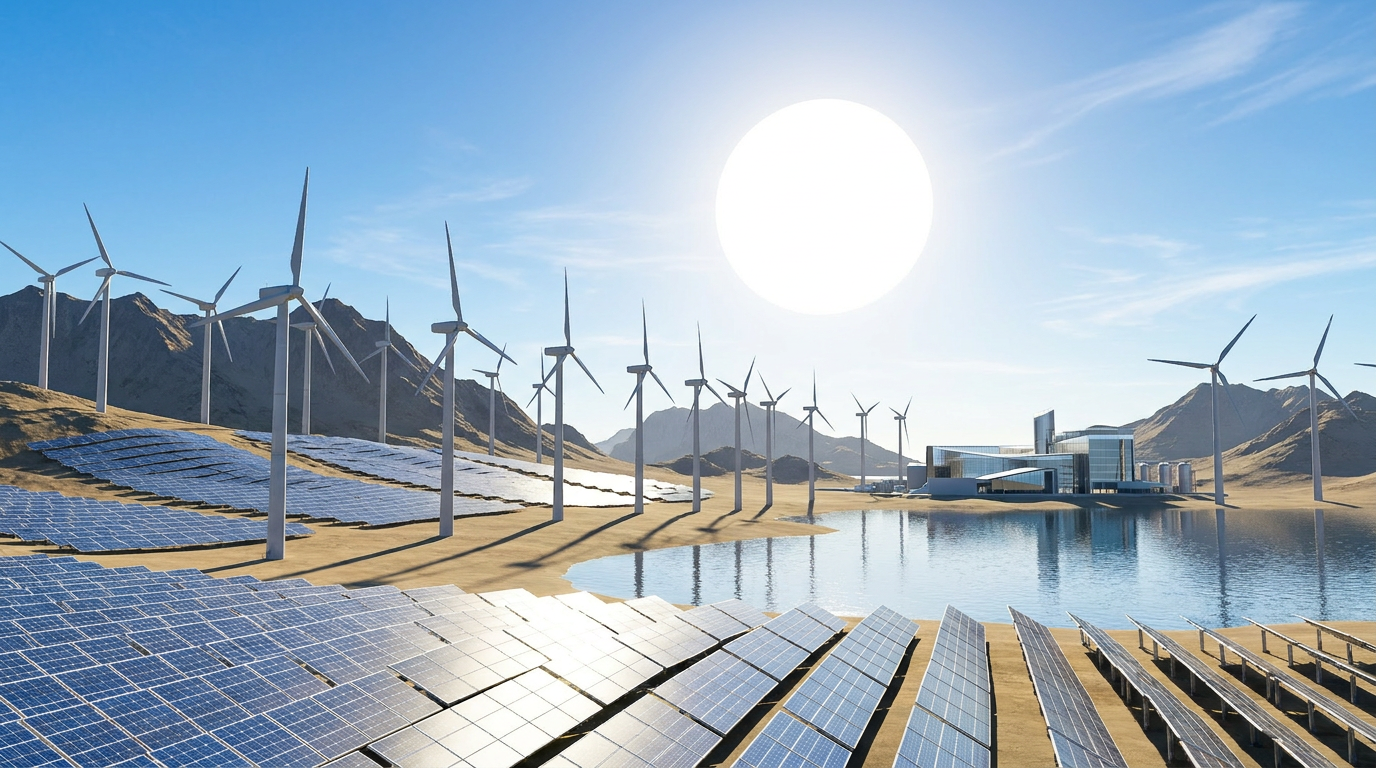
Unlike conventional "grey" hydrogen, which is stripped from natural gas in a highly carbon-intensive process, green hydrogen is produced through electrolysis. Massive arrays of solar panels and wind turbines generate renewable electricity, which is then fed into electrolyzers that split water into oxygen and hydrogen. Because hydrogen gas is notoriously difficult to transport over long distances, most Middle Eastern projects include an additional step: combining the hydrogen with nitrogen to create "green ammonia," a denser liquid that can be shipped globally using existing maritime infrastructure.[7]
The undisputed flagship of this regional pivot is the NEOM Green Hydrogen Project in northwestern Saudi Arabia. Backed by an $8.4 billion investment from ACWA Power, Air Products, and the Saudi government, the facility is the world's largest utility-scale commercial green hydrogen plant. As of April 2026, construction has surpassed the 90% completion mark across all major sites, transitioning the project from a conceptual rendering into a physical reality.[1][2]

The sheer scale of the NEOM operation illustrates the ambition of Gulf economic planners. The site is powered by 4 gigawatts of dedicated onshore wind and solar assets, which are scheduled to finish construction by mid-2026. Once the electrolyzers are fully commissioned in 2027, the plant will produce 600 tonnes of carbon-free hydrogen daily. This output will be converted into 1.2 million tonnes of green ammonia annually, all of which has already been secured by Air Products under an exclusive 30-year off-take agreement.[1][2]
While Saudi Arabia is building the biggest single facility, Oman is arguably executing the most comprehensive national strategy. Facing dwindling natural gas reserves that may only last another decade or two, Muscat has established a centralized entity called Hydrom to orchestrate its transition. Oman is targeting 1 million tonnes of green hydrogen production by 2030, with ambitions to scale up to 8.5 million tonnes by 2050—a volume sufficient to meet the entirety of Europe's current hydrogen demand.[3]
While Saudi Arabia is building the biggest single facility, Oman is arguably executing the most comprehensive national strategy.
Hydrom's approach of using transparent public auctions for land and renewable energy rights has won praise from international investors. Major consortiums, including BP and a partnership between OQ, Uniper, and DEME, are developing massive export hubs around the ports of Duqm and Salalah. If Oman achieves its 2040 targets, its green hydrogen exports will represent 80% of its current liquefied natural gas (LNG) exports in energy-equivalent terms, effectively replacing its fossil fuel revenue stream with clean energy.[3]

The United Arab Emirates is pursuing a parallel track through its National Hydrogen Strategy 2050. The UAE aims to produce 1.4 million tonnes of low-emission hydrogen annually by 2031, split between green hydrogen and "blue" hydrogen, which is produced from natural gas with carbon capture and storage. State-backed renewable energy giant Masdar is spearheading the green hydrogen push, leveraging the country's record-low solar power costs—which have recently dipped below $0.014 per kilowatt-hour—to ensure long-term cost competitiveness.[4][5]
The primary target market for these Gulf megaprojects is Europe, which has set aggressive decarbonization targets under its REPowerEU framework but lacks the land and solar irradiance to produce sufficient green hydrogen domestically. In response, new trade routes are being forged. Oman and the Netherlands have already agreed to develop a commercial-scale liquid hydrogen corridor connecting the Port of Duqm to the Port of Amsterdam, while Saudi Arabia's ACWA Power is laying the groundwork for exports under the proposed India-Middle East-Europe Economic Corridor (IMEC).[5]

Despite the rapid construction progress in 2026, the transition is not without friction. The global supply chain for electrolyzers remains constrained, and the specialized maritime infrastructure required to transport liquid hydrogen or crack green ammonia back into usable hydrogen at destination ports is still in its infancy. Furthermore, the capital required is staggering; industry analysts estimate that the Middle East and Africa currently have over $250 billion in active and planned hydrogen projects in the pipeline.[5][6]
There is also the emerging challenge of competing demands for renewable electricity. In a notable shift, the UAE's Masdar recently opted to redirect power from a planned $6 billion renewable energy project away from green hydrogen production and toward powering artificial intelligence data centers. This highlights a core tension: as the global AI boom accelerates, green hydrogen developers must increasingly compete directly with tech giants for the same zero-carbon electrons.[5]
Ultimately, the Middle East's green hydrogen gamble is an existential economic imperative. By leveraging their vast, sun-drenched deserts, established port infrastructure, and deep sovereign wealth, Gulf nations are attempting to future-proof their economies against the global phase-down of fossil fuels. If successful, the region will not just survive the energy transition—it will remain the indispensable energy supplier for the post-carbon world.[7]
How we got here
2020
The NEOM Green Hydrogen Project is officially announced as a joint venture in Saudi Arabia.
2022
Oman establishes Hydrom to centralize and orchestrate its national green hydrogen strategy.
May 2023
The NEOM project achieves a landmark financial close of $8.4 billion.
July 2023
The UAE updates its National Energy Strategy, setting a target of 1.4 million tonnes of hydrogen per annum by 2031.
April 2026
Construction on the NEOM Green Hydrogen Project surpasses 90% completion across all major sites.
Mid-2026
Target completion date for the 4 gigawatts of wind and solar generation sites powering the NEOM facility.
2027
Expected availability of the first green ammonia product from the NEOM plant for global export.
Viewpoints in depth
Gulf Economic Planners
View green hydrogen as a critical tool for economic diversification and maintaining the region's status as a global energy hub post-oil.
For regional governments, the green hydrogen pivot is fundamentally about economic survival and geopolitical relevance. Planners recognize that the global phase-down of fossil fuels threatens the core revenue streams that fund their states. By leveraging their natural advantages—abundant unpopulated land, world-class solar irradiance, and deep sovereign wealth—they aim to corner the market on the next generation of energy. They argue that transitioning from exporting liquid natural gas to liquid green ammonia allows them to utilize existing port infrastructure and trade relationships, ensuring the Gulf remains the indispensable energy supplier for the 21st century.
European Energy Importers
Focus on securing reliable, large-scale clean energy imports to meet aggressive domestic decarbonization targets that cannot be fulfilled locally.
European policymakers and industrial leaders view the Middle East's mega-projects as a necessary lifeline. Under frameworks like REPowerEU, the continent has committed to massive decarbonization targets for heavy industry and shipping. However, Europe lacks the physical space and consistent sunlight required to generate the sheer volume of renewable electricity needed to produce green hydrogen domestically at scale. Consequently, European stakeholders are actively funding and signing long-term off-take agreements with Gulf producers, prioritizing the rapid establishment of maritime import corridors to secure their future energy supply.
Energy Market Analysts
Emphasize the massive capital requirements, supply chain bottlenecks for electrolyzers, and emerging competition for renewable power.
While acknowledging the scale of the ambition, market analysts urge caution regarding the timeline and cost curves. They point out that the global supply chain for industrial-scale electrolyzers is still maturing, which could delay project commissioning. Furthermore, analysts note a new structural challenge: the explosive growth of artificial intelligence. As tech giants scour the globe for zero-carbon electricity to power massive data centers, green hydrogen developers are finding themselves competing for the same renewable energy assets, a dynamic that recently prompted the UAE's Masdar to redirect power from hydrogen to AI infrastructure.
Climate Advocates
Support the genuine emissions reductions of green hydrogen, but remain cautious about parallel investments in fossil-derived blue hydrogen.
Environmental groups generally applaud the massive deployment of solar and wind assets required for green hydrogen, recognizing it as one of the few viable pathways to decarbonize sectors like steelmaking and aviation. However, they remain highly critical of the parallel "blue hydrogen" strategies pursued by some Gulf states, particularly the UAE. Advocates argue that blue hydrogen—which relies on carbon capture technology that often underperforms—serves primarily to extend the lifespan of natural gas extraction, and they urge international buyers to strictly certify that their imports are genuinely zero-carbon.
What we don't know
- It remains unclear how quickly the specialized maritime infrastructure required to receive and process liquid green ammonia will be built at destination ports in Europe and Asia.
- The long-term impact of the AI data center boom on renewable energy availability and pricing for green hydrogen production is still unfolding.
- The exact cost trajectory of industrial-scale electrolyzers over the next decade is uncertain, which could affect the final market price of the exported fuel.
Key terms
- Green Hydrogen
- Hydrogen fuel produced by splitting water molecules using renewable electricity, resulting in a zero-carbon energy carrier.
- Electrolyzer
- An industrial device that uses an electric current to break water into its component elements of hydrogen and oxygen.
- Green Ammonia
- A chemical compound made by combining green hydrogen with nitrogen from the air, primarily used as a dense, easily transportable carrier for hydrogen energy.
- REPowerEU
- The European Commission's strategic plan to save energy, produce clean energy, and diversify energy supplies, which includes massive targets for hydrogen imports.
Frequently asked
What is the difference between green and blue hydrogen?
Green hydrogen is produced by splitting water using renewable electricity, resulting in zero carbon emissions. Blue hydrogen is produced from natural gas, with the resulting carbon emissions captured and stored underground.
Why convert hydrogen into ammonia?
Hydrogen gas is highly volatile and requires extreme pressure or cryogenic temperatures to transport. Converting it into liquid ammonia makes it significantly easier and cheaper to ship globally using existing maritime infrastructure.
When will the NEOM project start producing?
The renewable power sites are slated for completion in mid-2026, with the first green ammonia product expected to be available for export in 2027.
How much is the Middle East investing in this transition?
Industry analysts track over $250 billion in active and planned hydrogen projects across the Middle East and Africa, reflecting a massive shift in capital allocation.
Sources
Source coverage
7 outlets
4 viewpoints surfaced







[1]NEOM Green Hydrogen CompanyGulf Economic Planners
World's Largest Green Hydrogen Plant Reaches 80% Construction Completion
Read on NEOM Green Hydrogen Company →[2]Blackridge ResearchEnergy Market Analysts
NEOM Green Hydrogen Project Status 2026
Read on Blackridge Research →[3]Noria ResearchGulf Economic Planners
Oman's Green Hydrogen Strategy and Institutions
Read on Noria Research →[4]Green Hydrogen OrganisationGulf Economic Planners
UAE National Hydrogen Strategy 2050
Read on Green Hydrogen Organisation →[5]Mitsui Global Strategic Studies InstituteEuropean Energy Importers
Middle East Green Hydrogen Projects and European Export Markets
Read on Mitsui Global Strategic Studies Institute →[6]MEEDEnergy Market Analysts
Middle East & Africa Hydrogen Projects 2026
Read on MEED →[7]Factlen Editorial TeamClimate Advocates
Synthesis by Factlen editorial team
Read on Factlen Editorial Team →
Every angle. Every day.
Get world stories with full source coverage and perspective breakdowns delivered to your inbox.