
How Neuroaesthetics and Interior Design Actively Shape Brain Health
Emerging research at the intersection of neuroscience and architecture reveals that interior design choices trigger measurable biological responses, lowering stress and improving cognitive function.
By Factlen Editorial Team
- Neuroaesthetics Researchers
- Focuses on empirical data, arguing that design must be backed by fMRI scans and biometric tracking to prove its efficacy.
- Commercial Architects & Designers
- Focuses on translating clinical data into practical design choices to improve client well-being and productivity.
- Neuroinclusive Advocates
- Cautions against a one-size-fits-all approach, advocating for adaptable environments that support diverse sensory processing needs.
What's not represented
- · Lower-Income Renters
- · Traditional Decorators
Why this matters
Understanding how our physical environments affect our biology empowers us to design homes and workspaces that actively lower stress, improve focus, and support long-term mental health.
Key points
- Neuroaesthetics proves that interior design triggers measurable biological responses, including lowered heart rates and increased serotonin.
- fMRI studies reveal the human brain inherently prefers curvilinear spaces, which signal safety and comfort over sharp, rectilinear angles.
- Biophilic design, which incorporates natural elements, is clinically shown to reduce the stress hormone cortisol by 15 to 20 percent.
- Acoustic control and circadian lighting are critical components of neuroaesthetics, directly influencing cognitive focus and sleep cycles.
- The industry is shifting toward neuroinclusive design, recognizing that sensory processing varies widely among different individuals.
We have all walked into a specific room and felt an immediate, inexplicable sense of calm wash over us. For decades, interior designers relied entirely on intuition, training, and aesthetic judgment to create this effect, treating spatial harmony as an intangible art form. But today, the rapid convergence of neuroscience and architecture is proving that this feeling is not just a subjective preference or a trick of the light—it is a highly measurable, predictable biological response. The spaces we inhabit are actively rewriting our neurochemistry.[1][7]
Welcome to the rapidly emerging field of neuroaesthetics, the rigorous scientific study of how beauty, nature, and spatial design directly affect the human brain and nervous system. By utilizing functional magnetic resonance imaging (fMRI), galvanic skin response monitors, and biometric tracking, researchers are moving interior design out of the realm of pure decoration and firmly into the domain of preventative healthcare. This shift represents one of the most significant evolutions in the design industry in decades, validating artistic intuition with hard, peer-reviewed medical data.[3][5]
The foundational premise of neuroaesthetics is simple but profoundly impactful: the spaces around us are never passive backdrops. They are active agents that shape how we feel, heal, and function long before our conscious thought even catches up to our surroundings. When a room is designed with specific, evidence-based neuroaesthetic principles, the biological dividends are immediate and undeniable. Heart rates begin to slow, elevated blood pressure drops to healthier baselines, and the production of stress hormones decreases measurably within minutes of entering the environment.[1][4]
To truly understand how this mechanism works, we have to look at the brain's underlying architecture. According to researchers at the University of Pennsylvania and other leading cognitive institutions, human-building interactions are shaped by a complex neural triad: sensory-motor networks, knowledge-meaning networks, and emotion-valuation networks. When we cross the threshold into a new room, our brains rapidly and subconsciously process the geometry, lighting, and textures to determine if the environment is safe, stimulating, or stressful, triggering a cascade of physiological reactions.[5][7]

One of the most striking discoveries in the realm of neuroarchitecture involves the physical shape of the rooms and the furniture we inhabit daily. A landmark cognitive study published by Oxford University Press explicitly examined the impact of architectural contour on human aesthetic judgments and emotional states. Researchers placed participants in an fMRI scanner and showed them a series of images featuring various room interiors, carefully tracking which regions of the brain lit up in response to different spatial geometries.[6]
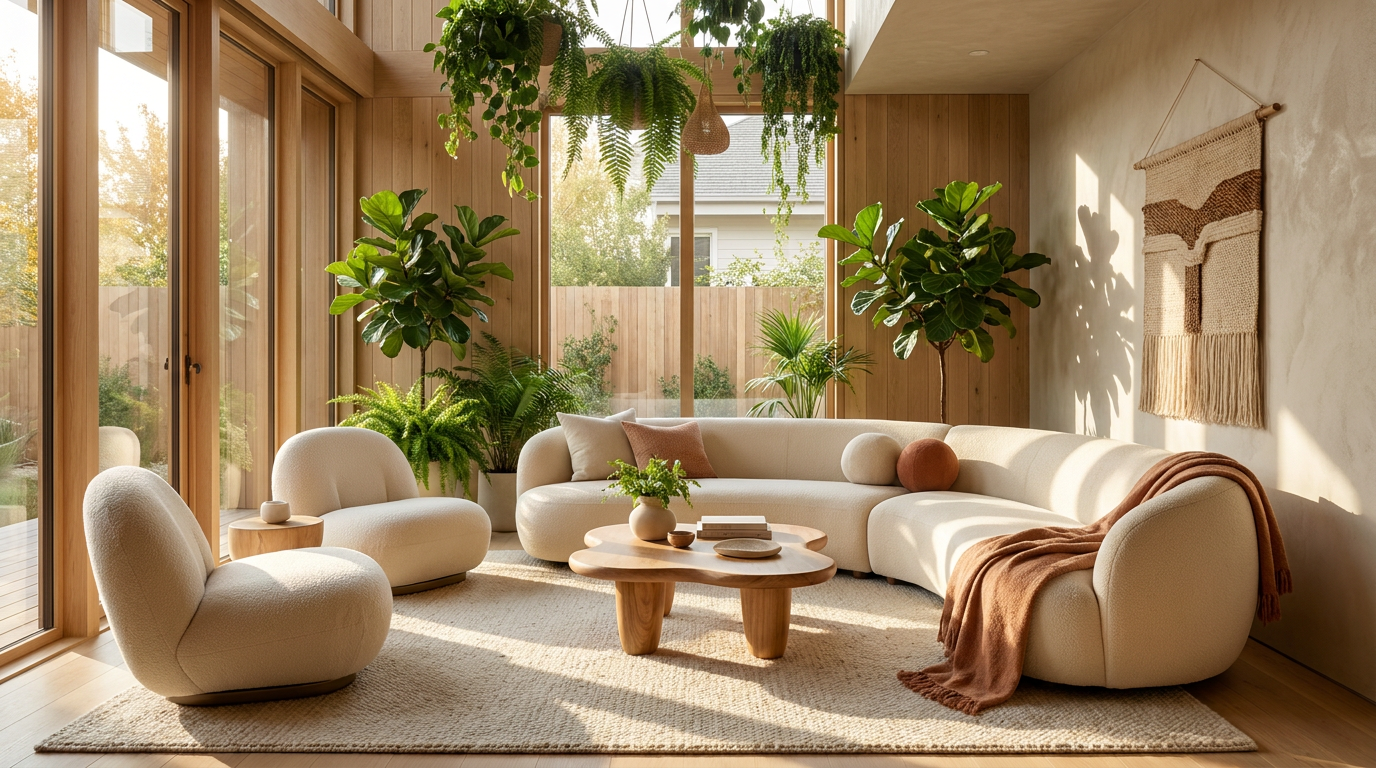
The neural data revealed a clear, overwhelming preference for curvilinear spaces over rectilinear ones. Viewing rooms with curved walls, rounded furniture, and arched doorways actively stimulated the anterior cingulate cortex—a region of the brain deeply involved in processing emotion, reward, and autonomic functions. Evolutionary biologists and neuroscientists suggest that the human brain inherently reads sharp, jagged angles as potential physical threats or hazards. In contrast, smooth, organic curves signal safety, comfort, and natural refuge, thereby triggering a deeply positive affective response that relaxes the nervous system.[6]
Beyond spatial geometry, the integration of nature—a practice known as biophilic design—produces some of the most dramatic and well-documented physiological shifts in the field. The Global Wellness Institute notes that our evolutionary history has hardwired the human species to seek out connections with living systems and natural environments. When interior spaces successfully mimic the natural world through materials, patterns, and direct access to flora, the biological benefits are profound, effectively counteracting the chronic stress of modern urban living.[2]
The Global Wellness Institute notes that our evolutionary history has hardwired the human species to seek out connections with living systems and natural environments.
Studies tracking human biomarkers in biophilic environments consistently demonstrate a remarkable 15 to 20 percent reduction in cortisol, the body's primary stress hormone. Furthermore, exposure to abundant natural light, organic tactile textures like raw wood, and lush indoor greenery actively stimulates the brain's release of serotonin and dopamine. These are the critical neurotransmitters responsible for mood regulation, pleasure, and cognitive focus, providing the biological foundation for why people universally report feeling more energized and creative in nature-inspired rooms.[1][2]

This biological reaction is so reliable and potent that the National Institutes of Health and other major medical bodies are increasingly exploring biophilic interior design as a legitimate, non-pharmacological intervention. It is being studied for its efficacy in managing chronic pain, severe migraines, and clinical depression. In modern healthcare settings, data shows that patients recovering in rooms with ample natural light and direct views of greenery require significantly less pain medication and experience faster recovery times than those confined to sterile, windowless clinical environments.[2][3]
But the science of neuroaesthetics extends far beyond visual stimuli; the acoustic environment plays a massive, often subliminal role in dictating our nervous system's baseline state. Unpredictable, harsh, or echoing noises elevate cortisol levels and keep the brain locked in a heightened state of alertness and anxiety. Conversely, intentional acoustic design—utilizing sound-absorbing soft furnishings, specialized acoustic wall panels, and ambient white noise systems—drastically reduces stress markers and measurably improves cognitive concentration and problem-solving abilities in both homes and commercial offices.[1][7]
Lighting, too, is being completely reimagined through a strict biological lens rather than just an aesthetic one. The human circadian rhythm is deeply tethered to the color temperature and intensity of the light we absorb throughout the day. Dynamic lighting systems that mimic the natural progression of the sun—starting with cool, blue-enriched light in the morning to stimulate alertness, and transitioning to warm, amber tones in the evening to promote melatonin production—are now becoming foundational elements of neuroaesthetic design.[2][4]

As the underlying science matures and becomes more accessible, major commercial design and architecture firms are aggressively adopting these principles to build what they call neuroinclusive workplaces. Experts at industry-leading firms like HOK emphasize that because sensory processing varies wildly among individuals, a rigid, one-size-fits-all approach to interior design is fundamentally flawed. Neurodivergent individuals, for instance, may experience a brightly lit, open-concept office not as an energetic collaborative hub, but as a deeply overwhelming and neurologically taxing environment that actively hinders their productivity and well-being.[4]
To create truly supportive and equitable environments, forward-thinking designers are now utilizing the 'Neuro-Architecture Triad'—a framework consisting of coherence, fascination, and hominess. Coherence ensures that a space is highly legible, structurally organized, and intuitively easy to navigate without causing mental fatigue. Fascination provides gentle, non-taxing sensory stimulation, such as watching leaves flutter in a breeze or observing water flow, which restores depleted attention. Finally, hominess offers a vital sense of refuge, warmth, and personal security. Together, these elements create spaces that accommodate a wide spectrum of neurological needs.[4][7]
Despite the widespread enthusiasm and promising data, the field of neuroaesthetics still faces notable hurdles as it scales. The National Institutes of Health notes that researchers, architects, and medical practitioners have historically operated in isolated silos, resulting in a lack of standardized measurement tools and large-scale, cross-disciplinary data sets. Furthermore, securing robust funding for architectural health interventions remains a persistent challenge compared to traditional pharmaceutical research, though new multi-million-dollar initiatives are finally beginning to bridge this critical funding gap.[3]

There is also the inherent, unavoidable complexity of human subjectivity to consider when applying these scientific principles. While universal biological baselines certainly exist across the species, an individual's cultural background, personal memories, and unique neurobiology mean that a space deemed perfectly 'healing' by one person might feel cold, unfamiliar, or alienating to another. The science of beauty and spatial perception is undeniably robust and growing stronger every year, but it is not an absolute mathematical certainty that applies uniformly to every single human brain without exception.[4][5]
Nevertheless, the paradigm shift currently sweeping through the architecture and interior design industries is irreversible. We are rapidly entering a new era where health has officially left the confines of the clinical laboratory and entered the living room and the corporate office. By validating the long-held intuition of creative designers with the rigorous, empirical data of neuroscience, the industry is definitively proving that everyday beauty is not a frivolous luxury—it is a fundamental biological necessity for human flourishing.[1][7]
How we got here
1984
Environmental psychologist Roger Ulrich publishes a landmark study showing hospital patients recover faster with views of nature.
1990s
Advancements in brain scanning technology allow researchers to measure physiological responses to beauty in real-time.
1999
Neuroscientist Semir Zeki officially coins the term 'neuroaesthetics'.
2013
A pivotal fMRI study reveals that curvilinear architecture actively stimulates the brain's emotion-processing centers.
2018
The National Institutes of Health expands funding to explore how arts and design interventions impact brain health.
2026
Major commercial architecture firms standardize neuroinclusive design practices for modern workplaces.
Viewpoints in depth
Neuroaesthetics Researchers
Focuses on the empirical data linking design to biological outcomes.
This camp argues that interior design must be backed by rigorous scientific evidence, including fMRI scans, biometric tracking, and peer-reviewed studies. They focus on proving the efficacy of spatial interventions in lowering cortisol and stimulating regions like the anterior cingulate cortex, pushing the industry to treat architecture as a form of preventative healthcare rather than mere decoration.
Commercial & Residential Designers
Focuses on translating clinical data into practical, everyday design choices.
Designers and architects emphasize the practical application of neuroaesthetic principles to improve client well-being and differentiate their practices. They are the ones implementing curved furniture, acoustic dampening, and circadian lighting in real-world homes and offices, bridging the gap between abstract neuroscience and tangible, livable spaces.
Neuroinclusive Advocates
Focuses on sensory diversity and accommodating different neurological needs.
This perspective cautions against a one-size-fits-all approach to neuroaesthetics. They note that what is calming to a neurotypical brain might be deeply overwhelming to a neurodivergent individual. Consequently, they advocate for adaptable, multi-sensory environments that offer users control over their lighting, acoustics, and spatial boundaries.
What we don't know
- How cultural background and personal memories alter an individual's biological response to specific design aesthetics.
- The long-term, generational impacts of raising children entirely in neuro-optimized indoor environments.
- How to fully standardize neuroaesthetic metrics across the highly subjective and fragmented interior design industry.
Key terms
- Neuroaesthetics
- The scientific study of how beauty, art, and spatial design affect the human brain and nervous system.
- Biophilic Design
- An architectural approach that connects occupants to nature by incorporating natural light, organic materials, and plants.
- Anterior Cingulate Cortex
- A region of the brain involved in processing emotion and regulating autonomic functions, activated by pleasing architectural curves.
- Circadian Lighting
- Artificial lighting systems designed to mimic the natural progression of daylight to support the human body's internal clock.
- Cortisol
- The body's primary stress hormone, which has been shown to decrease by 15-20% in well-designed, biophilic environments.
Frequently asked
Does neuroaesthetic design require expensive renovations?
Not necessarily. While structural changes like curved walls are costly, adding indoor plants, optimizing natural light, and using soft textures are highly effective, low-cost biophilic interventions.
How does room shape affect the brain?
fMRI studies show that curvilinear spaces (rooms with rounded edges and curved furniture) activate the brain's emotion-processing centers, signaling safety, whereas sharp angles can subconsciously trigger threat responses.
What is a neuroinclusive space?
A neuroinclusive space is designed to accommodate diverse sensory processing needs, offering adjustable lighting, acoustic control, and quiet zones so that both neurotypical and neurodivergent individuals feel comfortable.
Can lighting really change my mood?
Yes. Circadian lighting that mimics the sun's natural progression regulates melatonin and cortisol production, directly impacting your sleep quality, alertness, and overall mood.
Sources
Source coverage
7 outlets
3 viewpoints surfaced







[1]Science in DesignCommercial Architects & Designers
The Science Behind Neuroaesthetics
Read on Science in Design →[2]Global Wellness InstituteNeuroaesthetics Researchers
Biophilic Design Research and Mental Wellbeing
Read on Global Wellness Institute →[3]National Institutes of HealthNeuroaesthetics Researchers
Neuroaesthetics Evolves: The Biological Impact of the Arts and Architecture
Read on National Institutes of Health →[4]HOKNeuroinclusive Advocates
Wired for Beauty: Neuroaesthetics and the Built Environment
Read on HOK →[5]ArchDailyCommercial Architects & Designers
Neuroaesthetics: How Architecture Shapes the Brain
Read on ArchDaily →[6]Oxford University PressNeuroaesthetics Researchers
The Neuroaesthetics of Architecture
Read on Oxford University Press →[7]Factlen Editorial TeamNeuroinclusive Advocates
Synthesis by Factlen editorial team
Read on Factlen Editorial Team →
Every angle. Every day.
Get home stories with full source coverage and perspective breakdowns delivered to your inbox.