
How AI Tutors Are Democratizing One-on-One Education
Artificial intelligence is finally solving education's oldest bottleneck by providing scalable, personalized tutoring to millions of students. From Khan Academy to Harvard, AI companions are shifting the paradigm of online learning.
By Factlen Editorial Team

- EdTech Innovators
- Advocates who believe AI is the only scalable solution to global educational inequality.
- Pedagogical Researchers
- Academics focused on measuring the actual, evidence-based learning outcomes of AI integration.
- Humanist Educators
- Teachers and advocates who emphasize the irreplaceable emotional and social components of learning.
What's not represented
- · Students without reliable broadband internet access
- · Special education professionals working with neurodivergent learners
Why this matters
For decades, personalized tutoring was a luxury reserved for the wealthy, leaving millions of students behind in one-size-fits-all classrooms. The deployment of pedagogical AI means that 24/7, customized academic support is becoming universally accessible, fundamentally leveling the educational playing field.
Key points
- AI tutors are transitioning from experimental tools to core components of online learning, offering 24/7 personalized academic support.
- Modern educational AI uses the Socratic method, deliberately withholding answers to guide students through their own problem-solving process.
- Early studies show AI tutors deliver statistically significant improvements in math scores, though they still trail the effectiveness of expert human tutors.
- The technology is unbundling the teaching profession, automating repetitive instruction so educators can focus on high-level mentorship.
- AI tutoring democratizes education by giving underfunded schools and remote learners access to the same caliber of individualized support as elite institutions.
In 1984, educational psychologist Benjamin Bloom identified a phenomenon that would haunt the education sector for decades, famously known as the "two sigma problem." Bloom's research demonstrated that students who received personalized, one-on-one tutoring performed two standard deviations better than those learning in conventional, one-size-fits-all classroom settings. In practical terms, the tutored students outperformed 98 percent of their peers. For forty years, this finding served as both a north star and a source of deep frustration for educators. The pedagogical benefits of individualized instruction were undeniable, but the economics of providing a dedicated human tutor for every single student made the solution impossible to scale. Consequently, personalized tutoring remained a luxury largely reserved for affluent families, while the vast majority of students were left to navigate standardized curricula at a uniform pace, regardless of their individual comprehension levels. By 2026, however, the landscape of online learning has fundamentally shifted, driven by technological advancements that are finally making Bloom's vision economically viable.[3][8]
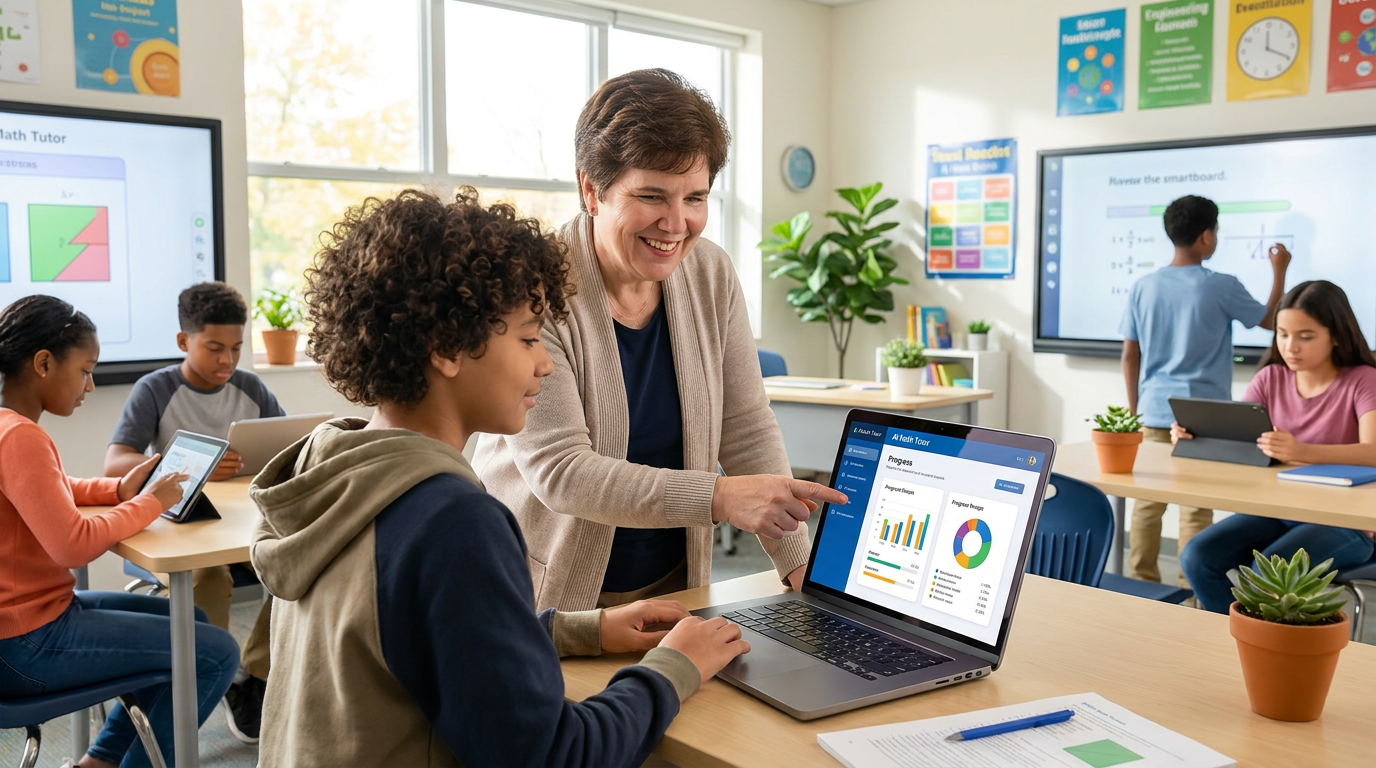
Artificial intelligence tutors have rapidly transitioned from experimental novelties to structural pillars of modern education, promising to democratize the one-on-one tutoring experience for millions of students globally. Unlike the early iterations of generative AI, which often functioned as sophisticated answer keys that inadvertently facilitated cheating, the current generation of educational AI is engineered with strict pedagogical guardrails. These purpose-built systems are designed to act as learning companions rather than answer generators. They employ the Socratic method, deliberately withholding direct solutions to force students to engage critically with the material. When a student encounters a roadblock, the AI tutor analyzes their previous steps, identifies the specific knowledge gap, and asks targeted, open-ended questions that guide the learner toward their own "aha" moment. This adaptive intelligence mirrors the responsiveness of an expert human tutor, transforming mistakes into opportunities for cognitive growth rather than sources of discouragement.[1][5][6]

The most prominent and widely adopted example of this pedagogical shift is Khanmigo, the AI tutor developed by the non-profit educational organization Khan Academy. Launched with the explicit ambition of providing a world-class tutor to anyone, anywhere, Khanmigo had reached over two million students across more than 15,000 school districts by 2025. The platform's architecture is specifically tuned to develop metacognition—the student's awareness of their own learning process. Early efficacy studies have begun to quantify the impact of this approach. A rigorous joint study conducted by researchers at Stanford University and the National Bureau of Economic Research (NBER) found that students utilizing Khanmigo for mathematics exhibited a 0.2 standard deviation improvement over control groups. While this metric remains notably below Bloom's theoretical two-sigma benchmark, achieving statistically significant, measurable learning gains at a global scale represents a watershed moment for educational technology and online learning platforms.[1][3]
The integration of AI tutoring is not limited to K-12 education; elite higher education institutions are also deploying bespoke AI systems to manage massive enrollment and complex curricula. At Harvard University, the flagship introductory computer science course, CS50, has fully integrated an AI-powered "rubber duck" to support its vast student body. Professor David J. Malan and his instructional team rolled out the CS50.ai bot with a highly ambitious goal: to approximate a 1:1 teacher-to-student ratio for the course's 600 on-campus students and its staggering 5.5 million online registrants on the edX platform. The CS50 bot is explicitly engineered to help students debug complex code, interpret arcane error messages, and understand fundamental design flaws. Crucially, it is programmed to refuse requests to write the code for the student, thereby fostering independent problem-solving skills while eliminating the anxiety of waiting hours or days for a human teaching assistant to respond.[2][7]

At Harvard University, the flagship introductory computer science course, CS50, has fully integrated an AI-powered "rubber duck" to support its vast student body.
This widespread technological integration is prompting a profound redefinition of the human educator's role within both physical classrooms and digital learning environments. For generations, teachers have been forced to act as the primary bottleneck for knowledge transfer, spending countless hours delivering rote lectures, grading standardized assessments, and answering the same foundational questions repeatedly. As AI tutors absorb the burden of repetitive instruction, offer infinite patience for basic queries, and provide real-time adaptive pacing for individual students, human educators are being freed to evolve into "learning architects." This paradigm shift allows teachers to redirect their energy toward the uniquely human aspects of education: emotional intelligence, complex mentorship, facilitating collaborative group work, and guiding high-level critical thinking. The technology is not replacing the teacher; it is unbundling the teaching profession, automating the mechanical tasks to elevate the human ones.[5][6][8]
The equity implications of this technological unbundling are profound and far-reaching. Historically, the quality of a student's educational support system was inextricably linked to their geographic location and socioeconomic status. Today, a student in a rural, underfunded public school district—or a self-directed learner in a developing nation—can access the same caliber of patient, personalized, 24/7 academic support as a student enrolled in an elite private academy. AI tutors democratize access to high-quality explanations, ensuring that a student struggling with algebra at midnight has immediate, non-judgmental assistance. Furthermore, these systems support self-paced learning, allowing advanced students to accelerate through mastered content while providing struggling learners with the additional review and alternative explanations they need without the stigma of falling behind their peers.[5][6]

Despite the overwhelming optimism surrounding these platforms, the transition to AI-mediated learning is not without significant friction and ongoing challenges. Educational researchers and institutional leaders note that large language models still occasionally struggle with fabrications or "hallucinations," presenting a real risk of students internalizing incorrect information if the AI is not rigorously monitored. Furthermore, current efficacy data indicates that AI tutors are substantially more effective in highly structured, rules-based subjects like mathematics, physics, and computer programming. In the nuanced, subjective realms of the humanities—such as literature, history, and creative writing—the AI's ability to evaluate complex argumentation and foster genuine original thought remains limited compared to its mathematical prowess.[3][4]
Ultimately, qualitative studies and student feedback underscore a fundamental truth about the educational process: while students highly value the immediate feedback, autonomy, and clarity provided by AI tutors, these systems cannot replicate the motivational and emotional support provided by a human mentor. An AI can explain a calculus concept with perfect clarity, but it cannot inspire a student to care about the subject, nor can it recognize when a student's academic struggles are rooted in external personal challenges. The future of online learning, therefore, is not a zero-sum contest between humans and machines. It is a hybrid, integrated ecosystem where artificial intelligence provides the scalable cognitive scaffolding and infinite patience, while human teachers provide the irreplaceable context, empathy, and connection that turn information into true education.[4][8]
How we got here
1984
Educational psychologist Benjamin Bloom identifies the 'two sigma problem,' proving 1-on-1 tutoring vastly outperforms classroom learning.
2023
Khan Academy launches Khanmigo, aiming to provide a scalable AI tutor to students globally.
Fall 2023
Harvard University integrates the CS50.ai 'rubber duck' bot to provide 24/7 coding support to millions of students.
2025
Stanford and NBER publish efficacy studies showing statistically significant math improvements for students using AI tutors.
Viewpoints in depth
EdTech Innovators
Advocates who believe AI is the only scalable solution to global educational inequality.
This camp, comprising platform developers and technologists, argues that the traditional classroom model is fundamentally broken because it forces a uniform pace on diverse learners. They point to the rapid adoption of tools like Khanmigo and CS50.ai as proof that AI can successfully deliver personalized, Socratic instruction at a fraction of the cost of human tutors. For these innovators, the primary goal is rapid deployment and iterative improvement, believing that AI's current limitations in subjects like the humanities will be solved through better models and more training data.
Pedagogical Researchers
Academics focused on measuring the actual, evidence-based learning outcomes of AI integration.
Researchers and institutional evaluators take a more measured approach, focusing on empirical data rather than technological promise. While they acknowledge early successes—such as the 0.2 standard deviation improvement seen in Stanford's Khanmigo study—they caution that AI is not a magic bullet. This camp emphasizes the need for strict pedagogical guardrails to prevent AI from simply giving students the answers. They are also deeply concerned with data privacy, algorithmic bias, and the ongoing risk of AI 'hallucinations' that could embed factual inaccuracies into a student's foundational knowledge.
Humanist Educators
Teachers and advocates who emphasize the irreplaceable emotional and social components of learning.
This perspective argues that education is fundamentally a human, relational endeavor, not merely the transfer of information. While humanist educators welcome AI's ability to automate grading and provide basic 24/7 support, they strongly push back against the narrative that software can ever truly replace a teacher. They highlight that AI lacks the emotional intelligence to recognize when a student is struggling due to external trauma, anxiety, or lack of confidence. For this camp, AI should strictly remain a supplementary tool that frees up human teachers to focus on mentorship, inspiration, and community building.
What we don't know
- It remains unclear how effectively AI tutors can be adapted for highly subjective, nuanced subjects like creative writing and advanced literature.
- The long-term impact of AI reliance on a student's independent critical thinking and attention span has not yet been fully studied.
- Institutions are still determining the best ethical frameworks for handling the massive amounts of personal learning data generated by these systems.
Key terms
- Two Sigma Problem
- A 1984 educational finding showing that students who receive one-on-one tutoring perform two standard deviations better than classroom-taught peers.
- Socratic Method
- A teaching tactic where the instructor asks a series of open-ended questions to lead the student to discover the answer themselves.
- Metacognition
- The awareness and understanding of one's own thought processes and learning patterns.
- Standard Deviation
- A statistical measure used in education to quantify how much a student's test scores improve compared to the average.
Frequently asked
Does an AI tutor just give students the answers?
No. Modern educational AI is programmed with strict guardrails to use the Socratic method. Instead of providing direct solutions, it asks guiding questions to help students find the answer themselves.
Is AI tutoring as effective as a human tutor?
Not yet, but it is closing the gap. Early studies show AI tutors improve math performance by 0.2 standard deviations, which is significant but still below the two-standard-deviation improvement seen with expert human tutors.
Will AI tutors replace human classroom teachers?
Experts agree that AI will not replace teachers. Instead, it will handle repetitive instruction and grading, allowing teachers to focus on complex mentorship, emotional support, and critical thinking.
What subjects do AI tutors handle best?
Currently, AI tutors excel in highly structured, rules-based subjects like mathematics and computer science. They are less effective in nuanced subjects like literature and history.
Sources
Source coverage
8 outlets
3 viewpoints surfaced







[1]Khan AcademyEdTech Innovators
Improving Khanmigo's Effectiveness: A Data-Driven Approach
Read on Khan Academy →[2]Harvard UniversityHumanist Educators
Using AI as a Personal Tutor in CS50
Read on Harvard University →[3]Stanford/NBER (via EduGenius)Pedagogical Researchers
Evaluating the Efficacy of AI Tutoring Systems
Read on Stanford/NBER (via EduGenius) →[4]Clareus ScientificPedagogical Researchers
Advancing AI-Powered Tutoring Systems in Higher Education
Read on Clareus Scientific →[5]ToddleEdTech Innovators
How AI Tutors Revolutionize Education and Foster Critical Thinking
Read on Toddle →[6]Visionary VoguesHumanist Educators
AI Tutors Become Always-On Learning Companions
Read on Visionary Vogues →[7]MediumEdTech Innovators
Harvard's CS50 Embraces Generative AI in the Classroom
Read on Medium →[8]Factlen Editorial TeamHumanist Educators
Synthesis by Factlen editorial team
Read on Factlen Editorial Team →
Every angle. Every day.
Get education stories with full source coverage and perspective breakdowns delivered to your inbox.