
The Science of Psychobiotics: How Your Gut Microbiome Shapes Your Mood
Emerging research reveals that specific dietary patterns can actively reshape the gut microbiome to produce mood-regulating neurotransmitters. By understanding the gut-brain axis, individuals can use targeted nutrition to support mental well-being and emotional resilience.
By Factlen Editorial Team
- Nutritional Psychiatrists
- Focus on clinical application, viewing targeted dietary interventions as a primary or adjunctive treatment for mood disorders.
- Microbiome Researchers
- Focus on the biological complexity, mapping exactly which bacterial strains produce specific neurotransmitters and immune responses.
- Public Health Advocates
- Focus on accessibility, arguing that if food is medicine for mental health, then food deserts represent an urgent psychiatric crisis.
What's not represented
- · Individuals with severe clinical depression requiring pharmaceutical intervention
- · Agricultural producers of fermented foods
Why this matters
Mental health interventions have traditionally focused entirely on the brain, but new nutritional science shows that the gut produces the vast majority of our serotonin. Understanding how to feed these beneficial bacteria gives you a daily, actionable tool to improve your emotional resilience and cognitive focus.
Key points
- The gut microbiome produces up to 95% of the body's serotonin, a key neurotransmitter for mood regulation.
- The vagus nerve serves as a bidirectional superhighway, constantly updating the brain on the state of the gut.
- Prebiotic fibers from whole plant foods are fermented by bacteria into anti-inflammatory compounds called SCFAs.
- Clinical trials show that adopting a Mediterranean-style diet can significantly reduce symptoms of clinical depression.
- Consuming 30 or more different types of plants per week is linked to a highly diverse, resilient microbiome.
For decades, the conversation around mental health has been firmly anchored in the brain. We have viewed mood, anxiety, and focus as the exclusive domain of neurochemistry operating above the neck. But a paradigm-shifting body of research is moving the center of emotional gravity downward, revealing that our dietary choices are inextricably linked to our psychological state.[1][6]
Welcome to the era of nutritional psychiatry and the gut-brain axis. Scientists now understand that the human digestive tract is not merely a processing plant for calories, but a complex endocrine organ and a primary manufacturer of mood-regulating chemicals. This shifts the narrative of food from simple weight management to profound cognitive maintenance.[2][4]
At the heart of this connection is the gut microbiome—an ecosystem of roughly 100 trillion bacteria, viruses, and fungi living in our intestines. These microbes do not just passively consume what we eat; they actively metabolize our food into neuroactive compounds that travel directly to the brain, influencing everything from stress responses to memory formation.[3]
The physical superhighway for this communication is the vagus nerve, a thick cable of neurons running from the brainstem down to the abdomen. While we once thought the brain used this nerve primarily to issue commands to the gut, researchers now know that 80 percent of the vagus nerve's fibers send signals from the gut to the brain, constantly updating the central nervous system on the state of the microbiome.[4][5]

The chemical implications of this signaling are staggering. An estimated 90 to 95 percent of the body's serotonin—the neurotransmitter targeted by many common antidepressants—is produced not in the brain, but in the gastrointestinal tract. Dopamine, GABA, and acetylcholine are also synthesized by our intestinal tenants.[2][6]
This brings us to the concept of "psychobiotics." Originally coined to describe live bacterial supplements that yield mental health benefits, the term has expanded to include the dietary patterns that cultivate these beneficial bacteria naturally. It is the realization that we can farm our own neurochemistry.[1][7]
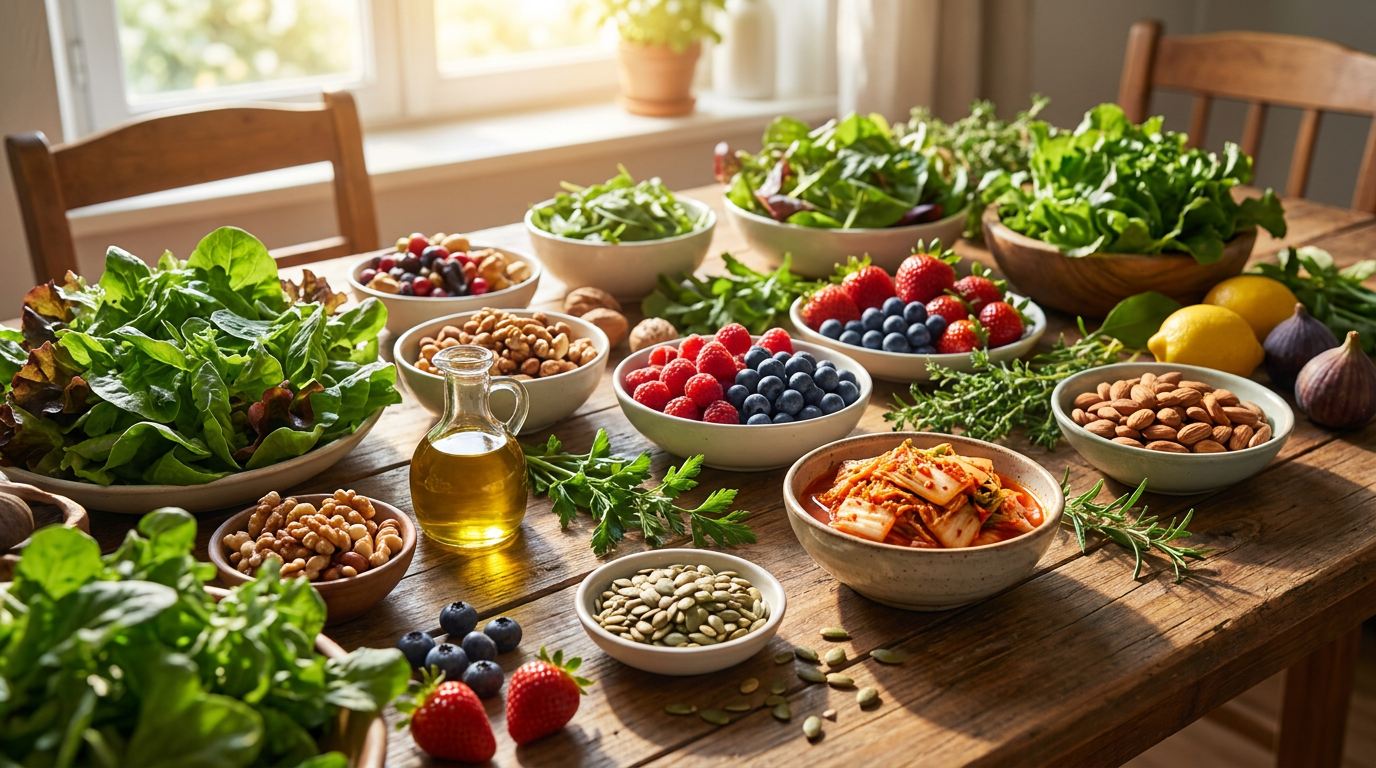
To understand how food alters mood, we must look at what our gut bacteria eat. Their preferred fuel is dietary fiber, specifically prebiotic fibers found in whole foods like onions, garlic, asparagus, oats, and bananas. Human enzymes cannot digest these fibers, so they pass intact to the lower intestine where microbes feast on them.[2]
When beneficial microbes ferment these fibers, they produce byproducts called short-chain fatty acids (SCFAs), with butyrate being the most heavily studied. SCFAs are crucial because they strengthen the gut lining, preventing inflammatory molecules from leaking into the bloodstream and triggering an immune response.[3][5]
When beneficial microbes ferment these fibers, they produce byproducts called short-chain fatty acids (SCFAs), with butyrate being the most heavily studied.
This barrier function is vital for mental health. Chronic, low-grade inflammation is increasingly recognized as a major underlying driver of depression, brain fog, and anxiety. By producing SCFAs, a fiber-fed microbiome actively suppresses systemic inflammation, which in turn reduces neuroinflammation in the brain.[4][7]

Alongside prebiotics, fermented foods play a critical role. A landmark study from Stanford University demonstrated that a diet high in fermented foods—such as kefir, kimchi, kombucha, and yogurt—steadily increases microbiome diversity and decreases markers of inflammation across the body.[2][5]
Conversely, the standard Western diet, heavily reliant on ultra-processed foods, actively starves beneficial microbes. Emulsifiers, artificial sweeteners, and a severe lack of fiber can degrade the mucosal lining of the gut, leading to a state of "dysbiosis" where harmful, inflammation-promoting bacteria thrive and outcompete the serotonin-producing strains.[1][6]
The clinical evidence supporting dietary interventions for mental health is robust. The groundbreaking SMILES trial, published in The Lancet Psychiatry, was one of the first randomized controlled trials to prove that clinical depression could be significantly improved through dietary changes alone, independent of weight loss.[7]
In the trial, patients who adopted a modified Mediterranean diet—rich in whole grains, legumes, fresh produce, and olive oil—experienced a massive reduction in depressive symptoms compared to a control group receiving only social support. A third of the dietary intervention group achieved full remission of their depression.[1][7]

For those looking to optimize their gut-brain axis, researchers often recommend the "30 plants a week" rule. Studies show that individuals who consume 30 or more different types of plant foods weekly have vastly more diverse and resilient microbiomes than those who consume fewer than 10, creating a broader spectrum of beneficial neurochemicals.[2][3]
It is important to note that nutritional psychiatry is not a replacement for traditional psychiatric care. For individuals with severe clinical depression or acute anxiety disorders, dietary changes are an adjunctive therapy, designed to raise the baseline of resilience, not a substitute for prescribed medications or psychotherapy.[1][6]
Furthermore, the commercial supplement industry has outpaced the science. While targeted probiotic strains show promise in clinical settings, the generic probiotic pills sold in supermarkets often lack the specific strains, viable cell counts, or targeted delivery systems needed to reliably alter mental health outcomes.[3][4]

The most effective, evidence-based approach remains whole-food nutrition. The gut microbiome is highly responsive; research indicates that shifting from a highly processed diet to a fiber-rich, plant-diverse diet can begin altering bacterial composition in a matter of days, though long-term stability requires consistent habits.[2][5]
Ultimately, understanding the gut-brain axis offers a profoundly empowering reframing of mental health. It transforms nutrition from a tool for physical aesthetics into a daily lever for emotional resilience, giving us agency over our minds through the simple, accessible act of feeding our microbes.[1]
How we got here
2004
Early studies on germ-free mice demonstrate that the presence or absence of gut bacteria fundamentally alters stress responses.
2013
The term 'psychobiotics' is officially coined by researchers to describe bacteria that yield positive psychiatric benefits.
2017
The landmark SMILES trial publishes results showing that dietary intervention can effectively treat clinical depression.
2021
A Stanford study reveals that diets high in fermented foods steadily increase microbiome diversity and lower systemic inflammation.
2026
Nutritional psychiatry continues to gain traction as a formalized, evidence-based component of preventative mental health care.
Viewpoints in depth
Nutritional Psychiatrists
Focus on clinical application and using food as a prescribed intervention alongside traditional therapy.
For nutritional psychiatrists, the gut-brain axis represents a massive untapped resource in clinical care. Pointing to landmark studies like the SMILES trial, they argue that dietary interventions should be a standard first-line or adjunctive treatment for mood disorders. Rather than simply asking patients about their feelings, these practitioners also ask about their fiber intake, viewing a diverse, plant-rich diet as a biological necessity for a stable mood, not just a lifestyle choice.
Microbiome Researchers
Focus on the biological complexity and caution against oversimplifying the science of bacterial strains.
While optimistic about the field's potential, microbiome researchers emphasize caution. They point out that the microbiome is incredibly complex and highly individualized—what works for one person's gut may not work for another's. They are currently focused on mapping exactly which bacterial strains produce specific neurotransmitters, warning that the commercial supplement industry's generic 'probiotic' claims often outpace the rigorous, strain-specific science required to reliably alter human neurochemistry.
Public Health Advocates
Focus on accessibility, arguing that nutritional psychiatry highlights systemic inequalities in food access.
Public health advocates view the science of psychobiotics through the lens of equity. If fresh produce, dietary fiber, and fermented foods are essential for maintaining mental health, they argue, then food deserts and the high cost of whole foods are not just physical health issues—they are urgent psychiatric crises. This camp advocates for policy changes, such as subsidizing fresh produce and expanding nutritional education, to ensure that 'food as medicine' is accessible to all socioeconomic groups.
What we don't know
- Exactly which specific bacterial strains are responsible for producing specific neurotransmitters in humans.
- How individual genetic differences influence the way a person's microbiome responds to dietary changes.
- The precise dosage and duration of dietary interventions required to achieve lasting remission in severe psychiatric disorders.
Key terms
- Gut-Brain Axis
- The two-way biochemical signaling pathway between the gastrointestinal tract and the central nervous system.
- Psychobiotics
- Live organisms or dietary interventions that, when ingested in adequate amounts, produce a mental health benefit by altering the microbiome.
- Short-Chain Fatty Acids (SCFAs)
- Beneficial compounds, such as butyrate, produced when gut bacteria ferment dietary fiber, which help reduce systemic inflammation.
- Vagus Nerve
- The primary cranial nerve connecting the brain to the abdomen, acting as the main physical communication line for the gut-brain axis.
- Dysbiosis
- An imbalance in the gut microbial community, often associated with a highly processed diet, leading to inflammation and disease.
Frequently asked
How long does it take for diet to change the microbiome?
Research shows that bacterial composition can begin to shift within 24 to 72 hours of a major dietary change, though establishing long-term stability requires months of consistent habits.
Are probiotic supplements as good as eating whole foods?
Generally, no. Whole foods provide a complex matrix of prebiotic fibers and diverse bacterial strains that most commercial pills cannot replicate or deliver effectively to the lower intestine.
Can changing my diet replace my antidepressants?
No. Dietary changes should be viewed as a complementary therapy to raise your baseline resilience. Anyone considering changes to their medication should consult their psychiatrist.
What counts as a 'plant' for the 30-a-week rule?
Fruits, vegetables, nuts, seeds, legumes, whole grains, and even herbs and spices all count toward the weekly diversity goal.
Sources
Source coverage
7 outlets
3 viewpoints surfaced







[1]Factlen Editorial TeamPublic Health Advocates
Synthesis by Factlen editorial team
Read on Factlen Editorial Team →[2]Harvard T.H. Chan School of Public HealthPublic Health Advocates
The Microbiome and Diet
Read on Harvard T.H. Chan School of Public Health →[3]National Institutes of HealthMicrobiome Researchers
The Gut Microbiome and the Brain
Read on National Institutes of Health →[4]Nature Reviews MicrobiologyMicrobiome Researchers
The gut-brain axis: interactions between enteric microbiota, central and enteric nervous systems
Read on Nature Reviews Microbiology →[5]Cell PressMicrobiome Researchers
Gut-microbiota-targeted diets modulate human immune status
Read on Cell Press →[6]American Psychological AssociationNutritional Psychiatrists
That gut feeling
Read on American Psychological Association →[7]The Lancet PsychiatryNutritional Psychiatrists
A randomised controlled trial of dietary improvement for adults with major depression (the 'SMILES' trial)
Read on The Lancet Psychiatry →



Every angle. Every day.
Get health stories with full source coverage and perspective breakdowns delivered to your inbox.