
Virtual Reality is Rewiring How the Next Generation Learns the Skilled Trades
Facing a massive labor shortage, vocational programs are increasingly turning to virtual reality to train welders, electricians, and plumbers faster and safer.
By Factlen Editorial Team
- Vocational Instructors & Unions
- Value VR for reducing material costs, improving safety, and accelerating the transition from novice to apprentice.
- Industry Employers
- See VR as a scalable solution to the massive labor shortage, allowing rapid upskilling across multiple locations.
- Educational Researchers
- Emphasize that VR must be paired with proven pedagogical models and cannot fully replace tactile, hands-on experience.
What's not represented
- · Veteran tradespeople skeptical of digital training methods
- · Students experiencing VR motion sickness or accessibility issues
Why this matters
As the global infrastructure boom demands an unprecedented influx of skilled labor, VR training is removing the physical and financial bottlenecks of traditional apprenticeships, making high-paying trade careers more accessible to a wider demographic.
Key points
- The skilled trades are facing a severe labor shortage, prompting a shift in how apprentices are trained.
- Virtual reality allows students to practice hazardous tasks like welding and electrical wiring without safety risks or material waste.
- Data indicates VR learners complete training up to four times faster and report significantly higher confidence levels.
- While highly effective for procedural memory, instructors stress VR must be paired with physical labs to teach tactile resistance.
The skilled trades are facing a demographic cliff. Across North America and Europe, seasoned electricians, plumbers, and welders are retiring at a pace that far outstrips the arrival of new apprentices. In the HVAC industry alone, an estimated 110,000 positions sit unfilled nationwide. Bridging this massive labor gap requires a monumental training effort, but traditional vocational education is struggling to scale fast enough to meet the demand.[2]
The traditional bottleneck in skilled trades education is a physical one. Training a novice requires dedicated shop space, expensive raw materials like copper pipe and steel plate, and constant supervision to mitigate severe safety risks. A mistake with a live electrical wire or a mismanaged welding torch can result in catastrophic injury or ruined equipment. These constraints naturally limit class sizes and slow the pace at which a student can practice through repetition.[2][7]

To break this bottleneck, vocational programs and industry employers are increasingly turning to the virtual jobsite. By integrating Virtual Reality (VR) headsets into their curricula, training centers are allowing students to immerse themselves in highly realistic, interactive simulations of construction sites, electrical panels, and plumbing systems.[1]
The core claim driving this adoption is that VR accelerates the acquisition of physical skills without the associated physical waste. By moving the initial stages of learning into a digital environment, students can practice complex, multi-step procedures hundreds of times before ever touching a real tool.[1][4]
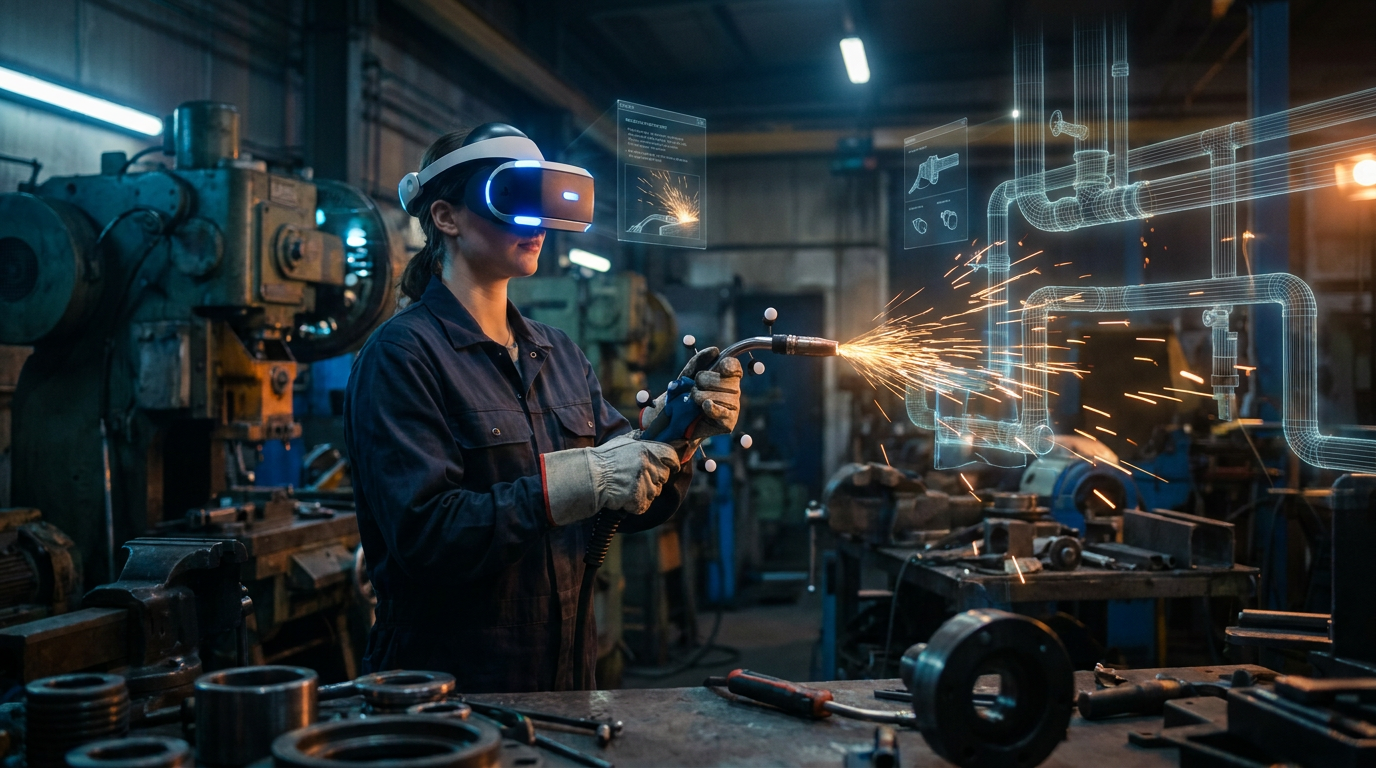
Consider the mechanics of a VR welding simulator. A student lowers a physical face shield equipped with a digital display and grips a lifelike torch. As they move the torch over a plastic podium, the headset generates the visual sparks, the hissing sound of the electric arc, and even the simulated puddle of molten metal. Virtual "training wheels," such as crosshairs and colored arrows, guide their angle and speed. Because no actual steel or shielding gas is consumed, a student can lay down dozens of virtual welds in the time it would take to prep a single real-world joint.[1][7]
The pedagogical results are striking. Industry data, including widely cited studies by PwC, demonstrates that learners using VR complete training up to four times faster than those in traditional classroom settings. Furthermore, these trainees report being 275% more confident in their ability to apply the skills they learned. The interactive nature of the medium forces active participation, leading to knowledge retention rates that far exceed passive observation.[4][5]

Furthermore, these trainees report being 275% more confident in their ability to apply the skills they learned.
Corporate employers are leveraging these efficiencies to standardize training across vast geographic areas. Southern Home Services, a company with 27 locations across 11 cities, deployed VR software to train its technicians in HVAC and plumbing maintenance. If a virtual worker reaches for an electrified component before properly turning off the breaker, the handheld joystick vibrates violently to simulate a shock—a visceral, memorable lesson delivered with zero actual danger.[2]
Labor unions and trade councils are also embracing the technology. The National Electrical Trade Council (NETCO) recently rolled out VR training programs for electrical apprentices in Ontario. The modules allow beginners to practice wiring receptacles, 3-way switches, and lighting panel boards. By removing the shock hazards and the cost of consumable copper wire, training centers can push more students through the foundational phases of their education.[3]
Academic research supports the efficacy of these virtual environments, provided they are built on sound instructional design. A recent study evaluating a VR vehicle painting simulator utilized the "4C/ID" pedagogical model to ensure students weren't just playing a game, but were actually developing integrated competencies. The researchers found that the cognitive understanding and psychomotor routines developed in the headset successfully transferred to real-world craftsmanship, proving VR's viability for complex physical tasks.[6]
The rapid proliferation of this technology is largely driven by plunging hardware costs. In 2019, a capable tethered VR setup required a high-end PC and cost upwards of $1,500. Today, standalone headsets deliver superior immersive experiences for under $350 per unit. This 75% cost reduction has moved VR from a niche corporate luxury into a standard line item on per-pupil technology budgets for public high schools and community colleges.[5]
Despite the enthusiasm, educators are transparent about the technology's current limitations. VR cannot perfectly replicate the tactile resistance of the real world. A digital simulation cannot convey the crushing weight of a 10-foot cast-iron pipe, the intense ambient heat of a confined boiler room, or the unpredictable stubbornness of a rusted bolt.[2][7]

For this reason, training directors emphasize that VR is a bridge, not a replacement. Relying entirely on virtual simulations without a physical, hands-on component remains a "pipe dream." Instead, VR serves as a highly effective supplemental tool—a way to build muscle memory, procedural knowledge, and safety awareness so that when a student finally steps into the physical lab, their time is spent refining technique rather than learning the basics.[2]
Beyond pure skill acquisition, VR is emerging as a powerful recruitment tool. By gamifying the trades, mobile VR workshops are visiting middle and high schools, allowing a tech-savvy generation to "try on" a career in heavy equipment operation or aviation maintenance. It reframes the skilled trades not as a relic of the past, but as a modern, technology-driven career path.[7]
As global infrastructure projects and green energy transitions demand an unprecedented influx of skilled labor, the traditional apprenticeship model must evolve. By merging the digital and physical worlds, virtual reality is rewiring vocational education, ensuring the next generation of tradespeople arrives on the jobsite safer, faster, and more confident than ever before.[1]
How we got here
2019
High-end tethered VR setups cost upwards of $1,500, limiting widespread educational adoption.
2020
PwC publishes a landmark study showing VR learners complete soft-skills and procedural training four times faster.
2023
Major HVAC and plumbing companies begin deploying VR headsets to standardize training across regional branches.
2025
Standalone VR headsets drop below $350, triggering widespread adoption in public high schools and community colleges.
Viewpoints in depth
Vocational Instructors & Unions
Value VR for reducing material costs, improving safety, and accelerating the transition from novice to apprentice.
For those running the training centers, the primary appeal of VR is resource management. Traditional training consumes vast amounts of raw materials—copper wire, steel plates, shielding gas—and requires constant, close supervision to prevent injury. By moving the foundational stages of learning into a headset, unions and trade schools can push more students through the pipeline safely. Instructors note that students can make catastrophic mistakes in a virtual electrical panel, experience a simulated haptic shock, and learn the lesson without any real-world danger or equipment damage.
Industry Employers
See VR as a scalable solution to the massive labor shortage, allowing rapid upskilling across multiple locations.
Corporate entities facing a demographic cliff of retiring workers view VR as an essential scaling tool. Companies with dozens of regional branches cannot afford to fly every new hire to a central physical training facility. VR allows them to deploy standardized, high-quality training modules directly to the field. Employers point to the dramatic reduction in training time—often up to four times faster—as the key metric that will allow them to fill tens of thousands of open positions in the coming decade.
Educational Researchers
Emphasize that VR must be paired with proven pedagogical models and cannot fully replace tactile, hands-on experience.
Academics studying vocational pedagogy warn against viewing VR as a magic bullet. While studies confirm that cognitive and psychomotor skills do transfer from the headset to the real world, researchers stress that this only happens when the software is built on rigorous instructional design, such as the 4C/ID model. Furthermore, they caution that VR currently lacks the fidelity to simulate the true physical resistance of the trades—the weight of a pipe or the heat of a torch—meaning virtual training must always be a bridge to a physical lab, never a total replacement.
What we don't know
- Whether the long-term retention of physical skills learned primarily in VR matches those learned entirely in physical labs over a multi-year career.
- How quickly smaller, independent trade businesses will be able to afford and integrate custom VR training modules compared to massive corporate fleets.
Key terms
- Haptic Feedback
- Technology that simulates the sense of touch through vibrations or motions, used in VR controllers to mimic the feeling of a tool or an electric shock.
- 4C/ID Model
- An instructional design model focused on teaching complex skills by breaking them down into learning tasks, supportive information, and part-task practice.
- Standalone VR Headset
- A virtual reality device that contains all necessary computing power within the headset itself, eliminating the need to be plugged into an expensive external PC.
- Psychomotor Skills
- Skills that require the coordination of cognitive processes and physical movement, such as welding, painting, or wiring.
Frequently asked
Can VR completely replace hands-on training?
No. Instructors emphasize that VR is a supplemental tool. While it builds procedural knowledge and muscle memory, it cannot replicate the true weight of materials or the physical resistance of real-world tools.
Is VR training actually effective for physical skills?
Yes. Studies show that when paired with proven instructional models, the cognitive and psychomotor skills developed in VR successfully transfer to real-world craftsmanship.
Why are trade schools adopting VR now?
A combination of a massive labor shortage requiring faster training, and a 75% drop in the cost of standalone VR headsets since 2019, has made the technology both necessary and affordable.
Sources
Source coverage
7 outlets
3 viewpoints surfaced







[1]Factlen Editorial TeamEducational Researchers
Synthesis by Factlen editorial team
Read on Factlen Editorial Team →[2]Facilities DiveIndustry Employers
How virtual reality is helping train the next generation of skilled trades workers
Read on Facilities Dive →[3]Electrical Industry CanadaVocational Instructors & Unions
NETCO Rolling Out VR Training for Electrical Apprentices
Read on Electrical Industry Canada →[4]EdquipEducational Researchers
Virtual Reality in Vocational Training: A Comprehensive Guide
Read on Edquip →[5]DataInteloIndustry Employers
VR Education Market Report
Read on DataIntelo →[6]SpringerEducational Researchers
Virtual Reality in Vocational Training: A Study Demonstrating the Potential of a VR-based Vehicle Painting Simulator
Read on Springer →[7]South West Durham TrainingVocational Instructors & Unions
Apprentices led a hands-on STEM day for 60+ students from South West Durham schools, delivering workshops in engineering, renewables, CAD and VR welding
Read on South West Durham Training →


Every angle. Every day.
Get education stories with full source coverage and perspective breakdowns delivered to your inbox.