
SpaceX's Historic IPO Expands to $85.7 Billion as Underwriters Exercise Option
SpaceX's record-breaking public debut has grown even larger after underwriters exercised their option to purchase additional shares, cementing its status as the biggest stock market launch in history and lifting the broader commercial space sector.
By Factlen Editorial Team
- Space Economy Optimists
- View the IPO as a definitive validation of the commercial space sector that will unlock funding for the entire industry.
- Institutional Investors
- Focused on the unprecedented scale of the capital raise, its impact on market liquidity, and index inclusion mechanics.
- Market Analysts
- Monitoring the high valuation multiples and the positive 'halo effect' lifting adjacent aerospace equities.
What's not represented
- · Retail investors who were shut out of the initial allocation due to massive institutional demand.
- · Competitors in the legacy aerospace and defense sectors facing a newly capitalized, publicly traded rival.
Why this matters
The unprecedented scale of SpaceX's public offering not only opens the commercial space economy to everyday investors for the first time, but it also establishes a massive new anchor for the tech sector. The capital raised will fund next-generation orbital infrastructure, while the sector-wide 'halo effect' is already lifting the valuations of adjacent aerospace companies.
Key points
- Underwriters exercised their greenshoe option, adding $10.7 billion to SpaceX's initial $75 billion raise.
- The $85.7 billion total makes it the largest initial public offering in global financial history.
- Shares closed their first day of trading up nearly 20%, pushing the company's valuation past $2.1 trillion.
- The blockbuster debut has created a 'halo effect,' driving up the stock prices of adjacent space companies like Rocket Lab.
- The capital will fund capital-intensive projects, including the Starship program and orbital AI infrastructure.
The largest initial public offering in the history of global finance has just grown even larger. On Monday, SpaceX announced that underwriters for its blockbuster IPO exercised their "greenshoe" option to purchase an additional 83 million shares, injecting another $10.7 billion into the aerospace giant's coffers. The move brings the total capital raised by the offering to a staggering $85.7 billion, underscoring the immense Wall Street appetite for Elon Musk's space and artificial intelligence conglomerate.[1][6]
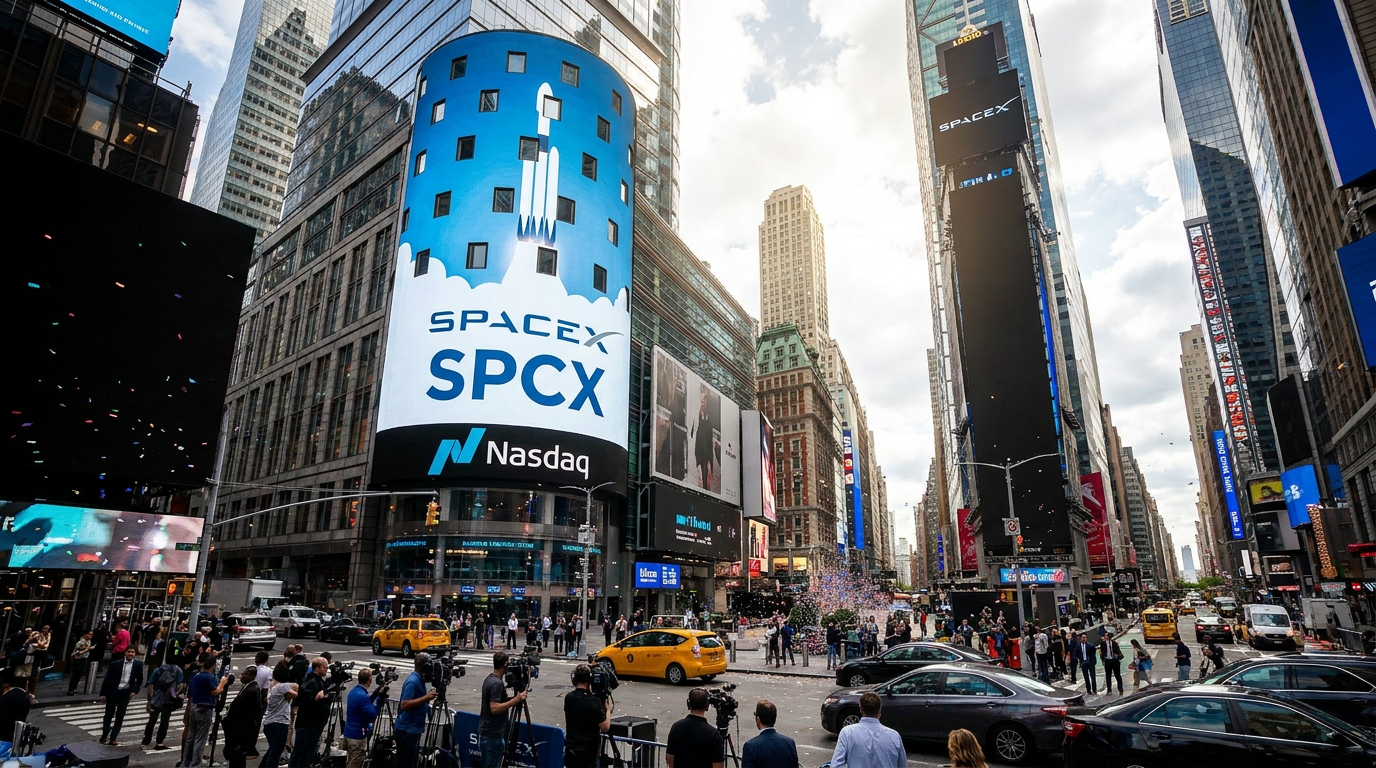
The exercise of the over-allotment option acts as a capstone to a historic week on the Nasdaq. When SpaceX debuted under the ticker SPCX on June 12, it bypassed traditional Wall Street price discovery mechanisms, setting a fixed offering price of $135 per share. Demand proved so overwhelming that shares opened at $150 and closed their first day of trading at $160.95—a nearly 20% surge that firmly established the company's market capitalization above $2.1 trillion.[2][3][5]
To put the scale of the SpaceX offering into perspective, the previous global record-holder for funds raised across all exchanges was Saudi Aramco, which secured $29.4 billion in 2019 after exercising its own over-allotment option. SpaceX has nearly tripled that benchmark, absorbing unprecedented levels of institutional and retail liquidity while instantly becoming the sixth-largest publicly traded company in the United States.[5][6]

The market enthusiasm is rooted in a narrative that extends far beyond traditional rocket launches. By the time it filed its prospectus, SpaceX had evolved into a hybrid infrastructure behemoth. Its Starlink division provides global satellite internet, its Falcon rockets dominate the launch market, and its recent all-stock acquisition of the AI firm xAI positions the company to build orbital data centers. This "Space + AI" thesis convinced investors to grant the company a valuation that rivals tech stalwarts like Alphabet and Amazon.[2][6]
The market enthusiasm is rooted in a narrative that extends far beyond traditional rocket launches.
The sheer gravity of the SpaceX listing has generated a powerful "halo effect" across the broader commercial space sector. For years, publicly traded space companies were viewed as highly speculative, but the $2.1 trillion validation of SpaceX has forced a sector-wide repricing. Rocket Lab (RKLB), one of the few scaled launch providers accessible in public markets, has seen its stock surge 111% year-to-date, with shares rebounding sharply as capital rotates into space-adjacent equities.[4]

Analysts note that the rising tide is lifting multiple boats. With SpaceX's pivot toward massive Starship missions and orbital data infrastructure, a lucrative gap has opened in the medium-lift launch market—a gap that competitors like Rocket Lab are racing to fill with their upcoming Neutron rocket. The influx of attention and capital into the sector is providing these smaller firms with the momentum needed to fund their own next-generation projects.[4]
For retail investors, the IPO marks a watershed moment. Previously, exposure to the commercial space economy was largely restricted to private equity, venture capital, and proxy investments. While the retail allocation for the SPCX offering was highly competitive and oversubscribed, everyday investors now have a direct mechanism to participate in the financial upside of reusable rockets, satellite constellations, and the long-term ambition of interplanetary settlement.[5][6]

Looking ahead, the market is bracing for SpaceX's inclusion in major indices. The company won a rule change allowing for early inclusion in the Nasdaq-100 index, which will trigger a wave of mechanical buying from passive index funds. As the dust settles on the record-breaking debut, the $85.7 billion war chest ensures that SpaceX has the capital required to push the boundaries of both aerospace engineering and artificial intelligence infrastructure for decades to come.[1][2][3]
How we got here
May 2026
SpaceX publicly files its S-1 offering statement, revealing highly anticipated details about its profitability and AI ambitions.
June 11, 2026
The company bypasses traditional price discovery, setting a fixed IPO price of $135 per share.
June 12, 2026
SpaceX debuts on the Nasdaq, with shares surging nearly 20% to close at $160.95, cementing a $2.1 trillion valuation.
June 15, 2026
Underwriters exercise the greenshoe option, purchasing an additional 83 million shares and bringing the total raise to $85.7 billion.
Viewpoints in depth
Space Economy Optimists
Investors and industry advocates who view the IPO as the ultimate validation of the commercial space sector.
For proponents of the new space race, the $2.1 trillion valuation is not just about SpaceX—it is a proof of concept for the entire industry. They argue that the massive capital raise demonstrates that Wall Street is finally willing to underwrite the long-term, capital-intensive infrastructure required for orbital economies. By proving that space logistics, satellite internet, and reusable rocketry can generate massive financial returns, this camp believes the IPO will unlock a golden age of funding for adjacent startups, lunar logistics companies, and orbital manufacturing firms.
Institutional Investors
Large-scale asset managers focused on the sheer scale of the offering and its impact on market liquidity.
Institutional fund managers are primarily focused on the mechanics of the record-breaking deal. The decision to bypass traditional price discovery and set a fixed $135 share price forced banks to rewrite their standard playbooks. Furthermore, the sheer size of the $85.7 billion capital absorption has triggered a temporary redistribution of market liquidity, with capital rotating out of other tech and semiconductor stocks to make room for the new aerospace behemoth. For these investors, the immediate focus is on managing portfolio weightings ahead of SpaceX's inclusion in major passive indices like the Nasdaq-100.
Market Analysts
Financial experts monitoring the 'halo effect' and the high valuation multiples assigned to the company.
While acknowledging the historic nature of the debut, market analysts are closely watching how the "Space + AI" narrative holds up to public scrutiny. They note that the company's valuation is heavily reliant on the future success of the Starship program and the profitability of its newly acquired xAI subsidiary. However, they also highlight the immediate benefit to the broader sector, noting that the "halo effect" has provided a crucial lifeline to smaller, publicly traded space companies that are now benefiting from renewed investor enthusiasm and higher sector-wide valuation benchmarks.
What we don't know
- How the expiration of early investor lock-up periods will impact the stock's volatility in the coming months.
- Whether the massive valuation multiples assigned to SpaceX's AI ambitions will be sustained by future earnings reports.
- Exactly how much of the $85.7 billion will be allocated to the Starship program versus the buildout of orbital data centers.
Key terms
- Greenshoe Option
- A provision in an underwriting agreement that allows the underwriters to sell more shares than originally planned if demand is higher than expected.
- Initial Public Offering (IPO)
- The process of offering shares of a private corporation to the public in a new stock issuance, allowing the company to raise capital from public investors.
- Market Capitalization
- The total value of a publicly traded company's outstanding shares, calculated by multiplying the current share price by the total number of shares.
- Halo Effect
- A market phenomenon where positive sentiment toward one major company or event spills over, boosting the stock prices of other companies in the same sector.
- Over-allotment
- Another term for a greenshoe option, allowing underwriters to issue additional shares to stabilize the price of a newly public stock.
Frequently asked
How much money did the SpaceX IPO raise?
SpaceX raised a total of $85.7 billion, consisting of an initial $75 billion offering and an additional $10.7 billion after underwriters exercised their greenshoe option.
What is SpaceX's total market valuation?
At the end of its first day of trading, SpaceX achieved a market capitalization of over $2.1 trillion, making it the sixth-largest publicly traded company in the U.S.
How did the IPO affect other space companies?
The historic debut created a 'halo effect' that lifted the broader commercial space sector, with companies like Rocket Lab seeing significant stock surges as investor enthusiasm grew.
What will SpaceX do with the raised capital?
The funds are expected to finance capital-intensive, long-term projects, including the development of the fully reusable Starship rocket and the buildout of orbital artificial intelligence infrastructure.
Sources
Source coverage
6 outlets
3 viewpoints surfaced






[1]MarketWatchInstitutional Investors
SpaceX’s stock jumps as the company reveals its IPO has raised another $10.7 billion
Read on MarketWatch →[2]The GuardianMarket Analysts
SpaceX makes biggest stock market debut in history
Read on The Guardian →[3]ForbesMarket Analysts
SpaceX IPO Timeline: Elon Musk Becomes First Trillionaire As Shares Jump 20%
Read on Forbes →[4]MarketBeatSpace Economy Optimists
RKLB Stock Surges 111% YTD on SpaceX IPO Buzz and Neutron Rocket
Read on MarketBeat →[5]Investing.comInstitutional Investors
World's biggest initial public offering: SpaceX valuation tops $2.1 trillion
Read on Investing.com →[6]Zacks Investment ResearchSpace Economy Optimists
SpaceX IPO Guide: Valuation, Risks, and ETFs
Read on Zacks Investment Research →

More in finance
See all 5 stories →Space Economy
SpaceX Shatters Records with $85.7 Billion IPO, Reaching $2.1 Trillion Valuation
0 sources
Space Economy
How SpaceX's $2.1 Trillion IPO is Rewiring Index Funds and the Space Economy
0 sources
Yield Strategy
How to Build a Durable Passive Income Portfolio in 2026's Shifting Rate Environment
0 sources
Every angle. Every day.
Get finance stories with full source coverage and perspective breakdowns delivered to your inbox.