
The Science of Neuroaesthetics: How Interior Design Physically Alters Your Brain
Neuroaesthetics is moving interior design from a purely visual art to a science of well-being. By measuring how the brain responds to light, geometry, and texture, designers are creating homes that actively lower stress and improve mental health.
By Factlen Editorial Team
- Evidence-Based Designers
- Architects and designers who use biometric data to shape residential and commercial spaces.
- Cognitive Neuroscientists
- Researchers studying the physiological mechanisms of how the brain processes spatial stimuli.
- Holistic Wellness Advocates
- Professionals viewing the home as an extension of preventive healthcare and emotional regulation.
What's not represented
- · Low-income housing developers
- · Traditional Feng Shui practitioners
- · Renters with limited control over their spaces
Why this matters
With modern humans spending up to 90% of their lives indoors, the built environment is a primary driver of baseline anxiety and cognitive fatigue. Designing spaces aligned with human biology offers a passive, continuous form of preventive mental healthcare.
Key points
- Neuroaesthetics uses biometric data to measure how interior design physically affects the brain and nervous system.
- Curvilinear shapes and organic textures activate the brain's pleasure centers, while sharp angles can trigger low-level anxiety.
- Dynamic circadian lighting is crucial for regulating hormones, improving sleep, and reducing daytime cognitive fatigue.
- The design industry is shifting away from purely visual trends toward creating functional, health-centric environments that support emotional regulation.
We spend the vast majority of our lives indoors, yet we rarely consider how the walls around us are actively shaping our brain chemistry. For decades, interior design was treated as a purely visual discipline—a subjective matter of matching colors, selecting furniture, and following fleeting aesthetic trends. But a quiet, profound revolution is underway in how we build our habitats. Designers are moving beyond the simple question of what looks good in a photograph, asking instead how a room physically makes the human body feel. This shift is transforming our homes from mere containers for our belongings into active participants in our daily mental health.[2][6]
Enter neuroaesthetics, a rapidly growing scientific field that sits at the intersection of neuroscience, cognitive psychology, and architecture. Researchers in this discipline are utilizing advanced medical technology to measure the precise biological impact of our surroundings. By tracking heart rates, brainwaves, skin conductivity, and stress hormones, scientists are proving that our built environments are not passive backdrops. Instead, every texture, angle, and beam of light sends continuous signals to the nervous system, subtly altering our mood, memory, and cognitive performance without our conscious awareness.[1][2]
The fundamental premise of neuro-design is rooted in evolutionary biology. The human nervous system evolved outdoors over millions of years, constantly scanning the natural environment for safety, resources, and potential threats. When we are placed in harsh, angular, or poorly lit indoor spaces, our brains subconsciously register a low-level state of alarm, leading to chronic cognitive fatigue. Conversely, spaces that mimic the geometries, materials, and lighting of the natural world can actively lower cortisol levels, quiet the mind, and promote deep psychological restoration.[5][6]
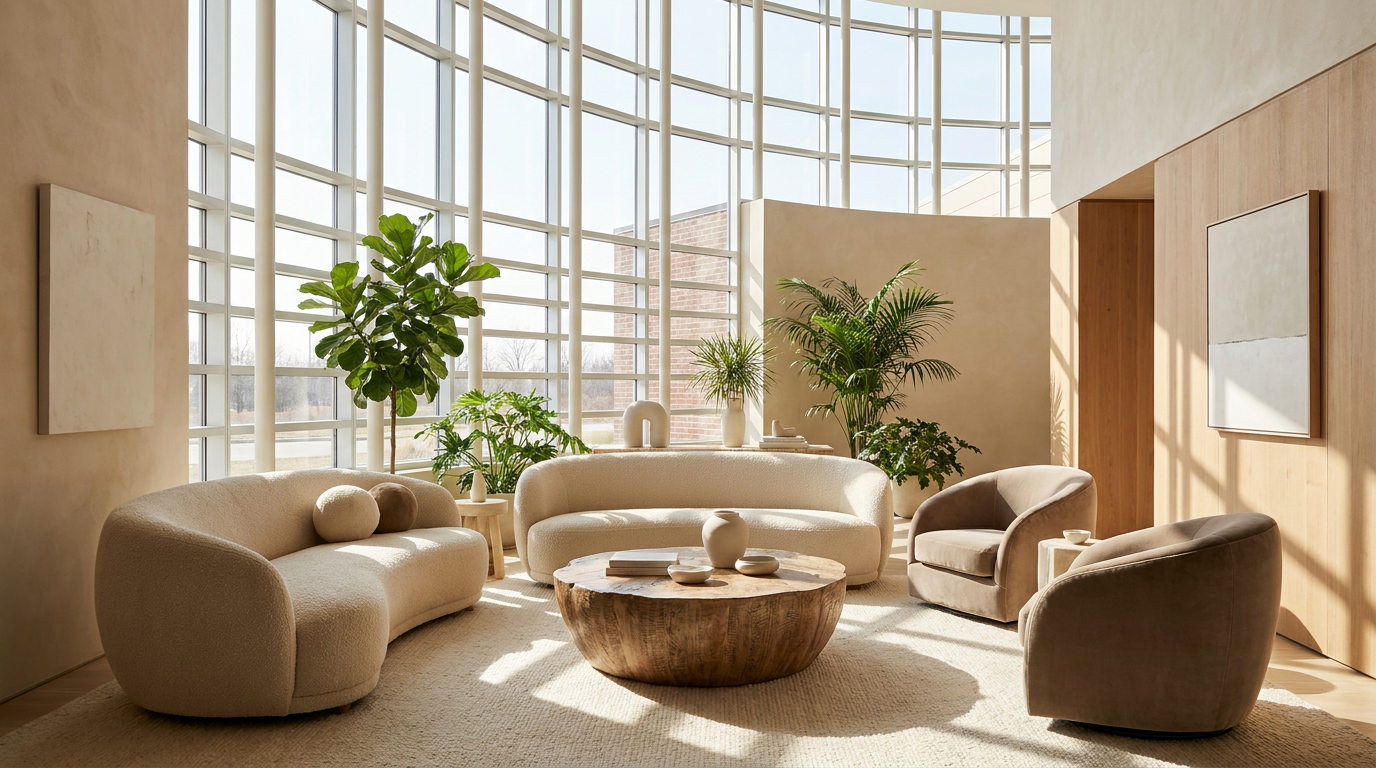
One of the most thoroughly studied mechanisms in neuroaesthetics is the brain's response to geometry and room shape. Functional magnetic resonance imaging (fMRI) studies have revealed that curvilinear spaces—rooms and furniture featuring soft, organic curves—actively stimulate the orbitofrontal cortex. This is the brain region closely associated with pleasure, reward, and emotional regulation. Sharp angles, jagged lines, and stark, boxy rooms, by contrast, can trigger the amygdala, subtly heightening alertness and anxiety as the brain interprets sharp edges as potential physical hazards.[3][4]

Color psychology, long treated as a soft science or a matter of personal taste in the design world, is also being validated by hard neurological data. It is not merely a cultural association that blue feels calming; specific wavelengths of light reflecting off colored surfaces stimulate different neural pathways. Cool tones like blues and greens have been shown to physically reduce heart rate and blood pressure, aiding in focus and relaxation. Meanwhile, warmer tones like reds and oranges stimulate the nervous system, increasing energy, appetite, and sociability.[1][2]
Lighting is perhaps the most critical variable in the entire neuroaesthetic equation. The human circadian rhythm is entirely dependent on the shifting color temperature of the sun to regulate hormones. Artificial lighting that remains static, bright, and blue-toned throughout the evening disrupts melatonin production, leading to poor sleep and heightened daytime anxiety. Evidence-based design now prioritizes dynamic, circadian lighting systems that transition seamlessly from cool, blue-rich light in the morning to warm, amber tones at night, keeping the body's internal clock synchronized with the natural world.[1][3]
To move these theories from the laboratory into practical application, researchers are conducting immersive field experiments in real-world settings. In a landmark study published in the VITRUVIO International Journal of Architectural Technology and Sustainability, scientists equipped 30 participants with electroencephalogram (EEG) monitors and biometric sensors. The goal was to measure heart rate variability and electrodermal activity as the subjects moved through a fully furnished, real-life dwelling during both daytime and nighttime conditions, capturing a holistic picture of domestic neuro-architecture.[3]
To move these theories from the laboratory into practical application, researchers are conducting immersive field experiments in real-world settings.
The VITRUVIO study yielded fascinating insights into how different zones of a house trigger distinct physiological states. Collective areas, such as the living room and entrance forecourt, were associated with higher levels of psychological pleasure and lower physiological arousal, indicating a state of relaxed dominance and comfort. In contrast, enclosed individual spaces like bedrooms elicited different autonomic responses, highlighting the brain's deep sensitivity to spatial volume, privacy, and the transition from public to private spheres within the home.[3]

The commercial design industry is taking note of these biometric findings and putting them to the test. At the prestigious Salone del Mobile in Milan, a collaborative exhibition titled 'A Space for Being'—spearheaded by Google, Muuto, and Reddymade Architecture—invited guests to wear custom biometric wristbands while exploring three distinct rooms. The data proved that participants' bodies reacted profoundly to the different textures, acoustics, and lighting schemes, often completely contradicting what the individuals consciously claimed was their favorite room.[4]
A core pillar of applying neuroaesthetics to the home is biophilic design, which goes far beyond simply placing a potted plant in a corner. True biophilia involves incorporating natural textures, fractal patterns, and organic materials like raw wood, stone, and natural fibers. These elements provide the brain with 'soft fascination,' a state of effortless attention that allows the prefrontal cortex to rest and recover from the intense cognitive fatigue caused by glowing screens, artificial environments, and focused work.[1][4]
Texture and tactile engagement also play a vital, often overlooked role in grounding the nervous system. The brain relies heavily on proprioception—the awareness of the body in physical space—to feel secure and oriented. Walking on a plush, textured rug or running a hand over a smooth, unvarnished wooden table provides sensory feedback that anchors the mind in the present moment. In a modern world increasingly dominated by frictionless glass screens, these tactile physical interactions are deeply restorative.[2][4]
However, researchers acknowledge a degree of uncertainty and subjectivity in the field of neuroaesthetics. While baseline physiological responses to natural light and biophilia are nearly universal across the human species, individual aesthetic preferences are heavily influenced by cultural background, personal memories, and even past trauma. A minimalist, open-plan space might feel liberating and breathable to one person, but exposed, noisy, and vulnerable to another who requires cozy, enclosed nooks to feel a sense of safety and refuge.[2][6]

This nuance is leading to a widespread reevaluation of the decade-long trend toward entirely open-plan living. While knocking down walls creates visual flow and maximizes light, it also removes crucial acoustic barriers and eliminates spaces for psychological retreat. Neuro-designers are now advocating for 'broken-plan' layouts—using textured screens, strategic furniture placement, and varied ceiling heights to create distinct zones. This approach offers both social connection and private sanctuary, preventing the sensory overload that comes from visual clutter and echoing noise.[6]
The real estate and construction industries are beginning to formally codify these neuro-design principles into measurable benchmarks. The internationally recognized WELL Building Standard, originally designed to ensure the health and productivity of commercial office spaces, has recently expanded to include a credential specifically for single-family residential homes. This rigorous standard evaluates homes based on air quality, thermal comfort, acoustic dampening, and lighting, ensuring the architecture actively supports the cognitive clarity and emotional well-being of the families living inside.[1]

Ultimately, the rise of neuroaesthetics represents a profound shift in how we value and interact with our domestic spaces. A home is no longer viewed merely as a financial asset or a stylish container for our belongings; it is increasingly recognized as a primary tool for emotional regulation. By bridging the gap between art and neuroscience, we are learning to design habitats that do not just look beautiful in a magazine spread, but actively heal, restore, and care for the human mind.[2][6]
How we got here
1990
Neurobiologist Semir Zeki discovers that perceiving beauty activates specific, consistent brain areas, laying the groundwork for neuroaesthetics.
2015
Major studies confirm that biophilic design and natural lighting in classrooms and offices measurably improve focus and reduce fatigue.
2019
Google and Reddymade Architecture launch 'A Space for Being' at Salone del Mobile, proving biometric responses to interior design.
2024
The WELL Building Standard expands its health and wellness certification from commercial buildings to single-family residential homes.
2026
Neuro-design principles become a mainstream expectation in residential real estate, shifting focus from pure aesthetics to mental well-being.
Viewpoints in depth
Evidence-Based Designers
Architects and interior designers who use biometric data to shape residential and commercial spaces.
This camp argues that the era of designing purely for visual trends is over. By utilizing data from fMRI scans and wearable biometrics, they believe designers have a moral imperative to create spaces that actively reduce cognitive load. They advocate for the integration of circadian lighting, acoustic dampening, and biophilic elements as non-negotiable standards in modern construction, viewing the home as a primary tool for emotional regulation and recovery.
Cognitive Neuroscientists
Researchers studying the physiological mechanisms of how the brain processes spatial stimuli.
Scientists in this field focus on the hard biological metrics—heart rate variability, electrodermal activity, and cortisol levels. They emphasize that the human nervous system is still wired for the natural world, and that modern, sterile, angular environments trigger chronic low-level stress. Their research aims to quantify exactly which wavelengths of light, geometric proportions, and tactile sensations optimize the brain's sensory-motor and emotion-valuation networks.
Holistic Wellness Advocates
Professionals viewing the home as an extension of preventive healthcare.
This perspective connects neuroarchitecture to the broader wellness movement. They argue that just as society has embraced nutrition and fitness, the next frontier of health is optimizing the habitats where we spend 90% of our time. They caution against over-medicalizing the home with too much tracking technology, instead favoring intuitive, low-tech interventions—like dedicated quiet zones and natural materials—that foster mindfulness, connection, and a sense of sanctuary.
What we don't know
- How to perfectly balance universal biological responses with highly subjective cultural and personal aesthetic preferences.
- The long-term, compounding neurological effects of living in fully optimized neuroaesthetic homes over multiple decades.
Key terms
- Neuroaesthetics
- The scientific study of how the brain processes and responds to beauty, art, and spatial environments.
- Biophilic Design
- An architectural approach that connects building occupants more closely to nature through natural lighting, ventilation, and organic materials.
- Proprioception
- The body's subconscious ability to sense its location, movements, and actions in physical space, heavily influenced by tactile feedback.
- Circadian Rhythm
- The natural, internal process that regulates the sleep-wake cycle, repeating roughly every 24 hours and heavily influenced by light exposure.
- Heart Rate Variability (HRV)
- The measure of the time variation between each heartbeat; higher HRV is generally an indicator of a relaxed, resilient nervous system.
Frequently asked
What exactly is neuroaesthetics?
It is a branch of neuroscience that studies how the brain and nervous system respond to aesthetic experiences, art, and architectural design.
How does room shape affect stress?
Studies show that sharp angles can trigger the brain's threat-detection centers, while curvilinear, organic shapes activate regions associated with pleasure and relaxation.
Do I need smart-home technology to use neuro-design?
No. While circadian lighting systems help, basic neuroaesthetics relies on low-tech solutions like maximizing natural light, using tactile natural materials, and arranging furniture to create safe, cozy zones.
Why is open-plan living being reconsidered?
Open layouts can cause sensory overload due to poor acoustics and a lack of visual privacy. Neuro-design favors 'broken-plan' layouts that offer quiet refuge spaces.
Sources
Source coverage
6 outlets
3 viewpoints surfaced






[1]ForbesEvidence-Based Designers
Neurodesign: Boost Well-Being, Comfort And Property Value With Science
Read on Forbes →[2]LivingetcEvidence-Based Designers
Neuroaesthetics Explains How Your Home Makes You Feel
Read on Livingetc →[3]VITRUVIO - International Journal of Architectural Technology and SustainabilityCognitive Neuroscientists
An Exploratory Neuroarchitecture Study: Emotional Responses to Residential Spaces Using Psychological and Physiological Indicators
Read on VITRUVIO - International Journal of Architectural Technology and Sustainability →[4]Connections by FinsaEvidence-Based Designers
Neuroaesthetics in interior design
Read on Connections by Finsa →[5]RISECognitive Neuroscientists
Neuroarchitecture for mental health and well-being in an urban context
Read on RISE →[6]Factlen Editorial TeamHolistic Wellness Advocates
Synthesis by Factlen editorial team
Read on Factlen Editorial Team →


Every angle. Every day.
Get home stories with full source coverage and perspective breakdowns delivered to your inbox.