
The Neuroscience of Decluttering: How Visual Chaos Drains Cognitive Load
A messy room doesn't just look bad—it actively depletes working memory and spikes stress hormones. Neuroscientists are mapping exactly how visual clutter overwhelms the brain.
By Factlen Editorial Team
- Cognitive Researchers
- Focus on how visual stimuli deplete working memory, increase cognitive load, and reduce neural efficiency.
- Behavioral Psychologists
- Emphasize the emotional toll of decision fatigue, cortisol spikes, and the behavioral coping mechanisms triggered by chaotic spaces.
- Environmental Designers
- Focus on how spatial arrangement, lighting, and color mitigate neurological stress.
What's not represented
- · Interior Decorators
- · Professional Organizers
Why this matters
Understanding the biological impact of clutter shifts organization from a guilt-inducing chore to a powerful tool for mental health. By controlling your visual environment, you can measurably lower your daily stress and reclaim lost focus.
Key points
- Visual clutter creates extraneous cognitive load, forcing the brain to constantly filter irrelevant stimuli and depleting working memory.
- fMRI studies reveal that multiple objects in a visual field actively compete for neural representation in the visual cortex.
- A decade-long UCLA study found that women living in cluttered homes experienced chronically elevated levels of the stress hormone cortisol.
- Disorganized spaces trigger decision fatigue and the Zeigarnik Effect, where the mind fixates on the unfinished tasks represented by the mess.
- While order improves focus, some psychological research suggests mildly disorderly environments can occasionally promote divergent thinking and creativity.
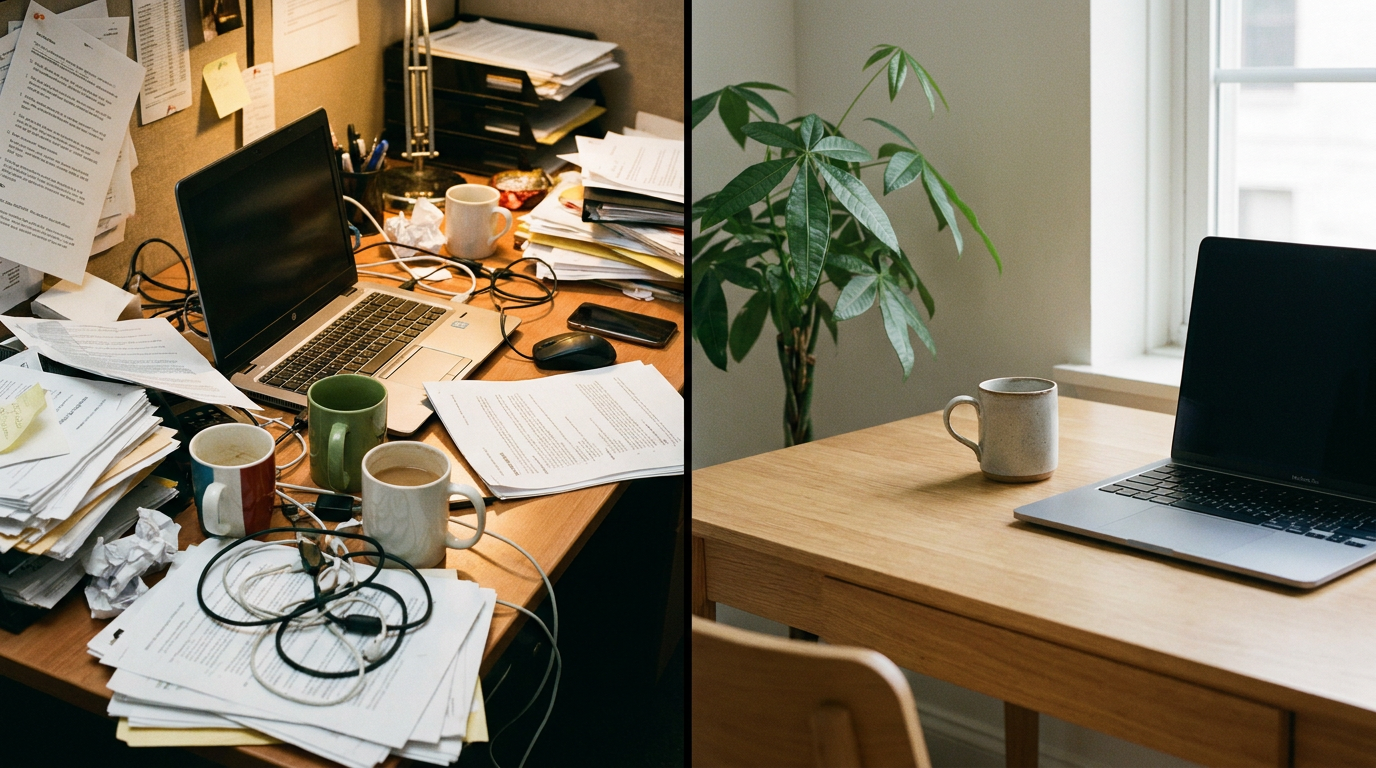
There is a distinct, almost universal sensation of walking into a chaotic, disorganized room and feeling an immediate wave of exhaustion. For decades, this feeling was dismissed as a personal failing—a lack of discipline, poor time management, or simple laziness. However, environmental psychologists and neuroscientists have increasingly demonstrated that this reaction has nothing to do with moral character. Instead, it is a measurable, involuntary neurological and endocrine response to visual stimuli. The built environment does not merely reflect our state of mind; it actively shapes our cognitive function, stress levels, and emotional regulation.[6]
At the core of this phenomenon is the concept of cognitive load. The human brain is an extraordinarily powerful processing engine, but its working memory has strict limitations. Every object in a room—from a stack of unopened mail to a tangled charging cable—is a piece of visual data that the brain must register, categorize, and decide whether to ignore. When an environment is filled with excess items, it creates what researchers call extraneous cognitive load. The nervous system is forced to work in the background, constantly filtering out irrelevant information just to maintain baseline focus.[4][6]
The mechanics of this visual overload have been mapped extensively using functional magnetic resonance imaging. Researchers at the Princeton University Neuroscience Institute spent over two decades studying how visual clutter disrupts human focus. Their fMRI scans revealed that multiple visual stimuli present in a single field of view will literally compete for neural representation in the visual cortex. When a person tries to focus on a specific task amidst physical chaos, the surrounding clutter actively suppresses the brain's ability to lock onto the target, depleting cognitive capacity.[1]
More recent neurobiological research has further refined our understanding of this processing drag. A 2024 study published in the journal Neuron by researchers at the Yale School of Medicine examined how visual clutter—referred to in clinical terms as crowding—affects the primary visual cortex. The study found that while clutter does not completely halt the transfer of information between neurons, it significantly reduces the efficiency of neural communication. The brain simply processes information more slowly when surrounded by visual noise, leading directly to mental fatigue and a measurable drop in productivity.[3]

This neurological inefficiency translates into stark real-world metrics. Studies examining academic and professional performance indicate that individuals working in organized environments demonstrate up to a 23 percent increase in sustained attention on complex tasks. Conversely, navigating messy spaces can cost individuals up to 10 percent of their productive time and reduce overall efficiency. The mental traffic jam caused by visual crowding means that even when a person is sitting perfectly still in a cluttered room, their brain is burning through metabolic resources just to manage the sensory input.[1][3]
The consequences of this cognitive drain extend far beyond lost productivity at a desk; they manifest physically through the body's endocrine system. A landmark study conducted by the UCLA Center on Everyday Lives of Families meticulously tracked 32 middle-class families over a decade to understand exactly how they interacted with their possessions. The researchers discovered a direct, undeniable correlation between the sheer volume of household objects and the physiological stress levels of the inhabitants. Clutter was not just an aesthetic annoyance to be ignored; it was a chronic biological stressor that altered their hormones.[2]
The UCLA researchers utilized linguistic analysis combined with saliva testing to measure this stress. Participants who described their homes using words like cluttered, messy, or unfinished exhibited chronically elevated levels of cortisol, the body's primary stress hormone, throughout the day. In contrast, those who described their homes as restful or restorative experienced the natural, healthy drop in cortisol levels as the day progressed. Chronically high cortisol is linked to a cascade of negative health outcomes, including anxiety, disrupted sleep, and weight gain.[2][6]

The UCLA researchers utilized linguistic analysis combined with saliva testing to measure this stress.
Interestingly, the UCLA study also highlighted a significant gender disparity in how environmental chaos is internalized. The marked increases in cortisol were predominantly observed in women and mothers, who historically and culturally bear the brunt of household management. Men in the same cluttered environments often did not exhibit the same physiological stress response, suggesting that the psychological weight of clutter is deeply intertwined with societal expectations and the invisible labor of maintaining a home.[2]
Beyond the sheer volume of visual data, clutter exerts a heavy psychological toll through decision fatigue. Every misplaced item in a home represents an unresolved choice: whether to keep it, where to store it, or when to throw it away. When a space is disorganized, it quietly demands these micro-decisions all day long. This constant demand drains mental energy before any meaningful work has even begun, leaving individuals feeling overwhelmed and incapable of making larger, more important decisions effectively.[6][7]
This phenomenon is exacerbated by the Zeigarnik Effect, a psychological principle stating that the human mind tends to fixate on interrupted or incomplete tasks far more than completed ones. A pile of laundry on a chair or a stack of bills on a counter acts as a persistent visual reminder of unfinished chores. This prevents the brain from fully shifting into a resting state, creating a low-level but constant background hum of anxiety that makes true relaxation nearly impossible.[6][7]
The stress induced by this environment can trigger a vicious cycle of behavioral changes. Research highlighted by mental health professionals indicates that clutter-induced anxiety often leads to destructive coping mechanisms. Feeling out of control in their physical space, individuals may subconsciously turn to overeating, excessive screen time, or oversleeping to self-soothe. Furthermore, the resulting depression or lethargy makes the physical act of cleaning even more daunting, compounding the original problem and making it harder to break the cycle.[6][7]

While physical objects are the most obvious source of visual noise, environmental psychologists emphasize that color and lighting also act as critical neurological inputs. The saturation and temperature of a room's colors can either soothe or stimulate the nervous system. Blue and green tones are known to activate the parasympathetic nervous system, which governs rest and recovery. In contrast, highly saturated warm colors like red can increase heart rate and psychological arousal, adding to the room's overall cognitive load if used excessively.[6]
Lighting plays a similarly foundational role in how the brain processes a space. Poor or harsh lighting increases eye strain and suppresses alertness, forcing the brain to work harder to interpret visual data. Conversely, artificial lighting that is too cool or bright in the evening can interfere with melatonin production, disrupting sleep cycles. Optimizing these ambient factors—shifting toward lower-saturation colors and utilizing warm-toned bulbs in the 2700 to 3000 Kelvin range—can significantly reduce environmental stress without discarding a single object.[6]
Despite the overwhelming evidence supporting the benefits of decluttering, the scientific consensus does contain nuances and areas of uncertainty. A perfectly sterile, hyper-minimalist environment is not universally optimal for human cognition. Some psychological studies have found that while orderly environments promote healthy choices and sustained focus, moderately disorderly environments can actually foster divergent thinking and creativity. For tasks requiring unconventional problem-solving, a slightly messy desk might provide the unexpected visual connections needed for a creative breakthrough.[5][7]

Additionally, the push for aggressive decluttering must account for neurodiversity. For some individuals, particularly those with ADHD or certain executive function deficits, out of sight literally means out of mind. Highly sanitized spaces with everything hidden in opaque bins can cause distress or lead to forgotten responsibilities. For these individuals, visual cues are necessary for daily functioning, meaning that organization must prioritize predictable layouts and clear labeling over pure minimalist aesthetics to truly reduce cognitive load.[7]
Ultimately, the science of decluttering reframes organization from a domestic chore into a vital practice of cognitive hygiene. By understanding that our brains are constantly processing our surroundings, we can view our physical spaces as extensions of our working memory. Clearing a desk or organizing a closet is not merely about achieving a magazine-worthy aesthetic; it is a deliberate act of reducing extraneous cognitive load, lowering cortisol, and reclaiming the mental bandwidth needed to navigate modern life.[6][7]
How we got here
2005
N. Lavie publishes foundational research on how visual distraction increases extraneous cognitive load.
2011
Princeton University researchers use fMRI to prove that visual clutter actively competes for attention in the visual cortex.
2012
UCLA publishes 'Life at Home in the Twenty-First Century,' linking household clutter to chronic cortisol spikes in mothers.
2024
Yale School of Medicine publishes findings in Neuron showing that visual crowding reduces the efficiency of neural communication.
Viewpoints in depth
Cognitive Researchers
Focus on the mechanical limits of the brain's working memory.
Neuroscientists view clutter primarily as a data-processing problem. Because the brain's working memory has strict bandwidth limits, every object in a visual field requires metabolic energy to process and filter. From this perspective, a messy room is a hostile cognitive environment that actively suppresses neural efficiency, slows down information transfer in the visual cortex, and degrades sustained attention.
Behavioral Psychologists
Emphasize the emotional and endocrine toll of disorganized spaces.
Psychologists focus on how the physical environment triggers the body's stress responses. They point to the measurable spikes in cortisol and the psychological weight of decision fatigue. To this camp, clutter is less about data processing and more about unresolved emotional baggage—every item represents an unmade choice, triggering the Zeigarnik Effect and leading to destructive coping mechanisms like overeating or withdrawal.
Creativity & Neurodiversity Advocates
Argue against hyper-minimalism, noting that some disorder can be beneficial.
This perspective cautions against the pursuit of perfectly sterile environments. Creativity researchers note that mildly disorderly spaces can promote divergent thinking and break conventional thought patterns. Furthermore, neurodiversity advocates highlight that for individuals with ADHD or executive function challenges, hyper-organized spaces where items are hidden away can cause distress; they often require visual cues and 'organized chaos' to function effectively.
What we don't know
- The exact threshold at which a 'restorative' minimalist space becomes so sterile that it causes under-stimulation or anxiety.
- How long-term exposure to digital clutter (e.g., thousands of unread emails) compares neurologically to physical household clutter.
- Whether the gender disparity in cortisol responses to clutter is purely sociological or has underlying biological components.
Key terms
- Cognitive Load
- The total amount of mental effort being used in the working memory; visual clutter increases extraneous cognitive load.
- Cortisol
- The body's primary stress hormone, which regulates metabolism and the immune response but can cause anxiety and fatigue when chronically elevated.
- Zeigarnik Effect
- A psychological tendency to remember interrupted or incomplete tasks better than completed ones, often triggered by visual reminders of chores.
- Visual Crowding
- A neurological phenomenon where the brain struggles to isolate and process individual objects when they are surrounded by excessive stimuli.
- Parasympathetic Nervous System
- The network of nerves that relaxes your body after periods of stress or danger, often activated by cool colors and orderly spaces.
Frequently asked
Why does a messy room make me feel physically tired?
Visual clutter forces your brain to constantly process competing stimuli, increasing extraneous cognitive load and draining mental energy even when you are physically resting.
Does clutter affect men and women differently?
A major UCLA study found that women living in cluttered homes experienced chronically elevated cortisol levels, whereas men in the same environments often did not show the same physiological stress response.
Is a perfectly clean room always better for the brain?
Not necessarily. While orderly environments improve focus and reduce stress, some psychological studies suggest that mildly disorderly environments can promote divergent thinking and creativity.
How does lighting affect cognitive load?
Poor lighting increases eye strain and suppresses alertness, adding to the brain's processing burden. Warm-toned bulbs are recommended for evening use to avoid disrupting melatonin production.
Sources
Source coverage
7 outlets
3 viewpoints surfaced







[1]Princeton University Neuroscience InstituteCognitive Researchers
Interactions of top-down and bottom-up mechanisms in human visual cortex
Read on Princeton University Neuroscience Institute →[2]UCLA Center on Everyday Lives of FamiliesBehavioral Psychologists
Life at Home in the Twenty-First Century: 32 Families Open Their Doors
Read on UCLA Center on Everyday Lives of Families →[3]Yale School of MedicineCognitive Researchers
Visual crowding and neural efficiency in the primary visual cortex
Read on Yale School of Medicine →[4]Trends in Cognitive SciencesCognitive Researchers
Distracted and confused? Selective attention under load
Read on Trends in Cognitive Sciences →[5]WebMDBehavioral Psychologists
Mental Health Benefits of Decluttering
Read on WebMD →[6]Factlen Editorial TeamEnvironmental Designers
Synthesis by Factlen editorial team
Read on Factlen Editorial Team →[7]Psychology TodayBehavioral Psychologists
How Clutter Affects Mental Health
Read on Psychology Today →

Every angle. Every day.
Get home stories with full source coverage and perspective breakdowns delivered to your inbox.