
Grid-Scale Batteries Are Quietly Stabilizing the US Power Grid
Record-breaking deployments of utility-scale battery storage are fundamentally altering how electrical grids operate, dampening price spikes and preventing blackouts during extreme weather.
By Factlen Editorial Team
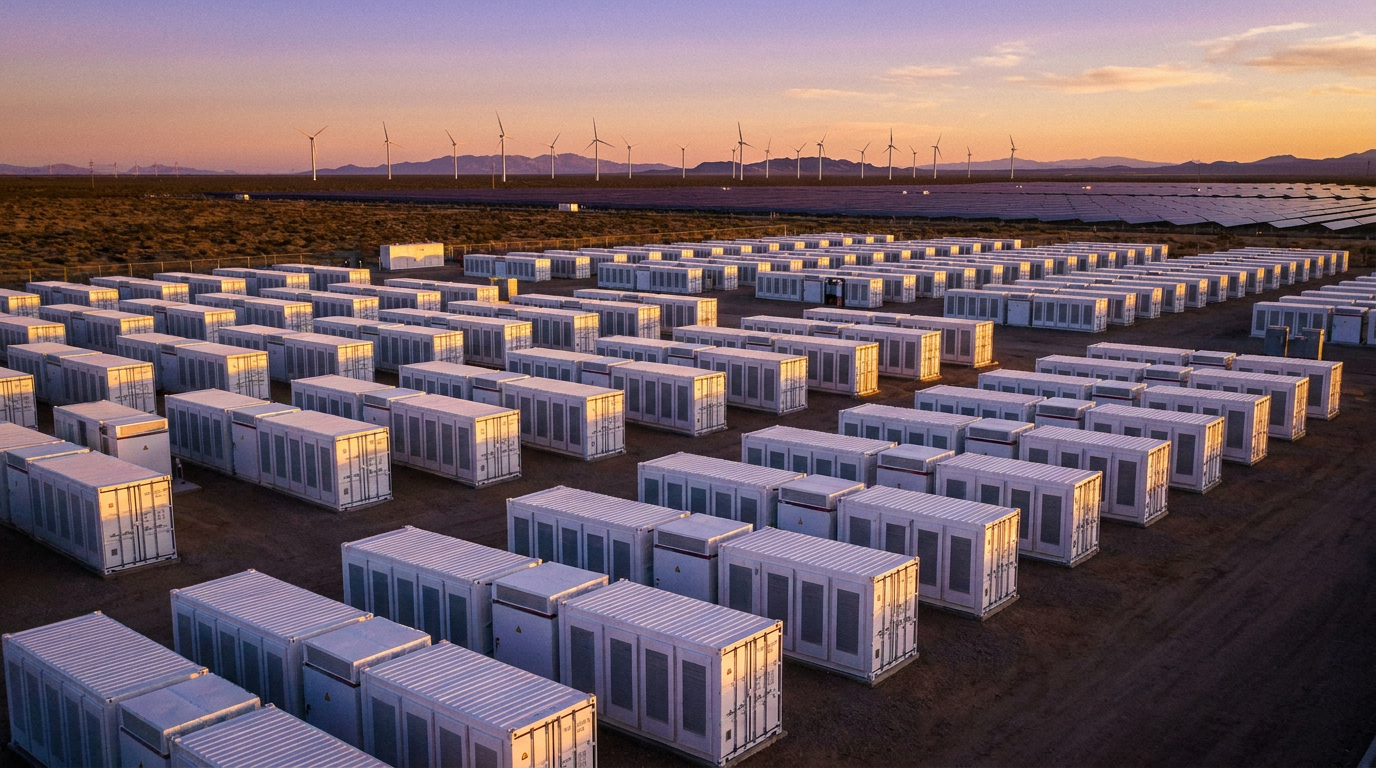
- Grid Operators & Utilities
- Focused on maintaining moment-to-moment reliability and managing the evening demand ramp.
- Renewable Energy Developers
- Focused on project economics, hardware costs, and navigating interconnection queues.
- Commercial Energy Buyers
- Focused on wholesale price dampening and avoiding scarcity pricing spikes during extreme weather.
- Fossil Fuel Incumbents
- Emphasize the limitations of short-duration storage and the ongoing necessity of baseload generation.
What's not represented
- · Local Communities Hosting Facilities
- · Raw Material Miners
Why this matters
The rapid deployment of grid-scale batteries is solving the biggest historical flaw of renewable energy—its intermittency. For consumers, this translates directly to fewer rolling blackouts during extreme weather and a buffer against sudden spikes in wholesale electricity rates.
Key points
- The U.S. is projected to add a record 24 gigawatts of utility-scale battery storage in 2026, up from 15 gigawatts in 2025.
- Texas and California are leading the deployment, utilizing batteries to manage evening demand spikes as solar generation drops offline.
- During a February 2026 cold snap, Texas batteries discharged a record 4,100 megawatts, saving commercial buyers an estimated $150 million.
- Global battery cell prices have plummeted to $55–$75 per kilowatt-hour, fundamentally altering the economics of grid storage.
- Current lithium-ion technology is limited to 1-4 hours of duration, leaving the grid vulnerable to multi-day weather events without fossil-fuel backup.
The central claim animating global climate policy in 2026 is that renewable energy can sustain a modern electrical grid without relying on fossil fuels for backup. For years, skeptics pointed to the intermittency problem—the fact that solar panels stop producing when the sun sets, precisely when evening electricity demand spikes. Today, the evidence indicates that this vulnerability is being systematically engineered out of the system. The mechanism driving this shift is the exponential deployment of grid-scale battery energy storage systems, which are now being installed at a pace that is rewriting utility forecasts and fundamentally altering wholesale power markets.[7]
The sheer volume of physical infrastructure being connected to the grid provides the strongest evidence of this transition. According to the U.S. Energy Information Administration, developers added a record 15 gigawatts of utility-scale battery storage in 2025. For 2026, that number is projected to surge to 24 gigawatts, making batteries the second-largest source of new grid capacity behind only solar power. To put this acceleration in perspective, the total installed battery capacity in the United States has grown from virtually zero a decade ago to over 40 gigawatts today, with the vast majority of that growth occurring in the last thirty-six months.[1][5]

This deployment is not distributed evenly; it is heavily concentrated in markets with abundant renewable generation and volatile pricing. Texas, California, and Arizona account for roughly 80 percent of the planned battery capacity additions in 2026. Texas alone is expected to add nearly 13 gigawatts this year. This geographic concentration provides a real-world laboratory for testing the primary claim of storage advocates: that batteries can step in instantaneously to balance supply and demand, preventing the kind of catastrophic grid failures seen in recent years.[1][5][7]
The evidence from the Electric Reliability Council of Texas (ERCOT) strongly supports this capability. Entering 2026, Texas boasted nearly 14 gigawatts of operational battery capacity, effectively doubling its fleet in a single year. The operational data from this fleet demonstrates a clear shift in how the grid is managed. Historically, ERCOT relied almost entirely on rapid-start natural gas peaker plants to manage the evening transition when solar generation drops off. Today, lithium-ion batteries are absorbing that role, charging during the midday solar peak when electricity is cheap, and discharging during the evening ramp when demand and prices peak.[2][3]

A critical test of this system occurred during a brief but intense winter cold snap in February 2026. As early morning heating demand spiked alongside a steep drop in wind generation, the Texas battery fleet successfully discharged a record 4,100 megawatts of power simultaneously onto the grid. Market analysts at EnergyForge Intelligence calculate that this rapid injection of stored energy actively dampened extreme real-time wholesale price spikes. By preventing prices from hitting the market cap, the battery fleet saved commercial electricity buyers an estimated $150 million in avoided scarcity costs across a single four-hour event.[2]
Similar evidence is emerging from California, where the California Independent System Operator (CAISO) manages a grid that has long struggled with the duck curve—a steep drop in net load during the day followed by a massive ramp-up in the evening. Data analyzed by the Institute for Energy Economics and Financial Analysis confirms that battery storage in California is now functioning as a daily workhorse. By the end of 2024, the state had reached over 13.4 gigawatts of installed storage capacity, allowing the grid to routinely capture otherwise-curtailed solar generation and deploy it after sunset.[4]
Data analyzed by the Institute for Energy Economics and Financial Analysis confirms that battery storage in California is now functioning as a daily workhorse.
The operational impact in California has been profound. During a late-season heatwave in October 2024, the CAISO battery fleet delivered a record 8,354 megawatts during the evening peak, strategically timed with declining solar output. Without this stored capacity, grid operators would have been forced to rely on imported power or local gas generation to meet demand. Furthermore, the presence of this storage buffer has allowed California to navigate multiple severe summer heat waves without issuing a single Flex Alert—a public plea for conservation—for three consecutive years.[4]

The underlying economic driver of this rapid buildout is a structural collapse in the cost of lithium iron phosphate (LFP) battery cells. LFP has become the dominant chemistry for utility-scale projects, capturing roughly 95 percent of the global market due to its superior thermal stability and lower degradation rates compared to older nickel-based alternatives. By early 2026, international cell pricing for utility-grade LFP had settled into the $55 to $75 per kilowatt-hour range, a price floor that has fundamentally altered the financial calculus for independent power producers and utility planners.[7]
This cost deflation is not isolated to the United States. The International Energy Agency reports that global investment in battery energy storage is accelerating rapidly, with China and the U.S. leading the market. The IEA projects that to meet global net-zero emissions targets, installed grid-scale battery capacity must expand to 1,500 gigawatt-hours by 2030. While this represents a massive industrial challenge, the current trajectory of manufacturing scale-up and deployment suggests that the battery sector is one of the few clean energy technologies currently tracking ahead of its required deployment curve.[6][7]
Despite the overwhelming evidence of short-term success, the data also reveals clear limitations to current battery technology, introducing transparent uncertainty into long-term grid planning. The vast majority of grid-scale batteries deployed today are designed to discharge at their rated power for only one to four hours. This duration is perfectly suited for managing daily diurnal cycles—shifting midday solar to the evening peak—and for providing instantaneous frequency regulation. However, it is entirely insufficient for managing multi-day weather events, such as prolonged winter storms or extended periods of low wind and solar output.[3][7]
This duration limitation means that while batteries are successfully displacing daily natural gas peaker plants, they cannot yet replace the firm, dispatchable baseload generation required to sustain a grid through a multi-day dunkelflaute—a dark, doldrums period. The evidence suggests that achieving a fully decarbonized grid will require the commercialization of long-duration energy storage technologies, such as advanced flow batteries, compressed air, or thermal storage, which currently lag far behind lithium-ion in both cost and deployment scale.[7]

Furthermore, the pace of battery deployment is increasingly constrained not by manufacturing capacity or capital, but by regulatory and physical bottlenecks. In markets like ERCOT and CAISO, the interconnection queues—the waiting lists for new projects to connect to the transmission network—are severely backlogged. While developers are eager to build, the physical grid infrastructure requires costly and time-consuming upgrades to accommodate the massive influx of bidirectional power flows. Data from Modo Energy indicates that new queue applications in Texas actually fell by 50 percent in late 2025, signaling that developers are becoming wary of interconnection delays.[3]
The safety profile of massive lithium-ion installations also remains a point of regulatory scrutiny. While LFP chemistry is significantly less prone to thermal runaway than earlier battery types, large-scale fires at storage facilities still occur and require specialized emergency response protocols. In California, utility regulators have recently proposed new standards for the maintenance and operation of battery facilities following incidents that forced local evacuations. The evidence indicates that as these facilities move closer to population centers to provide local grid support, community acceptance and rigorous safety engineering will become as critical as the underlying economics.[7]
Ultimately, the evidence pack surrounding grid-scale battery storage points to a technology that has successfully transitioned from a pilot-scale novelty to a foundational pillar of the modern electrical grid. The data from 2025 and the projections for 2026 confirm that batteries are actively suppressing wholesale price volatility, preventing blackouts during extreme weather, and enabling the continued exponential growth of solar and wind generation. While the challenge of multi-day storage remains unsolved, the immediate impact of the current battery boom is undeniably stabilizing the transition to a cleaner energy system.[1][2][4][7]
How we got here
2020-2022
Grid-scale battery storage remains a niche technology, primarily used for short-term frequency regulation in isolated markets.
August 2022
The U.S. passes the Inflation Reduction Act, introducing lucrative investment tax credits for stand-alone energy storage projects.
2024
Global lithium iron phosphate (LFP) battery cell prices begin a structural collapse, dramatically improving project economics.
2025
The U.S. adds a record 15 gigawatts of battery storage, with Texas doubling its operational fleet in a single year.
February 2026
Texas batteries discharge a record 4,100 megawatts during a winter cold snap, actively suppressing wholesale price spikes.
Viewpoints in depth
Grid Operators & Utilities
Focused on maintaining moment-to-moment reliability and managing the evening demand ramp.
For grid operators like CAISO and ERCOT, battery storage is a critical tool for frequency regulation and voltage support. They value the instantaneous response time of batteries, which can inject power into the grid in milliseconds—far faster than a mechanical gas turbine can spin up. Their primary concern is ensuring that enough battery capacity is available and fully charged precisely when solar generation drops off, preventing the need for emergency load shedding.
Renewable Energy Developers
Focused on project economics, hardware costs, and navigating interconnection queues.
Developers view battery storage as the key to unlocking the full value of their solar and wind assets. By co-locating batteries with solar farms, they can store energy generated during midday periods of negative pricing and sell it during lucrative evening peaks. However, their optimism is currently tempered by severe backlogs in grid interconnection queues and the shifting regulatory landscape regarding battery safety and local permitting.
Fossil Fuel Incumbents
Emphasize the limitations of short-duration storage and the ongoing necessity of baseload generation.
Traditional power generators argue that while lithium-ion batteries are effective for daily peak shaving, they provide a false sense of security against prolonged weather events. They point out that a four-hour battery cannot keep the grid running during a multi-day winter freeze when wind and solar output plummet. From this perspective, retiring dispatchable natural gas and coal plants prematurely, before long-duration storage is commercially viable, poses a severe risk to national energy security.
What we don't know
- Whether the commercialization of long-duration energy storage (10+ hours) will scale fast enough to allow for the complete retirement of natural gas peaker plants.
- How grid operators will manage the massive backlog of battery projects currently stuck in transmission interconnection queues.
- The long-term degradation rates and replacement costs of the massive lithium iron phosphate (LFP) fleets being deployed today.
Key terms
- Grid-Scale Battery
- A massive energy storage system connected directly to the transmission network, designed to balance supply and demand for the entire grid rather than a single building.
- Lithium Iron Phosphate (LFP)
- The dominant battery chemistry used in modern utility-scale projects, favored for its lower cost and higher thermal stability compared to older nickel-based batteries.
- Peak Shaving
- The process of discharging stored energy during periods of maximum electricity demand to prevent price spikes and reduce the need for fossil-fuel peaker plants.
- Interconnection Queue
- The waiting list and regulatory process that new power projects must clear before they are allowed to physically connect to the electrical grid.
- Dunkelflaute
- A term used in energy policy to describe a period of dark, still weather where both solar and wind generation are exceptionally low, testing the limits of energy storage.
Frequently asked
Why are batteries suddenly being built so quickly?
A combination of massive cost reductions in lithium-ion battery cells and new government tax incentives has made grid-scale storage highly profitable. Batteries can now buy cheap solar power midday and sell it at a premium during the evening.
Can batteries keep the power on during a multi-day winter storm?
Currently, no. Most grid-scale batteries are designed to discharge for only one to four hours. They are excellent for managing daily evening peaks, but cannot replace the long-term backup provided by natural gas or nuclear plants during extended weather events.
Are these massive battery facilities safe?
While the industry has shifted to safer LFP chemistry, large-scale battery fires can still occur and are difficult to extinguish. Regulators are actively developing stricter safety and spacing standards as these facilities move closer to populated areas.
Sources
Source coverage
7 outlets
4 viewpoints surfaced







[1]U.S. Energy Information AdministrationGrid Operators & Utilities
New U.S. electric generating capacity expected to reach a record high in 2026
Read on U.S. Energy Information Administration →[2]EnergyForge IntelligenceRenewable Energy Developers
ERCOT Battery Storage Sets New Winter Discharge Record, Stabilizing Commercial Rates
Read on EnergyForge Intelligence →[3]Modo EnergyRenewable Energy Developers
ERCOT Annual Buildout Report: Battery capacity reaches 14 GW entering 2026
Read on Modo Energy →[4]Institute for Energy Economics and Financial AnalysisCommercial Energy Buyers
Battery storage in California delivering as a daily workhorse
Read on Institute for Energy Economics and Financial Analysis →[5]Utility DiveRenewable Energy Developers
Electricity consumption is rising, driving solar, storage expansion: EIA
Read on Utility Dive →[6]International Energy AgencyGrid Operators & Utilities
Energy storage - IEA
Read on International Energy Agency →[7]Factlen Editorial TeamCommercial Energy Buyers
Synthesis by Factlen editorial team
Read on Factlen Editorial Team →
Every angle. Every day.
Get energy stories with full source coverage and perspective breakdowns delivered to your inbox.