
Smart Ring vs. Smartwatch: Which Health Tracker Should You Buy in 2026?
As smart rings challenge the dominance of the smartwatch, consumers face a choice between the rich features of a wrist-worn computer and the discreet, passive tracking of a screenless ring.
By Factlen Editorial Team
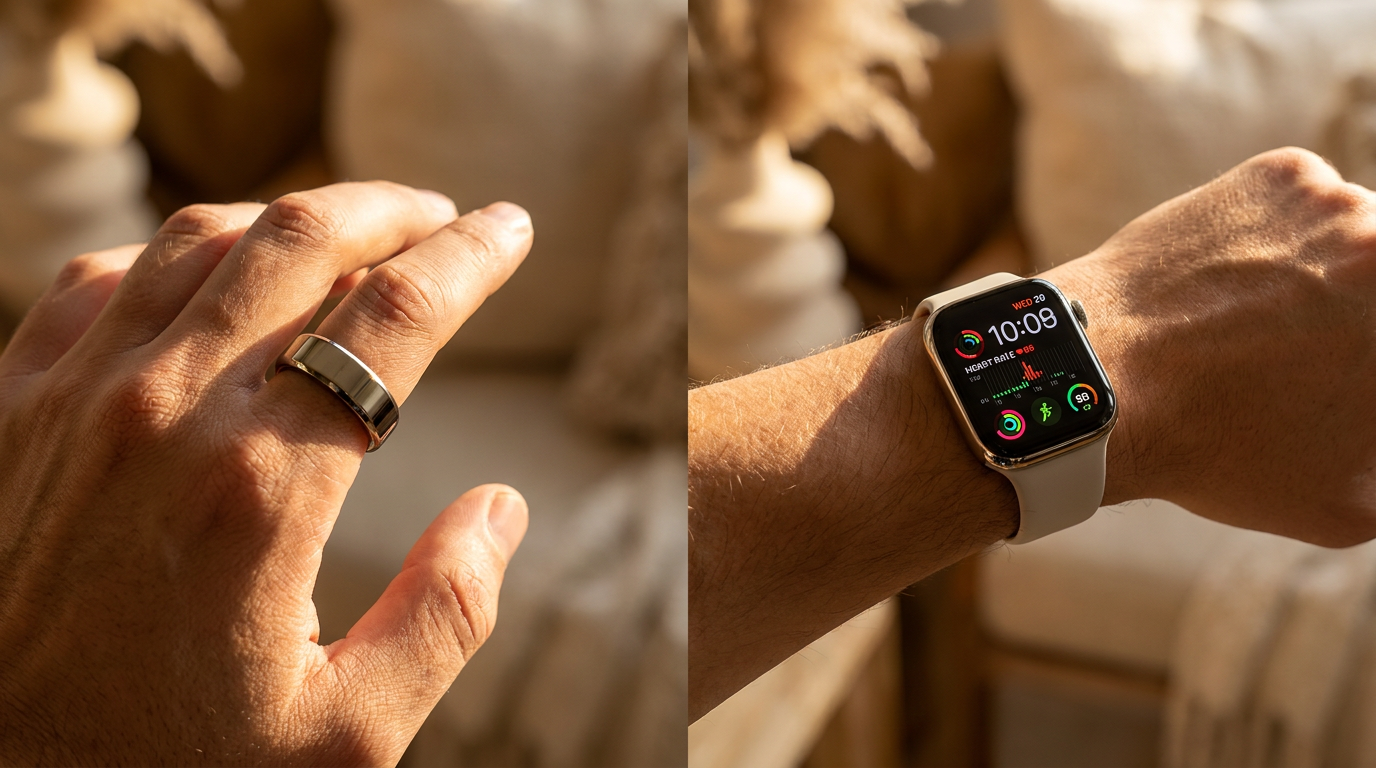
- Passive Tracking Minimalists
- Prioritize sleep accuracy and screen-free comfort, arguing that smart rings provide better long-term health compliance.
- Active Fitness Advocates
- Argue that real-time feedback and multi-sensor arrays make smartwatches the superior choice for serious athletes.
- Ecosystem Integrators
- View the devices as complementary, using watches for daytime workouts and rings for overnight recovery.
What's not represented
- · Medical professionals evaluating the clinical utility of consumer wearables
- · Budget-conscious consumers priced out of premium $300+ wearables
Why this matters
Wearable health technology is no longer just for athletes; it tracks sleep, stress, and early signs of illness. Choosing the right form factor determines whether you will actually wear the device consistently enough to benefit from its insights, or abandon it in a drawer.
Key points
- Smartwatches excel at active fitness tracking, offering GPS, live metrics, and real-time coaching.
- Smart rings dominate sleep tracking due to their lightweight, comfortable, and screenless design.
- Smartwatches typically require charging every 24 to 40 hours, while rings can last up to a week.
- The finger's dense capillary network provides highly accurate optical sensor readings for resting heart rate and HRV.
- Many users are adopting a dual-wear strategy, using a watch during the day and a ring at night.
The wearable health technology market has reached a definitive crossroads in 2026. For a decade, tracking daily steps, heart rate, and sleep meant strapping a miniature computer to the wrist. But as devices like the Oura Ring 4 and Samsung’s Galaxy Ring mature, they are directly challenging the dominance of flagship wrist wearables like the Apple Watch Series 11 and the Galaxy Watch 7. Consumers are no longer just choosing between iOS and Android ecosystems; they are choosing between two entirely different form factors that dictate how they interact with their own biometric data.[1][3]
The debate between the smartwatch and the smart ring is fundamentally a clash of design philosophies. Smartwatches are engineered as active extensions of the smartphone, designed to notify, display, and compute while tracking health as a parallel function. Smart rings, by contrast, operate as silent health sentinels. They lack screens, vibration motors for text alerts, and apps. Their entire surface area is dedicated to a single mission: collecting the most accurate biometric data possible without demanding the user’s attention.[6]
The case for the smartwatch rests heavily on real-time visibility and active engagement. Devices like the Apple Watch and Galaxy Watch feature bright OLED touchscreens, onboard GPS, and multi-sensor arrays that include electrocardiogram (ECG) capabilities. For users who want to check their running pace mid-stride, monitor live heart rate zones during a high-intensity workout, or leave their phone at home while streaming music, the smartwatch remains an unmatched, all-in-one tool. The immediate feedback loop helps athletes adjust their effort on the fly.[1][7]
However, the smartwatch’s greatest strengths are also its primary liabilities. Powering a bright display and continuous connectivity drains batteries quickly, limiting most flagship smartwatches to roughly 24 to 40 hours of endurance. This necessitates daily charging routines that often interrupt continuous health tracking. Furthermore, the constant influx of wrist-based notifications can exacerbate digital fatigue, turning a wellness device into another source of screen-induced stress for users trying to disconnect.[3][4]

The smart ring counters these drawbacks with frictionless, continuous wearability. By eliminating the screen and complex operating system, rings like the Oura and Galaxy Ring stretch their tiny 17 to 22.5 milliampere-hour batteries to last between six and seven days on a single charge. This multi-day endurance, combined with a lightweight titanium build that feels like a standard piece of jewelry, allows the device to disappear into the background of a user's life, quietly logging data without ever buzzing with an email alert.[2][4][8]
The smart ring counters these drawbacks with frictionless, continuous wearability.
Physologically, the finger offers distinct advantages for passive biometric tracking. The dense capillary networks in the finger sit much closer to the skin’s surface than the arteries in the wrist. This anatomical reality provides optical sensors with a highly stable and clean signal. During periods of rest, smart rings consistently deliver highly accurate readings for heart rate variability (HRV), blood oxygen saturation, and minute temperature fluctuations, often catching subtle sleep disturbances that wrist-based accelerometers might miss.[4][6]
The trade-off for this ambient tracking is a complete lack of real-time utility. A smart ring cannot guide a runner through a mapped route, nor can it display a live calorie count during a spin class. Users must open a smartphone app to view any collected data, introducing a layer of friction for active fitness enthusiasts. Additionally, the financial model for some rings includes hidden costs; the Oura Ring, for example, requires a monthly subscription to unlock its full suite of daily readiness and sleep scores.[1][7]
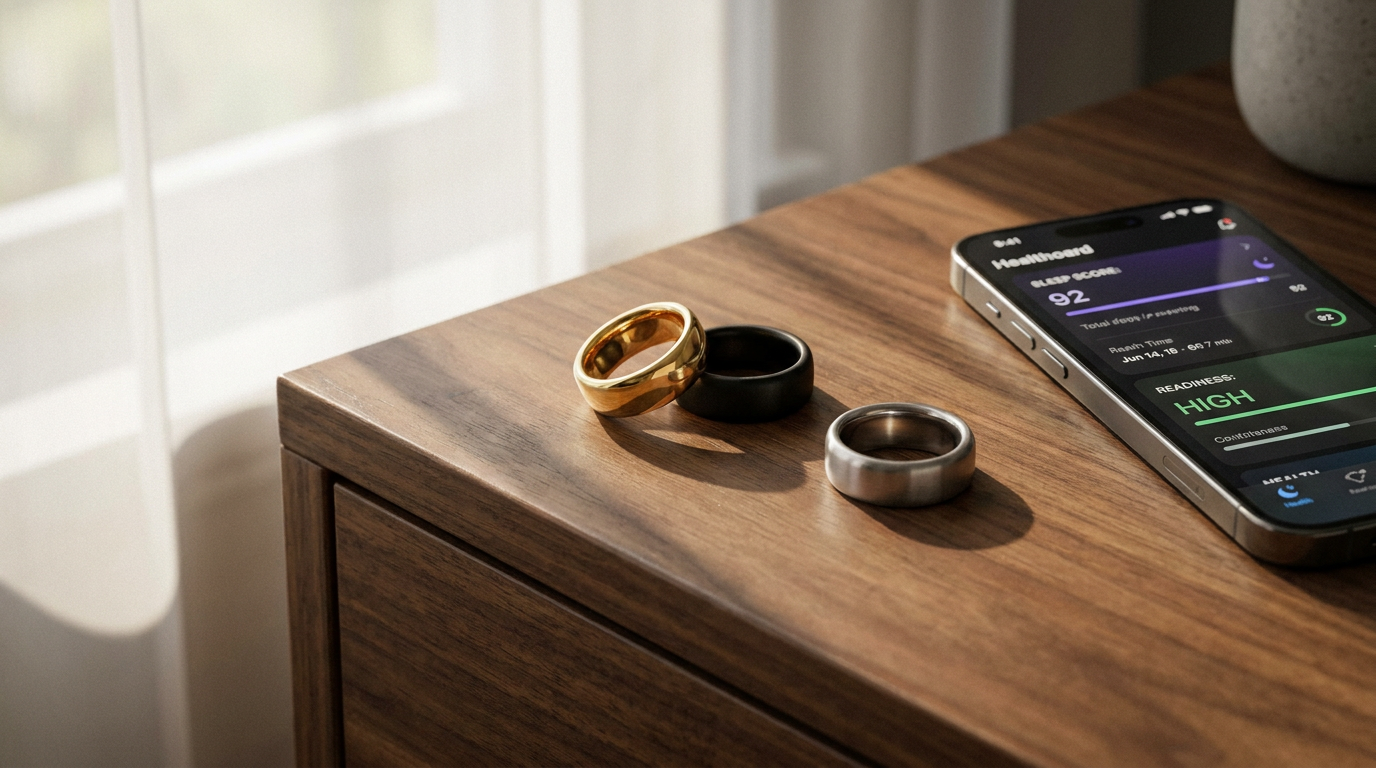
Sleep tracking is the arena where smart rings have established their strongest foothold. Sleeping with a bulky smartwatch can be uncomfortable, with silicone bands sticking to the skin and heavy cases pressing into the wrist. As a result, many users simply take their watches off at night to charge them. A smart ring, however, is unobtrusive enough to wear around the clock, allowing its sensors to capture uninterrupted sleep stages, latency, and overnight recovery metrics with remarkable consistency.[4][5][6]

Conversely, the smartwatch firmly retains its crown in the gym and on the trail. The combination of wrist-based accelerometers, live heart rate displays, and automatic workout detection makes watches far superior for structured exercise. While a ring can log the duration and average heart rate of a run after the fact, a smartwatch actively coaches the user through the session, tracking precise distances and elevation gains that a screenless ring simply cannot process independently.[1][3]
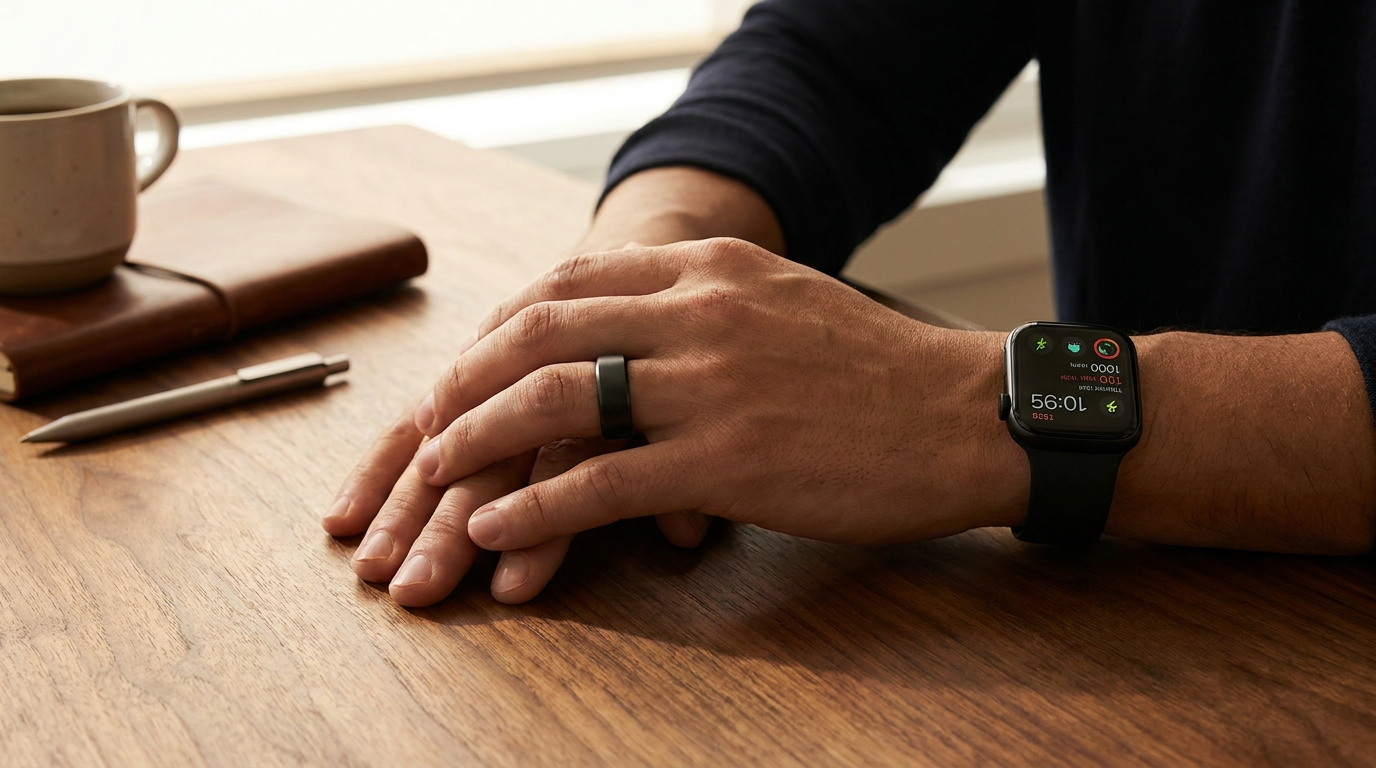
Rather than choosing a single winner, a growing segment of health-conscious consumers is adopting a dual-wear strategy. These users rely on an Apple Watch or Garmin during the day for active workout tracking and notifications, then switch to an Oura or Galaxy Ring at night for comfortable, high-fidelity sleep monitoring. Health platforms seamlessly aggregate the data from both devices, offering a comprehensive picture that leverages the strengths of each form factor.[2][5]

Ultimately, the smart ring fits well when a user prioritizes passive recovery data, demands multi-day battery life, and wants to reduce their daily screen time. It is the ideal choice for individuals who care deeply about sleep architecture and overall wellness trends but find traditional wearables too bulky or distracting. It does not fit when a user requires live workout metrics, GPS navigation, or the ability to triage text messages from their wrist.[4][6]
The smartwatch fits well when a user wants a proactive fitness coach, an extension of their digital life, and real-time biometric feedback during exercise. It is the definitive choice for runners, cyclists, and tech-savvy individuals who value connectivity and actionable data on the go. It does not fit when a user suffers from notification fatigue, hates the daily chore of charging another device, or finds sleeping with a wrist-bound computer intolerable.[1][3][7]
How we got here
2015
Apple launches the first Apple Watch, cementing the wrist as the primary location for wearable tech.
2018
Oura releases its second-generation ring, proving that a finger-worn device can accurately track sleep stages.
2022
Smartwatches begin incorporating advanced medical sensors, including ECG and temperature tracking.
2024
Samsung enters the smart ring market with the Galaxy Ring, bringing mainstream competition to Oura.
2026
Smart rings achieve widespread adoption as standalone health trackers, challenging the necessity of wrist-based screens.
Viewpoints in depth
Active Fitness Advocates
Argue that real-time feedback and multi-sensor arrays make smartwatches the superior choice for serious athletes.
This camp, largely composed of runners, cyclists, and gym-goers, views the screen as an essential training tool. They argue that health tracking is only useful if it can be acted upon in the moment. For them, the ability to glance at a wrist to check a heart rate zone, follow a GPS route, or log a specific set of lifts makes the smartwatch indispensable. They view the daily charging requirement as a minor inconvenience compared to the wealth of actionable, mid-workout data the device provides.
Passive Tracking Minimalists
Prioritize sleep accuracy and screen-free comfort, arguing that smart rings provide better long-term health compliance.
Minimalists and sleep researchers champion the smart ring for its ability to gather data without demanding attention. They point to studies showing that users are far more likely to wear a ring 24/7 than a bulky watch, leading to more complete datasets over months and years. This camp argues that the constant buzzing of smartwatch notifications actively harms mental health and sleep hygiene, making the silent, ambient tracking of a ring the healthier long-term choice.
Ecosystem Integrators
View the devices as complementary, using watches for daytime workouts and rings for overnight recovery.
Rather than treating the decision as a zero-sum game, this growing demographic utilizes both form factors. They recognize that smartwatches are unparalleled for active fitness and connectivity, while smart rings are unmatched for sleep tracking and comfort. By leveraging health aggregation apps like Apple Health or Samsung Health, they sync the daytime exertion data from their watch with the overnight recovery data from their ring, creating a holistic, 24-hour biometric profile.
What we don't know
- Whether smart ring manufacturers will eventually find a way to incorporate haptic feedback for real-time pacing without sacrificing battery life.
- How the long-term durability of smart rings compares to smartwatches, given the constant friction rings endure on the hand.
Key terms
- Heart Rate Variability (HRV)
- The measure of the time variation between each heartbeat, used as a key indicator of physical recovery and stress levels.
- Optical Heart Rate Sensor (PPG)
- A technology that uses light to measure changes in blood volume at the skin's surface to determine heart rate.
- Electrocardiogram (ECG)
- A test that records the electrical timing and strength of the heartbeat, available on premium smartwatches to detect irregular rhythms.
- Sleep Architecture
- The cyclical pattern of sleep as it shifts between different stages, including light, deep, and REM sleep.
Frequently asked
Can a smart ring track my running pace?
No. Because smart rings lack a screen and built-in GPS, they cannot provide real-time pace or distance feedback while you are running.
Do I have to pay a monthly fee for a smart ring?
It depends on the brand. The Oura Ring requires a monthly subscription to access detailed health data, while the Samsung Galaxy Ring currently does not.
Is a smart ring more accurate than a smartwatch?
For resting metrics like sleep and HRV, rings are often more accurate due to the finger's dense capillaries. For active workouts, smartwatches are superior.
Can I wear both devices at the same time?
Yes. Many users wear a smartwatch during the day and a smart ring at night, syncing the data from both into a central app like Apple Health.
Sources
Source coverage
8 outlets
3 viewpoints surfaced








[1]ForbesActive Fitness Advocates
Oura Ring Vs. Apple Watch: Which Is The Better Health Tracker?
Read on Forbes →[2]MashableEcosystem Integrators
Oura Ring vs Apple Watch: The best fitness tracker for 2025
Read on Mashable →[3]TechWiserActive Fitness Advocates
Samsung Galaxy Ring vs. Galaxy Watch 7: Where to Put Your Money?
Read on TechWiser →[4]TechglimmerPassive Tracking Minimalists
SmartRing vs Smartwatch: Why Smart Rings Win in 2026
Read on Techglimmer →[5]CosmopolitanEcosystem Integrators
Oura Ring vs. Apple Watch: Which Should You Buy? I Tested Both!
Read on Cosmopolitan →[6]JCVitalPassive Tracking Minimalists
Smart Ring vs Smartwatch 2026: Which Is Right for You?
Read on JCVital →[7]Garage Gym ReviewsPassive Tracking Minimalists
Expert Comparison: Oura Ring vs Apple Watch (2026)
Read on Garage Gym Reviews →[8]SamsungPassive Tracking Minimalists
Smart ring vs smartwatch: Find the best wearable tech
Read on Samsung →
More in shopping
See all 6 stories →Digital Workflows
E-Ink vs. iPad: The Ultimate Trade-Off Analysis for Office Productivity
0 sources

Cooktop Tech
Induction vs. Gas Cooktops: The 2026 Efficiency, Health, and Cost Breakdown
0 sources
Display Tech
Comparing Premium TV Display Technologies: OLED and Mini-LED
0 sources

Wearable Tech
Smart Ring vs. Smartwatch: Which Health Tracker Fits Your Life in 2026?
0 sources
Every angle. Every day.
Get shopping stories with full source coverage and perspective breakdowns delivered to your inbox.