
The Living Room is Growing: How Mycelium and Seaweed Are Replacing Plastic Furniture
Designers are swapping petroleum-based foams and plastics for agricultural waste and fungi, growing durable, 100% compostable furniture in a matter of days.
By Factlen Editorial Team
- Bio-Design Innovators
- Designers who view biology as the ultimate manufacturing technology for creating complex, sustainable forms.
- Circular Economy Advocates
- Environmental experts focused on eliminating landfill waste through fully compostable end-of-life solutions.
- Commercial Scale Manufacturers
- Industry pragmatists focused on standardizing biomaterials to pass durability tests and achieve mass-market scale.
- Industry Analysts
- Observers tracking the broader market shift from petroleum-based goods to bio-fabricated alternatives.
What's not represented
- · Traditional furniture manufacturers heavily invested in polyurethane and synthetic supply chains.
- · Mass-market consumers who prioritize low upfront costs over sustainable materials.
Why this matters
The traditional furniture industry is a massive contributor to global landfill waste, relying on toxic foams and unrecyclable plastics. Bio-fabricated furniture offers a circular alternative that is grown from waste and can safely compost in your backyard at the end of its life.
Key points
- Designers are growing furniture using mycelium, the root structure of fungi, mixed with agricultural waste.
- The growth process takes 5 to 14 days inside custom molds, followed by baking to deactivate the spores.
- Seaweed bio-foam and plant-based faux fur are replacing toxic polyurethane padding and synthetic upholstery.
- Mycelium chairs are now passing rigorous commercial durability tests and entering semi-industrial production.
- At the end of its life, a pure mycelium frame can fully compost in soil within 45 days.
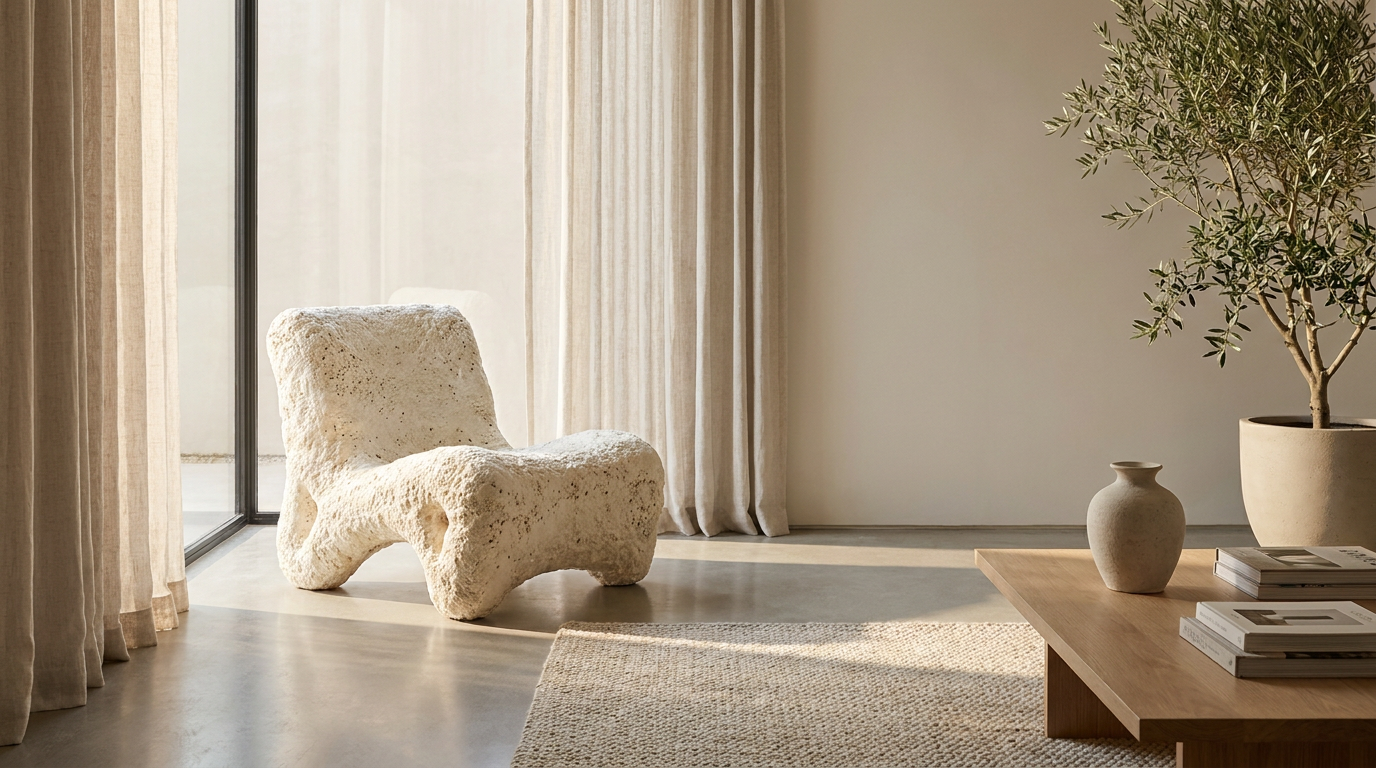
The traditional furniture industry relies heavily on petroleum-based foams, synthetic fabrics, and formaldehyde-laced woods. Because these materials are fused together, a broken sofa is nearly impossible to recycle, meaning millions of tons of furniture end up in landfills every year. But a quiet revolution is taking root in design studios across Europe. Instead of cutting, carving, or pouring, designers are now growing the next generation of living room furniture using the root structures of fungi.[5][7]
At recent major design festivals, including Milan Design Week and Copenhagen's 3 Days of Design, bio-fabricated furniture has moved from experimental art to functional, semi-industrial reality. Dutch design brand Aifunghi recently debuted a collection of dining chairs and loungers that swap plastic and polyurethane for mycelium, seaweed bio-foam, and plant-based faux fur, proving that sustainable design can compete aesthetically with high-end legacy brands.[1]
The process of growing a chair begins not in a lumber yard, but with agricultural waste. Manufacturers take substrates like locally sourced hemp fiber, corn stalks, or sawdust, and inoculate them with mycelium spores. This mixture is then packed into custom 3D-printed or earthen molds that dictate the final shape of the furniture piece.[2][3]

Over the next five to fourteen days, the mycelium acts as a biological binder. It consumes the agricultural waste, expanding its dense, microscopic network of hyphae through the mold. As it grows, it weaves the loose fibers into a solid, lightweight, and incredibly strong bio-composite that takes on the exact contours of its container.[2][3][6]
Once the object reaches its desired density and form, it is removed from the mold and baked. This crucial thermal treatment deactivates the spores, ensuring the chair won't sprout mushrooms in a humid living room. The resulting material is fire-resistant, naturally water-repellent, and boasts industrial-level strength.[2][6]
Once the object reaches its desired density and form, it is removed from the mold and baked.
A truly circular piece of furniture requires more than just a sustainable frame. To replace toxic polyurethane memory foams, companies are integrating padding made from seaweed bio-foam, pioneered by startups like Norway's Agoprene. For upholstery, designers are turning to materials like BioFluff, a plastic-free faux fur spun from nettle, hemp, and flax fibers sourced from agricultural waste streams.[1]

The aesthetic of mycelium furniture is also evolving rapidly. While early prototypes often resembled raw soil or cork, modern iterations are pushing boundaries. Parisian studio Aléa experiments with growing mycelium in glass tanks to monitor its stark white natural finish, while Swedish Studio TOOJ wraps wooden cores in Reishi—a leathery mycelium fabric—to create surrealist, draped forms that challenge perceptual boundaries.[2][6]
The biggest hurdle for biomaterials has historically been scale and durability. However, manufacturers are now proving these pieces can withstand everyday life. Aifunghi's dining chair recently became the first mycelium chair to pass the rigorous EN16139 Level 1 European durability tests for contract furniture, and their Enkhuizen factory is equipped to produce over 1,200 pieces annually, signaling a shift toward semi-industrial viability.[1]
The ultimate promise of bio-fabricated furniture lies in its end-of-life phase. When a traditional sofa breaks, its mixed materials guarantee a permanent stay in a landfill. In contrast, a pure mycelium chair is 100% compostable. As demonstrated by a recent prototype collaboration between designer Tom Dixon and the Magical Mushroom Company, these pieces can safely biodegrade in soil within 45 days, returning their nutrients to the earth.[4][5]

While costs remain higher than mass-produced flat-pack furniture, the trajectory is clear. As production scales and the technology matures, bio-fabricated furniture offers a tangible solution to the interior design industry's waste crisis. The living room of the future won't just be built; it will be grown.[7]
How we got here
Early 2010s
Material science companies begin using mycelium primarily as a biodegradable alternative to styrofoam packaging.
2021
Independent designers start producing limited-run, experimental art pieces and stools using raw mycelium composites.
2024
Studios refine the aesthetic control of mycelium, achieving pure white finishes and leathery textures that mimic high-end fabrics.
2025
Bio-fabricated furniture reaches semi-industrial scale, with brands debuting fully certified, mass-producible dining chairs at major design festivals.
Viewpoints in depth
Bio-Design Innovators
Designers who view biology as the ultimate manufacturing technology.
For experimental studios and material researchers, mycelium represents a paradigm shift from extractive manufacturing to regenerative growth. They argue that nature has already perfected structural engineering at a microscopic level. By guiding the growth of hyphae, designers can create complex, organic shapes that would be impossible or highly wasteful to carve from wood or cast in plastic. Their focus is on pushing the aesthetic boundaries of the material, proving that sustainable design can be luxurious and visually striking.
Circular Economy Advocates
Environmental experts focused on the end-of-life phase of consumer goods.
This camp evaluates furniture strictly by its lifecycle footprint. They point out that the current industry model—extracting raw materials, binding them with toxic glues, and discarding them after a few years—is fundamentally broken. To circular economy advocates, the primary value of mycelium and seaweed bio-foams is their compostability. They champion these materials because they require minimal energy to produce and, crucially, leave zero toxic residue when they eventually break down in the soil.
Commercial Scale Manufacturers
Industry pragmatists focused on scaling biomaterials for the mass market.
While supportive of the environmental benefits, commercial manufacturers are primarily concerned with standardization, durability, and cost. They emphasize that for bio-fabricated furniture to make a real impact, it must move out of the gallery and into the contract furniture market (offices, hotels, and restaurants). This camp focuses on passing rigorous European durability tests, optimizing the 14-day growth cycle to increase factory throughput, and bringing the unit economics down to compete with traditional petroleum-based materials.
What we don't know
- How quickly production costs can be reduced to make bio-fabricated furniture competitive with mass-market flat-pack options.
- How the material will hold up over decades of heavy use in highly variable, humid climates without synthetic sealants.
- Whether mainstream consumers will overcome the psychological hurdle of buying furniture made from 'fungi' and seaweed.
Key terms
- Mycelium
- The vegetative, root-like network of fungi, consisting of a mass of branching, thread-like structures called hyphae.
- Bio-composite
- A strong, lightweight material formed by combining a natural binder (like mycelium) with a reinforcement of natural fibers (like hemp or sawdust).
- Substrate
- The base material—often agricultural waste—that provides nutrients and physical structure for the mycelium to grow on.
- Bio-foam
- A sustainable, naturally derived alternative to petroleum-based polyurethane memory foams, often made from seaweed or algae.
- Circular Design
- An approach to product creation that eliminates waste by ensuring materials can be continuously reused or safely returned to nature.
Frequently asked
Will mycelium furniture grow mushrooms in my house?
No. The furniture is baked at high temperatures at the end of the manufacturing process, which deactivates the spores and permanently stops all biological growth.
Is mushroom furniture durable enough for daily use?
Yes. Modern mycelium composites are incredibly strong and have passed rigorous European durability tests for contract furniture, making them suitable for everyday use.
What happens if the furniture gets wet?
The baked mycelium forms a naturally water-repellent outer skin. For heavy-use items like dining chairs, designers often apply organic, bio-based sealants for extra protection against spills.
How do you dispose of bio-fabricated furniture?
Unlike traditional furniture that goes to a landfill, pure mycelium furniture can be broken into pieces and buried in a garden or compost bin, where it will naturally biodegrade in about 45 days.
Sources
Source coverage
7 outlets
4 viewpoints surfaced







[1]DezeenBio-Design Innovators
Moooi alumni launch design brand to make mycelium furniture 'a little bit more sexy'
Read on Dezeen →[2]About FuturesBio-Design Innovators
Mycelium production process: Step-by-step guide
Read on About Futures →[3]Materials AssembleCommercial Scale Manufacturers
Bespoke Mycelium Furniture: A new way of making furniture
Read on Materials Assemble →[4]Magical Mushroom CompanyCircular Economy Advocates
Tom Dixon and Magical Mushroom Company Create Mycelium Chair Prototype
Read on Magical Mushroom Company →[5]Encyclopedia of DesignCircular Economy Advocates
Biomaterials in Sustainable Furniture Design
Read on Encyclopedia of Design →[6]VAWAABio-Design Innovators
The Parisian Studio Growing the Future of Biodesign
Read on VAWAA →[7]Factlen Editorial TeamIndustry Analysts
Synthesis by Factlen editorial team
Read on Factlen Editorial Team →
Every angle. Every day.
Get home stories with full source coverage and perspective breakdowns delivered to your inbox.